
🌳 Desert Ironwood
What it looks like
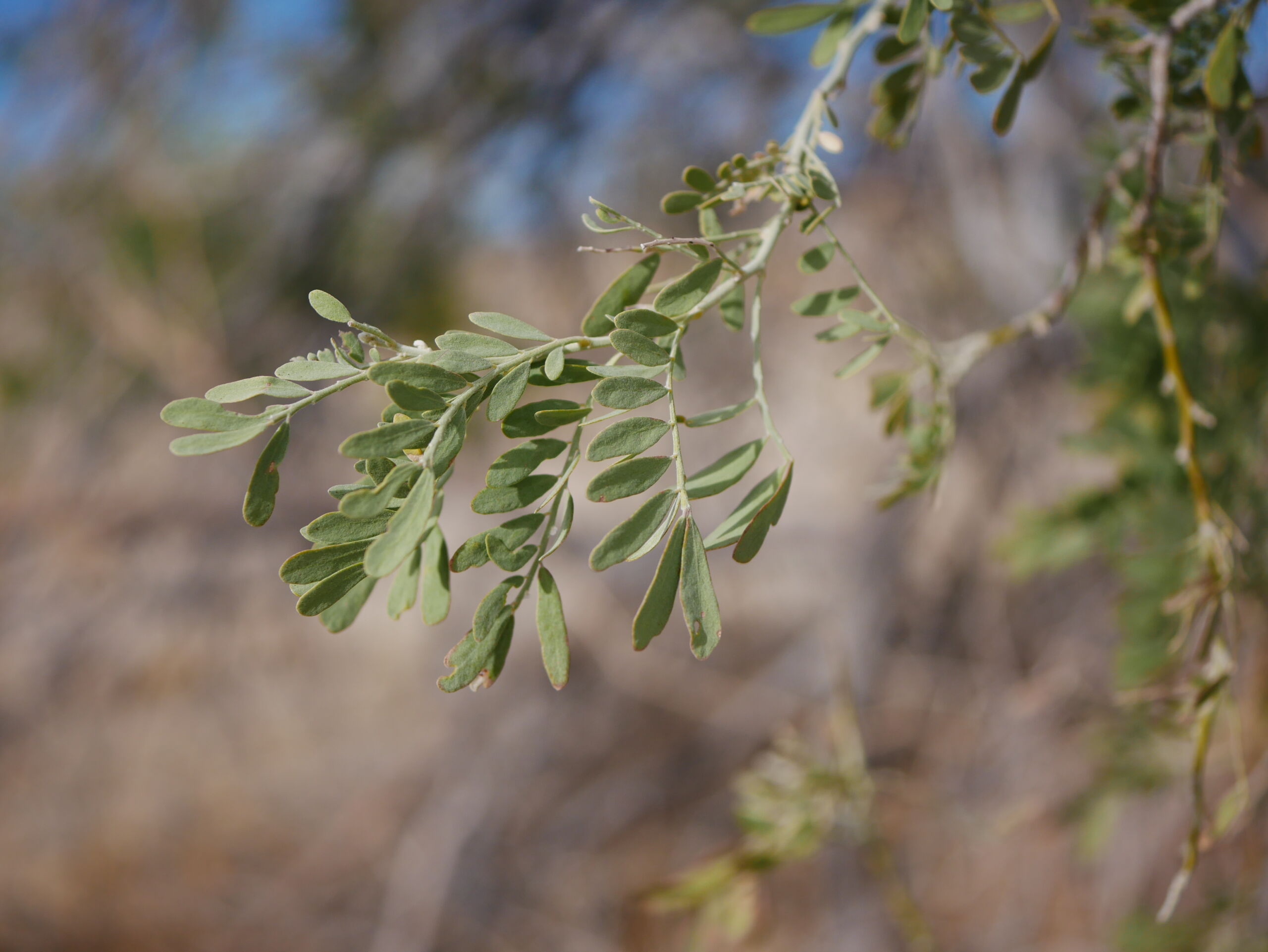
Desert ironwood is a tree that earns its name twice: once for its wood, which is so dense and heavy that it sinks in water, and once for its endurance, which is the kind of thing deserts reward. It is the only species in its genus — Olneya is monotypic, so there is no close cousin to confuse it with — and a member of the legume family (Fabaceae), the pea family, which means its flowers look like sweet peas and its roots fix nitrogen. It grows as a bush or small tree, commonly multi-trunked, typically to about 10 metres (33 feet) tall, with exceptional trees in large protected washes growing taller, and old trunks reaching about 60 cm (24 inches) in diameter. The canopy is broad and low, often dipping down to touch the ground, and the bark is gray and smooth on young trees, becoming fissured and shredding on older limbs and trunks. It is, in short, a tree shaped like a shady umbrella that forgot how to die young.
The leaves are pinnately compound, bluish-green to gray-green, with 6 to 20 small leaflets each 7 to 20 mm long, and at the base of each leaf petiole sit two sharp, slightly curved spines about a centimetre long — the spines are the detail to learn, because they separate ironwood from the palo verdes it grows beside, which lack them, and from mesquite, which it resembles at a distance. The flowers are the spring event: pink to lavender (sometimes pale rose, purple, or white), pea-like, about 15 mm long, borne in short, dense racemes or panicles in late spring, usually May into June, and in good years — roughly half of them, with flowering prolific every 2 to 5 years — the tree turns lavender or purple with masses of bloom. The pods that follow are a few inches long, hairy and glandular, constricted between the seeds, with several seeds each. The foliage is semi-evergreen to drought-deciduous: trees in favorable spots stay nearly evergreen, while trees about to bloom may yellow and drop their leaves in April, re-leafing when the summer rains come. A tree that drops its leaves to flower and then puts them back on for the monsoon is a tree that runs on desert time, and desert time is the only clock that matters here.
Only one verified photograph could be confirmed for this guide, so the leaf portrait above stands alone — no substitute species was slipped in to pad the gallery. What it does show is the identification story in a single frame: small gray-green leaflets, compound leaves, and the spiny architecture that makes desert ironwood recognizable once you have learned it.
How to grow
Desert ironwood grows where the Sonoran Desert is at its hottest and driest, and that is the whole cultivation brief. It is endemic to the Sonoran Desert region, found in central and southwest Arizona and southeast California, much of the Baja California peninsula, western Sonora, and extreme northwest Sinaloa, usually below about 2,500 feet elevation, most often in sandy and rocky soils of plains, slopes, and along dry washes, where storm runoff increases the available moisture. Give it full sun and extreme heat — it tolerates summer temperatures of 45 °C — and soil that drains fast: sandy, rocky, gravelly, or caliche soils are all fine, provided water does not sit. Plant it 25 to 30 feet from structures and paths, because the mature canopy is broad and the spines are sharp, and give it room to become the multi-trunked, broad-crowned tree it wants to be. It is slow-growing in the wild, though established plants can grow up to about 60 cm a year under favorable conditions in cultivation, so patience is part of the planting plan.
Propagation is by seed, and the seed needs the desert’s own cues: pods ripen in summer, seeds are hard-coated, and scarification — nicking or soaking the seed coat — helps germination, as it does for many desert legumes. Water a new tree regularly until it is established, then back off: once established it is drought-resistant, and overwatering in heavy soil is a greater danger than underwatering. It needs no pruning to perform, and any pruning should respect the spines and the tree’s slow architecture. And one rule is absolute: never wild-collect this tree. It is a protected native plant in Arizona, where harvest is restricted, and it is classified as Near Threatened by the IUCN, threatened by felling for wood carving and fuel, urbanization, and buffelgrass-driven wildfire. Buy nursery-grown stock, plant it where it belongs, and let the wild trees stand.
Florida note: Stated plainly, because Florida gardeners deserve it straight: desert ironwood is not a Florida tree, even though its hardiness zones overlap the state. Zones measure cold, not humidity, and Florida’s summer rain, humidity, and wet soils are the opposite of the dry washes it evolved in. A young tree is hardy only to about 25 °F and a mature one to about 20 °F, and cold snaps are the least of its Florida problems — wet feet and fungal pressure in humid summers are the greater ones. This guide exists because butterfly guides list it as a host plant, not because it belongs in a Florida garden, and planting it in the peninsula would be an experiment with a predictable ending.
Water & feeding
Water needs are low once the tree is established, and its native washes explain why: desert ironwood grows where water arrives in pulses — storm runoff down a dry wash — and then disappears, so the tree is built to drink deeply when water comes and wait patiently when it does not. Water deeply but infrequently in the first year or two, then let it live largely on rainfall in any climate that resembles its own. In a desert garden, an occasional deep soak in a long dry spell is plenty, and the danger is always too much water in heavy soil, never too little. A deep taproot and a water-storing, slow-growing habit do the rest.
Feeding: barely, or not at all. Desert ironwood is a legume, so it fixes nitrogen through its root associations, feeding the lean desert soil around it rather than demanding rich garden soil — which is part of why it is a keystone species, not just a shade tree. A gravel mulch that keeps the root zone drained and cool is worth more than any fertilizer. The soil science here is the wash story: sandy, rocky soil, storm pulses, a nitrogen-fixing tree, and a community of microbes and fungi that cycle nutrients in bursts after rain. The tree’s fallen leaves and pods feed that community, its shade cools the ground beneath it, and seedlings of other desert plants establish in its shelter — the canopy can make the ground beneath it dramatically cooler than the open desert sun. Planting a desert ironwood is therefore not just planting a tree. It is installing a microclimate, and the tree will run it for centuries without your help.
Common problems
- Cold damage. The limiting factor outside the desert. Young trees are hardy only to about 25 °F and mature trees to about 20 °F, with stem damage below about −6 °C. Prolonged freezing can severely damage or kill it. Do not plant it where hard freezes are routine.
- Wet soil. Heavy soil that holds water rots the roots of a wash tree. Plant high, plant sandy or rocky, and let the soil drain.
- Thorns. Not a tree problem, a people problem. The paired spines at the leaf bases are sharp and curved. Site the tree away from paths and wear gloves when working around it.
- Slow growth. A tree that adds inches rather than feet in a year has not failed. It is a slow plant on a desert clock, and the shade it builds is worth the wait.
- Wild collection. Never dig or cut a wild ironwood. It is protected in Arizona, Near Threatened globally, and slow to replace. Buy nursery-grown stock only.
- Caterpillar feeding. Duskywing caterpillars eat the leaves, and that is the point of planting it. A healthy tree recovers, so do not spray the caterpillars — they are the crop.
Harvest
The harvest of desert ironwood is shade, flowers, seed, and carving wood — in that order, and with one firm boundary. The seeds can be roasted and eaten — they are said to taste like peanuts — and the wood, one of the densest in North America, is carved into durable sculptures and knife handles, most famously in the Seri carving tradition that developed in the 1960s. But that wood harvest belongs to the cultural traditions of the tree’s native range and to sustainably sourced material, not to a backyard tree: a slow-growing, protected, Near Threatened tree is not firewood, and its heartwood is so hard and dense that working it is difficult even for professionals. The home gardener’s harvest is different: decades of shade, a spring cloud of pink-lavender pea flowers that feeds native bees, pods to collect for seed, and the knowledge that the tree overhead is sheltering seedlings, birds, and insects in its canopy. Leave most trees standing through the season for the caterpillars and the pollinators, prune only with gloves, and let the tree do what desert ironwoods do: outlive the gardener, shade the wash, and drop seeds for the next century. That is the harvest, and it is enough.
Browse all plant & pest guides
Saving seeds
Saving desert ironwood seed is an exercise in desert patience, which is fitting, because the tree itself is one. The pods ripen in summer and dry to brown on the tree; gather them when they are dry and starting to split, and take only a small share from any one tree. Ironwood feeds a whole desert community — birds, rodents, and the nurse-plant shade economy under its canopy — and a tree that lives for centuries does not need you to strip it bare. A pocketful of pods is plenty.
Crush the dry pods gently in a paper bag or over a sheet, pick out the shiny dark seeds, and winnow away the pod bits. Check for tiny holes or dust, the calling cards of bruchid beetles, which love legume seed the way the rest of us love a pantry. A couple of days in the freezer deals with any hitchhikers before storage; just let the seed come back to room temperature in its sealed container afterward so condensation does not undo your drying.
Ironwood seed wears armor. Fresh seed, sown right away, usually needs no persuasion at all, but stored seed has a hard coat that keeps water out, and that is where most failures happen. Pour hot — not boiling — water over the seed and let it soak as the water cools, for roughly 12 to 24 hours. Seeds that have drunk their fill will look swollen; any that stay hard and wrinkled can be nicked very carefully at the edge, away from the embryo, and soaked again. Sow shallowly, about a quarter of an inch deep, in a gritty, fast-draining mix, and keep it warm: sources agree the sweet spot is roughly 25 to 30°C. Fresh seed germinates well and fast by tree standards, often emerging within about a week or two, though stored or stubborn lots can take longer.
Two warnings from the desert apply in the pot, too. First, cool and soggy is the enemy: seedlings damp off readily if you coddle them with cold water and still air, so give them warmth, drainage, and air movement, and water like a monsoon — a good drink, then a real dry-down. Second, ironwood grows a taproot with opinions. Sow where the tree will live if you can, or use deep pots and transplant young, because a big taprooted seedling resents being moved the way the tree resents being hurried.
For storage, dry the seed thoroughly, seal it in an airtight jar with a desiccant packet, and keep it cool and dark. In Florida’s humidity — ironwood is a warm-climate tree, hardy only in the warmest parts of the state — that drying step is not optional: seed sealed even slightly damp will mold in the jar before it ever sees soil. Seedlings grow true to species, since there are no hybrid ironwoods to surprise you, but every seedling is still its own individual, the way every wild tree is. And the honest timeline: a seed you save this summer is a shade tree for your grandchildren. That is not a flaw. That is the whole point of planting one.
Species in this group
Desert ironwood (Olneya tesota) — the species this guide covers: the sole species of the genus Olneya, the Sonoran Desert legume tree with sinking wood and pink-lavender pea flowers, and the host plant named in the Funereal Duskywing guide. Also called tesota, palo fierro, palo de hierro, and palo de fierro.
Eastern ironwood, American hornbeam (Carpinus caroliniana) — NOT desert ironwood: an unrelated eastern woodland tree that shares the common name “ironwood” and a different climate, with different care requirements.
Eastern ironwood, hophornbeam (Ostrya virginiana) — NOT desert ironwood: another unrelated eastern tree called ironwood, listed here only so nobody plants a woodland tree for a desert job.
Mesquite (Prosopis species) — NOT desert ironwood: a fellow Sonoran Desert legume that resembles ironwood at a distance, but a different genus with different flowers and foliage.
Palo verde (Parkinsonia species) — NOT desert ironwood: the yellow-flowered desert tree it is most easily mistaken for, distinguished by its green bark and yellow flowers where ironwood has gray bark and pink-lavender flowers.