
🌿 Eriogonum nudum
What it looks like
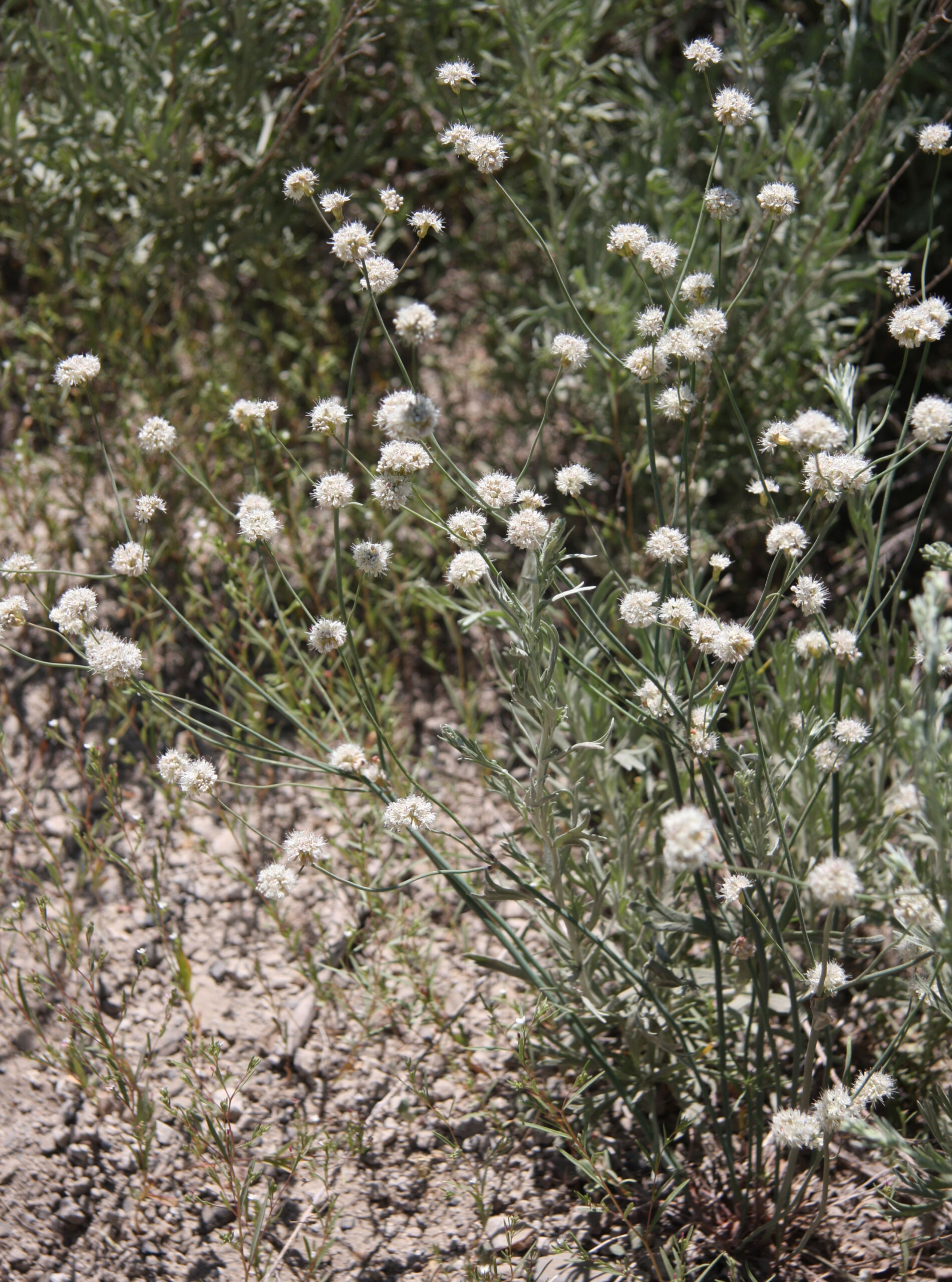
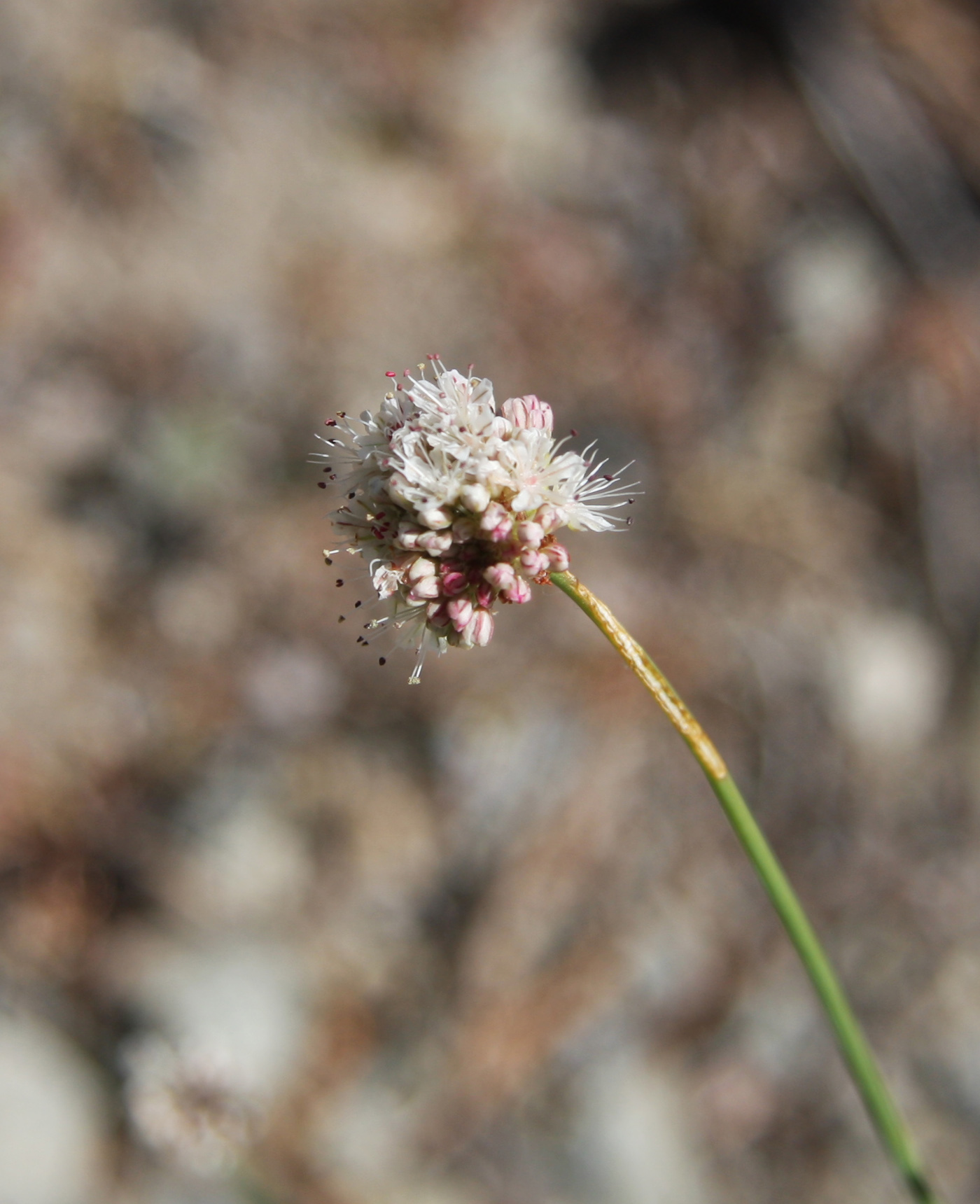

Eriogonum nudum is naked buckwheat, nude buckwheat, or barestem buckwheat — three names for the same joke. The plant grows a rosette of leaves flat on the ground, then sends up slender stems that are, as the Latin nudum promises, naked: bare, hairless or nearly so, branching into two or more stems toward the top, with the leaves left behind at the base like someone who got dressed from the waist down and forgot the rest. Flora of North America calls it a mostly erect herb with a woody base, and the University of California’s Master Gardener account calls the result dramatic: bare stems topped with rounded flower clusters, above which float delicate anthers, standing three to four feet tall and occasionally reaching six feet in the late summer landscape.
The leaves are the first thing you meet and the first thing you lose track of. They are basal or sheathing up the stem, on petioles up to about four inches long, with blades roughly one to six centimetres long and up to four centimetres wide, oblanceolate to elliptic or ovate, often densely white-woolly underneath and greener above, sometimes with wavy or crisped margins. In spring they form a ground-hugging green rosette; by late summer they have often faded from green to brown while the stems do the showy work. Unlike most wild buckwheats, which are evergreen subshrubs, Eriogonum nudum is deciduous: the whole display dies back in winter and begins again the following spring, which makes it an outlier in its own genus and a plant you should not panic about in January.
The flowers are small and numerous, which is the buckwheat way. Each flower is only about two to four millimetres across, with a perianth that is white or yellow, sometimes pink or rose, and stamens that stick out well beyond the petals, two to five millimetres long, giving each cluster a frilly, fuzzy look. The clusters are cymose, usually branching dichotomously — forking in pairs like a Y — and they bloom from May into August or September depending on elevation and variety. The fruit is a small light-brown to brown achene, one and a half to three and a half millimetres long. Nothing about any single flower is spectacular; the spectacle is hundreds of them at once, floating on bare stems above a dry slope.
The range is western North America, and here the sources disagree in a way worth stating plainly. Flora of North America maps it to California, Nevada, Oregon, Washington, and northwest Mexico. The UC Master Gardener account describes a wider spread, from Alberta and British Columbia in Canada down to the southern border of California and the eastern border of Nevada, and notes its ability to thrive at sea level along the coast and in wet conditions, which makes it unusual among buckwheats. Both agree on the core: this is a western plant of coastal sage scrub, chaparral, oak woodlands, grasslands, and sagebrush deserts, and a progenitor of many local forms — Flora of North America recognises thirteen varieties.
How to grow
Grow naked buckwheat the way the western landscape grows it: in full sun, in lean, gritty, well-drained soil, and with no coddling. This is a plant of dry slopes, rocky ground, sandy washes, and open woodland, and its one great hatred is wet feet. Most wild buckwheats tolerate drought, rocky soil, and blasting summer heat, and Eriogonum nudum is no exception — but unlike many of its cousins it also tolerates coastal conditions and somewhat wetter sites, which is why it turns up in more gardens than the strict desert buckwheats do. Still, heavy clay that stays soggy in winter will kill it faster than any drought will. If your soil is clay, plant it on a slope, in a raised rock garden, or in a bed heavily amended with gravel and coarse sand, and let drainage do the work that watering cannot.
Sun is non-negotiable: full sun for the best bloom, with part shade tolerated, especially in the hottest inland sites. Soil pH is forgiving — variety accounts put the preferred range at roughly 5.5 to 8.0, slightly acidic to mildly alkaline — and fertility should stay low. Rich, heavily composted soil produces soft, floppy growth and invites rot; a gritty, sandy, or rocky loam with little organic matter is closer to home. Space plants so each rosette has room and the branching stems can form the airy thicket that makes the plant beautiful. Plant container-grown stock in spring or fall, water to establish, and then step back.
Hardiness is where you must read the variety, because the species spans a huge range and the varieties do not share one zone. Variety accounts variously list zones 5 to 9, 7 to 10, and 8 to 10, and the species as a whole is best described as roughly zones 5 to 10 with the variety doing the deciding. A coastal California variety and a high-elevation interior variety are not interchangeable plants, even though they share the species name. Buy from a nursery that names the variety and its provenance, and match it to your winters rather than trusting the species name alone. In Florida, frankly, this is not a plant for most of the state: it wants a Mediterranean or cold-winter climate with dry summers, and Florida’s wet, humid summers and warm winters are the opposite of its home. Grow it if you are in a dry, western, or Mediterranean climate; admire it from afar if you are gardening in the Southeast.
Propagation is by seed or by division of established clumps, and seed is the honest way to get variety-true plants. Sow in fall or after cold stratification, in gritty mix, and do not bury the small seed deeply. Cut the dead stems back in late winter before the spring rosette pushes, and leave the plant alone otherwise. It does not want pruning into shapes, staking, or fussing. A buckwheat that evolved to hold a dry slope with bare stems and a ground-hugging rosette knows what it is doing; your job is mostly to get out of the way.
Water & feeding
Water naked buckwheat like a western native: deeply but rarely once established, and almost not at all in summer if your climate gives it a dry season to match. New plantings need regular water through their first growing season to root in. After that, the plant is drought tolerant and prefers to dry out between waterings; the woody base and deep roots do the rest. Overwatering, especially in winter when the plant is dormant and the top growth has died back, is the fastest way to lose it. If you are watering it weekly in January, you are loving it to death.
Feeding is simple because it is mostly unnecessary. No fertiliser is needed in lean, native-type soil, and a heavy dose of nitrogen will do more harm than good, pushing soft growth that flops and rots. If you must feed, a thin topdressing of compost in spring, or a light application of a balanced, slow-release fertiliser at half strength, is the ceiling — not the starting point. Mulch with gravel or small stone rather than wood chips, which hold moisture against the crown. Think rock garden, not cottage border, and the plant will repay you with years of late-summer bloom on almost no input.
Common problems
- Wet feet. The defining problem. Heavy clay, soggy winter soil, or a low spot that ponds will rot the crown. Plant high, plant gritty, and do not irrigate it like a lawn plant.
- Wrong variety for your winter. Zone ratings differ sharply by variety (accounts list 5–9, 7–10, and 8–10). A variety from coastal California may fail in a cold interior winter, and a high-elevation variety may sulk in a hot, humid climate. Buy named varieties with provenance.
- It disappears in winter. Not a problem, but it alarms new growers. Eriogonum nudum is deciduous and dies back in winter, unlike most evergreen wild buckwheats. Mark the spot and wait for the spring rosette.
- Floppy growth in rich soil. Too much compost or nitrogen produces soft, sprawling stems instead of the upright, airy display. Lean soil is a feature, not a deficiency.
- Humid-summer climates. Florida-style heat plus humidity is a poor match for this western native. In the Southeast it is a plant to admire in books and botanical gardens, not a reliable garden perennial.
- Deer and rabbits. Buckwheats are generally not preferred browse, but young spring growth can be nibbled in hard winters. The plant usually regrows from its woody base.
Harvest
There is no crop harvest from naked buckwheat in the garden sense, but there is a human history worth knowing, because this plant fed people long before it fed gardeners’ pollinator lists. Flora of North America records that several California Native peoples used members of this species: the Karuk of Siskiyou County and the Miwok of California’s Central Coast ate the young, tender stems raw — moist and tasty, with a sour aftertaste — and older stems, upended with the leaves still attached, were used as brooms. The Kawaiisu used hollow stems, probably of variety westonii, as drinking tubes and pipes, and roots of variety pauciflorum as an infusion for coughs. That is a plant with a résumé, not just a flower.
The garden harvest is seed and pollinators. Let some flowerheads ripen and the small achenes will self-sow lightly in gritty soil, giving you new rosettes without any work — though seedlings of named varieties may vary. And the pollinator harvest is the real point: the long bloom from May into September feeds bees, butterflies, and other beneficial insects through the hardest part of the dry season, and the plant is a documented food plant for the Bauer’s dotted-blue, the Pacific dotted-blue, the gorgon copper, and the Mormon metalmark. A slope of naked buckwheat in August, buzzing and fluttering over bare stems, is the harvest. You do not pick it; you stand in it.
Saving seeds
Naked buckwheat is a generous seed producer, which is a polite way of saying it will try to save its own seed all over your garden whether you help or not. The seed hides in the dried bracts of the flower heads, and early fall is the moment: when the heads have turned brown and papery and the first seeds start to loosen, clip whole heads into a paper bag and let them finish drying indoors for a week or so. Rub the dried heads over a tray and the small, dark seeds shake free with very little argument. What you are holding at that point is a desert plant’s idea of a savings account — small, hard, and built to wait out a winter before it even thinks about sprouting.
That winter wait is the whole trick. Sow the seed outdoors in fall and nature handles the cold, moist stratification for you, no fridge required. If you miss the fall window and want to sow in spring, you will need to fake winter yourself: mix the seed with damp sand in a bag and refrigerate it. Sources disagree on exactly how long — one seed house says about 60 days, the California native-plant guidance says 90 days significantly improves germination — so treat 60 to 90 days as the honest range and lean toward the longer end if your germination has been patchy before. After chilling, sow shallowly in a sandy, sharply drained mix, keep it moist but never waterlogged, and expect sprouts over a few weeks rather than all at once. Buckwheat seedlings sulk in rich, wet soil, so grit is your friend and coddling is not. Grow them on in pots, letting them dry between waterings, and set them out once they have a real root system — a seedling with two leaves and a dream is not ready for a dry garden yet.
Storage follows the usual desert-seed rules with one Florida twist: dry the seed completely, then keep it in an airtight container with a desiccant packet somewhere cool and dark. Florida air will rehydrate poorly stored seed faster than you would believe, and damp seed in a warm jar is a mold farm, not a seed bank. Fresh seed is best, but properly dried seed keeps for a few seasons. One more honesty note: naked buckwheat has thirteen recognised varieties, and seed from a named variety will not reliably reproduce that variety’s exact form — open pollination shuffles the deck. Seed from a straight species plant gives you the species, with natural variation; a cutting or a division gives you the plant itself. And a practical warning for the enthusiastic: this plant self-sows with real enthusiasm in suitable ground, so if you do not want a buckwheat colony, deadhead a share of the flowers before they set seed. Saving seed is a choice; letting it save itself everywhere is also a choice, just a louder one.
Browse all plant & pest guides
Varieties
No single variety list can be called complete for a species with thirteen recognised varieties, and nursery availability is far narrower than the botanical list. The varieties below are the ones named in the sources used for this guide; they are real, but they are a selection, not the whole thirteen.
Variety nudum — Eriogonum nudum var. nudum — The typical variety, also called coast buckwheat; low-growing perennial to about three feet, white or pink clustered flowers, blooming May to August, full sun, well-drained soil, pH roughly 5.5 to 8.0.
Variety pauciflorum — Eriogonum nudum subsp. pauciflorum — Fewflowered buckwheat or California buckwheat; one to three feet tall, small narrow grey-green leaves about an inch long, flowers blooming May to September; roots used by the Kawaiisu as an infusion for coughs.
Variety pubiflorum — Eriogonum nudum var. pubiflorum — A spreading herbaceous form one to two feet tall and two to three feet wide, basal rosette leaves one to three inches long, small cream flowers in umbel-like clusters; hardy in accounts to zones 5 to 9, soil pH roughly 5.5 to 7.5.
Variety deductum — Eriogonum nudum var. deductum — A California, Oregon, Nevada, and Baja California form, Y-shaped spreading branches to about two feet, small white to pinkish bell-shaped flowers in clusters up to two inches wide, blooming June to September; listed in one account for zones 8 to 10.
Variety scapigerum — Eriogonum nudum var. scapigerum — Stalked buckwheat; herbaceous perennial with a rhizomatous root system and woody base to about three feet, small white flowers about one-sixteenth of an inch across, twenty to thirty per flowerhead, blooming June to September; California, Oregon, and Washington, east to Utah and Nevada.
Variety murinum — Eriogonum nudum var. murinum — A named variety documented in botanical garden collections; included here as a real variety name, with garden performance varying by provenance.
Variety psychicola — Eriogonum nudum var. psychicola — A named variety documented in botanical garden collections; included here as a real variety name, with garden performance varying by provenance.
Variety westonii — Eriogonum nudum var. westonii — The variety whose hollow stems the Kawaiisu used as drinking tubes and pipes, according to Flora of North America’s ethnobotanical notes.