
🌿 Four-Petal Pawpaw
What it looks like
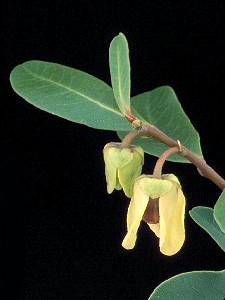
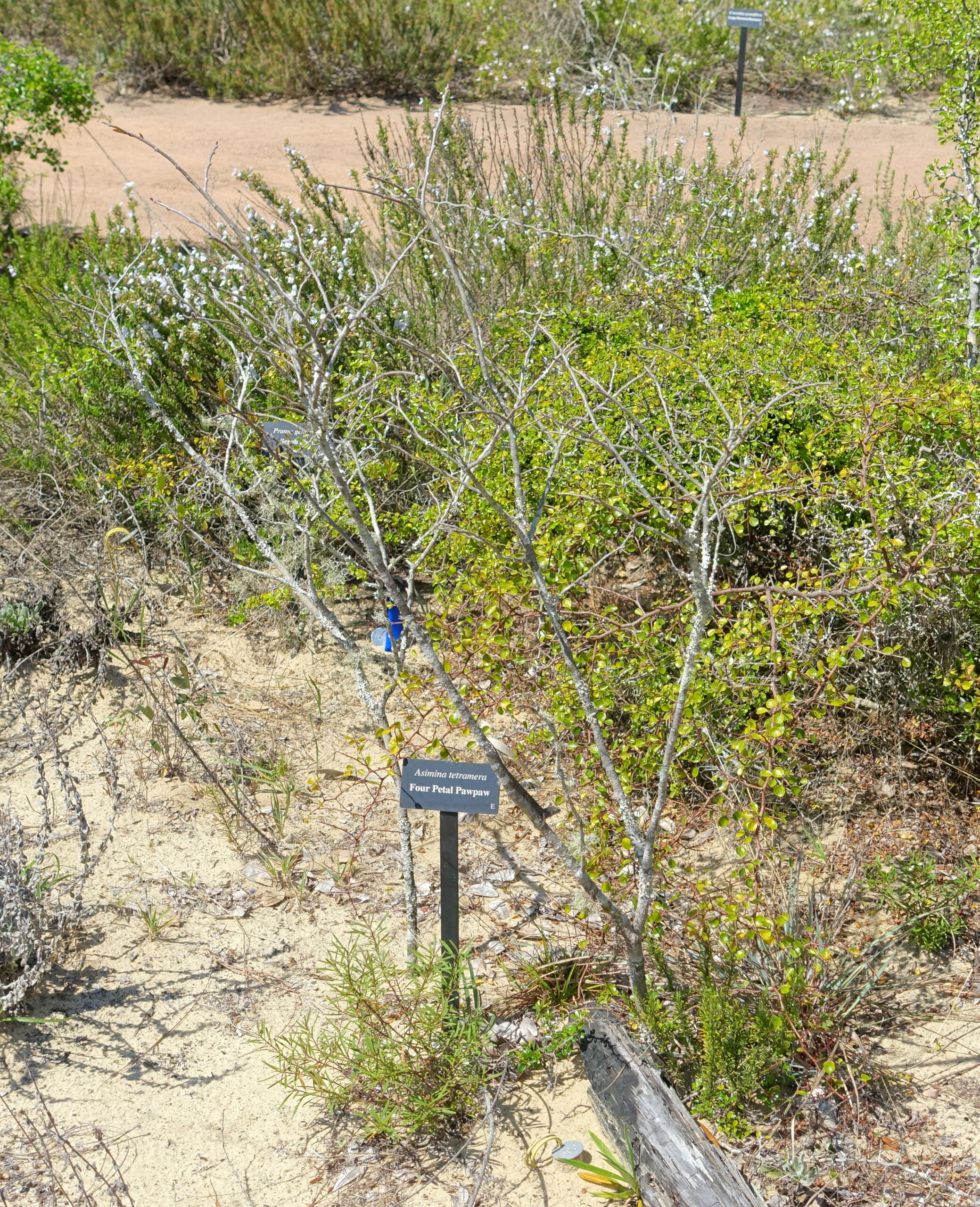
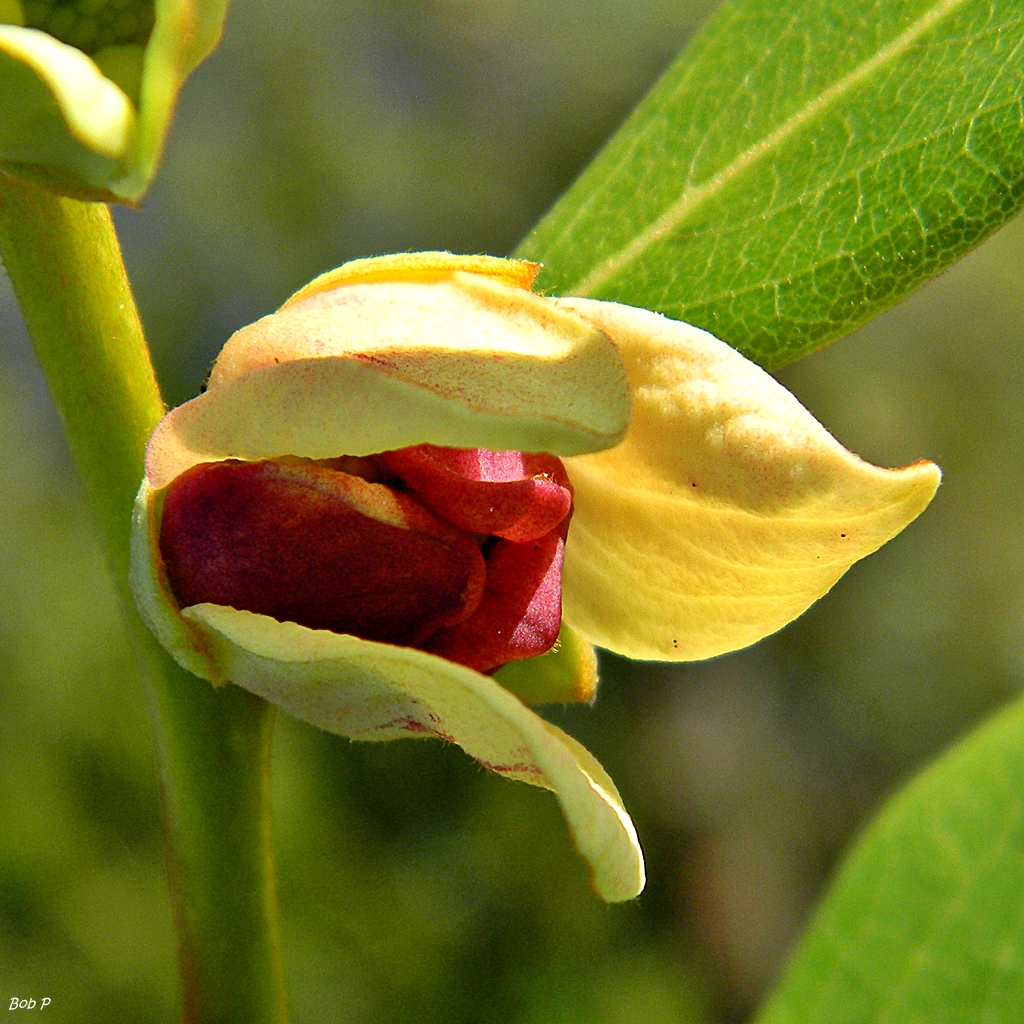
Four-petal pawpaw is a large woody shrub, sometimes a small tree, formed of one or several upright stems 1 to 3 meters tall — the tallest of the American pawpaws, and also the rarest. It carries the family look: large, untoothed leaves, and flowers that start out cream-colored and turn maroon or yellow as they age. The flowers have a fetid scent, which is not a flaw but a strategy — they are pollinated by beetles and flies, the insects that answer a smell most gardeners would call unpleasant. The fruit is a pale yellow-green aggregate that smells of banana, and it is eaten by wildlife. If you have ever eaten a common pawpaw, you know the flavor family; this species keeps that flavor in a plant almost nobody will ever see in the wild.
It lives in exactly one kind of place: sand pine scrub on the Atlantic Coastal Ridge, the old dune ridges of Martin and Palm Beach Counties in southeast Florida, growing alongside sand pine, saw palmetto, and scrub oaks. That is the whole native range. Not Florida in general — two counties. The species was first discovered in 1924 near Rio, just north of Stuart, and its historic range ran along the scrub dunes of the Atlantic coast in those two counties. Today it survives in small, disconnected remnant patches, and the populations are isolated from one another, which is itself a threat: isolated plants pollinate poorly and recolonize nowhere.
Four-petal pawpaw is federally listed as endangered — listed under the Endangered Species Act in 1986 — and state-endangered in Florida, and the International Union for Conservation of Nature lists it as Endangered as well. Counts vary by survey year and by what is counted, so this guide will not pin a single current number: older accounts put the wild total around 500 to 950 plants, while the IUCN’s 2018 assessment gave 1,800 mature individuals, with the population trend decreasing. Whichever count you take, it is a plant counted in the hundreds to low thousands, not the millions. About ten of its seventeen known occurrences sit on protected land, including Jonathan Dickinson State Park and the Hobe Sound National Wildlife Refuge, and several more sit on private land with no protection at all.
And here is the butterfly connection, the reason this guide exists in this project at all: four-petal pawpaw is one of the zebra swallowtail’s hosts. The zebra swallowtail caterpillar feeds on pawpaws and only pawpaws, and in the South and in peninsular Florida its menu includes the shrubby southern species — slimleaf pawpaw, woolly pawpaw, smallflower pawpaw, netted pawpaw, and this one. A zebra swallowtail in southeast Florida scrub may be a four-petal pawpaw caterpillar all grown up, which is a lovely thought and a fragile one, since both partners depend on scrub that keeps disappearing under development.
How to grow
Plainly: do not try to grow this plant from the wild, and do not expect to buy it. Four-petal pawpaw is an endangered species, and wild plants, seed, and cuttings are not yours to take. No nursery trade in this species exists at any scale worth calling a trade, and any plant offered as wild-collected four-petal pawpaw should be treated as suspect on conservation grounds alone. This section, then, is about what the plant needs where it already grows, and what a person who cares about it can actually do.
What it needs is scrub, and scrub needs fire. Sand pine scrub is a fire-shaped community: without periodic fire, oaks and pines shade this shrub out, and the open, sunny gaps it grows in close over. Jonathan Dickinson State Park stewards its scrub with controlled burns on roughly a six-year rhythm, and that rhythm is not landscaping — it is the plant’s life support. Fire suppression is named, alongside urbanization and habitat loss, as one of the main threats to this species, and it is the threat ordinary people most misunderstand: a scrub that never burns is not a scrub being protected; it is a scrub being slowly shaded to death.
If you live in Martin or Palm Beach County and you have scrub on your land, the single most useful thing you can do is get professional advice before clearing, mowing, or “tidying” it — scrub that looks empty to a mower is often the whole world to the plants in it. If you do not live there, the useful things are visiting and supporting the protected places where it grows — Jonathan Dickinson State Park and Hobe Sound National Wildlife Refuge both hold populations — and supporting scrub conservation generally. Seeing a four-petal pawpaw in a state park, behind no fence you had to sneak past, is the right way to meet this plant.
For gardeners who want the zebra swallowtail connection without touching an endangered species: plant common pawpaw (Asimina triloba) where it is suited, or the other southern shrubby pawpaws where they are suited and legally available from reputable native nurseries. The butterfly does not require this exact species; it requires a pawpaw. Giving it a common one is the conservation move, and it leaves the rare one to the scrub it belongs to.
Water & feeding
Four-petal pawpaw lives on rainfall in deep, nutrient-poor scrub sand, and it wants nothing you would put in a garden bed. Do not fertilize scrub plants: fertilizer feeds the fast-growing competitors — the oaks and pines already shading it out — faster than it feeds the pawpaw. Do not irrigate it into lushness either; scrub sand drains fast by design, and a plant adapted to that drainage rots and sulks in rich, wet soil the way a desert plant does in a bog. The honest water and feeding advice for this species is: leave its soil alone. The scrub’s poverty is part of its ecology, not a problem to fix.
What the plant actually responds to is light and space, and both arrive with fire. After a burn, the scrub opens, the pawpaw resprouts and flowers in the sun, and its beetle and fly pollinators can find it. Between burns, the slow closing of the canopy is the clock ticking. If you are stewarding scrub habitat with professionals, the conversation is about burn intervals and canopy cover, not about fertilizer schedules — and that is a sentence you will not find in most growing guides, because most growing guides are about plants you can buy.
Common problems
Development is the first problem, and it is permanent: scrub turned into subdivisions does not come back, and the remaining patches are islands. Fire suppression is the second, and it is slower but just as final — a scrub that never burns becomes a closed forest, and four-petal pawpaw does not live in closed forest. Fragmentation is the third: with populations isolated from one another, pollinators move less between them, seed set drops, and a single bad year in one patch cannot be rescued by neighbors, because there are no neighbors.
There is also the quiet problem of being overlooked. A shrub with no showy garden reputation, in a habitat most people read as empty sand and scrubby bushes, is easy to clear without ever knowing what was cleared. That is why the protected-land occurrences matter so much, and why the park and refuge populations are not just nice to have — they are the species’ insurance policy. The plant’s own biology adds one more wrinkle: its flowers smell of carrion to attract beetles and flies, which means it will never be a popular garden shrub even if it were legal and available. Its pollination strategy is brilliant and completely unmarketable, and that is fine. Not every plant needs to be a product.
Harvest
Do not harvest four-petal pawpaw. Do not pick its fruit, do not take cuttings, do not dig suckers, do not collect seed from wild plants. The fruit belongs to the wildlife that eats it and to the next generation of seedlings the scrub is barely producing. This is the one harvest section in this whole project where the advice is a single prohibition, and it is the most important sentence in the guide: leave it alone, and let the park rangers and the refuge biologists count it in peace. If you want pawpaw fruit to eat, grow common pawpaw — it is delicious, it is legal, and it will not cost an endangered species a seed.
Browse all plant & pest guides
Saving seeds and stewardship
Stop here before you reach for a paper bag, because this section is deliberately not a normal seed-saving how-to. Four-petal pawpaw (Asimina tetramera) is a Florida-endemic shrub listed as endangered, found in the wild only in the sand pine scrub of Martin and Palm Beach counties, and its wild populations are small enough that any casual collecting genuinely matters. Do not collect seed, fruit, cuttings, or suckers from wild plants. Do not buy a plant that was dug from the wild. Do not plant one in a garden outside its native scrub country and call it conservation. The fruit that a wild shrub manages to make belongs to the tortoises, raccoons, and beach mice that eat it and to the next generation of seedlings the scrub is barely producing on its own. If you want pawpaw fruit to eat, grow common pawpaw instead. It is delicious, it is legal, and it will not cost an endangered species a seed.
What, then, is a gardener allowed to do? Only this: work with material that was nursery-propagated from garden-grown plants, bought from a reputable native-plant nursery, and keep it as a garden plant, not as a rescue mission. Even then, treat its seed as a short-lived, fussy thing rather than a pantry staple. Pawpaw seed is recalcitrant, which is the soil-science word for seed that cannot be dried out and stored like bean seed. The seed carries a large, oily endosperm, and as that oil dries and ages the seed loses viability fast. Fresh seed planted promptly germinates far better than older seed, and dry-stored seed is, for practical purposes, dead seed. There is no home seed-bank trick for this plant: no drying it thoroughly, no airtight jar on a shelf, no saving it for next year. If you have fresh seed from a garden-grown plant, it needs to stay moist from fruit to sowing medium, full stop.
That moisture rule shapes the whole method. Clean the pulp from fully ripe fruit, keep the seed damp in moist mix, and sow it promptly rather than storing it. Sources describe a two-stage dormancy: a warm, moist period followed by a cold, moist period, each on the order of a few months, before germination, which itself can be erratic and spread over many months. Other accounts simply sow fresh seed at once and let the seasons do the work. Both point at the same lesson, which is patience: the root system develops underground before much shows above it, seedlings grow slowly, and most of the early growth goes into a deep taproot that resents disturbance. Sow where the plant can stay, or in a deep pot you will not need to move often, and do not bare-root a pawpaw seedling the way you would a tomato transplant.
Two more honest notes before anyone sows. First, four-petal pawpaw is not self-fertile, and it is beetle-pollinated, so a lone shrub in a garden may flower beautifully and set little or no fruit; fruit needs genetically distinct plants flowering together. Second, seedlings are not clones. Seed from a garden plant shuffles its genes, so a seedling may differ from its parent in size, habit, or fruit, and that variation is normal, not a failure. None of this is a reason to go looking for wild seed to improve your odds. The honest seed-saving advice for this species is the shortest version in this whole project: leave wild plants alone, buy nursery-grown plants, and if you ever handle garden-grown seed, keep it fresh, keep it moist, and accept that the plant sets the timetable.
Varieties and relatives
Four-petal pawpaw (Asimina tetramera) — this guide’s species, and the only one this guide covers. It is endemic to Martin and Palm Beach Counties, Florida, and federally and state listed as endangered.
Common pawpaw (Asimina triloba) — the widespread pawpaw of the eastern United States, the one with the edible fruit in markets and nurseries, and the zebra swallowtail’s host across most of its range. Covered by the Asimina genus guide.
Slimleaf pawpaw (Asimina angustifolia), woolly pawpaw (Asimina incana), smallflower pawpaw (Asimina parviflora), and netted pawpaw (Asimina reticulata) — the other shrubby southern pawpaws named as zebra swallowtail hosts in the South and peninsular Florida. None of them is covered by this guide; each is a different species with its own range and habits.
Other Asimina species exist beyond the zebra swallowtail’s host list, and the genus as a whole is covered by the Asimina genus guide. This guide claims tetramera only, and no other pawpaw should be wired to it.