
🌿 Giant Ragweed
What it looks like
Giant ragweed is the plant you already know, even if you never learned its name. It is the coarse, towering weed at the edge of the field, along the riverbank, and in the vacant lot, the one that by August is taller than you are and by September is shedding pollen into every breeze that passes. It is an annual herb in the aster family, Asteraceae, native to North America, where it is widespread across Canada, the United States, and northern Mexico, and it is known as a common weed in many regions of Europe and Asia where it has been introduced. It is also called great ragweed, tall ragweed, buffaloweed, and kinghead, and every one of those names is a size joke: this is the giant among the ragweeds, and it earns the title every summer.
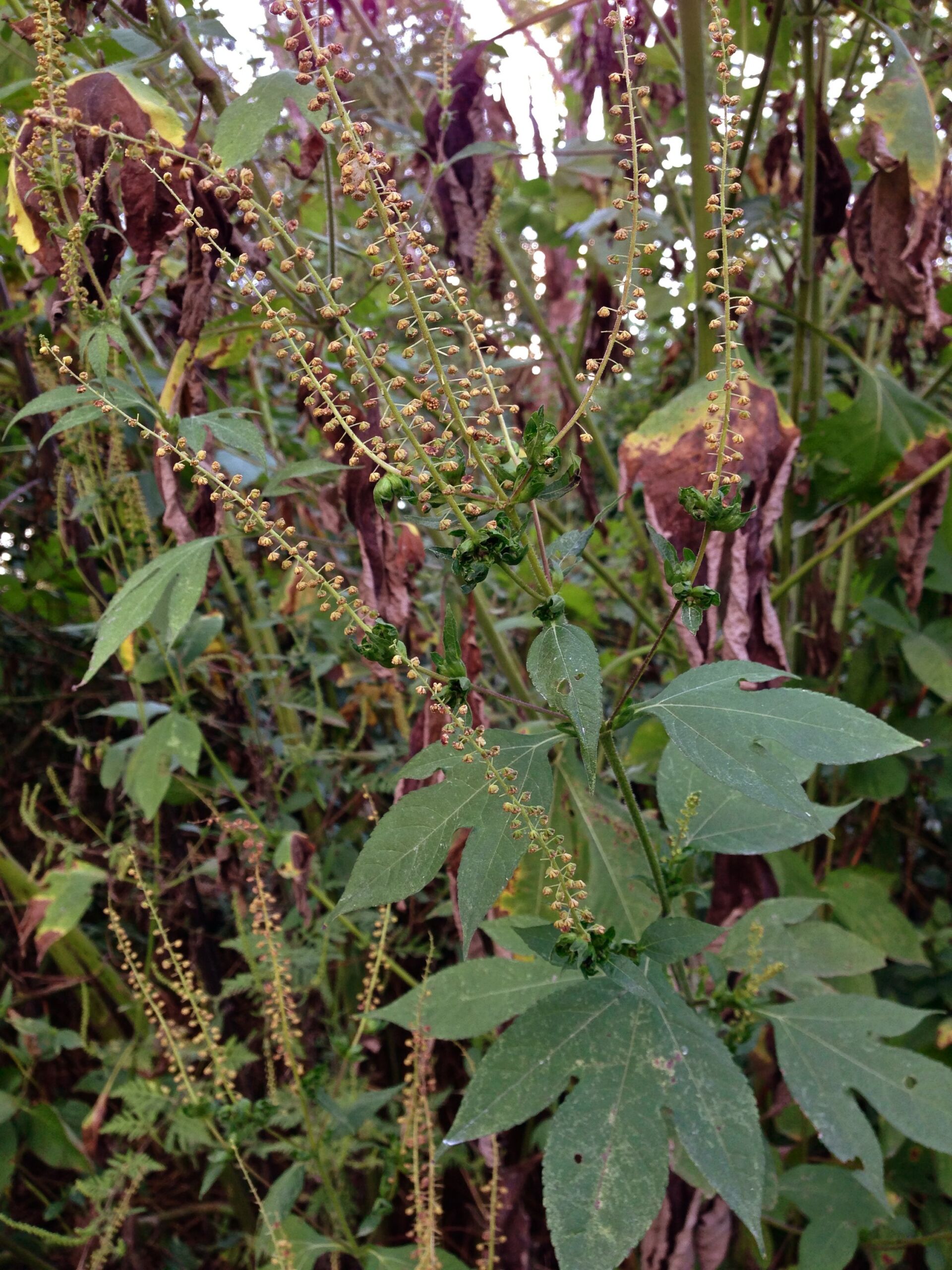
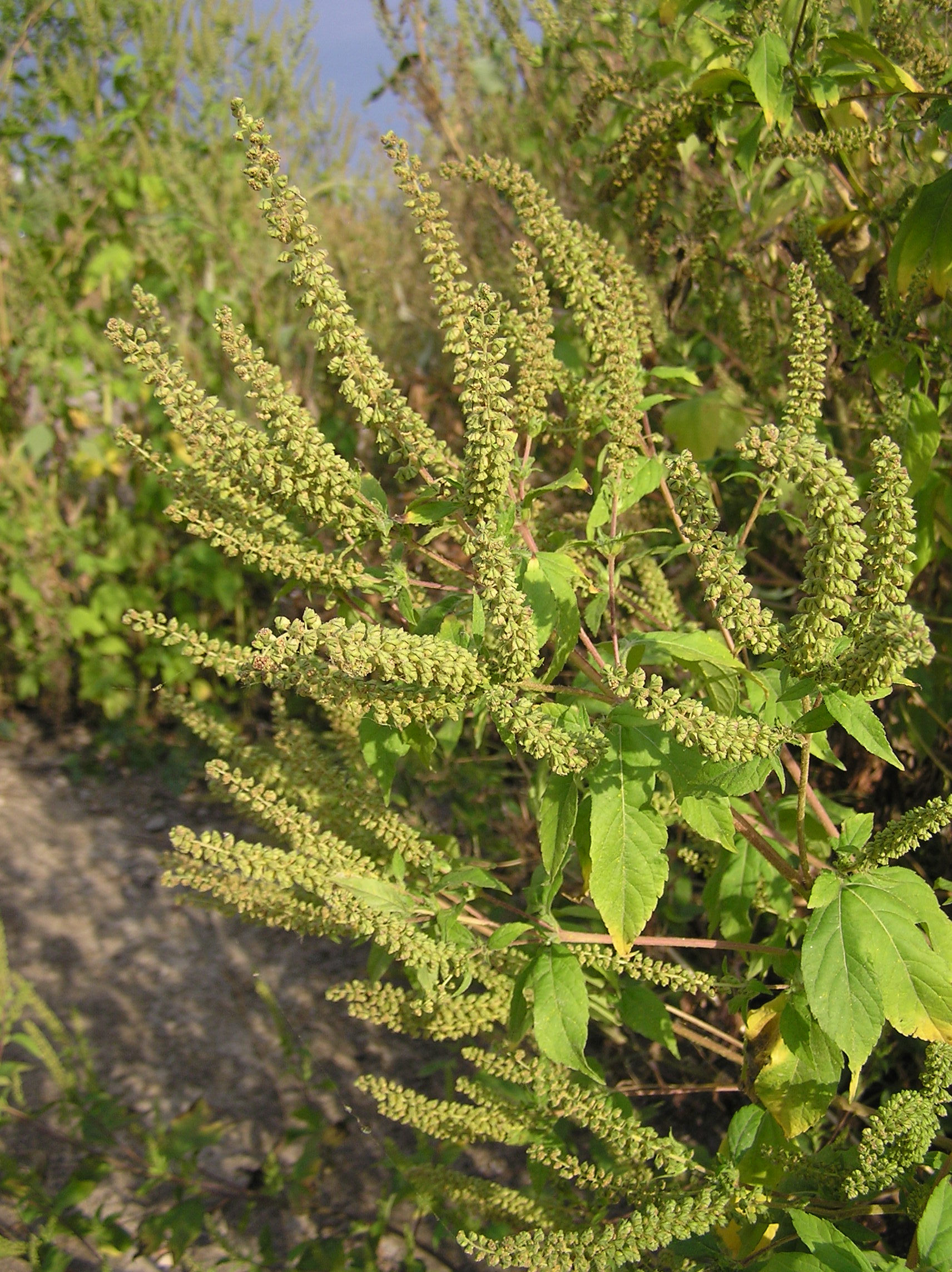
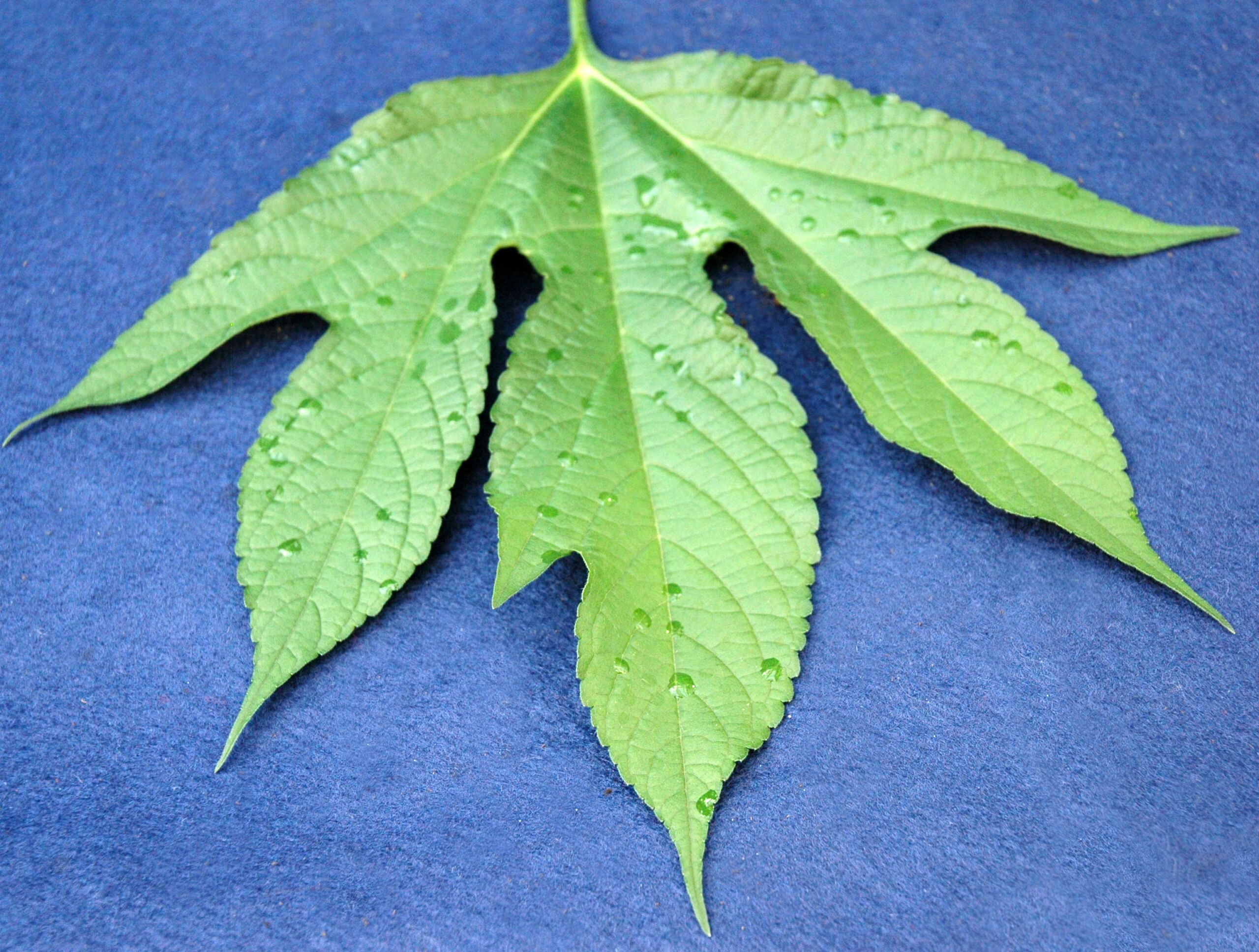
The first clue is size. Giant ragweed is usually 6 to 12 feet tall, often shorter on poor ground, and it is known to reach over 20 feet in rich, moist soils, which is taller than most garden fences and taller than the gardener. The stems are tough, erect, branching or unbranched, with woody bases on large plants, green and sometimes reddish, rough and hairy, and they feel like sandpaper when you run a hand along them. The leaves are the second clue, and they are the reason for the Latin name: trifida means three-cleft, and most leaves are palmately divided into three lobes, sometimes five, with toothed edges, opposite on the lower stem and sometimes alternate above, borne on long petioles, rough and gland-dotted on both surfaces. The largest leaves can be over 10 inches long and 8 inches wide, which is a dinner-plate leaf on a weed, and the upper leaves are smaller and more lance-shaped, often with three lobes and a winged stalk.
The flowers are the third clue, and they are easy to miss because they are not flowers in the way a gardener means flowers. Giant ragweed is monoecious, carrying separate male and female flowers on the same plant. The male flowers are tiny, greenish-yellow, petal-less heads that nod on short stalks along long terminal spikes, sometimes a foot long, and they are the pollen factory: wind carries their pollen for miles, and a single plant is reported to release millions of grains a day, with season totals in some accounts reaching about a billion grains per plant. The female flowers are far less showy, clustered in the leaf axils below the male spikes, each one hidden inside a small involucre that matures into a bur, a few millimeters long, tipped with a central beak surrounded by several short, stout spines. Those burs are the plant’s travel plan: they catch on fur, clothing, and machinery, and they wash downstream in floods, which is how a riverbank weed becomes a field weed becomes a vacant-lot weed in a single season.
Giant ragweed’s habitat tells you where to look for it and where to expect it. It grows in disturbed ground of almost every kind: crop fields, floodplains, field edges, riverbanks, roadsides, waste places, and gardens that have been left alone for a season. It is one of the earliest emerging summer annuals, which lets it dominate plant communities in disturbed habitats before slower plants get going, and it easily outcompetes neighboring plants for light, shading out crops and wildflowers alike. It prefers moist, fertile soil and does best where water is plentiful, which is why its largest specimens grow in bottomlands and along streams, but it tolerates a wide variety of soil types and will make do with dry ground by staying smaller. A plant that can be 3 feet tall on a dry lot and 20 feet tall in a bottomland is not confused about what it is; it is flexible, and flexibility is why this weed covers so much of the continent.
How to grow
Do not plant giant ragweed on purpose. That sentence is the whole growing advice in its shortest form, and the rest of this section explains why, and what to do about the plants that plant themselves. Giant ragweed needs no help from you: it self-seeds prolifically, with a single plant producing around 1,800 seeds in ordinary conditions and up to about 5,100 seeds in good ones, and those seeds wait in the soil for disturbed ground and an open spring. If you have bare, fertile, moist soil in a sunny spot, giant ragweed will find it, and it will grow faster than almost anything you planted on purpose.
If you are reading this guide because butterfly guides list giant ragweed, the honest translation is this: the butterflies are using a plant that grows itself, and you do not need to cultivate it to keep them fed. Leave a weedy edge, a fencerow, or a damp corner alone through the summer, and giant ragweed will very likely appear there on its own, along with the checkerspots and patches whose caterpillars eat it. If you are reading this guide because it has taken over a bed, the control advice is equally plain: pull it young, before it sets seed, while the taproot is still shallow, and do not let a single plant go to seed in a bed you care about, because one plant’s seed output is next year’s colony. Mowing helps only if it is repeated and timed before flowering; a plant cut once will branch and flower lower, and a plant cut after pollen has started has already done its damage for the season.
The conditions giant ragweed wants are the conditions of a disturbed, fertile, sunny site: full sun, moist soil, and open ground. It is an annual, so there is no zone rating in the usual perennial sense; it grows as an annual wherever summers are long enough for it to flower and set seed, which is most of North America, from southern Canada to northern Mexico, and it flowers from July into September or October, with the exact timing set by day length, which is why it is reported to establish best between about 30 and 45 degrees north latitude. In a garden, the way to discourage it is to deny it those conditions: keep beds mulched and planted, so there is no bare soil for it to colonize, and keep damp, fertile edges mowed or planted with competitive perennials rather than left bare. A mulched bed is not a guarantee, giant ragweed can push through thin mulch, but a thick mulch and a closed canopy are the closest thing to one.
One more growing note, and it is the one that matters most to anyone tempted to keep a specimen out of curiosity: giant ragweed is a documented agricultural weed, and in many places it is treated as a noxious weed. It reduces crop yields by shading and competition, it has developed resistance to widely used herbicides, and its pollen is a public-health problem for millions of people. Keeping one plant as a curiosity is a defensible choice in a rural fencerow, and a poor choice next to a neighbor’s house, a school, or a vegetable garden. Know which situation you are in before you decide to let one stand.
Water & feeding
Giant ragweed waters and feeds itself, and that is the problem. It prefers moist, fertile soil and grows largest where water and nutrients are plentiful, in bottomlands, along streams, and in fertilized fields, and it will use every bit of nitrogen you put down for your crops or your garden. It does not need supplemental water or fertilizer, and giving it either only makes it taller. In a garden bed, the practical advice is the reverse of the usual: do not water or feed a patch of giant ragweed, and do not leave a fertile, irrigated bed bare in spring, because that is an invitation written in the plant’s own language.
If you want to weaken it without chemicals, the levers are light and water, in that order. Shade suppresses it: a closed canopy of competitive perennials or a thick mulch layer that blocks light will keep seedlings small and slow, while open, sunny, moist ground lets them race. Drying a site out also helps, since its largest growth comes from moist ground, though it will still grow on drier sites, just shorter. And because it is an annual, it has no perennial root system to kill: every plant you see this year grew from a seed this spring, which means that preventing seed set for a few years in a row genuinely reduces the population, as long as new seed is not arriving from upstream or upwind.
Common problems
- Allergies, and they are severe. Giant ragweed pollen is one of the most allergenic pollens in North America, and it is a major cause of late-summer hay fever. Its pollen is wind-dispersed, produced in enormous quantities, and capable of traveling long distances, so removing the plants in your own yard only marginally reduces your exposure if the regional pollen load is high. People with ragweed allergy should avoid handling the plants in flower, wash hands and clothes after working near them, and keep windows closed on high-pollen days. This is not a plant to brush against casually in August if you are sensitive to it.
- Herbicide resistance. Giant ragweed populations resistant to Group 2 herbicides, the ALS inhibitors, and Group 9 herbicides, glyphosate, were first identified in the late 1990s and are now widespread across much of the Midwest, and resistance to multiple modes of action is a growing concern. If you farm or manage land, do not rely on a single herbicide mode of action against this weed, and rotate control methods, including mechanical removal before seed set.
- Crop competition. In fields, giant ragweed outcompetes crops for light, water, and nutrients, and a dense stand can cut yields sharply. Early emergence is its weapon: it gets up before the crop canopy closes, and once it is taller than the crop, the crop loses. Early-season control, before it overtops the crop, is far more effective than late-season rescue.
- Skin irritation and livestock. The rough, hairy foliage can irritate skin on contact, and the plant is reported to be toxic to livestock if ingested in quantity. Do not let animals graze a dense stand, and wear gloves and long sleeves when pulling large plants.
- Mistaken identity, in both directions. Giant ragweed is often confused with common ragweed, Ambrosia artemisiifolia, which is smaller, usually 1 to 4 feet tall, with finely divided, fern-like leaves, and with other tall weeds such as horseweed. The size and the large, palmately lobed leaves are the distinguishing marks: if it is over 6 feet tall with dinner-plate, three-lobed leaves, it is giant ragweed, not common ragweed, and if it is knee-high with lacy leaves, it is the other way around. Getting this right matters, because bare ragweed in ordinary speech almost always means common ragweed, not this plant.
- Seed bank persistence. Burs survive in soil and arrive by water, animals, and machinery, so a cleared patch can be recolonized from upstream or from a neighbor’s fencerow in a single season. Control is a multi-year habit, not a one-time event.
Harvest
There is no kitchen harvest gardeners should attempt from giant ragweed, and the historical harvest is a story, not a recommendation. Indigenous peoples of North America used the plant medicinally in recorded traditions: the Cherokee used crushed leaves on insect bites, skin eruptions, and hives, and chewed the root, and the Iroquois used it to treat diarrhea, and those uses are reported in ethnobotanical records, not prescribed here. The seeds were also gathered as food in some traditions, and archaeologists have suggested that giant ragweed may have been cultivated by pre-Columbian peoples as an oily seed crop, part of the Eastern Agricultural Complex, because seed caches found in ancient settlements contain seeds several times larger than those of present-day wild plants. That is a fascinating hint about a lost crop, and it is not a reason to eat the seeds from the vacant lot: modern plants are weedy, the pollen is a potent allergen, and the plant is reported to be toxic to livestock, so the safe harvest from giant ragweed is knowledge, not food.
Butterfly guides list giant ragweed as a host plant in two guides, both in their Host plants sections, and the exact forms matter, so they are given here exactly. The Gorgone checkerspot lists giant ragweed, with the Latin name Ambrosia trifida given. The bordered patch lists ragweed, with the Latin name Ambrosia trifida given for that entry, and it also carries a bare ragweed entry without a Latin name. That is the record, and it comes with a warning for anyone wiring links from it: bare ragweed elsewhere usually means common ragweed, Ambrosia artemisiifolia, not this plant, so only the entries paired with Ambrosia trifida, and the giant ragweed form, belong to this guide. Do not let a bare ragweed mention anywhere else point here by default. That host relationship is the reason this guide exists in the butterfly project, and it is worth stating plainly rather than padding it into a longer list. A weed that feeds checkerspot caterpillars while making half the neighborhood sneeze is a complicated neighbor, and complicated neighbors deserve exact records.
The one genuinely useful garden harvest from giant ragweed is compost, handled with care. It has been used successfully as a compost activator and as an ingredient in sheet mulch gardens, because it grows fast, accumulates nutrients, and breaks down readily, but only plants pulled before they set seed should go into compost, and hot composting is the safer route, since a cold pile can preserve viable seed and spread the weed with the compost. Pull it young, compost it hot, and never compost a plant that has already made burs, or you will be harvesting giant ragweed in every bed you mulch.
Seed prevention, not seed saving
This section is the opposite of seed saving, and it is here because giant ragweed is the one plant in this project you should never deliberately grow, save, or share. It is a towering annual weed and one of the most allergenic plants in North America: its wind-blown pollen travels for miles and makes late summer miserable for millions of allergy sufferers, and a single plant produces thousands of seeds. The good news is also the plant’s one weakness — as an annual, it is entirely dependent on those seeds. No seed set, no next generation. Every tactic below is aimed at that single fact.
Timing is everything, because ragweed flowers on a daylight trigger in mid- to late summer — roughly mid-August in most of its range — and once it flowers, the damage is already underway. Act in early summer, while plants are still young and before any flower spikes appear. Pull seedlings and young plants by the root when the soil is moist, wearing gloves, long sleeves, and a mask if you are sensitive; the plant’s rough foliage can irritate skin, and disturbing a flowering plant showers pollen. For larger patches, cut plants at soil level before flowering — but do not mow once and walk away, because ragweed regrows and can still throw up late blooms. Repeat cutting until frost kills the plants, and keep an eye out for late emergers, since some seed germinates well into summer.
What you do with the pulled plants matters as much as pulling them. If a plant has already set seed, bag it immediately and put it in the trash — do not compost it, do not leave it in a brush pile, and do not toss it in the ditch, because home compost rarely gets hot enough to reliably kill weed seed and a discarded plant finishes dropping seed exactly where you dropped it. For prevention, cover bare soil with mulch or competitive planting so seed cannot germinate, and avoid unnecessary tilling, which hauls buried seed up to the light like a waiter delivering appetizers. Finally, a note on patience, because sources disagree here: some researchers report that most giant ragweed seed loses viability within a year or so, while others document buried seed persisting far longer. The safe reading is that one clean season is not victory — keep the ground covered and keep pulling for a few years, and the seed bank will spend itself down. In Florida, where the growing season runs long, the same playbook applies: get them before they bloom, bag what has seeded, and never give a weed with this pollen count a free place to stand.
Varieties
Giant ragweed is not a garden plant, and no named garden varieties were verified for this guide. That is stated plainly, not padded: nobody is breeding giant ragweed for the catalog, and any seller offering a named giant ragweed variety should be asked to show that the name is real and distinct.
- Ambrosia trifida, the straight species: The tall annual described in this guide, opposite palmately three- to five-lobed leaves, male spikes above female clusters, crown-shaped burs, 6 to 12 feet tall and occasionally over 20 feet in rich, moist soil. This is what butterfly guides mean when they list giant ragweed, and what they mean when they list ragweed paired with the Latin name Ambrosia trifida.
Regional forms are not garden varieties and are not listed here as if they were: a southern form, sometimes called var. texana, is recognized in Texas and the surrounding region, with smaller burs and wingless petioles, and hybrids between giant ragweed and common ragweed are recorded under the name Ambrosia × helenae. Related ragweeds are not varieties of this plant either: common ragweed (Ambrosia artemisiifolia) is a different, smaller, far more widespread species with finely divided leaves and its own identity, and it is the plant most people mean when they say ragweed without a qualifier. If you are identifying a ragweed, check the leaves and the height first, and the Latin name second, and do not let the bare word ragweed do the identifying for you.