
🧡 Globe Mallow
What it looks like
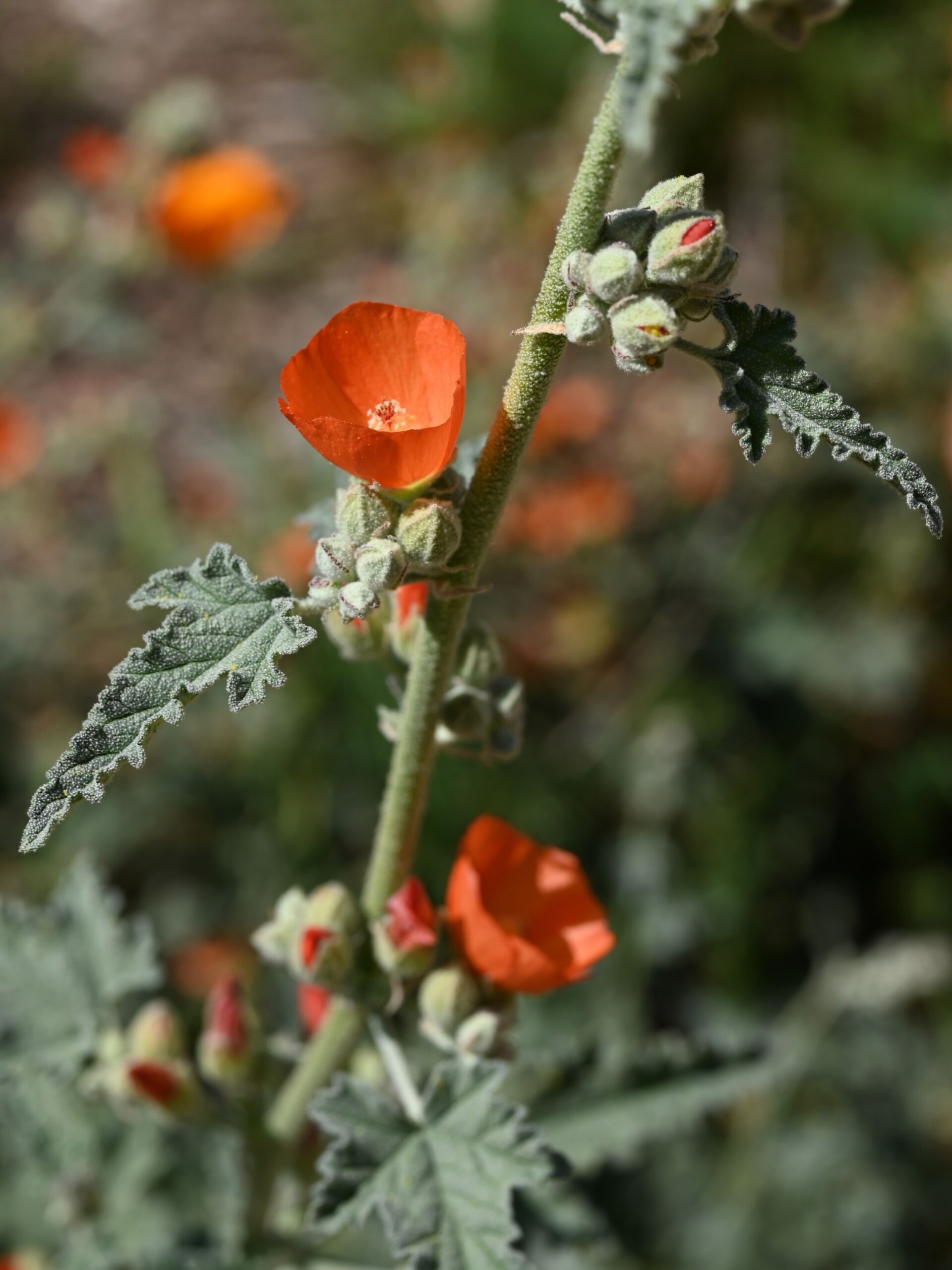
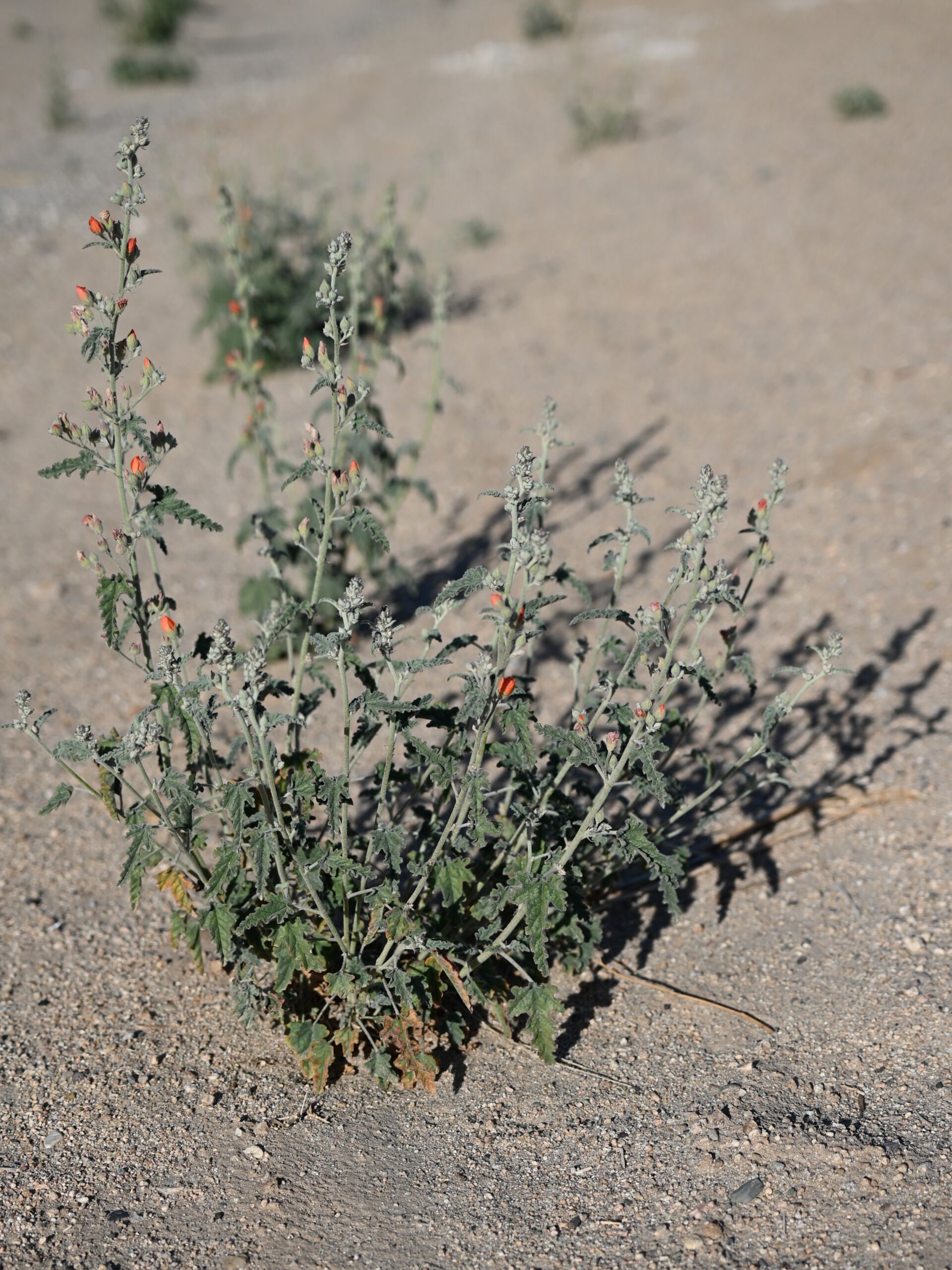
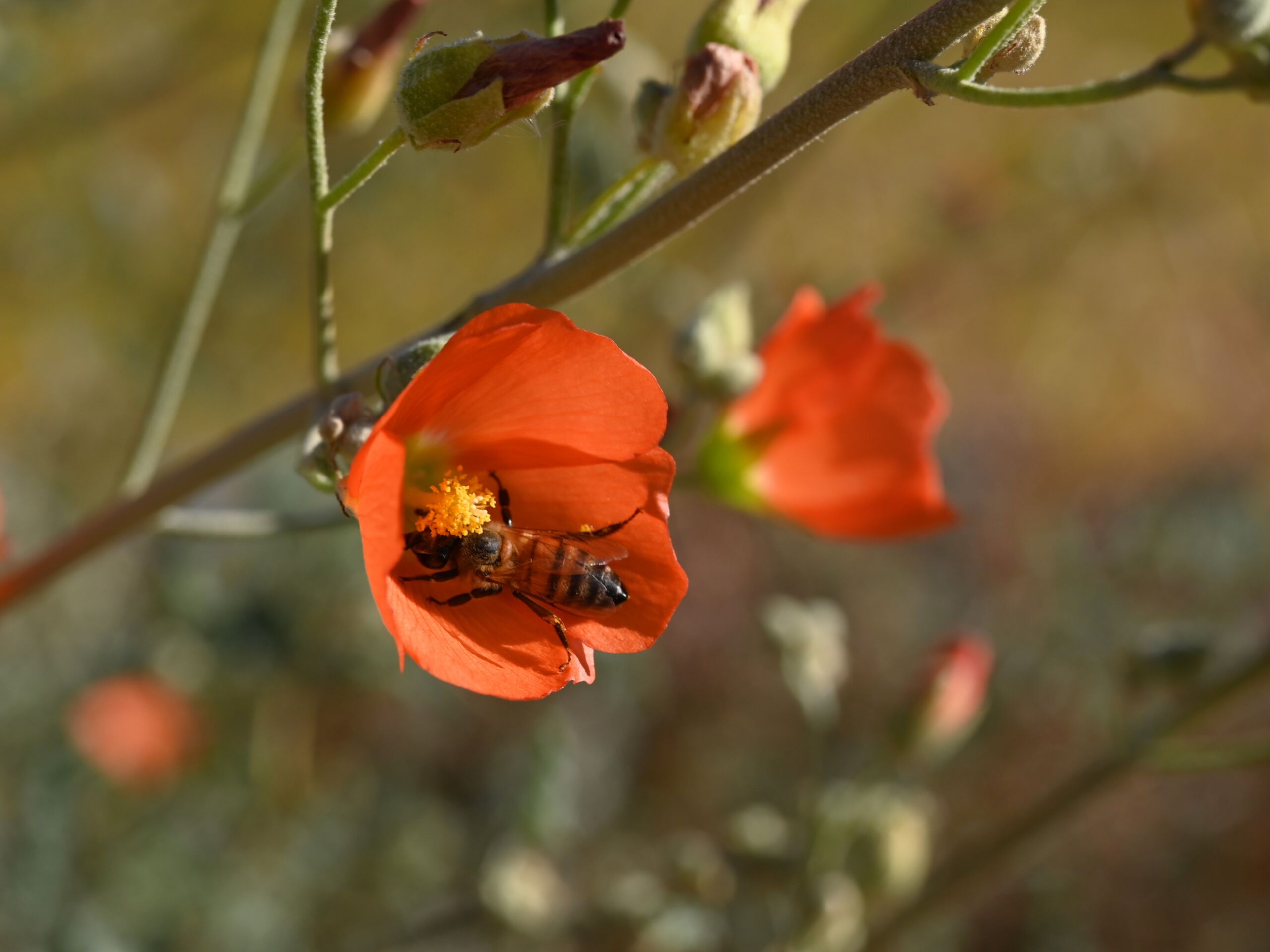
Globe mallow is Sphaeralcea, a genus of about fifty plants, mostly North American, in the mallow family Malvaceae — and the first thing to get straight is what it is not. It is not the mallow of the cottage garden. The site’s existing Mallow guide covers Malva, the genus of common mallow and musk mallow, and it says so itself: globe mallows, bush mallows, and alkali mallows are cousins with their own genera. Globe mallow is the desert cousin, and it looks the part: a perennial subshrub with silvery foliage and cupped flowers that resemble small hollyhocks, because hollyhocks are family too. The genus name even tells you the flower’s shape if you squint at the Greek: sphaira, a globe, plus alcea, the mallow — the globe mallow.
The signature species is desert globemallow, Sphaeralcea ambigua, also called apricot mallow. The Arizona Native Plant Society’s profile describes it as a perennial subshrub with slightly woody stems restricted mostly to the crown, growing in a large rounded clump twenty to forty inches tall, sometimes with over a hundred stems rising from the same root. The foliage is the giveaway before the flowers open: a characteristic silvery colour, covered in tiny star-shaped woolly hairs, two adaptations that conserve moisture and reflect sunlight. In a desert garden, that silver reads as coolness itself — the plant looks air-conditioned.
The flowers are bowl-shaped, five-petalled, up to an inch and a half long in desert globemallow, and they run the warm end of the spectrum: orange most famously, but also red, rose, pink, and white across the genus, with most species in the orange-to-red range. Desert globemallow blooms most heavily in spring but keeps flowering through November, and a mature plant in bloom is a cloud of apricot cups over silver leaves. The genus as a whole ranges from about eighteen inches to six feet tall depending on species, with lobed leaves and summer bloom, and the flowers are cup-shaped and silky. If you know one mallow-family flower — five petals, a central column of fused stamens — you know this one; Sphaeralcea just wears the family face in desert colours.
In the wild, desert globemallow grows in desert scrub below about 3,500 feet on dry, rocky slopes, along the edges of sandy washes, on roadsides, and in disturbed areas, across Arizona, California, New Mexico, Nevada, and Utah, and into Sonora and Baja California in Mexico. It is an early colonising species after fire and disturbance, useful in range revegetation, and it has been used to revegetate abandoned mines — a plant that shows up where the land has been knocked flat and gets to work. Its stems were used by the Yavapai to make trays for drying saguaro fruit and slabs of pounded mescal. That is a tough, useful plant wearing a very pretty flower.
How to grow
Grow globe mallow in full sun and do not apologise for the poor soil. This is a plant that survives in its native habitat on as little as five inches of annual rainfall, handles reflected heat off west-facing walls, and is described by desert gardeners as taking whatever the desert dishes out: extreme heat, cold, drought, and wind. The single requirement that matters is drainage. It grows in rocky, sandy, clay, and even disturbed soil, provided the soil is well-drained. A wet spot is the one place it will fail; a dry, sunny, gravelly spot is where it will thrive and reseed.
Plant seeds or container plants in spring or fall. Give each plant about three feet of room — desert globemallow matures around three feet tall and wide, and a typical specimen can reach about five feet wide by four feet tall in generous conditions — and then leave it alone to form its rounded clump. It is a fast grower and a free reseeder: seed planted one year may produce plants of a different colour the next, which desert gardeners treat as a surprise rather than a problem. If you want a uniform colour, buy named container plants; if you like surprises, let it seed.
Hardiness needs a plain statement of disagreement, because the sources do not agree and a gardener deserves to know that. Desert globemallow is variously listed at zones 7 to 11, zones 6 to 9, and zones 5 to 9, with cold hardiness given as down to about fifteen or twenty degrees Fahrenheit depending on the source. The genus-wide growing guides put the range at roughly zones 7 to 9. The honest summary is that desert globemallow is reliably hardy through the mild-winter desert Southwest and into zone 6 in dry soil, and that colder or wetter winters are a gamble — dry cold it tolerates far better than wet cold. In Florida, that last point matters: globe mallow wants dry air, dry soil, and sharp drainage, and Florida’s humidity and summer rain make it a poor fit for most of the state outside a very gritty, raised, rain-sheltered spot. It is a western xeriscape plant, and this guide will not pretend otherwise.
Soil pH is broad: genus guides give roughly 5.0 to 8.0, acidic to alkaline, with poor soil preferred over rich soil. Do not amend the planting hole with rich compost as you would for a rose; a handful of gravel does more good. Once established, do not disturb it — globe mallows resent transplanting and root disturbance, and they reseed freely enough that you will have replacements without moving anything.
Water & feeding
Water globe mallow like a desert plant that is doing you a favour by blooming at all. New plantings need regular water through their first growing season to establish — deeply once a week until established, roughly six to eight weeks, is the usual pattern. After that, back off hard. Established plants need very little water and can survive on natural rainfall in arid climates; one desert-growing guide suggests watering every other week in summer and once a month in winter in the absence of rain for the best appearance, and less is survivable. Overwatering is the classic killer: a globe mallow in a lawn irrigation zone, watered daily with the turf, will rot while the grass thrives.
Feeding is essentially unnecessary. Globe mallow thrives without fertiliser thanks to its adaptation to poor soils, and regular watering produces larger plants than feeding does. If you feed at all, a light spring dressing of compost is the ceiling. Prune back in late winter to promote fresh growth and to remove the previous year’s woody stems; the plant regrows fast from the crown. Deadheading spent flowers can extend bloom, but leaving some seed heads gives you the free reseeding that makes a globe mallow patch self-renewing. The plant is semi-deciduous and will drop leaves in extreme drought or cold — that is dormancy, not death, and it leafs out again when conditions improve.
Common problems
- Overwatering. The number one killer. Wet soil, lawn irrigation, and heavy clay that stays soggy will rot globe mallow. Plant high, plant gritty, and keep it out of the turf zone.
- Wet cold. Desert globemallow tolerates dry cold down to roughly fifteen to twenty degrees Fahrenheit, but cold plus wet soil is a different and harsher test. Dry winter drainage matters as much as the zone number.
- Confusion with Malva mallow. Globe mallow (Sphaeralcea) is not common mallow (Malva sylvestris) and not marshmallow (Althaea). If a guide or seed packet says Malva, it is a different plant with different needs.
- Colour surprises from seed. Seed-grown plants may bloom a different colour than the parent. Buy container plants for a guaranteed colour; embrace the lottery if you sow seed.
- Self-seeding enthusiasm. Globe mallow reseeds freely. In a xeriscape that is a gift; in a tidy border it means volunteers to edit each spring.
- Humidity. In humid climates like Florida’s, globe mallow struggles no matter how good the drainage is. It is a dry-climate plant, and humid summers invite fungal problems it never meets at home.
Harvest
There is no food harvest from globe mallow in the ordinary garden sense, and this guide will not invent one. The harvest is flowers, seed, and habitat. The long bloom from spring into late autumn feeds bees and butterflies for months in a landscape where little else is flowering, and the plant is a larval host for the checkered-skippers and the West Coast lady — which is why it is in this project at all. Leave some flowerheads to set seed and the patch renews itself; cut others for the vase, where the cupped orange flowers hold well and look like small hollyhocks that survived a desert summer.
The other harvest is a lesson in what a garden can be. A globe mallow patch proves that a dry, rocky, neglected corner is not a problem to fix but a habitat to plant: five inches of rain, reflected heat, and poor soil are not obstacles to this genus, they are the conditions it was built for. In a world of rising water bills and hotter summers, a plant that blooms for eight months on almost no water is not a compromise. It is the plan.
Saving seeds
This guide covers a genus — Sphaeralcea, roughly fifty species, mostly North American — so what follows is the genus-level method, and it is labelled as such. Species differ in detail, and desert globemallow, Sphaeralcea ambigua, is the best documented of them, so the pattern below follows it most closely; apply it to its cousins with the same broad strokes and a little less certainty.
Collect when the capsules have matured and begun to split open. The fruit is a segmented pod that breaks into individual seed-bearing segments, so the easiest method is to cut whole stalks into a paper bag and let them finish drying in a warm, dry room until the capsules split on their own; one published nursery protocol for ambigua dries the seed for four to six weeks this way. Rub out the seed, winnow away the chaff, and wear gloves while you work — the fine star-shaped hairs on this genus can irritate eyes and skin.
The hard seed coat is the whole game. Water cannot get through it easily, which is why untreated globemallow seed germinates poorly and unevenly, so do not sow it straight from the pod and blame the seed. Scarify first: a light nick or sandpaper scrape of the coat, or the hot-water treatment — pour just-off-the-boil water over the seeds, let them soak in the cooling water for twelve to twenty-four hours, and sow the ones that have swollen. If a seed still has not swollen, nick it carefully and soak it again. Sow about a quarter inch deep in a fast-draining mix, keep it moist but never soggy, and do not throw the tray away early: germination is uneven even with treatment, and sprouts may straggle in over several weeks, so sow generously. Fall sowing outdoors lets winter’s cold and moisture help break dormancy; spring sowing after scarification works too.
Will seedlings grow true? Seed from an isolated species planting mostly resembles its parent, but where Sphaeralcea species grow together they can hybridise, so a mixed collection may yield intermediates that belong to no catalogue. Softwood cuttings in early summer and division of established plants are clones, and the surer route to an exact copy of a favourite.
Store the seed dry, airtight, and cool — a refrigerator works well — and in Florida, dry it thoroughly before the jar ever closes, because humid air sealed in with seed is a slow funeral. One last piece of Florida honesty: this is a desert genus, and in Florida humidity it struggles no matter how good the drainage is, so seed saving still works, but raising the seedlings here means sharp drainage, full sun, and no soggy soil. Do not blame the seed for a climate mismatch. Where the climate suits, leave some heads to self-sow and the colony renews itself for years, which is how a short-lived plant becomes a permanent patch.
Browse all plant & pest guides
Species in this group
Desert globemallow / apricot mallow — Sphaeralcea ambigua — The signature species, twenty to forty inches tall in a rounded clump with silvery star-haired foliage, bowl-shaped flowers up to one and a half inches long in orange, red, rose, pink, or white, blooming spring through November; Arizona, California, New Mexico, Nevada, Utah, Sonora, and Baja California.
Scarlet globemallow — Sphaeralcea coccinea — A widespread western species with scarlet to orange-red flowers, lower-growing and spreading, common in prairie and desert grassland.
Munro’s globemallow — Sphaeralcea munroana — A Great Basin and Intermountain West species with orange to rose flowers, valued for revegetation of dry, disturbed ground.
Small-leaf globemallow — Sphaeralcea parvifolia — A desert species of the Southwest with smaller leaves and orange flowers, adapted to very dry, rocky sites.
Gooseberry-leaf globemallow — Sphaeralcea grossulariifolia — An Intermountain West species named for its gooseberry-like leaves, with orange to pink flowers on dry slopes and flats.
Copper globemallow — Sphaeralcea elegans — A desert globemallow of the southwestern United States and northern Mexico, a perennial subshrub of dry, arid ground with drought-tolerant, xeriscape habits.