
🌿 Golden-Aster
What it looks like
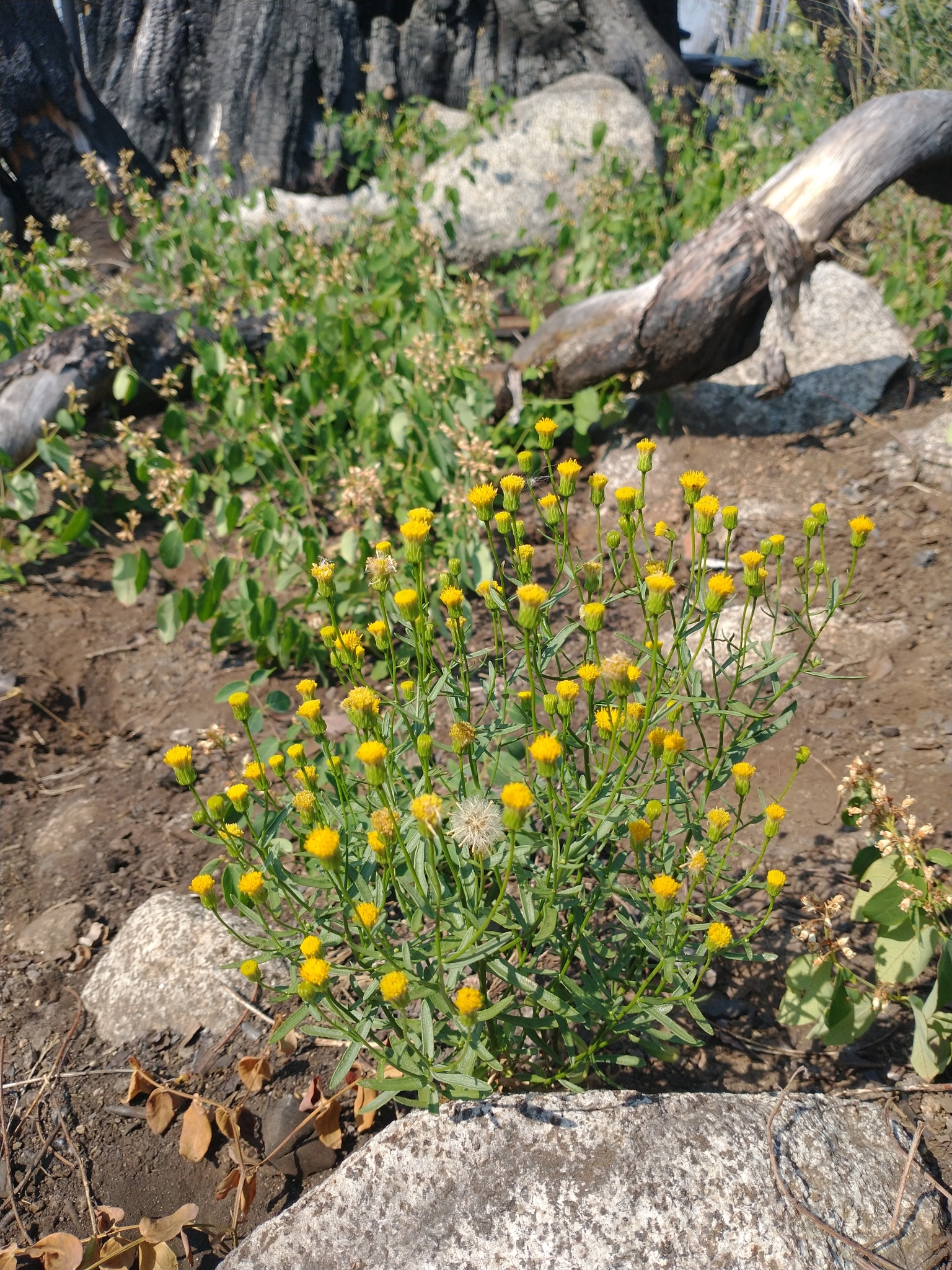
A plain note on photographs, before anything else: only one verified photograph of Eucephalus breweri could be found on Wikimedia Commons at the time of writing — the iNaturalist import shown above, reviewed by the iNaturalist review bot and released CC0 — so this guide shows one photograph rather than padding the gallery with a different aster. If more verified photographs surface, they belong here. The description below leans on the published flora accounts, and it is honest about that.
Golden-aster is the butterfly guide’s name for Brewer’s aster, a perennial herb of the aster family from a woody caudex, native to California where it grows primarily in the Sierra Nevada at subalpine elevations, with its range extending into northwestern Nevada and southwestern Oregon. It grows in meadows and open woodland, roughly 4,000 to 10,500 feet up, and it is a variable plant: anywhere from 4 inches to about 3 feet tall, with mainly erect stems coated in woolly fibers and resin glands, and abundant hairy, glandular leaves, lance-shaped to oval, pointed, smooth or toothed along the edges, up to about 2 inches long. The flower heads are the giveaway and the joke: they are discoid, packed with long yellow disc florets and no ray florets at all, lined with hairy, glandular phyllaries. An aster with no rays is an aster that forgot the petals and kept the middle — golden buttons on woolly stems, blooming July through September, named for the botanist William Henry Brewer.
The butterfly context for this species is the Hoffmann’s Checkerspot guide, whose Host plants section says caterpillar hosts are asters, including western showy aster (Eurybia conspicua) and Cascade aster (Eucephalus ledophyllus) in Oregon, and golden-aster (Eucephalus breweri), confirmed as a host in the Sierra Nevada. This guide claims only the golden-aster half of that list. The Hoffmann’s guide itself tells the dating story: its host was confirmed on a Sierra peak in 2011 as golden-aster, a reminder that even for a butterfly described in the 1800s, basic facts like what the caterpillars eat were still being nailed down in living memory. A mountain aster confirmed as a host in 2011 is a plant with a short published butterfly history and a long mountain history, and this guide treats both with respect.
One plain-text disambiguation, because the aster names are a tangle and this species guide must not swallow its neighbours. This guide covers Eucephalus breweri only, also called Brewer’s aster and, in some treatments, Doellingeria breweri or Aster breweri — the genus has moved, the plant has not. Cascade aster (Eucephalus ledophyllus) is a different species with its own growing guide, and it is not covered here; that guide says so explicitly, naming breweri as a fellow Hoffmann’s Checkerspot host it does not cover. Western showy aster (Eurybia conspicua) is a different species, and it is not covered here. Brewer’s fleabane (Erigeron breweri) is a different plant that shares the Brewer name, and it is not covered here — same botanist, different genus, different flower. The site’s aster guide covers Symphyotrichum species as a genus and does not cover this species. Buy and plant — or, better, admire in place — by Latin name, Eucephalus breweri, and if a seller offers golden-aster without one, ask which genus they mean.
How to grow
Grow golden-aster the way the mountains grow it, or do not grow it at all: this is a wild subalpine plant, not a border perennial, and the honest growing advice starts with admiration in place. In a suitable mountain garden — high, cool, sunny, with sharp drainage and cold winters — give it full sun and well-drained, lean mountain soil, plant from nursery stock or seed in spring, water until established, and then let mountain conditions do the work: cool summers, cold winters, and no pampering. It is a perennial from a woody caudex, which means it returns from the same base year after year, and it does not want rich soil, heavy water, or a warm winter. In a lowland garden, in a hot climate, or anywhere summers stay warm and wet, do not plant it expecting success; the plant will tell you, by dying, that subalpine meadows are not a suggestion.
The zone question is one this guide leaves unpinned, and it says so openly. Garden sources disagree — one weak source lists zones 5 to 8, another zones 6 to 10 — and neither range is authoritative for a subalpine wildflower whose real address is elevation, not a zone map: meadows and open woodland at 4,000 to 10,500 feet in the Sierra Nevada and southern Cascades. The honest statement is that this plant belongs in cool mountain gardens inside or near its native range, and nowhere else on a promise. Florida note, stated plainly rather than hopefully: golden-aster is not a Florida plant, not close, and not with effort. Hot, humid, sea-level Florida is the opposite of its subalpine home, and a Florida gardener who wants yellow aster-family bloom should grow a Florida native instead. The Hoffmann’s Checkerspot’s host list is a description of a Sierra butterfly’s caterpillar food, not a planting list for a subtropical garden, and this guide says so rather than pretending otherwise.
For the mountain gardener, the honest translation is a rock garden or meadow edge in cool country — not a row crop, not a border star, and not a plant to coddle. Let a patch stand in a sunny, open, unsprayed spot, let it flower golden and rayless in summer, let the checkerspots and other mountain insects do what they do, and do not spray it, because a host patch sprayed for weeds is a host patch emptied of caterpillars. And do not collect it from the wild: a subalpine aster with a small range is admired where it grows, and nursery stock — if you can find it — is the only honest way to garden with it.
Water & feeding
Water, for golden-aster, is a question of mountain moisture and then nothing. In its home meadows it gets snowmelt and summer storms in cool air, which means in a mountain garden it waters itself through most of its season, and the gardener’s job is only to keep new plants moist until established and through dry spells. Once summer heat arrives at low elevation, watering will not save it, because heat, not water, is what ends it. In a container, the rule tightens in the other direction: a pot in cool mountain air still needs drainage first, because a caudex that sits wet rots, and a rotted caudex is a perennial that does not return.
Feeding: none, across the board. Golden-aster grows in lean mountain soils, and no fertilizer program at all is the right scale of feeding for a wild aster. Ordinary to poor, well-drained soil is plenty, and anything more mostly grows soft stems that flop. The soil science here is the resin-gland story: those woolly fibers and resin glands on stems and leaves are the plant’s own defense and drought toolkit, cutting water loss and deterring chewers, and a plant that makes its own resin does not need a gardener’s fertilizer to survive a mountain summer.
Common problems
- Heat. The most predictable problem in this species. Golden-aster is a subalpine plant that wants cool summers and cold winters. Planting it in a hot climate is gardening against the calendar, and it will fail on schedule.
- Wrong aster, wrong tag. Cascade aster is Eucephalus ledophyllus, western showy aster is Eurybia conspicua, Brewer’s fleabane is Erigeron breweri. Check the Latin name, and buy by Latin name, not by common name alone.
- Genus hopscotch. This plant appears as Eucephalus, Doellingeria, and Aster in different treatments. The plant is the same; the label is not. Match the species name breweri, not just the genus on the tag.
- Spraying the host patch. The leaves that feed Hoffmann’s Checkerspot caterpillars are the point of a mountain patch. Spraying during the growing season empties it of the visitors this guide exists to feed.
- Wild collection. A subalpine aster with a small range is admired where it grows. Do not dig it from meadows; use nursery stock or leave it alone.
- One photograph. Only one verified Commons photograph of this species was found, so only one is shown. Do not trust a stock photo labeled golden-aster without a Latin name attached.
Harvest
Golden-aster’s harvest is a mountain harvest, not a human one, and this guide says so on purpose: no food, tea, or remedy is claimed here, and a subalpine aster with a small range is not a plant to experiment on. The harvest is golden discoid heads through the summer over woolly stems, a rayless aster blooming at 4,000 feet and up, and, in the Sierra Nevada, Hoffmann’s Checkerspot caterpillars eating the leaves the way the butterfly guide describes — a host relationship confirmed in 2011, in living memory, on a Sierra peak. Leave most plants to flower and seed, let the patch return from its woody caudex year after year, and let the golden-aster do what it has always done: grow woolly, bloom gold, and feed a checkerspot. That is the crop, and it arrives without a single spray, because spraying it would kill the very thing that makes the patch worth standing in.
The simplest harvest is a high meadow afternoon with no agenda at all: a sunny clearing in the Sierra, golden buttons without rays, a checkerspot working the meadow because the season is short and nectar cannot be wasted, and the knowledge that the plant beneath you was still a mystery host in 2011. That is enough, and it is honest.
Browse all plant & pest guides
Saving seeds
A word of scope before anything else: this guide covers one wild mountain plant, Brewer’s aster (Eucephalus breweri), a Sierra Nevada subalpine native, and its seed is not a Florida garden project. If you are reading this in Florida, the honest use of this section is understanding how the plant renews itself in its own mountains, not a promise that it will thrive in a humid lowland garden. And a word of stewardship to match: never wild-collect from mountain populations: save seed only from garden-grown plants, or buy from a native-seed house.
On a garden-grown plant, let a few flower heads stand after blooming instead of deadheading the lot. By late summer into early fall the heads dry, the little rayless discs turn brown and papery, and the seed — each one wearing its fluffy aster-family parachute, the pappus — is ready. Cut the heads into a paper bag on a dry day and let them finish drying indoors for a week or two. Then rub the heads gently over a tray or through a coarse sieve: the seed drops out, the fluff mostly stays behind, and the fluff that remains does no harm, since seed germinates perfectly well with its parachute still attached. Work indoors: the slightest breeze will steal a pappus-borne harvest.
Sowing is where the sources politely disagree, so here is the disagreement stated plainly rather than smoothed over. Some growers report straightforward warm germination in two to three weeks at around 68 degrees Fahrenheit in a well-drained, sterile mix, sown shallowly and kept moist but never wet. Others recommend a cold period of roughly eight weeks before the seed will wake up at all. Both can be true for different seed lots, and the practical answer is to let winter referee: sow outdoors in fall in the plant’s own cold climate and let the season stratify the seed naturally. If you are starting seed indoors, give it a cold, moist chill in the refrigerator — mixed with barely damp sand or vermiculite in a sealed bag — for several weeks first, then move it to warmth and light. Sow on the surface or barely covered — aster seed wants light — in a gritty, sharply drained mix, kept moist but never soggy: wet feet rot subalpine seedlings faster than cold ever will.
Germination is often slow and uneven, so sow more seed than you think you need and do not discard a flat that looks empty after a month; some seeds are simply late. Prick seedlings out once they have true leaves and grow them on in bright light with excellent air movement before they go to their final, sunny, well-drained spot. If seed fails you entirely, division of an established plant in early spring or fall is a reliable backup, and it has the advantage of being an exact copy. Seed-grown plants of a wild species generally resemble their parents, since there are no named garden varieties of this species to lose — but if other asters are flowering nearby, a seedling is still open-pollinated stock, so expect the small, normal variation of any wild plant grown from seed.
For storage, dry the seed completely, then keep it in a labelled paper envelope inside an airtight jar somewhere cool and dark. Aster-family seed is not famous for long storage: use it within a year or two for the best results, and run a small germination test on older seed before you trust a whole sowing to it. In humid climates the drying step is everything — seed that goes into a jar with any dampness left in it will mold instead of waiting — so dry until papery, add a desiccant packet, and keep the jar out of the light.
Species
Golden-aster (Eucephalus breweri, also called Brewer’s aster; also listed as Doellingeria breweri and Aster breweri in some treatments) is the species this guide covers, and it is listed here for completeness alongside its relatives, in plain text, with the naming warning repeated because it matters. Cascade aster (Eucephalus ledophyllus) and western showy aster (Eurybia conspicua) are different species with their own guides or listings, and neither is covered here. Brewer’s fleabane (Erigeron breweri) is a different plant, and it is not covered here. The site’s aster guide covers Symphyotrichum species as a genus and does not cover this species. No named garden varieties of the wild species were verified, and none is claimed here. This guide covers Eucephalus breweri only.