
🌱 Groundsel
What it looks like
Groundsel is the plant you already know, even if you never learned its name. It is the ankle-high weed with lobed, jagged leaves and clusters of small yellow flower heads that look like a dandelion that never quite opened, standing in the crack of the sidewalk, the edge of the vegetable bed, and the gravel path, flowering in March and flowering in November as if seasons were a rumor. That plant is common groundsel, Senecio vulgaris, and it is the reason this guide exists — not because you should grow it, but because butterfly guides list “groundsel” and “groundsels” as nectar plants, and a gardener deserves to know exactly what the butterflies are drinking from, and why you should not go out of your way to help it.
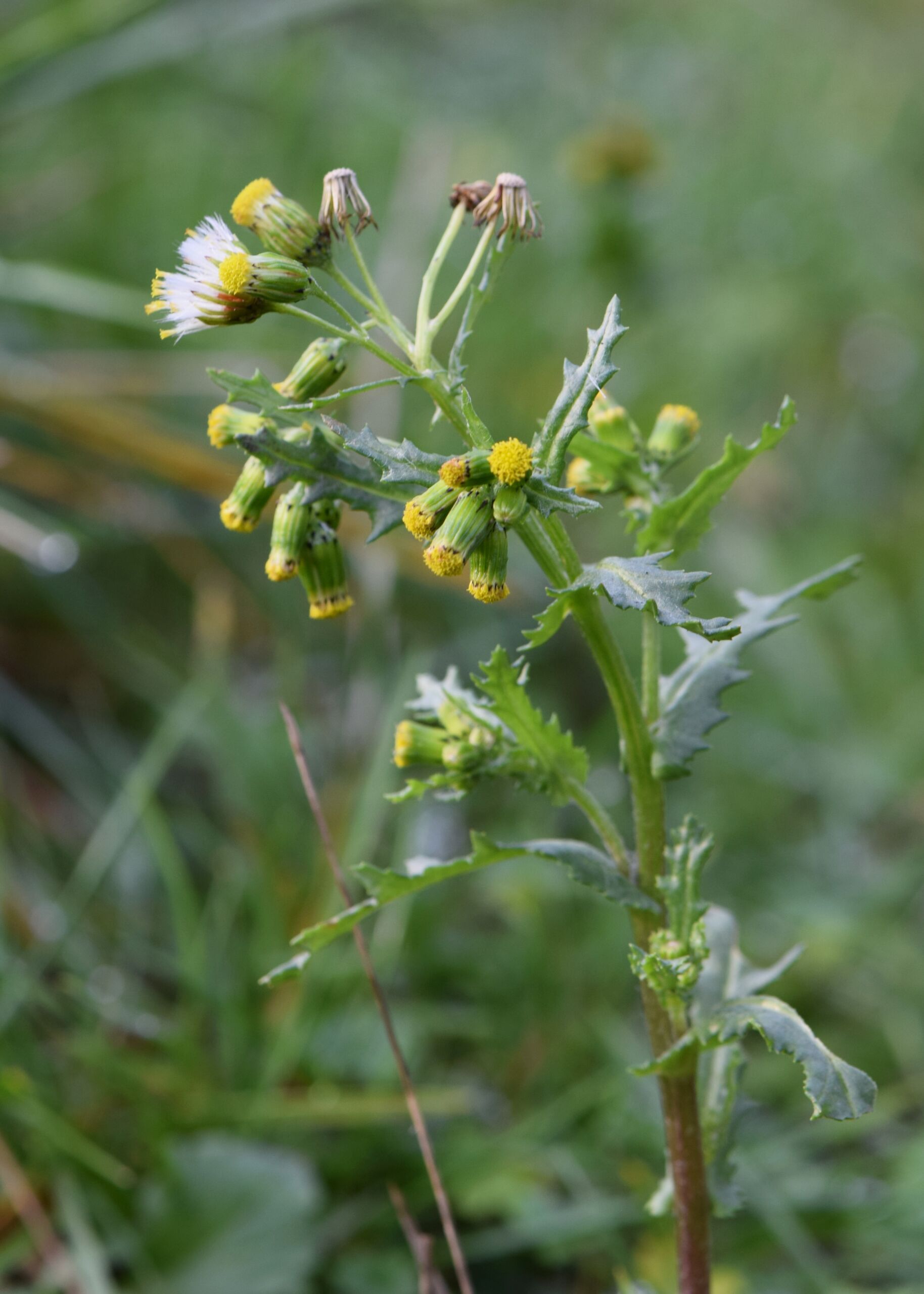
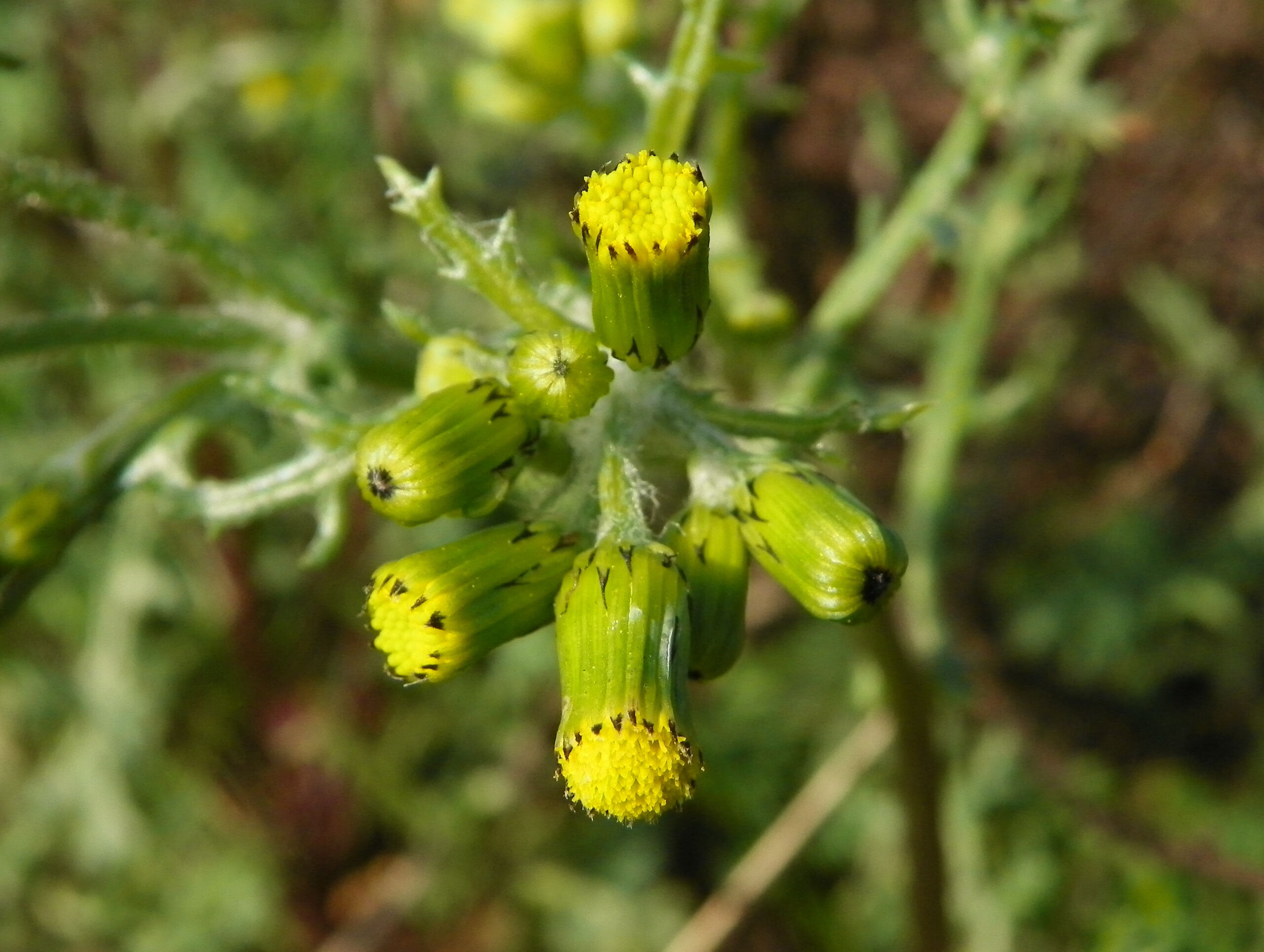

Common groundsel is an annual in the daisy family Asteraceae, native to Europe, North Africa, and temperate Asia, and now naturalized almost everywhere else that has disturbed soil and a crack to grow in. It grows upright, usually 10 to 60 centimeters tall, with hollow, slightly fleshy stems that are often purplish at the base, alternate leaves that are irregularly toothed to pinnately lobed, and a shallow taproot with fibrous side roots. The flower heads are the giveaway: small cylinders, about ¼ to ½ inch long, of yellow disc florets with no ray florets — no petals sticking out like a daisy — wrapped in green bracts with distinctive black tips. When the seeds ripen, the head opens into a ball of white fluff, the pappus, and the wind does the rest. The genus name Senecio comes from the Latin senex, “old man,” for that white-haired seed head. The common name groundsel comes from the Old English grundewilige, “ground-swallower,” for the speed with which it colonizes bare ground. Both names are accurate. Neither is a compliment.
The genus behind the weed is enormous and unruly. Senecio is one of the largest genera of flowering plants on Earth — Plants of the World Online currently accepts 1,482 species, while other treatments say around 1,250, and the honest statement is that nobody knows the exact number, because the genus has been split and re-split and no single morphological feature cleanly defines it. It contains annual and perennial herbs, shrubs, small trees, climbers, aquatics, and around a hundred succulents. Most gardeners meet it at its weediest — groundsels and ragworts — but the same genus also gives us dusty miller, the silver garden annual, and string of pearls, the trailing houseplant. Same genus, wildly different life choices.
And here is the part that matters for the butterfly guides: groundsel flowers are small, open, and full of nectar, and they appear for most of the year, which is why coppers, metalmarks, and hairstreaks visit them. The butterflies are not making a mistake. The flowers are genuinely useful to them. The gardener’s job is to hold two facts at once: this is real pollinator forage, and it is also a toxic, self-seeding weed that you should manage, not cultivate.
How to grow
Let us be blunt: you do not need to grow common groundsel, and this section is about how it grows itself, so you can recognize it and decide what to do about it. Groundsel germinates over a wide range of temperatures, tolerates cold, and can go from seed to seed-producing plant in as little as five to six weeks. A single plant can produce up to three generations in one year, and it flowers from early spring to late fall, with individual plants in bloom for three to four weeks at a time. It prefers moist, loamy, fertile soil but will grow in sand, heavy clay, and infertile ground, and it does not grow in shade — which is why it owns the sunny path edge and leaves the woodland floor alone. It reproduces exclusively by seed, and the seeds need no dormancy period before germinating, so a plant you let go to seed in May is a patch by July.
If you want groundsel-type flowers for pollinators without the weed, plant something else on purpose: the garden members of the genus, like dusty miller, or any small daisy-family nectar plant that stays where you put it. If you want groundsel itself gone from a bed, the method is gloriously low-tech and it works: hand-pull or shallow-hoe young plants before they set seed, and mulch bare soil about three inches thick to keep new seedlings down. Do not rototill a groundsel patch into next year’s problem — tilling buries seed that will germinate later — and do not compost plants that have already gone to fluffy seed unless your pile genuinely runs hot enough to kill seed, because a cool compost pile is just a groundsel nursery with extra steps. For the ornamental Senecio species, the rules flip completely: dusty miller wants sun and well-drained soil and is grown as a tender annual in cold climates, and string of pearls wants bright indirect light indoors and soil that dries between waterings. Same genus, opposite care sheets. Always check which Senecio you actually have.
Water & feeding
Common groundsel needs no watering and no feeding from you, and it will take both from your garden anyway. It grows best in moist, fertile soil and is most abundant in cool, moist weather, but it tolerates dry, poor ground that kills fussier plants. That adaptability is the whole story: it is a pioneer of disturbed ground, and the way to starve it is not to withhold water from your garden but to deny it bare soil. A mulched, densely planted bed has no vacancy for groundsel seedlings. A freshly dug, empty bed is a groundsel hotel with the lights on.
For ornamental Senecio, water is where gardeners go wrong in the other direction. Dusty miller likes consistent moisture while establishing and then tolerates dryness, but it sulks in soggy soil. Succulent Senecio species — the string-of-pearls crowd — demand the opposite of groundsel’s world: infrequent, thorough watering and soil that dries out fully between drinks, because cold, soggy soil rots them fast. Never water a succulent Senecio on a groundsel schedule. The genus contains multitudes, and the watering can must match the species, not the name on the pot.
Common problems
- It never stops: The core groundsel problem. Three generations a year, no seed dormancy, wind-blown fluff. The fix is timing: pull before the white pappus appears, because once the head goes fluffy, the next generation is already airborne.
- Toxicity — take this seriously: Senecio species contain pyrrolizidine alkaloids, including senecionine and seneciphylline, which are cumulative liver toxins. Livestock generally avoid the plants because they taste bad, but animals on poor pasture or eating contaminated hay can be poisoned, and cattle and horses are especially vulnerable. Do not eat groundsel, do not feed it to animals, and do not let it seed into hay or pasture. This is not a “maybe toxic” plant. It is a toxic plant that happens to have pretty yellow flowers.
- It hosts other trouble: Groundsel can host the fungus that causes black root rot in peas, alfalfa, soybeans, carrots, tomatoes, and other crops, and its leaves can carry cineraria leaf rust. Another reason to pull it from vegetable beds rather than admire it there.
- Confusion with its cousins: Common groundsel is distinguished from heath groundsel (Senecio sylvaticus) by its well-developed, black-tipped outer bracts, and from sticky groundsel (Senecio viscosus) by its lack of glandular hairs and ray florets. If your groundsel has obvious ray florets — little petals around the edge — you may be looking at a different species, or at the radiate form that results from crossing with Oxford ragwort.
- Succulent Senecio rot: For the houseplant cousins, the classic killer is overwatering in cold, soggy soil. Bright light, dry soil between waterings, and a pot that drains. If the pearls go mushy, it was water, not neglect.
Harvest
There is no harvest to recommend for common groundsel, and this guide will not pretend otherwise. Do not harvest it for food, tea, or medicine: the pyrrolizidine alkaloids that make it toxic to livestock make it unsafe for people too, and no folk history changes the liver chemistry. The honest “harvest” is removal: pull plants before they seed, and the reward is a bed that stays a bed instead of becoming a groundsel farm. The ornamental harvest is different and genuinely pleasant: dusty miller foliage, cut for its silver felted leaves in arrangements, and string-of-pearls cuttings, which root readily for sharing. And the wildlife harvest belongs to the insects: groundsel flowers feed butterflies and bees for most of the year, and the famous cinnabar moth caterpillars feed on ragwort, groundsel’s close cousin — a reminder that the most toxic plants often have the most specialized insect friends, because the caterpillars that can handle the alkaloids face almost no competition. Leave a wild corner’s groundsel for the pollinators if you can, pull it from the beds if you cannot, and never let it seed into pasture. That is the whole management philosophy in one sentence.
Seed prevention, not seed saving
This section is deliberately not a how-to-save-seed guide, because for groundsel, saving seed would be the worst advice on this site. Start with the warning up front: common groundsel is toxic. It contains pyrrolizidine alkaloids, the liver-damaging compounds that make it unsafe for people and livestock, and no folk history, tea recipe, or old herbal mention changes that chemistry. Do not harvest it for food, tea, or medicine, do not save its seed, and do not pass seed on to another gardener as a favour. The kindest thing you can do with a groundsel seed is make sure it never becomes a plant, and this section is about exactly that — seed prevention as a gardening skill, which is a stranger and more useful skill than seed saving.
Groundsel’s seed strategy is why prevention matters. It reproduces exclusively by seed, flowers and sets seed for much of the year, and one plant can produce a great many wind-blown seeds, each with a fluffy white pappus that carries it away like a tiny parachute. It has almost no dormancy, so seed can germinate within days, and one plant can produce several generations in a season. A patch ignored in spring is a patch weeded all year, and a plant pulled carelessly may still win: flowers on a pulled plant can mature into viable seed as it wilts, so a groundsel tossed on the path is not dead, it has a head start.
The prevention routine is therefore ruthless about timing. Pull plants before they flower, roots and all, when the soil is moist and the whole plant comes up cleanly, and do it often — a weekly patrol in the growing season beats a heroic annual clearance, because groundsel does not wait for your schedule. Bag any plant that is already flowering or in seed, and put that bag in the trash, not the compost heap: composting flowering groundsel is how you plant it twice, once in the bed and once in the compost you later spread on the bed. Home compost rarely stays hot and even enough to guarantee seed death, and the plant’s toxins are no reason to gamble on the heap either. Mulch helps enormously — a thick, coarse organic mulch, around three inches deep, blocks the light groundsel seed needs to germinate — and so does dense planting, because bare soil is groundsel’s invitation and a full bed is its closed door. Check nursery pots and new transplants, too, because groundsel loves to hitchhike in a pot and start its career in your garden uninvited.
There is a silver lining: extension sources report that groundsel seed generally remains viable in the soil for only about a year, so a season of diligent prevention — pull before flowering, bag the flowerers, mulch the bare ground — can dramatically shrink next year’s population. Treat that as a hopeful figure rather than a promise, because other accounts give longer persistence, so keep patrolling even after a good year. In Florida, where mild weather lets groundsel flower through seasons that would stop it further north, there is no safe off-season to relax. And a final distinction, because this is a genus guide: the ornamental relatives in this group — dusty miller grown for its silver foliage, string of pearls grown as a houseplant — are propagated by cuttings and division, not by saving common groundsel seed. Enjoy those, admire the butterflies that nectar on groundsel flowers from a safe distance, and let the weed itself go to the trash bag, unmourned and unplanted.
Species in this group
- Common groundsel — Senecio vulgaris: The weed of this guide. Erect annual, 10 to 60 centimeters, rayless yellow heads with black-tipped bracts, seed to seed in as little as five weeks. Native to Europe, North Africa, and temperate Asia; naturalized worldwide.
- Heath groundsel — Senecio sylvaticus: The slender, woodland-edge cousin, distinguished from common groundsel by its poorly developed outer bracts. Same weedy habits, thinner build.
- Sticky groundsel — Senecio viscosus: The glandular-haired one, with ray florets that common groundsel lacks. Sticky to the touch, same disturbed-ground lifestyle.
- Oxford ragwort — Senecio squalidus: The rayed ragwort that crossed with common groundsel to produce its radiate form. A railway-ballast wanderer turned widespread weed.
- Tansy ragwort — Senecio jacobaea: The pasture poisoner, famous for killing livestock and feeding cinnabar moth caterpillars. Often now placed in the genus Jacobaea as Jacobaea vulgaris, which tells you everything about how unsettled Senecio taxonomy is.
- Dusty miller — Senecio cineraria: The garden ornamental, grown for silver-felted foliage. Often now placed in Jacobaea as Jacobaea maritima. This site already has growing guides for dusty miller cultivars; they are the friendly face of the genus.
- String of pearls — Senecio rowleyanus: The trailing houseplant with bead-like leaves. Often now placed in Curio as Curio rowleyanus. Proof that one genus can hold a pasture weed and a hanging-basket jewel at the same time.