
🌿 Guiana Plum
What it looks like
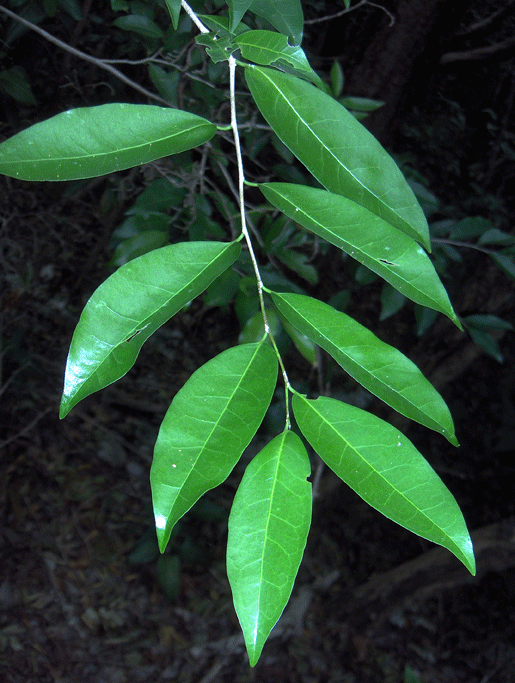
Guiana plum is a tree that keeps a low profile even in its own home range. Drypetes lateriflora, in the family Putranjivaceae, is native to southern and east-central Florida, the West Indies, eastern Mexico, and Central America, and in Florida it is a tree of tropical hammocks: maritime hammocks, mesic hammocks, and rockland hammocks, from sea level to about 10 metres elevation. It is also called milk bark, for the milky latex in its bark, a name that doubles as a warning. This guide covers lateriflora only, and it does not cover the other Drypetes species, several of which share the milk bark name.
It is a tree reaching about 10 metres (30 feet), with light brown bark that is rough and separates into scales, hairy buds that are not resinous, and glossy dark green leaves up to about 4 inches long with a pointed tip and slightly wavy edges. The flowers are small, yellow or green, in spring, and the fruits are small, turning reddish-brown when ripe, each with a seed inside. Flowering runs late winter to spring, roughly February to May, with fruiting spring to early summer, roughly March to July. The most charming detail in the flora accounts is also the most frustrating for botanists: the fruits are apparently removed by animals soon after they ripen, so specimens with mature fruits are rarely collected. The tree feeds something, promptly, and leaves little evidence behind.
One disambiguation, in plain text: the Florida white butterfly’s host list names Guiana plum, Drypetes lateriflora, outright, which is why this guide exists. The Florida white is a southern Florida butterfly, and this is a southern Florida tree, and the pairing is exact. Do not confuse Guiana plum with flatwoods plum, which is a Prunus, a completely different family and a completely different tree, or with any other plum in the site’s guides.
How to grow
Plant Guiana plum as a tropical hammock tree, not as a general landscape tree. In practice that means a warm, frost-free site in South Florida, in the dappled light of a hammock edge or in full sun once established, in well-drained soil over limestone. It is listed for zones 10a to 11b, which is a narrow tropical band, and anywhere colder it is a container or conservatory plant at best. It is also a conservation-sensitive plant in Florida: the state Plant Atlas lists it as native and state-threatened, and one nursery account calls it threatened in the wild in the state and infrequent in South Florida hammocks. That status has a practical consequence, which is to buy nursery-propagated stock and never dig or collect from a wild hammock.
Expect a medium-sized tree, typically 20 to 30 feet tall, with small ascending branches, rather than a fast shade tree. It is not a tree for instant gratification, and it is not a tree for a small yard in North or Central Florida, however tempting the butterfly connection sounds. In its proper place, a South Florida native garden or a hammock restoration, it is a quiet, evergreen, wildlife-supporting tree that asks for little beyond warmth, drainage, and being left to its hammock habits.
Water & feeding
Water deeply at planting and through establishment, then water as a hammock tree expects: regular moisture in well-drained soil, without waterlogging. Tropical hammocks are not swamps, and this tree does not want wet feet, but it is also not a desert plant, so a long dry spell in a container or in thin soil will stress it. Mulch with leaf litter in the hammock manner, kept off the trunk, and do not fertilize heavily. A native tree in its own soil type grows steadily without rich feeding, and pushed growth is soft growth.
Pruning is light and structural: remove dead or crossing branches, shape a young tree gently, and otherwise let it form its compact canopy. There is no fruit harvest to prune for, and no shearing regime.
Common problems
- Frost. The hard limit. A tropical hammock tree does not survive a North Florida freeze, and no mulch reliably saves it.
- Wet soil. Poor drainage rots roots even in a tree that likes regular moisture. Drainage first, water second.
- Milky sap. The bark latex is reported as poisonous, which is why the tree is also called milk bark. Do not taste it, do not use it medicinally on folk authority, and keep children from chewing bark or leaves, as with any milky-sapped tree.
- Wild collection. State-threatened in Florida means wild plants are not a source. If a seller cannot say the plant is nursery-propagated, walk away.
- Shy fruit. Do not expect a fruit display. Animals take the fruit as soon as it ripens, which is ecologically excellent and photographically disappointing.
Harvest
There is no food harvest from Guiana plum, despite the plum in its name, and the harvest here is the tree itself: evergreen hammock structure, small spring flowers, and service as a Florida white host plant in southern Florida. The name Guiana plum is a common-name trap, and this guide says so plainly: it is not a Prunus, it does not produce eating plums, and the small reddish-brown fruits are wildlife food, taken promptly, not a crop. For butterfly gardeners in South Florida, the value is the host relationship, and for everyone else, the value is knowing the tree exists and leaving wild hammocks alone.
Propagation is not well documented in garden sources, and this guide does not invent a protocol. Nursery-propagated plants, where available, are the honest route, and seed, where obtainable from cultivated plants, should be sown fresh in warm, well-drained mix, with the usual tropical-tree patience.
Saving seeds: a threatened native, handle with care
Guiana plum comes with a Florida warning that runs in the opposite direction from guava: this tree is not a threat to Florida, it is threatened in Florida. Drypetes lateriflora is listed as state threatened in Florida, where it grows wild in tropical hammocks of the southern peninsula, and that listing sets the rules. Never collect seed from wild trees, never dig or cut from a wild plant, and start only from nursery-grown stock or from a garden tree you already own. The honest context for everything below is that published propagation detail for this species is thin, and this section says so rather than dressing up guesswork as protocol. What exists points in a consistent direction, and that direction is fresh seed, sown promptly, from a cultivated tree.
First, the birds-and-bees fact that decides whether you get seed at all: Drypetes species are dioecious, meaning individual trees are male or female, and only female trees bear fruit, and only when a male tree flowers nearby. A lone female tree with no male in the neighborhood sets no seed, and a male tree never sets any at all, so if your tree has never fruited, it may simply be male, or lonely, rather than broken. Fruit ripens in spring to early summer as small red-orange drupes, each usually holding a single seed, and animals remove ripe fruit fast, so watch the tree and collect promptly when fruit colors up. Take fruit from your own garden tree only, and leave wild fruit for the wildlife and the hammock it belongs to.
Clean the thin fleshy pulp off the seed and sow immediately in a well-draining mix, potting soil lightened with sand, vermiculite, or perlite. Keep the container warm and humid with indirect light, moist but never soggy, and be patient: germination is reported to take several weeks to a few months, and uneven sprouting is normal for a hammock tree that never evolved to hurry. There is no reliable published storage life for this seed that I could stand behind, so do not bank it. Treat fresh-sown as the only plan, and sow more seed than you need, because not every seed will cooperate and you cannot simply go buy a packet.
Seedlings grow true to the species, with normal variation between individuals, since this is a species tree rather than a named cultivar, but expect a slow tropical tree, not a quick screen. A guiana plum seedling is a hammock tree in training: shade-tolerant when young, happiest in the dappled light and leafy soil of a native planting, and in no rush to become a specimen. In Florida, plant it where a threatened native belongs, in a native hammock-style planting or a shaded garden corner, not as a generic ornamental in a sunny lawn. Saving seed from a cultivated guiana plum is a small, real contribution to keeping a threatened Florida native in cultivation, which is exactly where a threatened plant is safest: in gardens, tended, and fruiting where the next gardener can do the same.
Species in this group
This is a species guide, not a genus guide, and the varieties section here is really a disambiguation list, in plain text. No named garden varieties of Drypetes lateriflora are verified or claimed.
- Guiana plum — Drypetes lateriflora: This guide’s species. Southern and east-central Florida, West Indies, eastern Mexico, Central America. Hammock tree to about 10 metres, light brown scaly bark, milky latex, small spring flowers, fruit taken promptly by animals. Florida white host. State-threatened in Florida.
- Whitewood / milkbark — Drypetes diversifolia: A different, related Florida species, also state-listed as endangered. Not covered here, and not a substitute host on the evidence in this guide.
- Flatwoods plum — Prunus umbellata: A different tree entirely, in the rose family, despite the shared plum name. Not covered here.