
🌿 Sawtooth Goldenbush
What it looks like
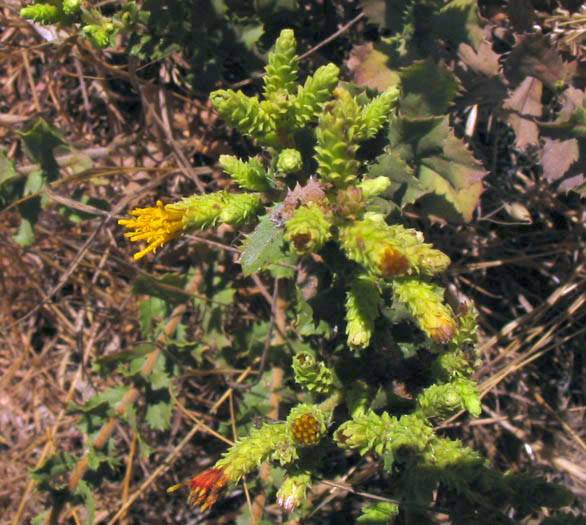
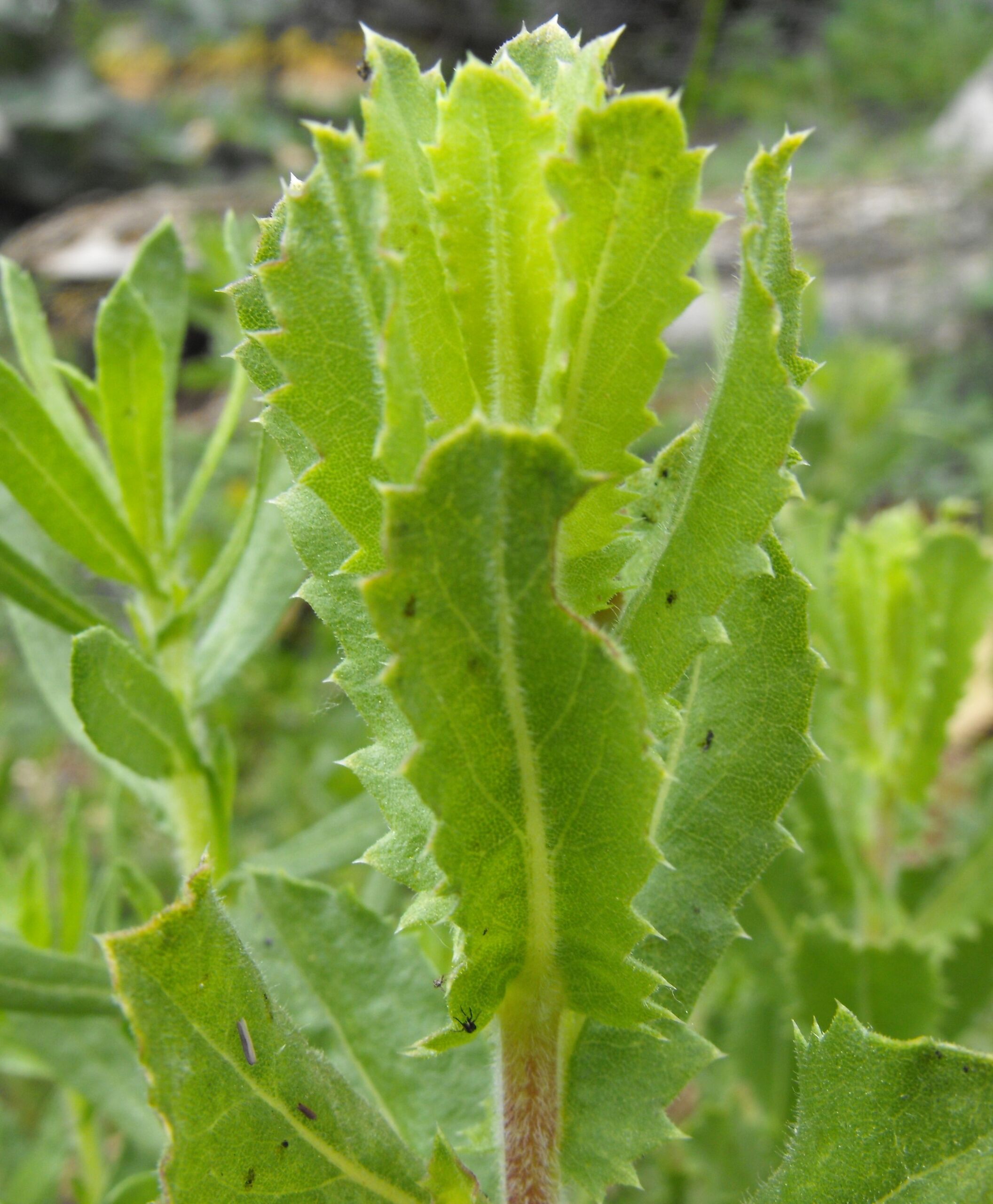
Sawtooth goldenbush is a plant with two names and one very good reason to know both. The butterfly guides list it as Haplopappus squarrosus, and that is the name this guide is filed under, because the coordinator’s linker matches the butterfly guide’s Latin forms. Modern taxonomy places it as Hazardia squarrosa, in the sunflower family Asteraceae, with Haplopappus squarrosus as a synonym, alongside Aplopappus squarrosus, Homopappus squarrosus, and Bigelowia squarrosa in the synonym list. If a nursery tag, a flora, or a seed packet says Hazardia squarrosa, it is the same plant, and this guide covers it under both names, plainly, so no one buys it twice.
It is a North American shrub, native to California and Baja California, growing in coastal and inland scrub and chaparral habitats. It grows as a rounded or mounding shrub, typically about four feet tall, up to about six feet, with bright, shiny green leaves with toothed, saw-like edges, which is where sawtooth comes from, and yellow daisy flowers. The leaves are reminiscent of Grindelia, the gumweed genus, which is a useful field association and also a warning: similar leaves do not make it a gumweed, and this guide does not claim it as one. It is a tough, adaptable plant, thriving in a variety of soil types and sun exposures, and it is extremely drought-tolerant once established.
One disambiguation, in plain text: the Gabbs checkerspot’s host list names Haplopappus squarrosus outright, which is why this guide exists. That butterfly is a Great Basin and California checkerspot, and this is a California and Baja shrub, and the pairing is exact under the old name. Do not confuse sawtooth goldenbush with other goldenbushes, a common name shared across Hazardia, Isocoma, and Ericameria, or with brittlebush and false sunflower, two other folk names that appear in some accounts of this species.
How to grow
Plant sawtooth goldenbush in full sun, in well-drained soil. It thrives in a variety of soils, from sandy coastal ground to inland scrub soils, and it tolerates drought, wind, and poor soil once established. It is commonly listed for zones 8a to 10b, which fits its California and Baja range, and it is not a Florida plant: Florida humidity and summer rain are a poor match for a coastal scrub shrub built for dry air and sharp drainage. In California, plant in fall or early winter in mild climates so winter rain establishes the roots, space 3 to 4 feet apart for a mounding shrub, and give it a sunny, open spot where its golden flowers can be seen from a distance, because that is what they are for.
It is a plant for native gardens, coastal scrub restoration, dry banks, and pollinator plantings in its range, rather than for formal beds, where its scrubby, mounding habit looks out of place. It needs little once established, and the main garden skill is the usual California native skill: do not overwater it, do not enrich its soil into a sponge, and do not shear it into a ball.
Water & feeding
Water deeply at planting and through the first season, then water sparingly. Established plants are drought-tolerant, and they prefer soil that dries out between waterings. A deep, infrequent drink in a dry spell is better than daily sprinkling, and in a humid climate, the least watering that keeps it alive is the kindest watering. Do not fertilize richly. A scrub plant in lean soil grows tough and compact; a pushed plant grows soft and flops, and then needs cutting back that a scrub shrub resents.
Pruning is light: remove dead wood, shape gently after flowering, and pinch or tip-prune young growth to encourage branching if a denser mound is wanted. Do not shear it like a hedge, and do not cut it hard back into old wood without expecting a slow recovery.
Common problems
- Wet soil. Poor drainage is the main killer in cultivation. Plant high, on a slope or berm, if your soil is heavy.
- Humidity. Hot, humid summers stress a dry-air scrub shrub. In humid climates, grow it as a curiosity, not as a reliable perennial.
- Name confusion. Haplopappus, Hazardia, Aplopappus, and Bigelowia all appear in older sources for this plant, and goldenbush is shared across genera. Check the species epithet squarrosa, not just the common name.
- Wrong goldenbush. Menzies’ goldenbush is Isocoma menziesii, and other goldenbushes are Hazardia or Ericameria species. They are not this plant, and they do not carry the Gabbs checkerspot host record in this guide.
Harvest
There is no food harvest from sawtooth goldenbush, and the harvest here is flowers, foliage, and butterfly service. The golden daisy flowers feed pollinators through their season, the sawtooth leaves give the shrub year-round texture, and in its range it serves as a Gabbs checkerspot host plant, which is why this guide exists. Traditional medicinal uses are reported for this species in some accounts, including use by the Chumash people of California for fevers, body aches, and headaches. That history is reported, not prescribed, and this guide gives no dosage or preparation.
Propagation is by seed or cuttings, with the usual scrub-shrub patience. Seed sown in warm, well-drained mix in spring, or softwood cuttings from new growth, are the routes, and nursery plants, where available in California native nurseries, are the honest shortcut.
Saving seeds
A note on honesty before the method: sawtooth goldenbush is now usually called Hazardia squarrosa, filed here under its older butterfly-guide name Haplopappus squarrosus, and species-specific seed research for this exact shrub is thin. What follows is therefore the well-established method for this plant and its close aster-family relatives, applied to sawtooth goldenbush, with the places where the evidence runs out marked as such rather than papered over with a confident number. That is not a disclaimer to skip; it is the method.
Collect in fall, after flowering, when the flower heads have dried and the small, dry, single-seeded fruits, the achenes, turn brown and begin to loosen, each wearing its tuft of fluffy hairs like a tiny parachute. Those parachutes are wind dispersal doing its job, which means your harvest window is the gap between “dry enough to collect” and “gone with the next breeze.” Clip whole dry heads into a paper bag, or bag heads on the plant before they fully fluff out, and finish drying them indoors in a single layer in a dry, airy spot. Rub the heads over a screen to free the seed, winnow away the fluff and chaff, and keep only plump, firm achenes. Birds eat these seeds too, so leave some heads standing for them; a goldenbush stripped bare in fall is a bird feeder emptied on purpose.
For storage, treat this seed like any dry aster seed: dry it thoroughly, then keep it in a small airtight jar with a desiccant packet in a cool, dark place. No published long-term viability figure for this species was found in preparing this section, so do not plan around a multi-year shelf life; sow saved seed the following spring, or at most within a season or two, and sow a little thickly to cover for the seed that does not wake up. That is a genuinely useful rule for a plant that reseeds itself freely on bare ground in its home range: fresh seed is the reliable seed. Sow on the surface or barely covered, in a warm, well-drained mix, kept moist but never waterlogged, and expect sprouts over roughly two to four weeks in warm weather. A short pre-chill, a few weeks of cold, moist storage before sowing, is reported to increase germination for this plant, so if a warm sowing is thin, a chilled batch is worth trying; it is an optional boost, not a requirement, and sources do not agree on how much it matters.
Seedlings will be variable, as seed-grown shrubs always are, and they will not be exact copies of a particular parent plant; if you have one outstanding shrub you want to duplicate, softwood cuttings from new growth are the faithful route. Sawtooth goldenbush is a California and Baja California native of scrub and chaparral, so save seed only from garden-grown plants, never by stripping wild plants, and be aware that in a garden it reseeds readily on bare ground, which is a gift if you want a drift of goldenbush and a chore if you wanted exactly one shrub. Cut the shrub back in winter after seed has set, as its home-range gardeners do, and let the seed you saved do what this plant has always done: wait for warm soil, a little bare ground, and its moment in the fall sun.
Species in this group
This is a species guide, filed under the butterfly guide’s name, and the varieties below are the recognized varieties of Hazardia squarrosa, in plain text.
- Sawtooth goldenbush, var. squarrosa — Hazardia squarrosa var. squarrosa (syn. Haplopappus squarrosus): The nominate variety, from San Benito County to San Diego County in California.
- Sawtooth goldenbush, var. grindelioides — Hazardia squarrosa var. grindelioides: The coastal variety, from Monterey County to Baja California, and the variety in photo 1. Formerly Pyrrocoma grindelioides and Aster grindelioides in older accounts.
- Sawtooth goldenbush, var. obtusa — Hazardia squarrosa var. obtusa: The inland southern variety, in Santa Barbara, Ventura, Los Angeles, and Kern counties, formerly Hazardia obtusa.
- Not this species — other Hazardia goldenbushes: Hazardia detonsa (northern island haplopappus) and other Hazardia species share the goldenbush name but are different plants, not covered here.