
🌿 Hedge Mustard
What it looks like
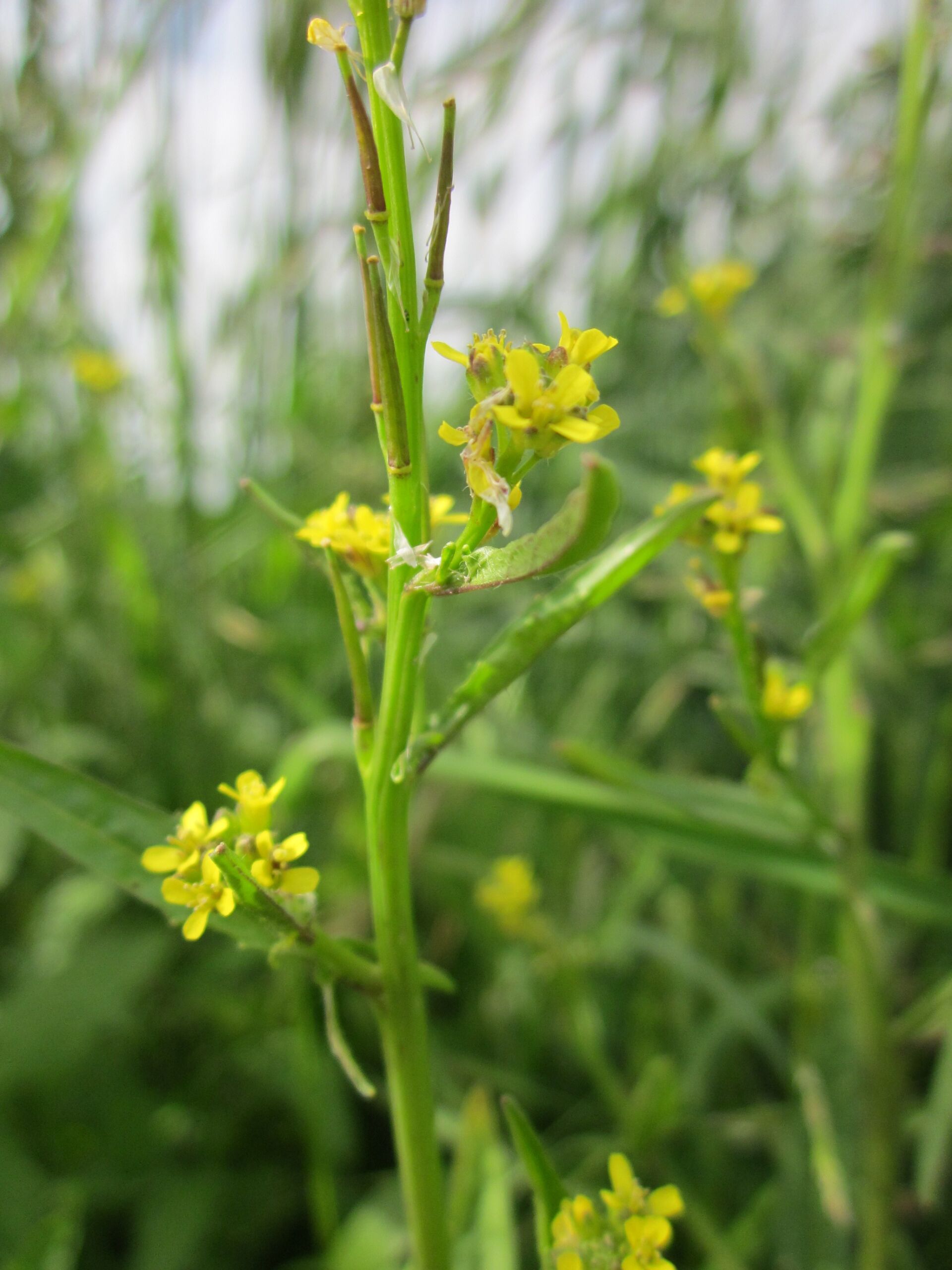
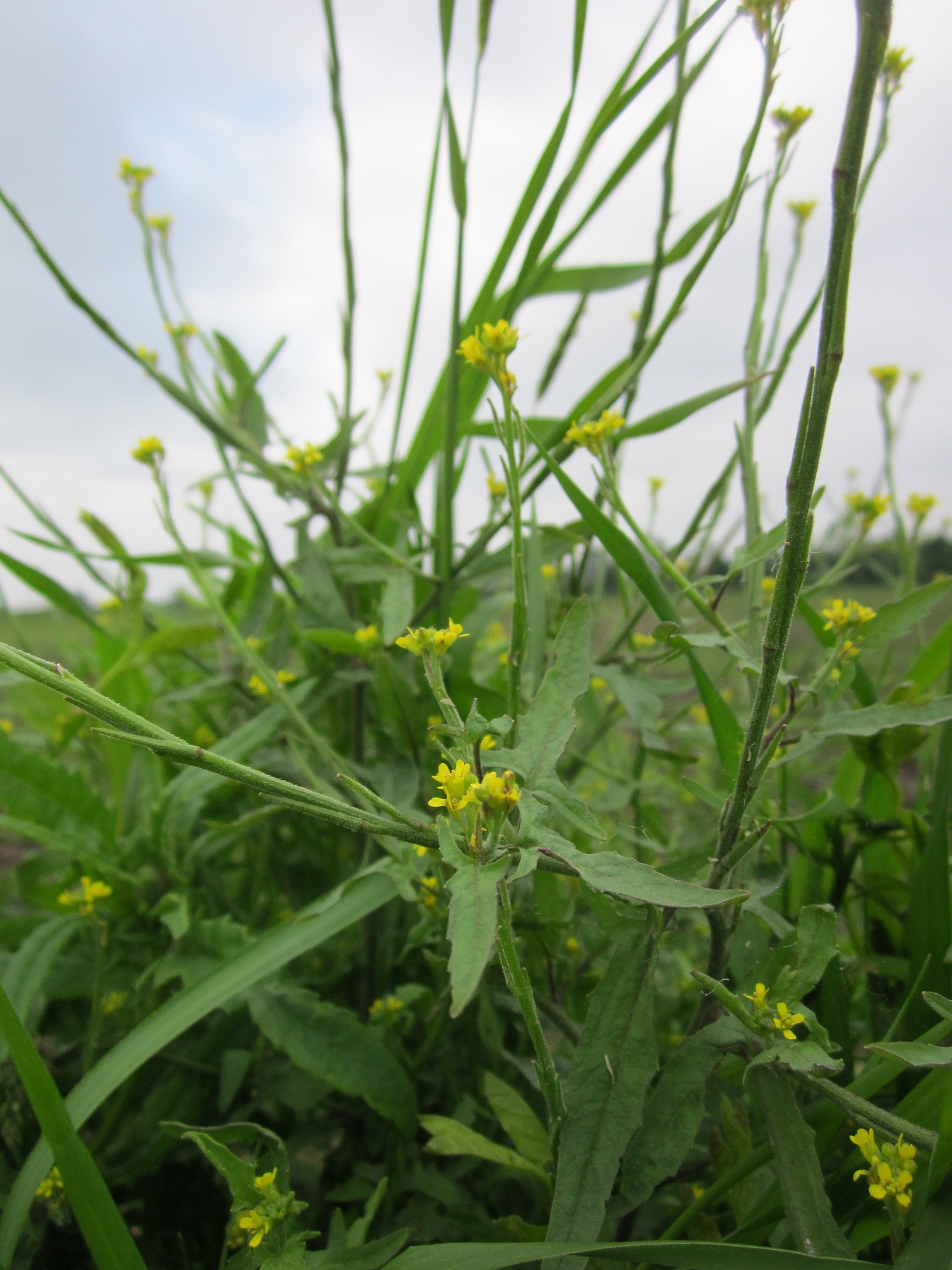

Hedge mustard is a mustard you identify by its skeleton. The plant grows to about 80 centimeters tall on erect, branching stems, and the branches have a habit that stops you mid-walk: they leave the stem at nearly right angles and then curve upward, like a candelabra drawn by someone who only had a ruler. The lower leaves are broad with two or three lateral lobes; the upper leaves shrink to narrow straps or vanish. And the flowers are almost an afterthought — tiny, yellow, about 4 millimeters across, a few open at the very tip of each branch while the rest of the branch is already fruiting.
The fruit is the identification. The pods are long (to about 18 millimeters), hairy when mature, and pressed tightly against the stem on short stalks, pointing upward in parallel ranks instead of hanging free the way most mustard pods do. That appressed-pod habit, plus the candelabra branching, separates hedge mustard from its Sisymbrium cousins at a glance: tumble mustard’s pods stick out, hedge mustard’s pods stand to attention. The whole plant is hairy, the stems are stiff, and the overall impression is of a weed that grew up along a hedge and learned to be narrow, upright, and unobtrusive about it.
The butterfly context is the Sara Orangetip guide, whose Host plants section names “hedge mustard (Sisymbrium officinale)” among the mustards its caterpillars eat, alongside rock cresses, yellow rocket, and weedy mustards. Orangetip caterpillars eat the reproductive parts first — buds, flowers, and fruits — which is a neat fit with a plant whose branches are mostly fruit with a few flowers at the tip: the caterpillar eats its way along the branch like someone working down a menu. This guide covers Sisymbrium officinale only. Rock cresses, yellow rocket, and the weedy mustards have their own guides, and none is covered here.
One plain-text disambiguation, because the mustard names are a thicket. This guide covers Sisymbrium officinale only, formerly Erysimum officinale. Tall tumble mustard (Sisymbrium altissimum) is a different species with its own growing guide, and it is not covered here — altissimum is the tumbleweed one, officinale is the hedge one, and the pods tell them apart. Other Sisymbrium species, and the many plants called “mustard” in other genera, are different plants and none is covered here. Buy and plant by Latin name, and let this guide be the hedge mustard, not a substitute for the genus.
How to grow
Growing hedge mustard starts with the same strange instruction as the other weeds in this series: mostly, you do not have to. It is a weed of roadsides, hedgerows, wasteland, and arable field edges, native to Europe, western Asia, and North Africa and now naturalized across much of North America. If you want a deliberate patch — for a butterfly corner, for the old herbalist’s “singer’s plant” tradition, or for peppery greens — sow seed thinly in fall or early spring in a sunny, open spot in ordinary soil, keep it moist until germination, and then stand back. It is an annual or biennial: rosette first, then the erect candelabra stems, flowering roughly April through September with the main flush in mid-June to late July.
It asks for almost nothing: full sun, ordinary soil, and open ground. It tolerates poor soil and dry spells once established, and it will seed itself freely, which is the whole system and the whole warning in one sentence. A patch that reseeds itself is a perennial planting made of annual plants — and a patch that reseeds itself beyond its corner is a weed problem you planted on purpose. Grow it contained, pull extras before they seed if the patch outgrows its corner, and check local weed listings before planting, because an introduced mustard with ambitions is not a plant to release into a landscape.
Florida note, stated plainly rather than hopefully. Hedge mustard is a cool-season Eurasian weed of hedgerows and roadsides, and a hot, humid Florida summer is not its address. It may appear as a winter weed in the cooler parts of the state, but it is not a Florida garden plant to plan around. The Sara Orangetip is a West Coast butterfly, and its hedge-mustard host record is a description of a western mountain and wood-road butterfly’s food, not a planting list for a subtropical garden. A Florida gardener who wants mustard-family butterfly plants should look to the site’s Florida-native mustards instead.
For the garden, the honest translation is a contained nectar and host corner in cool country — not a row crop and not a border star. Let a patch stand in a sunny, unsprayed corner, let it flower its tiny yellow flowers, let the orangetips and small whites find it, and do not spray it: a host patch sprayed for caterpillars is a host patch emptied of the very thing this guide exists to feed.
Water & feeding
Water hedge mustard like a roadside plant: ordinary moisture until germination, then very little. It grows in waste places and field edges, which is a plant telling you it does not need pampering. In most gardens it waters itself through its season, and the gardener’s job is only to keep a sown patch moist until it is up and through dry spells in spring. Once summer heat arrives, the plant seeds and finishes, and watering it then is wasted water on a plant that has already done its year.
Feeding: none. Hedge mustard grows in hedgerows and wasteland, and no fertilizer program at all is the right scale of feeding for it. The soil science here is the mustard-oil story again: brassicas make sulfur compounds that give hedge mustard its bite — it is hot and mustardy, related to rocket, mustard, and horseradish — and those same compounds are the plant’s chemical defense, the reason most herbivores leave it alone and the reason the caterpillars that can eat it, like the orangetips, are specialists. The bite is the defense, the spice is the accident, and the patch is the treaty between them.
Common problems
- Self-seeding enthusiasm. Numerous pods per plant and a patch that reseeds itself freely. Pull extras before they seed if the patch outgrows its corner.
- Heat. A cool-season plant that seeds and finishes as heat arrives. That is its life cycle, not a failure, and replanting it in July is gardening against the calendar.
- Wrong mustard, wrong tag. Tall tumble mustard is Sisymbrium altissimum; hedge mustard is Sisymbrium officinale. Check the Latin name and the pods: appressed to the stem means hedge mustard.
- Spraying the host patch. The flowers that feed adults and the buds that feed caterpillars are the point of a host patch. Spraying during flowering empties it of the visitors this guide exists to feed.
- Introduced-weed status. A Eurasian import, naturalized across North America. Grow it as a contained patch, not as a landscape release, and check local weed listings before planting.
- Eating without certainty. The young leaves and seeds are traditional foods with a hot, mustardy bite, but only with certain identification — this family has lookalikes, and a misidentified mustard is a different plant.
Harvest
Hedge mustard’s harvest is a spice and a song, in that order. The young leaves are the spring harvest — hot and mustardy, best mixed with milder greens. The seeds are the pantry harvest — a peppery, mustardy seasoning, and the reason the plant has carried kitchen names for centuries. And the old herbal name is the singer’s plant: hedge mustard tea was the traditional remedy for a lost voice, which is why it also answers to “singer’s plant” in the herbals — a weed for throats, prescribed by apothecaries who noticed that a hot mustard clears more than a palate. Leave most plants to seed, let the patch reseed itself, and let the hedge mustard do what it has always done: grow along the hedge, flower small and yellow, and taste of mustard.
Saving seeds: a prevention note
This section is not a seed-saving guide, and that is deliberate. Hedge mustard (Sisymbrium officinale) does not need your help to reproduce. It is a weedy annual or biennial brassica of roadsides, waste ground, and disturbed soil, and it reproduces entirely by seed, in numbers that should make any gardener pause: a large plant can bear thousands of seeds in its slender, upright pods, and those seeds are wind-dispersed, self-compatible, and, in the reports that vary most, capable of persisting in the soil seed bank for years, with some buried seed reported to germinate after a very long time. Saving and sowing it on purpose is like bottling dandelion fluff and calling it a crop plan.
There is a second reason to keep it out of the seed box. As a brassica, hedge mustard can harbour clubroot, the soil-borne disease that swells and stunts the roots of cabbages, turnips, and their relatives, so a patch left to seed near the vegetable garden is not just untidy, it is a reservoir of trouble for next year’s brassicas. The management goal is therefore the opposite of seed saving: prevent seed production. Pull plants by hand while they are in first flower, before the pods fill, or hoe-cut autumn plants before fruiting stalks appear, and do it before a dry, windy day turns the job into a broadcast sowing.
Dispose of pulled plants with seed heads the way you would dispose of a problem, not a resource: bag them and put them in the trash, never in the compost heap and never in a brush pile at the edge of the garden, because home compost rarely gets hot enough, for long enough, to reliably kill weed seed, and a brush pile is just a seed bank with better drainage. Clean tools, boots, and mower decks after working a weedy patch, and keep garden edges and brassica beds dense and mulched so stray seedlings have less bare soil to colonise. If you value hedge mustard for its traditional herbal or culinary uses, harvest leaves from young plants before they flower, enjoy them, and still pull the plant before it sets seed; the leaves are the useful part, the seeds are the invasion. That is the whole seed strategy for this plant: enjoy it young, remove it early, and let the seed bank starve.
Species
Hedge mustard (Sisymbrium officinale, formerly Erysimum officinale; also called bank cress, hedgeweed, and singer’s plant) is the species this guide covers. Tall tumble mustard (Sisymbrium altissimum) is a different species with its own growing guide, and it is not covered here. Other Sisymbrium species are different plants, and none is covered here. No named garden varieties of the wild species were verified, and none is claimed here. This guide covers Sisymbrium officinale only.