
🍵 Labrador Tea
What it looks like
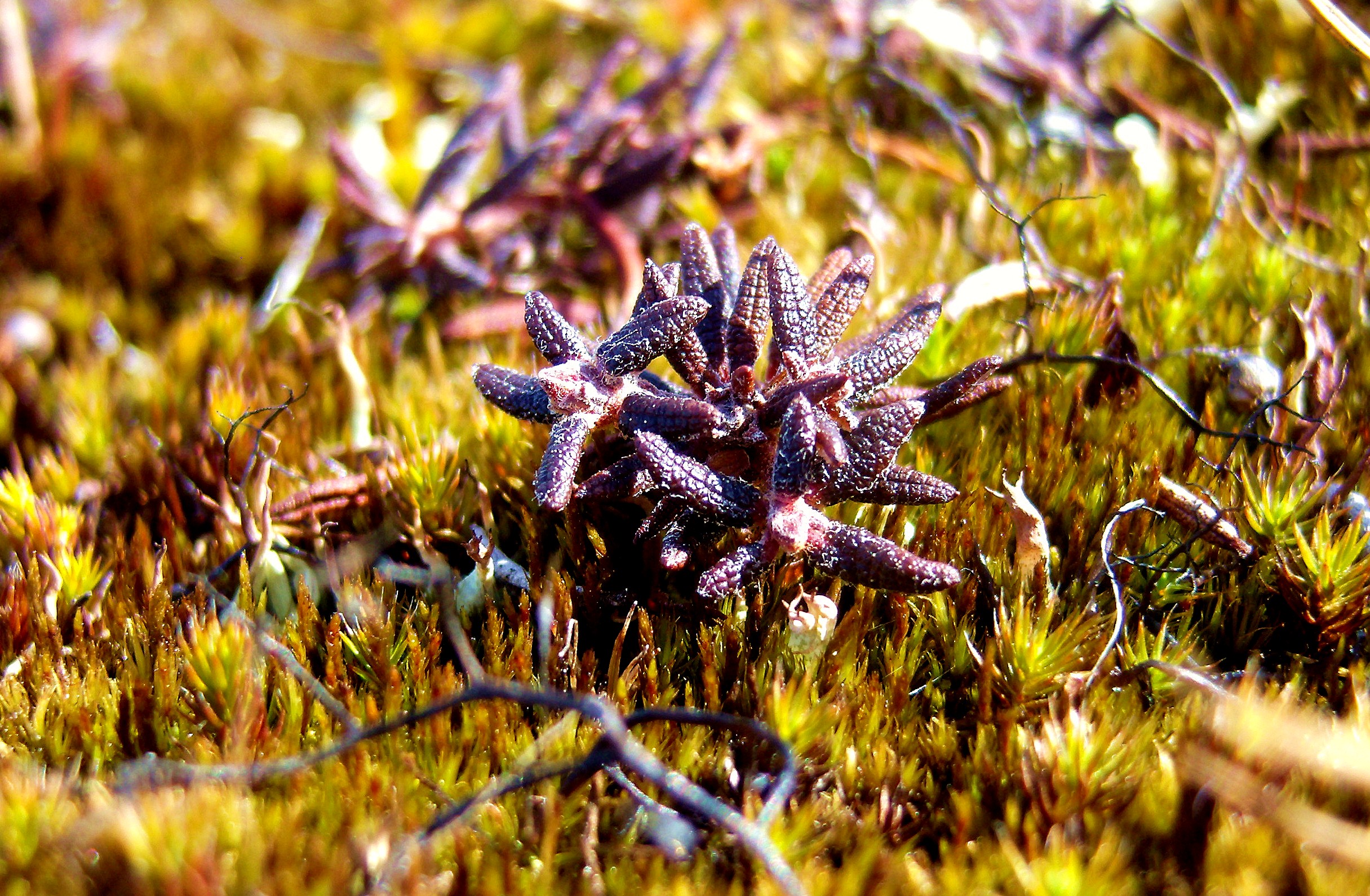
Labrador tea is a low, evergreen shrub of the heath family, Ericaceae, and it looks like a plant that has dressed for a cold climate and means it. It grows 0.2 to 1.5 metres tall, rhizomatous and much-branched, with erect or prostrate stems and twigs covered in dense, rusty, woolly hairs. The leaves are evergreen, leathery, 20 to 60 millimetres long and 3 to 15 millimetres broad, dark green and wrinkled on top, with edges that curl under, and underneath they carry the plant’s signature: a dense coat of white to red-brown woolly hairs that looks like the shrub is wearing a coat underneath its coat. That rusty underside is the field mark — flip a leaf, and if the underside is rusty-woolly, you are looking at Labrador tea and not at one of its smooth-leaved bog neighbours.
The flowers are the reason a bog full of Labrador tea in late spring is worth a trip. They are borne in slightly rounded, terminal clusters of 10 to 35 flowers at the ends of the branches, each flower small — 5 to 8 millimetres across — with five white to cream petals that appear distinct almost to the base, and 5 to 10 stamens that stick out well beyond the petals, giving the whole cluster a frothy, delicate look. Flowering runs from late May through June, and the effect of a bog in bloom is a sea of white clusters against dark green foliage. The fruit that follows is a small, hairy, drooping capsule, and the flowers are fragrant and sticky — a combination that brings in bees and other pollinators in numbers.
Range is one of the largest of any North American shrub: Labrador tea is reported from Greenland, every province and territory of Canada, and the northeastern and northwestern United States — New England, New York, Pennsylvania, Michigan, Wisconsin, Minnesota, Idaho, Washington, Oregon and Alaska — in bogs, spruce forests, muskeg, swamps, stream margins, talus slopes and tundra, from sea level to 2,000 metres. It is a boreal to subarctic plant, a plant of cold, acidic, nutrient-poor wetlands, and that range line is also a warning label: this is not a plant for warm climates, and no amount of enthusiasm will make it one.
Now the name, because the name has moved and you will meet both versions. The butterfly guides list this plant as Ledum groenlandicum, and this guide keeps that as its organising name because that is what the guides say. Modern botanical classification places the plant in Rhododendron as Rhododendron groenlandicum, on the grounds that Ledum is nested within Rhododendron — a placement supported by the shared glandular scales and by phylogenetic analyses — and the older names Ledum latifolium and Ledum palustre subsp. groenlandicum are synonyms of the same plant. So if a nursery tag says Rhododendron groenlandicum and a butterfly guide says Ledum groenlandicum, they are talking about the same shrub, and neither of them is wrong; they are just standing on different sides of a 1990 reclassification.
How to grow
Grow Labrador tea only where it belongs, and be honest about whether that is your garden. It wants a bog or a bog garden: acidic, wet to moist, peaty soil, in sun to part shade, in a cold climate — zones 2 to 6 are the range usually given. The honest version of this advice is that most gardeners south of the northern United States should not plant it at all. It will not thrive in hot, humid summers, it will not tolerate alkaline soil, and it will not survive as a houseplant on a windowsill. If you garden in the north and you have a naturally wet, acidic spot — a low corner, a rain garden that stays damp, a constructed bog of peat and sand — Labrador tea will be happy there. If you garden in Florida, this guide is for identification and for understanding the butterfly host lists, not a planting recommendation, and a Florida garden should spend its bog energy on plants that actually want Florida.
Where the climate fits, build the bog first and plant second. Dig a shallow basin, line it if your soil drains fast, and fill it with a mix of peat moss and sand — the acidic, nutrient-poor, moisture-holding medium of a real bog — rather than garden soil, which is too rich and usually too alkaline. Set the plant at the same depth it grew in its pot, water it in with rainwater if your tap water is hard and alkaline, and mulch with pine needles or sphagnum, which keep the soil acidic as they break down. Space plants 2 to 3 feet apart; they spread by rhizomes into a low, much-branched thicket, and they will fill the space in their own time.
Propagation is by seed or by rhizome division. Seed ripens in August through autumn in the capsules, and it germinates on moist, acidic peat — surface-sow, do not bury it, and keep it damp and cool. Rhizome cuttings root readily in peat, and layering — pinning a low branch to the bog surface until it roots — is the patient gardener’s method. Nursery plants are the honest shortcut: buy a named plant from a native nursery that can tell you it is Rhododendron groenlandicum, not one of its relatives, and check the leaf underside when it arrives — rusty-woolly means you got the right plant.
Water is the whole game. Labrador tea grows in soil that is saturated for much of the year, and it wants consistently moist to wet ground. A bog garden that dries out in summer will stress it fast, so top up with rainwater in dry spells and never let the peat dry to dust. At the same time, do not fertilise it: bog plants live in nutrient-poor soil, and fertiliser pushes soft growth and invites trouble. The plant’s neighbours in a bog — sphagnum, cranberries, leatherleaf — are all plants that expect poverty, and Labrador tea expects it too.
Water & feeding
Keep it wet, keep it acid, and keep your hands off the fertiliser. Water with rainwater where possible, because hard tap water raises the pH of peat over time and undoes the acidic conditions the plant needs. In a constructed bog, a water level that sits just below the soil surface in wet weather and drops only slightly in dry weather is about right; in a naturally wet corner, the ground will do this for you. Mulch with pine needles or shredded bark to hold moisture, and top up the peat as it settles — peat shrinks as it dries, and a bog garden needs occasional topping to stay level.
Feeding is not required and is usually harmful. Labrador tea evolved in nutrient-poor bogs, and its roots and their fungal partners are tuned to scarcity. A dose of general fertiliser will not make it grow faster in any useful way; it will make it grow soft, and soft bog growth is the growth that pests and diseases notice first. If the foliage yellows, check water and pH before reaching for a bottle — yellowing in a bog plant usually means the ground dried out or the pH drifted up, not that it is hungry.
Pruning is minimal. Remove dead wood in spring, and tip back straggling branches after flowering if you want a denser shrub. Do not shear it into a hedge shape; Labrador tea’s charm is its loose, much-branched, slightly wild habit, and shearing destroys the flowering wood for next year. Old plants can be rejuvenated by cutting a few of the oldest stems to the base each spring, which encourages fresh rhizome shoots without shocking the plant.
Common problems
- Wrong climate. The commonest failure. Labrador tea is a boreal plant for zones 2 to 6; hot, humid summers and alkaline soil will kill it slowly and expensively. Do not plant it in the south.
- Drying out. Bog plants that dry out do not forgive. Keep the peat consistently moist, top up with rainwater, and mulch to hold moisture.
- Alkaline soil or hard water. Soil pH above about 6 starves the plant of iron and other nutrients it can only take up in acid conditions. Use peat, pine-needle mulch and rainwater, and test pH if foliage yellows.
- Wrong Ledum. The Ledum subsection holds several species, and they are not interchangeable. Marsh Labrador tea (Rhododendron tomentosum) is a different, Eurasian and northern species, explicitly not to be confused with the traditionally used Rhododendron groenlandicum; western Labrador tea (Rhododendron neoglandulosum) is another distinct species; and the old Ledum glandulosum has a reputation for being poisonous where groenlandicum is the tea plant. Check the Latin and the leaf underside before you brew anything.
- Tea safety. Labrador tea leaves contain ledol, a compound that can cause headache or dizziness if ingested in quantity. Traditional use steeps dried leaves in small quantities; this guide describes that use historically and does not recommend self-medicating with a wild bog shrub. If you brew it, use a small amount, do not drink it daily in quantity, and never brew a plant you have not positively identified — some bog neighbours are toxic.
- Pests are minor. In a proper bog, Labrador tea has few serious pests. Stressed plants in dry or alkaline ground attract more trouble than healthy ones; fix the ground first.
Harvest
The harvest is leaves, dried and steeped. Labrador tea takes its common name from that use: the leaves were brewed into a tea by northern Indigenous peoples and early settlers for centuries, famously as a substitute during the American Revolution, and the tea tastes, by one old account, very much like green tea. Harvest a few leaves per branch — never strip a plant — dry them fully before use, and steep a small amount. The plant’s traditional use is as a tea and a medicine, and its leaves are also strongly aromatic, which is why they were laid among stored grain to drive mice away and kept in closets to repel moths.
The other harvest is for the garden’s wildlife, and it is the reason this plant sits in butterfly host lists. Labrador tea is a host plant for the brown elfin, whose caterpillars feed on it among the bog shrubs, and its flowers feed bees and pollinators in early summer when the bog is in bloom. If you grow it for butterflies, do not spray it, do not harvest leaves from a plant that is hosting caterpillars, and leave the flower clusters standing — the frothy white bloom is both the plant’s best feature and its pollinator offering.
A final caution belongs in the harvest section because it is where mistakes happen. Only harvest leaves from a plant you have positively identified as Rhododendron groenlandicum — rusty-woolly leaf undersides, white five-petalled flowers in rounded clusters, bog habitat — and only in small quantities, because of the ledol content. Other bog plants look similar and some are toxic, and other Ledum-subsection species are not the tea plant. When in doubt, do not brew it. A shrub that feeds an elfin has already earned its keep without ever reaching your teapot.
Saving seeds
Labrador tea is a bog plant, and its seed-saving method only makes sense if you remember where it comes from: cold, wet, acidic muskeg, where the seed falls onto sphagnum moss and waits out a long winter. The tiny seed capsules ripen in late summer and fall, splitting open to release seed so fine it is almost dust. Collect the capsules just as they turn brown and dry, before they split and scatter, and shake them out over white paper where you can see what you are catching.
The seed is surface-sown — never buried. It needs light to germinate, so press it gently onto the surface of a moist, acidic mix of peat and sand or sphagnum, and do not cover it at all. Keep the mix constantly moist, never soggy and never allowed to dry out, because a dry spell at this size kills the seedling outright. A humidity dome or a clear cover helps hold the moisture steady, but lift it daily for air, or mold will move in faster than the seedlings do.
Here is the honest disagreement: sources do not agree on how much cold the seed needs. Some give about 60 days of cold-moist stratification; others say four to six weeks in the fridge does the job; still others skip the fridge entirely and simply sow fresh seed outdoors in autumn so winter does the chilling. The practical answer is to let nature do the measuring — sow fresh seed outdoors in fall in a pot of moist acidic mix, sunk in a sheltered spot — or, indoors, mix the seed with damp peat in a sealed bag and refrigerate it for six to eight weeks, checking that the mix stays moist. After chilling, keep the tray bright and cool, roughly 60–70°F, and expect slow, uneven germination over several weeks. Prick the seedlings out as soon as they are large enough to handle, grow them on in pots in a shady frame for a year or more before planting out, and do not rush them: Labrador tea is a slow grower, and a seedling needs time to build the tough little shrub it will become.
Cuttings are the faithful alternative if you want an exact copy of a particular plant. Take cuttings of half-ripe wood, about 2–3 inches long with a heel, in midsummer, dip the cut end in rooting hormone, and set them in a moist mix of peat and perlite under cover. Layering works too — bend a low branch down in autumn, pin it to the soil, and wait a year. Division is possible where the plant has spread by rhizomes, but take only small pieces and leave the parent clump strong. Seed is for new colonies and wild plantings; cuttings and layering are for copying a plant you already love.
Now the Florida honesty, stated plainly: Labrador tea is a northern bog plant that wants cold winters, acidic, constantly moist soil, and summers that are not a furnace. It is not a Florida plant, and in most of the state it will not thrive no matter how good your seed is. In the coolest, shadiest, wettest corner of north Florida, with a boggy, acidic bed you can keep moist year-round, it may survive as a curiosity — but treat it as an experiment, not a landscape shrub. Good seed cannot fix a climate mismatch, and this one is a big mismatch. If you love the plant, grow it in a pot you can baby, and enjoy the tea leaves it gives you.
Species in this group
Labrador tea — Ledum groenlandicum, now Rhododendron groenlandicum — The species of this guide: a low evergreen bog shrub, 0.2 to 1.5 metres tall, with leathery leaves rusty-woolly underneath and white flowers in clusters of 10 to 35; zones 2 to 6, acidic bog soil pH 4.5 to 6.
Note on relatives, plainly labelled as different plants: marsh Labrador tea — Rhododendron tomentosum — A northern and Eurasian species of the same Ledum subsection, also called northern Labrador tea or wild rosemary, but explicitly not the traditionally used tea plant of this guide.
Western Labrador tea — Rhododendron neoglandulosum — The western North American member of the group, formerly called Ledum groenlandicum in western floras, now recognised as its own species; do not substitute it for bog Labrador tea.
Columbian Labrador tea — Rhododendron columbianum — The third species customarily placed in Ledum alongside groenlandicum and tomentosum; included here only so gardeners meeting the old Ledum names can tell the group apart.
This is a single-species guide, not a genus guide, and there are no garden varieties to list. If a seller offers a “Labrador tea variety”, ask for the Latin — it is almost certainly one of the relatives above, not a variety of this plant.