
🌿 Leatherleaf
What it looks like
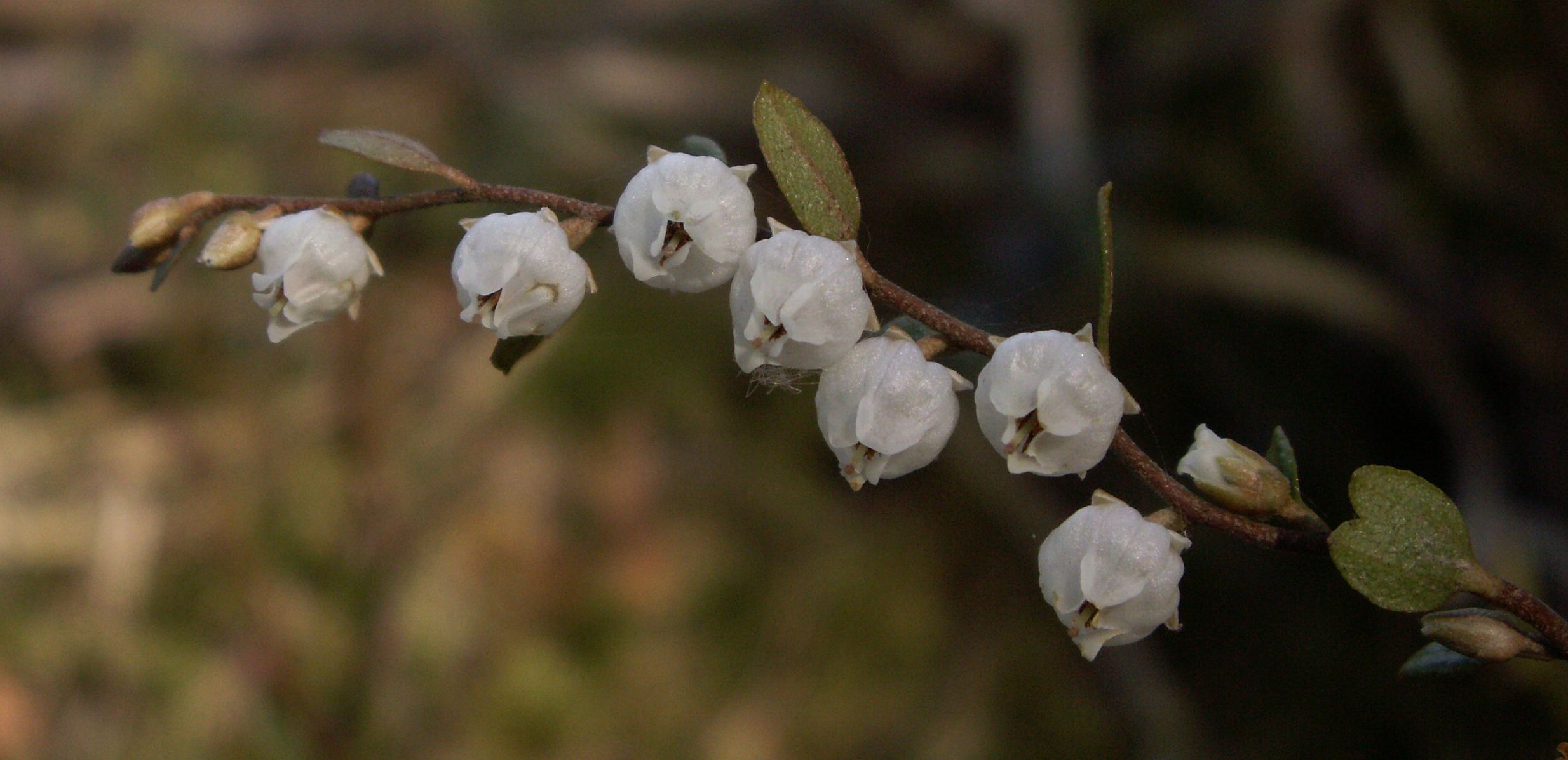
Leatherleaf is a low, wiry, evergreen shrub of northern bogs, and it is the only species in its genus, Chamaedaphne, in the heath family, Ericaceae. That last fact is worth pausing on: most garden shrubs share their genus with dozens of cousins, but leatherleaf stands alone, a monotypic genus, and its solitary status matches its solitary habitat. It lives where almost nothing else wants to: on floating sphagnum mats, in poor fens, at the boggy margins of ponds and conifer swamps, in soil that is saturated, nutrient-poor, and strongly acidic, from Alaska across Canada and south through the Northeast and the Great Lakes, with scattered relict populations reaching the Mid-Atlantic and the Carolinas, and across northern Eurasia as well. If you see leatherleaf, you are looking at a true acid bog, and the plant is telling you so more reliably than a soil test.
In appearance, leatherleaf is twiggy, irregular, and unglamorous for most of the year, which is part of its charm. It grows 1 to 3 feet tall, occasionally to 4 or 5 feet in favorable bog conditions, with slender, much-branched, rusty-brown stems that spread and layer where they touch wet sphagnum, rooting at the nodes and slowly expanding into a thicket many feet across. The evergreen leaves are alternate, oblong to elliptic, 1.5 to 5 centimeters long, dull olive-green above and paler beneath, thick and leathery to the touch, and covered, especially underneath, with minute rust-colored, scurfy scales that give the foliage a dusty, scaly look. Leaves get progressively smaller up the stem toward the flowering raceme, and in winter the foliage often bronzes or turns purplish before greening up again in spring. The common name is literal: these are leaves with the texture of leather, built to survive a bog winter.
The flowers are the reward for paying attention. They appear in nodding, one-sided racemes 4 to 12 centimeters long at the branch tips, each small white to creamy bell-shaped corolla about 5 to 7 millimeters long, urn-shaped and hanging, held in the axil of a small leaf-like bract, so that each branchlet carries a neat row of little white bells all along one side. Flower buds form the previous summer and overwinter on the plant, ready to open in late winter or early spring, often among the first native shrubs to bloom in a northern bog, sometimes while snow still lingers at the bog’s edge. The fruit is a small, dry, woody, gray-brown capsule, depressed and globe-shaped, persisting through winter and splitting to release tiny seeds. It is not a berry, it is not eaten by birds in any quantity, and it is not the point; the point is the plant itself, holding a bog together.
How to grow
Leatherleaf is not a plant for an average perennial border, and this guide will not pretend otherwise. Success starts with matching its very specific soil and moisture requirements before planting, because everything else follows from them. It needs consistently saturated, strongly acidic, low-fertility peat, the kind of ground found in a sphagnum bog, a constructed bog garden, or the saturated margin of a pond. It will not thrive in average garden loam, in soil that dries out between waterings, or in neutral to alkaline soil, and no amount of good intentions substitutes for peat and water. If you do not have a bog garden, a rain garden basin with a peat-based substrate, or a pond margin that stays wet, do not plant leatherleaf; admire it on a boardwalk instead, which is where most people meet it, and where it is happiest.
Plant container-grown leatherleaf in spring, setting the root ball at the same depth it grew in the nursery pot and working sphagnum peat moss into the planting area if the native soil is not already strongly acidic. Space plants 2 to 3 feet apart if establishing a bog-edge planting, since the colony will slowly fill the gaps by layering over the years. Give it full sun to light shade, mirroring its native setting on open sphagnum mats; in denser shade it becomes leggy and flowers sparsely, and it is strongly shade-intolerant, thinning out as taller shrubs or bog forest species like tamarack and black spruce establish over it. In the garden, that means keeping it out from under trees and out of the shadow of taller shrubs, and giving it the open sky a bog plant expects.
Hardiness is zones 2 to 6, the cold, northern range the plant actually occupies, from boreal Canada and Alaska south through the Great Lakes and the Northeast. One database lists zones 6 to 9 for leatherleaf, which does not match its boreal, bog-bound range or the experience of northern growers, and this guide does not follow that outlier; the hero stat of 2 to 6 follows the northern sources and the plant’s own distribution. Southern gardeners, note the consequence: leatherleaf is not a Florida plant, not a Gulf Coast plant, and not a plant for a warm, humid garden, however much you like the idea of a bog shrub. Its southernmost populations are relicts in isolated mountain and coastal-plain bogs, and they are conservation concerns precisely because the plant is at its climatic edge there. Grow it where it belongs, in the cold north, and it will be nearly indestructible; grow it where it does not belong, and it will tell you, quickly and finally.
Water & feeding
Water is not a chore for leatherleaf; it is the habitat. Keep the root zone saturated through the first growing season and, ideally, for the life of the plant. A bog garden that dries out in summer is a leatherleaf graveyard, and a pond margin that drops in a drought will stress the plant in a way that no later watering fully repairs. If your bog garden has a water source, use it; if it relies on rainfall, site it where water collects and peat holds it, and mulch with sphagnum moss, not bark, to slow evaporation without raising the pH. Leatherleaf tolerates standing water on sphagnum mats in the wild, and it is one of the few garden shrubs for which the advice is, genuinely, wetter is better.
Never fertilize leatherleaf, and never plant it in rich soil. It evolved in nutrient-poor bogs where nutrients arrive mostly from the atmosphere, and it performs poorly where nutrients are abundant. Fertilizer pushes weak growth and can kill a plant that was perfectly happy starving, which is a sentence that sounds like a joke and is, in fact, bog ecology. Pruning is almost unnecessary: remove dead or winter-damaged stems in early spring before new growth begins, and otherwise leave it alone. Because it spreads slowly by layering, an established planting rarely needs dividing or thinning, and gardeners who want to contain its spread can simply trim rooted layers at the colony’s edge.
Common problems
- Wrong soil. The most common cause of death, and the most preventable. Average loam, neutral pH, or soil that dries out will kill leatherleaf no matter how much you fuss over the top. Saturated, acidic peat is the cure, and there is no substitute for it.
- Shade. Leatherleaf is strongly shade-intolerant. Under trees or taller shrubs it thins, stretches, and flowers poorly, and eventually disappears. Give it open sun.
- Drying out. A bog garden that dries in summer, or a pond margin that drops, stresses the plant severely. Site it where water stays, and water it before it dries, not after.
- Fertilizer and rich soil. Feeding a bog plant is not kindness; it is a slow poisoning. Keep it lean, keep it peaty, keep it wet.
- Toxicity note. Leatherleaf foliage is reported to contain andromedotoxin and related compounds, and it is generally avoided as browse by deer and most mammals for that reason. Do not eat it, do not brew it on the strength of a bog neighbor’s reputation, and do not confuse it with Labrador tea, which is a different genus that grows beside it in the same bogs.
- Slow growth mistaken for failure. Leatherleaf is slow, expanding inches per year by layering. A plant that looks unchanged after a season is usually establishing, not dying, provided its soil is wet and acidic. Patience is part of bog gardening.
Harvest
There is no edible harvest from leatherleaf, and this guide does not recommend eating, brewing, or otherwise consuming it. What you harvest is ecological and seasonal: some of the earliest nectar of the year for native bees emerging in bog habitats, at a time when few other plants are flowering, and a direct link to the bog ecosystems it shares with cranberries, Labrador tea, sphagnum moss, and carnivorous pitcher plants. For butterfly gardeners, leatherleaf earns its place twice over: it is a host plant for the brown elfin, and a nectar plant for elfins and hairstreaks that visit its early bells. Plant it in a dedicated bog planting, leave its leaf litter and its capsules in place, and let it do the quiet, wet, acidic work it evolved to do.
Propagation is possible but slow, like everything else about this plant. Semi-hardwood cuttings taken in late summer root in a moist, acidic medium, and rooted layers from the edge of an established colony can be divided and transplanted, which is the most reliable method for a home gardener. Seed propagation is possible but slow and uneven, requiring the same saturated, acidic conditions the species needs as a mature plant, and germination can be erratic. For most gardeners, the honest advice is to buy a container plant from a native-plant nursery that knows bog plants, plant it in a real bog garden, and then enjoy the fact that the most demanding thing about leatherleaf is building the bog in the first place. Once the bog exists, the plant largely takes care of itself.
Propagation
Leatherleaf is the plant in this guide that most rewards honesty about what it is. It is a bog shrub — Chamaedaphne calyculata, the only species in its genus — and it lives where almost nothing else wants to: on floating sphagnum mats, in saturated, strongly acidic peat, in cold country from zones 2 to 6. It will not live in a normal garden bed, and it will not live in Florida except in a purpose-built bog planting in the far north of the state. If you do not have a real bog, the best propagation advice is to enjoy this plant in other people’s bogs and in the wild, and spend your effort on plants that want your soil.
If you do have a bog — a lined, rain-fed, peat-filled hollow with soil in the pH 3.5 to 5.5 range and water that never dries out — then propagation is possible, and there are three routes. Seed is the slowest and least reliable. Collect the small, dry capsules in late summer or early fall, when they turn brown and open easily. The seed is tiny and needs a cold, moist spell to break dormancy: mix it with damp sand or sphagnum moss in a labelled bag and refrigerate it for sixty to ninety days, then sow it on the surface of a saturated peat-based mix and keep it constantly moist but not waterlogged. Germination is erratic and can take weeks to months, and the seedlings grow slowly. It is a project for a patient person with a real bog, not a shortcut.
The reliable routes are vegetative. Semi-hardwood cuttings taken in late summer root in a moist, acidic medium — peat and perlite, kept damp and humid — and rooted layers are the easiest of all: leatherleaf spreads by layering naturally, its low stems rooting where they touch wet sphagnum. In spring, pin a low branch to the surface of the bog, cover the pinned section lightly with sphagnum, and wait. Once it has rooted, sever it from the parent and move it to its new spot in the bog. Division of an established clump works the same way, provided each division carries roots and several stems.
Whichever route you take, do not collect plants or seed from wild bogs. Leatherleaf colonies are slow-growing, decades-old communities, and a bog that has been dug up does not recover quickly. Buy a container plant from a native-plant nursery that knows bog plants, plant it in a real bog garden, and let it layer itself outward at its own unhurried pace — inches a year, thicket-wide over decades. That is the plant telling you, in its own way, that some things are worth waiting for.
Varieties
Leatherleaf is usually grown as the species, not as named garden cultivars, and this section says so plainly because the botanical history invites confusion. Older floras recognized several varieties within leatherleaf, based mainly on differences in leaf size and shape, with names like var. latifolia for broad-leaved northern forms and var. angustifolia for narrow-leaved forms. The United States Department of Agriculture plant guide for the species states that these taxa are currently regarded as within the limits of continuous variation of the species and are not formally recognized, and modern treatments follow that view. In other words, the varieties intergrade into each other across the plant’s huge circumboreal range, and they are not sold as distinct garden cultivars. No widely grown, verified named cultivar of Chamaedaphne calyculata itself was found in reliable sources for this guide. Buy the straight species, by Latin name, from a native-plant nursery that knows bog plants, and you will have the real leatherleaf, in whatever leaf shape your region’s population happens to wear.