
🌿 Missouri Rock Cress
What it looks like
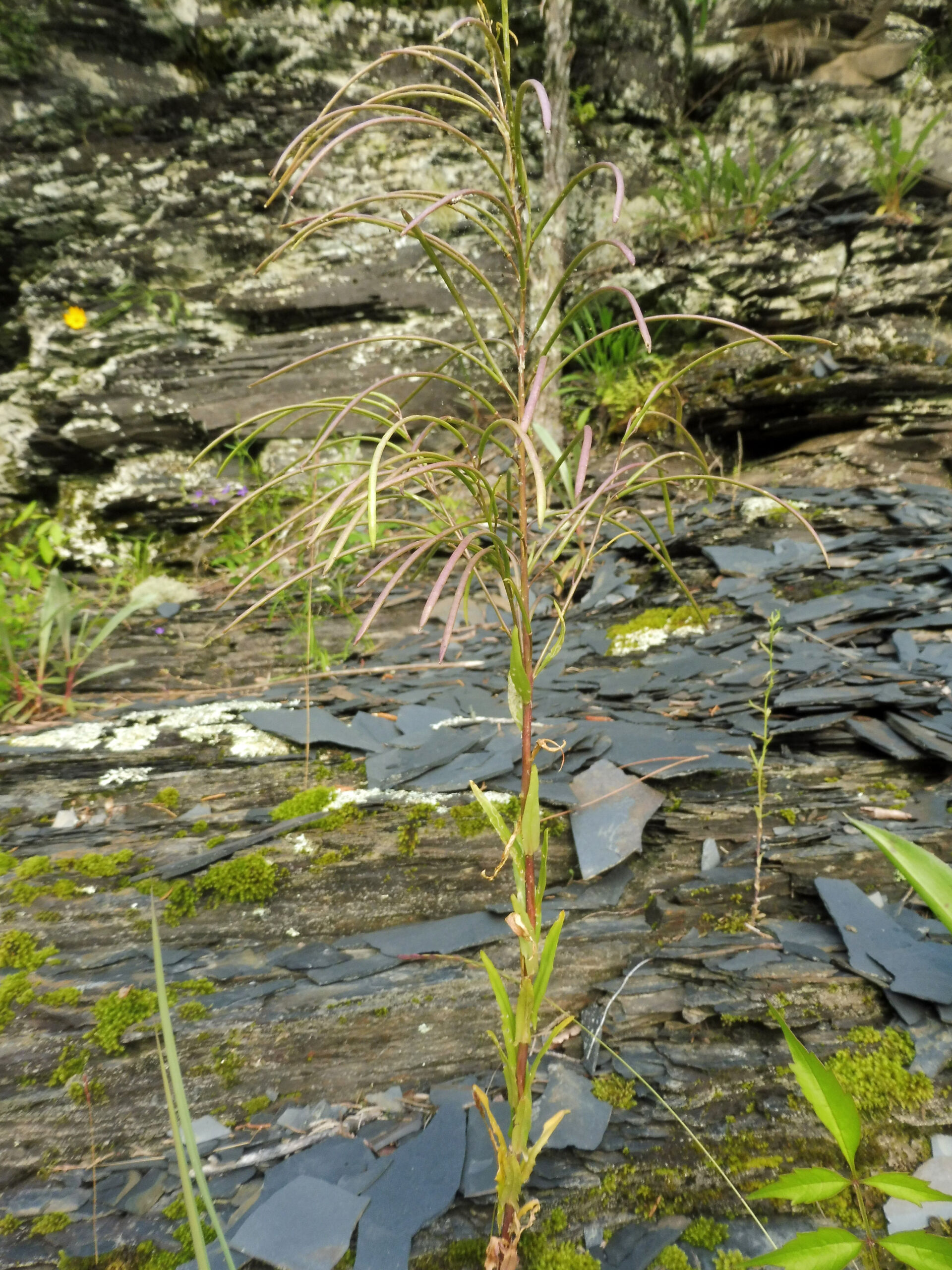
Missouri rock cress is a taprooted biennial herb in the mustard family, Brassicaceae, and it looks like what it is: a plant built for places where the soil gives up early. In its first year it sits as a basal rosette of leaves, low and unassuming, the way biennials do while they decide whether the site is worth the gamble. In its second year (or a later one, since it is a facultative biennial that can wait) it sends up a stiffly upright, mostly unbranched stem, typically 20 to 50 centimeters tall, topped with a raceme of small, creamy-white, four-petalled flowers. The petals are about twice as long as the sepals, a small detail that helps separate it from its close lookalike, smooth rock cress. The fruits are the long, narrow siliques of the mustard family, 6 to 9 centimeters long and strongly flattened, held ascending to spreading and often arching downward along the upper half. The stem leaves are dense, erect, and overlapping, the basal leaves persistent and pinnately lobed, and the stems often flush red-tinged in strong sun. None of this is showy. It is a rock plant, and rock plants do their showing off quietly.
Its habitat is the giveaway, and the reason most gardeners will never meet it in a garden center. Missouri rock cress grows on rocky or sandy woodlands and bluffs, on dry, thin soil over exposed bedrock, on upland forests and rocky slopes, usually on acidic substrate, at elevations roughly 50 to 300 meters in the accounts that describe it. Think trap rock glades, sandstone ledges, and woodland edges where the bedrock is never far below your boots. It is native to the eastern United States in a highly fragmented, disjunct range: principally Missouri and Arkansas, with scattered populations through the upper Midwest, New England, and the Southeast, from Quebec and Ontario south to Georgia and west to Oklahoma. It is considered globally secure but rare or imperiled in most states where it occurs, listed as threatened in New York and Massachusetts, imperiled in a long list of states, and secure only in Missouri. That is the first and most important thing this guide has to say: this is a plant to recognize and leave alone, not a plant to dig up. If you are lucky enough to find it, the correct garden action is admiration from the trail.
And then there is the name, which needs a paragraph of its own because it will confuse anyone who looks it up. The plant was originally described as Arabis missouriensis in 1908. Molecular work then showed that most North American Arabis species were not closely related to the true Arabis at all, and they were transferred to Boechera, giving Boechera missouriensis. More recent work moved the eastern biennial rock cresses again, into Borodinia, giving Borodinia missouriensis, the name used by several current state floras. Meanwhile it has also been treated as a variety of smooth rock cress, Arabis laevigata var. missouriensis, and it carries the common names Missouri rockcress and green rock cress. This guide files it under Borodinia missouriensis with the older names as synonyms, because that is where the current taxonomy points, but the butterfly guide that names it calls its hosts rock cresses, Arabis species, in the older, broader sense. If you search for it under any of the three Latin names, you are looking at the same plant. The name changed; the plant did not.
How to grow
Let us be blunt about the honest scope of this section: Missouri rock cress is not a garden plant in the ordinary sense, and this guide will not pretend otherwise. It is a wild plant of thin, rocky soils, rare across most of its range, and it has no business in a Florida garden, where it does not occur and where the climate is wrong for it in every direction. What follows is how the plant lives, written so that a gardener in its native range can understand what it needs, and so that everyone else can understand why it is not on a seed rack.
In its home ground, the recipe is neglect of a very specific kind: open, rocky or sandy ground, thin soil over bedrock, good drainage, and sun to light shade, with the competition kept low by the poverty of the soil itself. Rich, deep, fertile garden soil is not an upgrade for this plant; it is an invitation to every faster-growing neighbor to bury it. The biennial rhythm matters too. First-year rosettes do not flower, and a colony needs rosettes of more than one age present every year to keep going, because each individual dies after it flowers and sets seed. A gardener or land steward working with rock cresses should think in cohorts, not in specimens: protect the rosettes, let the seed fall where it may, and do not tidy the site into oblivion. Seed, where it is legitimately available from a native-plant nursery propagating it (never wild-collected), should be sown on the surface of lean, gritty soil, because mustard seeds of this kind want light and air, not burial under mulch.
For Florida readers, the useful translation is the family resemblance, not the plant itself. Missouri rock cress is a mustard, and the mustards that matter in a Florida butterfly garden are the native pepperweeds, the tansymustards, and the other small, weedy Brassicaceae that feed the whites and sulphurs. If you want to help the Olympia marble, the butterfly whose host list names this plant, you cannot do it from Florida anyway: that butterfly is a northern and midwestern insect of prairies and open woodlands, and its host patchwork is made of local rock cresses, region by region. Plant the mustards that belong to your place, and leave Missouri rock cress to its bluffs.
Water and feeding
Water is not the limiting factor for this plant; drainage and thin soil are. In its bluff and glade habitats it gets what rain falls and then watches it drain away through rock and sand, and it is built for that bargain: a taproot reaching down, fleshy-enough foliage to ride out dry spells, and a life cycle that does not demand a long, lush season. Supplemental watering in a garden setting would mostly help its competitors. Feeding is likewise a case of less being more. This is a plant of acidic, nutrient-poor substrates, and fertilizer is the fastest way to lose it under a wave of generalist weeds. If you are stewarding a site where it grows, the feeding plan is simple: feed nothing, and keep the canopy open enough that light reaches the ground.
Common problems
The main problem for Missouri rock cress is not a pest or a disease; it is us. Habitat loss, canopy closure as woodlands grow shady, quarrying and development of rocky sites, and the slow smothering of glades by invasive plants all shrink a range that is already fragmented into islands. Collection is a second, entirely avoidable problem: a rare biennial that dies after flowering cannot afford to lose its flowering individuals to a trowel. The plant has no famous insect enemies in the accounts checked, which makes sense: its enemies are the ordinary ones of the mustard family, the flea beetles and caterpillars that nibble mustards everywhere, and a wild population absorbs that nibbling as part of the deal. The Olympia marble itself is one of those caterpillars, eating flowers and fruits first and leaves later, and a healthy colony feeds its butterflies without collapsing, because the butterflies lay a single egg per flower bud rather than stripping a plant bare.
Identification is the other practical problem, because Missouri rock cress looks a great deal like its relatives. Smooth rock cress, Borodinia laevigata, is the closest lookalike, and the separation rests on small characters: denser, more overlapping stem leaves, persistent pinnately lobed basal leaves, and petals about twice the sepal length in Missouri rock cress. Drummond’s rock cress, tower mustard, low rock cress, and smooth rock cress all share the Olympia marble’s host list, and they are all rock cresses in the same broad sense, which is why the butterfly’s range is really a patchwork of local host relationships rather than one plant’s map. If you think you have found Missouri rock cress, photograph it, note the bedrock and the county, and check it against your state flora before you claim it. Rare plants deserve that care.
Harvest
There is no harvest here, and that is a deliberate statement, not an omission. Missouri rock cress is not a food plant, not a medicine plant in any tradition this guide can verify, and not a plant to gather. Its value is ecological: it feeds a butterfly, it holds a place in a glade community, and it tells a story about how plant families get reorganized when DNA evidence arrives. The only thing to take from it is a photograph and a better understanding of mustards. Leave the seed for the glade.
Saving seeds
Missouri rock cress is a rock-garden plant that saves seed the way rock-garden plants do: modestly, in dry pods, on a plant that asks for almost nothing. The flowers give way to slender siliques — the long thin pods of the mustard family — and the pods dry and split when they are ready. Collect them just as they turn tan and papery, before they pop open and scatter, and a paper bag held under the stem catches most of them.
Sow the seed in fall or early spring, barely covered, in lean, sharply draining soil. A period of cold helps germination — winter-sown seed, or a few weeks in the refrigerator in a bag of damp sand, wakes it up more evenly than spring-sown seed without a chill. Germination is uneven even then, which is the plant hedging its bets, so sow more than you need and thin to the strongest.
The plant is a short-lived perennial or biennial in most gardens, which is exactly why saving seed matters: the colony renews itself from its own seed, year after year, if you let a few plants go to seed each season. Self-seeding is gentle, not a takeover — a few volunteers in the gravel or the rock wall, easy to move while small and easy to pull if they land where you do not want them.
Stored dry, the seed keeps for a few years. Florida humidity is the enemy of stored seed, so dry it thoroughly before jarring it, add a silica gel packet, and keep the jar cool and dark. The seed you save is next spring’s rock garden, grown from a plant that thrived on neglect and gave you flowers for it.
Varieties
No named garden varieties or cultivars of Missouri rock cress were verified for this guide, and none should be invented to fill this section. The variation that matters in this plant is taxonomic, not horticultural: the three Latin names, Arabis missouriensis, Boechera missouriensis, and Borodinia missouriensis, all denote the same species, and the older variety name Arabis missouriensis var. deamii and the synonym Arabis viridis belong to the same tangle. Related rock cresses worth knowing, each with its own place in the Olympia marble’s world, include smooth rock cress (Borodinia laevigata), Drummond’s rock cress, tower mustard, and low rock cress. The site’s rock-cress genus guide covers the group as a whole; this guide covers one rare member of it, and only this member. Do not confuse it with the garden rock cress sold for walls and edging, which is a different plant entirely (Aubrieta), despite the shared common name.