
❄️ Mountain Aven
What it looks like
Mountain aven is the plant that makes a mockery of your climate complaints. It grows on arctic tundra, on windswept limestone barrens, on alpine scree where the soil is a rumor and winter lasts most of the year — and it does so as a cheerful evergreen mat studded with white flowers that look far too delicate for the places they live. The genus Dryas, in the rose family (Rosaceae), holds only a handful of species — sources give 2 to 6 depending on how the taxonomists are feeling that decade — and all of them are low, mat-forming, woody-based perennials with small, leathery, oak-like leaves and flowers held on naked stalks above the mat. The name Dryas comes from the dryads, the tree nymphs of Greek myth, which is either poetic or a botanist’s idea of a joke about a plant that is barely ankle-high.
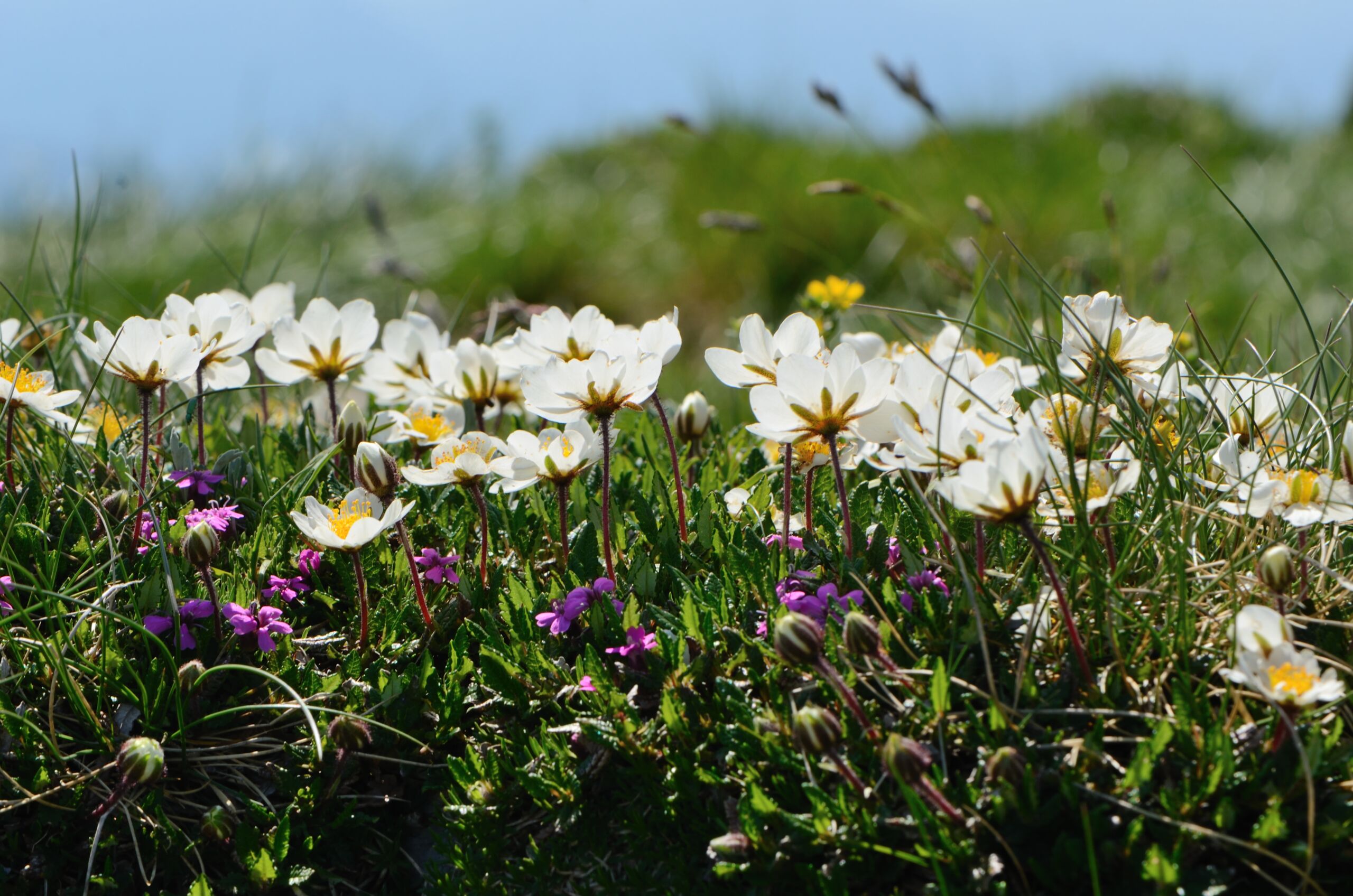
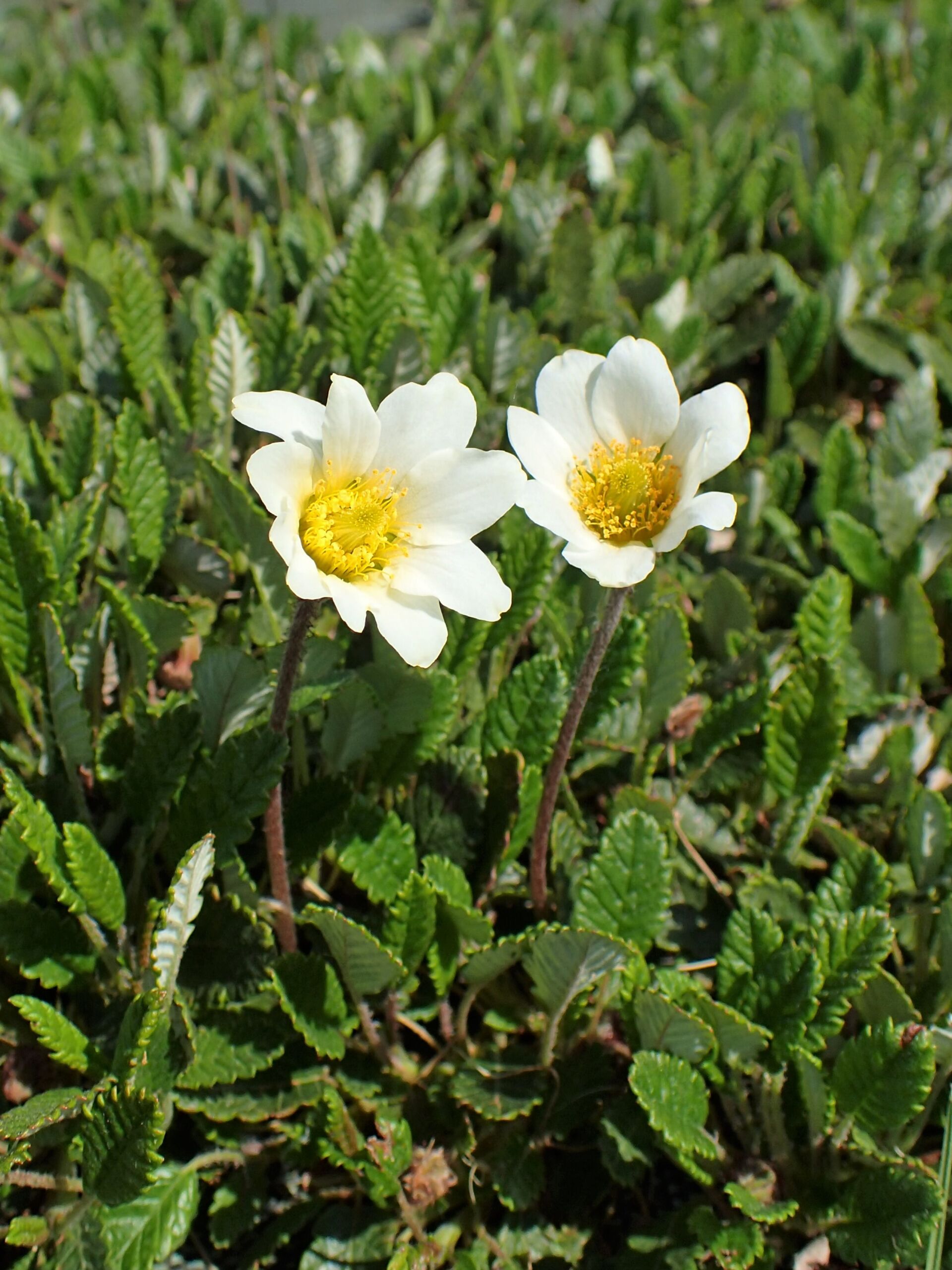
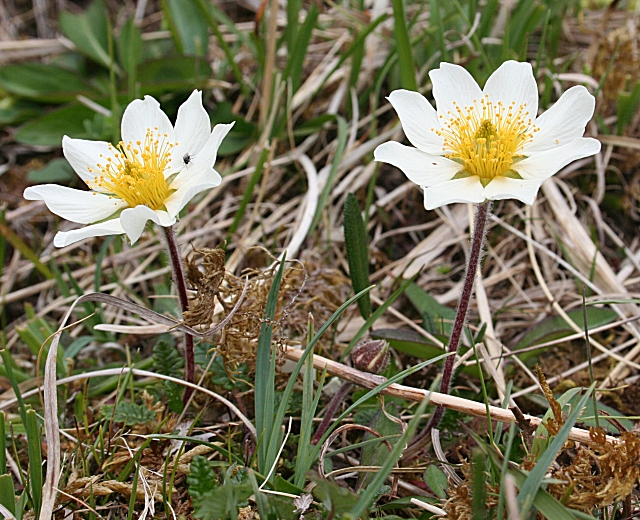
The star of the genus is Dryas octopetala, the eightpetal mountain-avens, and its name is a botany lesson in itself: octo means eight, petalon means petal, and the flowers normally carry eight creamy-white petals around a golden center — an unusual number in the rose family, where five is the standard issue. Flowers with up to 16 petals occur naturally, and the blooms are large for the plant’s size, about 1.5 inches across, held on stalks 1 to 4 inches tall above a mat that rarely exceeds 4 to 8 inches in height but can spread 2 to 3 feet wide. The leaves are small, glossy dark green above and densely white-felted beneath, with scalloped or toothed edges that really do resemble miniature oak leaves, which is where the “dryad” connection comes from. After flowering, the plant produces one of its prettiest features: feathery, silky seed heads that twist into glossy spirals and then open into wind-blown plumes, like tiny white fireworks frozen mid-burst.
Mountain avens flowers do something most garden plants do not bother with: they track the sun. The parabolic, sun-facing blooms follow the sun’s movement across the sky — heliotropism — and the dish shape focuses warmth onto the flower’s center, heating it by a few degrees, which is a real advantage for pollinating insects in a cold climate. It is a solar panel that happens to be a flower, and it is one reason mountain avens punches above its weight as a pollinator plant in the far north. For butterflies, Dryas is a host plant for arctic and alpine fritillaries — the astarte fritillary, the polaris fritillary, and the polixenes arctic all use mountain avens — and the polaris fritillary also visits it for nectar. These are butterflies of tundra and high mountains, not of suburban flower beds, which tells you most of what you need to know about where this plant belongs.
Florida note, stated as plainly as possible: Mountain avens is not a Florida plant. It needs cold winters, cool summers, and sharp drainage, and its heat tolerance tops out around heat zone 6 — Florida is far beyond that in every direction. This guide exists because butterfly guides list mountain avens as a host, and because gardeners in cool climates grow it beautifully — not because anyone in Florida should plant it and watch it melt. Florida gardeners: admire the photos, enjoy the story, and plant something that likes your climate.
How to grow
Mountain avens is easy to grow in the right climate and nearly impossible in the wrong one, and the entire skill lies in knowing which climate you have. In cool regions — zones 2 to 6, roughly, with Gardenia giving 3 to 6 for Dryas octopetala and other references reaching down to zone 2 — plant in full sun or light shade in sharply well-drained soil. Limestone or calcareous soil is ideal, since the wild plant is a limestone specialist, but the Royal Horticultural Society lists it as tolerant of acid, alkaline, or neutral soils, so do not panic if your soil is not chalky. What it will not forgive is wet feet: plant it in a rock garden, on a slope, in a raised bed, or in a gravelly scree mix, somewhere water runs away fast. Space plants 12 to 36 inches apart and be patient — the mat spreads by stems that root as they go, and a full carpet takes a few years to form. The RHS gives 5 to 10 years to full maturity, which is slow by garden standards and perfectly normal by alpine standards.
Propagation is by seed or by cuttings. Seed is best sown as soon as it is ripe, in pots in a shady cold frame or a sheltered spot outdoors, and germination can be slow and erratic — anywhere from a month to a year or more — so do not throw the pots out in frustration. Heeled cuttings taken in early summer root reasonably well. Division of established mats is possible but the plant resents disturbance, so divide only when you must, and do it in spring. Once established, mountain avens needs almost no care beyond weeding: it is evergreen, it holds its mat through winter under snow, and it asks for nothing except drainage and cool air.
Water & feeding
Water mountain avens like an alpine gardener: moderately, and never to the point of sogginess. It prefers consistent but modest moisture in well-drained soil and tolerates dry conditions once established — in the wild it grows in dry localities where snow melts early, on gravel and rocky barrens. Water new plantings until established and during dry spells in cool climates, and then step back. In hot, humid climates, no amount of careful watering will save it, because the problem is heat, not thirst. Mulch with gravel rather than bark: a gravel mulch keeps the crown dry, suppresses weeds, and matches the plant’s native scree habitat, while organic mulch holds moisture against the crown and invites rot.
Feeding is unnecessary and can be counterproductive. Mountain avens evolved on thin, infertile, calcareous soils, and rich feeding produces soft growth that flops and rots. If your soil is extremely poor, a light dressing of compost in spring is the most it will ever want. Think of fertilizer for this plant the way you think of a blanket for a polar bear: well-intentioned, and entirely beside the point.
Common problems
- Heat and humidity: The number-one killer. Mountain avens needs cool summers (heat zones 1 to 6) and fails in hot, humid climates. If your summers are long and steamy, do not plant it — no soil amendment fixes a climate mismatch.
- Wet winters and crown rot: The second killer. Waterlogged winter soil rots the crown. Sharp drainage, gravel mulch, and a slope or raised bed are non-negotiable in wet-winter climates.
- Slow establishment: Mountain avens is slow-growing at first and can take years to form a full mat. Weed around young plants so they are not smothered, and resist the urge to declare failure in year one.
- Wrong avens: The common name “avens” also belongs to Geum species (wood avens, water avens), which are entirely different plants in the same family. If the plant you bought has five-petaled yellow or pink flowers on tall stems, it is a Geum, not a Dryas. Count the petals: eight (or thereabouts) and white means Dryas octopetala.
- Slugs in mild, wet gardens: In mild, damp climates, slugs may nibble the low foliage. Gravel mulch and good drainage help, and the plant usually outgrows minor damage.
Harvest
Mountain avens is not a food crop, and this guide does not recommend eating it as one. What you harvest is ornamental and ecological: the feathery seed heads are beautiful left standing through summer and fall, and the evergreen mat provides year-round groundcover structure in a rock garden. The leaves are occasionally used as an herbal tea in traditional practice, which this guide reports without recommending — if you are interested, research it properly and treat it as a traditional use, not a garden-blog prescription. For most gardeners, the real harvest is the sight of white stars opening over a rock garden in late spring, in a place cold enough that few other plants dare to bloom at all.
Saving seeds
Mountain avens is a plant of arctic and alpine places, and saving its seed is an exercise in imitating a winter. The seed is small, it ripens in late summer, and it does not keep well — sow it fresh if you can, and never count on stored seed behaving the same way. Collect the fluffy seed heads when they are dry and the seed strips easily from the stem, then clean out the fluff and sow right away or store the seed cool and dry for only a short while.
Fresh seed sown in a shady cold frame or a sheltered pot outdoors will usually germinate on its own schedule, because a real winter does the work for you. Stored seed needs cold stratification first, and this is where the sources disagree: some say two to four weeks in the fridge, some say about two months, and one propagation guide warns germination can take anywhere from one month to a year. The honest answer is the range — mix the seed with damp sand or vermiculite, seal it in a bag, refrigerate it for four to eight weeks, then sow it on the surface of a well-draining mix and keep it cool, moist, and out of hot sun.
Germination is slow and uneven, and seedlings grow slowly at first. Grow them on in pots for their first winter and plant them out in late spring, after the last frost. Division of established clumps in early spring is the faster route to more plants, and cuttings taken in early summer will root with bottom heat, though they can take up to two months.
One Florida reality check: this is a plant that wants cool summers and cold winters, and it will struggle in Florida heat. If you are growing it here, you are growing it as a cool-season curiosity in a pot, not as a garden staple. Save the seed anyway if you love the plant — just do not expect a Florida summer to be kind to the seedlings.
Species in this group
Dryas is a small genus of perennial, mat-forming evergreen dwarf shrubs in the rose family, native to arctic and alpine regions of Europe, Asia, and North America. The species gardeners and botanists meet most often, in plain text:
- Eightpetal mountain-avens — Dryas octopetala: The classic. Circumpolar arctic-alpine species, from the Arctic through Scandinavia, Iceland, the Alps, and the Caucasus, and in North America from Alaska through the Canadian Rockies as far south as Colorado. White flowers with usually eight petals, oak-like leaves with toothed margins and white-felted undersides, mats to 2 to 3 feet wide and 2 to 8 inches tall. Holds the Royal Horticultural Society’s Award of Garden Merit. Numerous subspecies and varieties are recognized, differing mainly in leaf shape and hairiness.
- Entire-leaved mountain-avens — Dryas integrifolia: The other widespread white-flowered species, abundant across the North American Arctic from the coastal plain to the alpine. Distinguished from octopetala by smooth, untoothed leaf margins. Long-lived — some plants are reported to live over 100 years — and a major food plant for lemmings, ground squirrels, and caribou.
- Yellow mountain-avens — Dryas drummondii: The yellow one. Distinguished by pendulous, all-yellow flowers and broader leaves, where the white species hold their flowers erect. Native to western North America, and the species to choose if you want a yellow dryas rather than a white one.
One final disambiguation: mountain avens is sometimes confused with the various Geum avens (wood avens, water avens, mountain avens is NOT a Geum). If it has eight white petals and a woody, mat-forming base, it is Dryas. If it has five petals, it is something else, however pretty.