
🌿 Mountain Mahogany
What it looks like
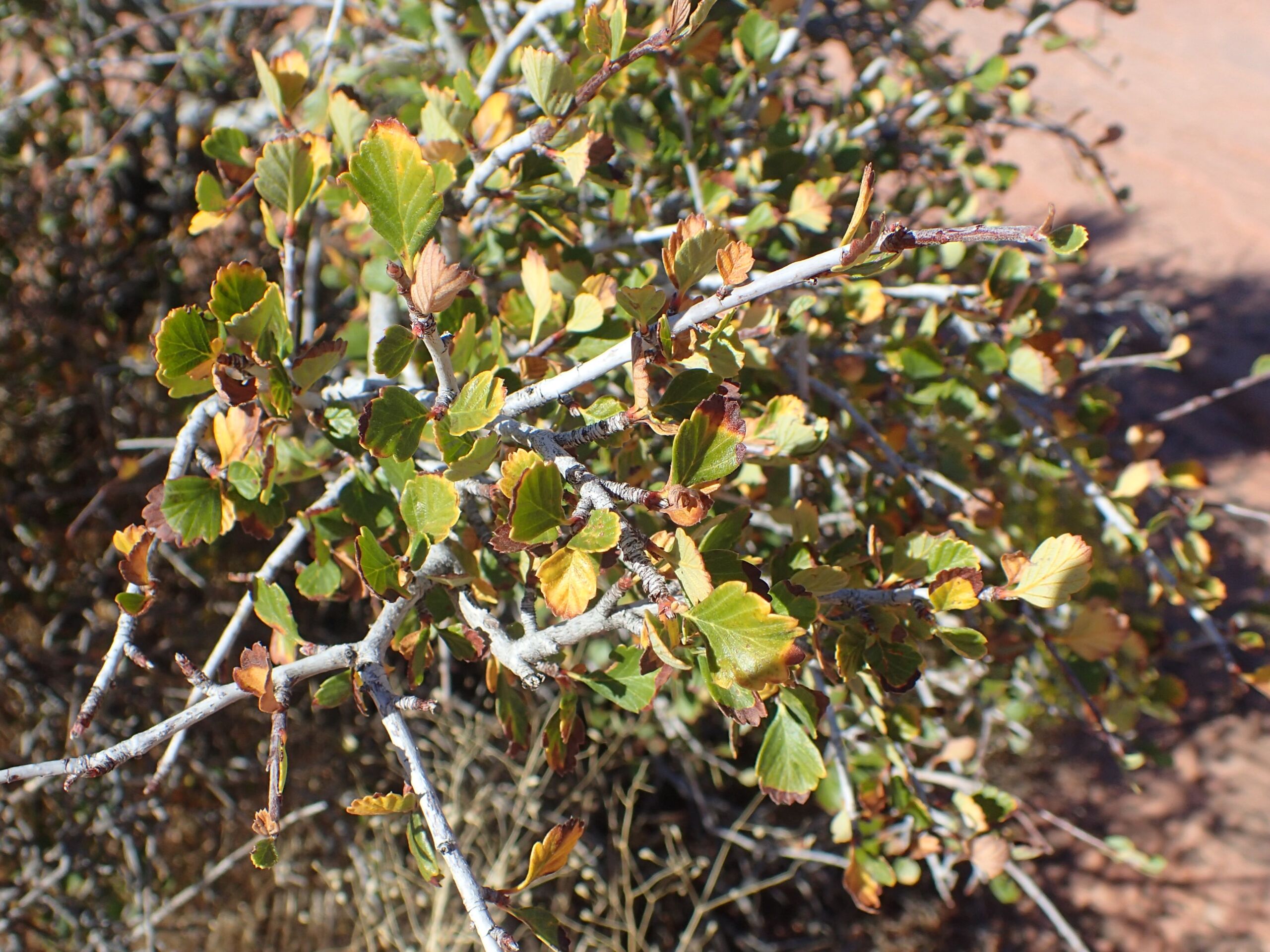
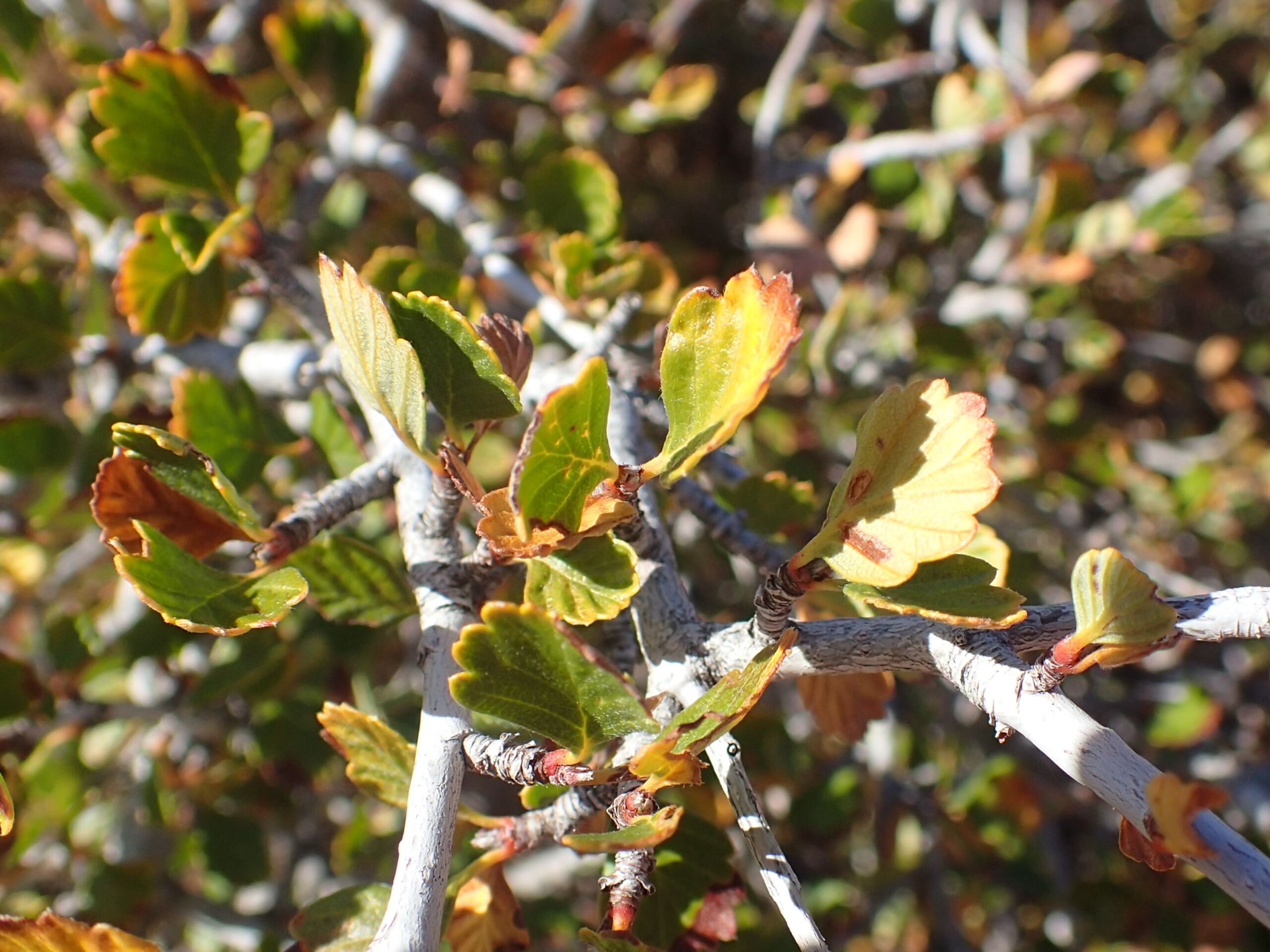
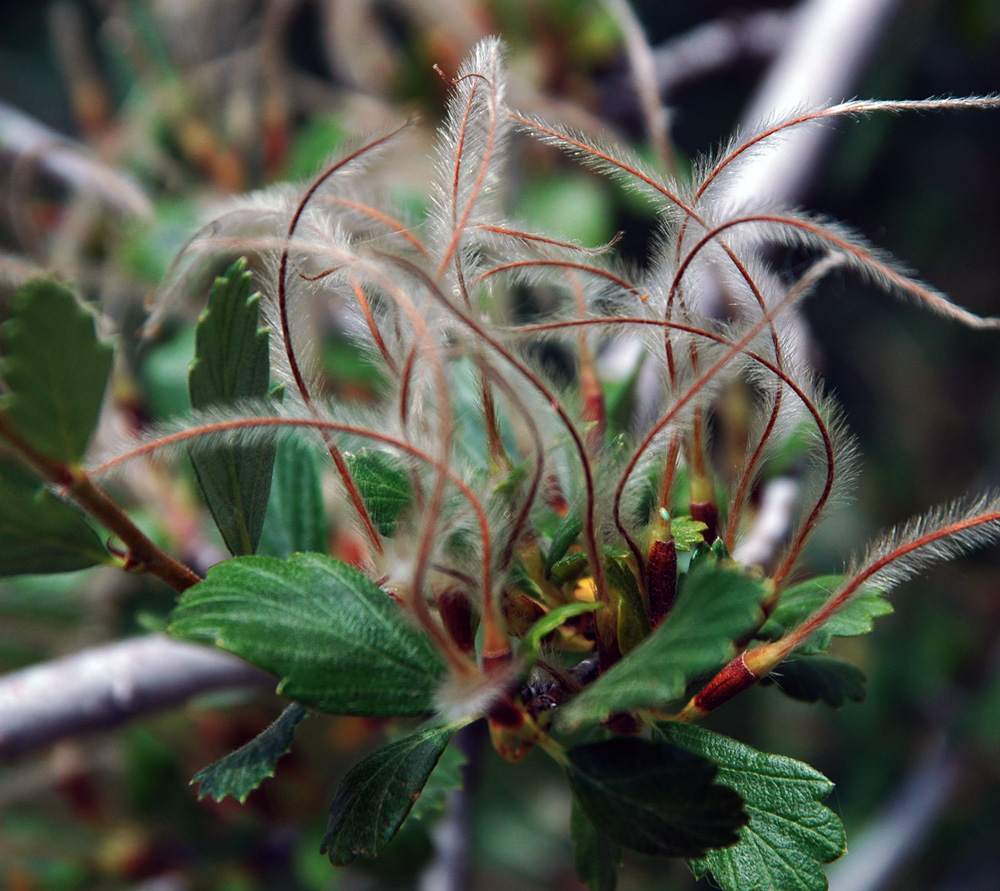
Mountain mahogany is a shrub or small tree in the rose family, Rosaceae, and its genus name is a field guide in miniature: from Greek kerkos, a tail, and karpos, a fruit, for the long, feathery, plume-like tail carried by each seed. In fall, a mountain mahogany in seed looks silvered and soft from a distance, as if the shrub had grown a beard, and up close each seed is a small, dry fruit with a twisted, feathery awn that catches the wind and drills the seed into the soil with changes in humidity. It is one of those plants whose reproductive strategy you can watch happening if you stand still long enough in October.
The plant itself is an upright to spreading, multi-stemmed shrub, typically 5 to 16 feet tall, occasionally taller in favorable sites, with some forms described as low as 2 feet and others as small trees to 20 feet, because this is a variable species across a huge range. The leaves are the field mark that gives it its other common names, alderleaf mountain mahogany and birch-leaf mountain mahogany: they are birch-like, dark green above and whitish beneath, toothed along the margins, and, unlike its curl-leaf cousin, they do not curl at the edges. It is the only deciduous species in its genus, though some forms hold their leaves long enough to be called semi-evergreen, and the bark is smooth gray with whitish tones and dark red wood beneath. The flowers are inconspicuous, small and greenish-white, easy to walk past in May and June, and that is fine, because the flowers are not the show. The seed tails are the show, and the leaves are the livelihood: they are important browse for mule deer, elk, and bighorn sheep, particularly in spring and fall, and they are the food of the mountain mahogany hairstreak’s caterpillars.
Its range is the western map in one shrub: mountains and foothills from Washington and Oregon east through Idaho, Montana, Wyoming, Colorado, Utah, Nevada, Arizona, and New Mexico, extending into the Great Plains of South Dakota, Nebraska, and Oklahoma, with a southwestern form reaching into Baja California, generally on rocky, dry, well-drained slopes and ridges at elevations from about 3,000 to 9,500 feet. It grows where the soil is thin and the sun is strong, on south- and west-facing slopes too dry and exposed for most competing shrubs, and it does so with the help of a partnership most gardeners never see: its roots carry nodules housing Frankia actinobacteria that fix atmospheric nitrogen, enriching poor soils over time. That is why mountain mahogany thrives where fertilized garden plants would starve, and why fertilizing it is not merely unnecessary but counterproductive. It is a plant that makes its own fertility, and then shares it with its neighbors through leaf litter that decomposes quickly into the surface soil.
How to grow
Plant mountain mahogany in full sun in lean, rocky, well-drained soil, and then resist every instinct to pamper it. This is a plant of dry slopes and washes, and it wants the garden equivalent: a sunny bank, a rock garden, a xeric bed, or a revegetation slope, with soil that drains fast and no summer irrigation regime. In its native range it succeeds on rocky, clay, or sandy soils, and it tolerates a wide pH range and even serpentine soils, but it does not tolerate wet feet or heavy shade. Space plants several feet apart, because a mature shrub is a broad, multi-stemmed presence, and give it room to develop the open-branching form that lets its seed tails show. It is hardy in the coldest forms to about zone 5, and it is heat tolerant, but it is not a Florida plant in any sense: it needs cold winters, dry air, and elevation, and a humid, sea-level Florida garden will not give it any of those. This guide is honest about that, because a guide that pretends every western shrub will thrive in Florida is a guide that wastes its readers’ money.
Propagation is by seed, and the seed tails are your handling hint: collect seed in fall when the plumes are fluffy, sow in a gritty, well-drained mix, and be patient, because mountain mahogany is a medium-rate grower that builds a deep root system before it bothers much about top growth. Cuttings are possible but less reliable, and the plant resprouts vigorously after fire and after browsing, which tells you something useful about pruning: it tolerates hard cutting better than most shrubs, and it responds to browsing with vigorous new growth. Prune, if you prune at all, to remove dead wood and to shape a young plant, and do it in late winter before growth resumes. Do not shear it into a box: a sheared mountain mahogany loses the open form and the seed display that are the reasons to grow it.
The butterfly connection is the reason this guide was written, and it is specific. The mountain mahogany hairstreak’s caterpillars feed on mountain mahogany, Cercocarpus montanus, in the rose family, with related Cercocarpus species used in different populations: foothill populations feed on the chaparral species, while interior populations feed on other mountain mahoganies. Eggs are laid singly or in small groups on twigs or leaves, and they hibernate until spring, when the caterpillars eat the leaves. One shrub genus, one butterfly, one chaparral address. The California hairstreak also lists mountain mahogany among its hosts, in a bare, genus-level way that maps to the Cercocarpus genus guide, while the hairstreak that wears this plant’s name maps here, to the species. If you live in mountain mahogany country and you want the hairstreak, plant the species, protect the shrubs you have, and do not spray a host plant because it has caterpillars on it. The caterpillars are the point.
Water and feeding
Water sparingly once established, and do not feed at all. Mountain mahogany is drought-tolerant, adapted to 25 to 58 centimeters of annual precipitation in much of its range, and it handles drought, flooding pulses in washes, and salinity better than most shrubs, but it does not handle a permanently wet root zone. Deep, infrequent watering during establishment is enough; after that, natural rainfall in its native range is the plan. Fertilizer, especially nitrogen fertilizer, is unnecessary and may be counterproductive, because the Frankia nodules already supply nitrogen, and added nitrogen mostly feeds competitors. The plant’s roots extend deep, to about 1.7 meters in the accounts that measured them, which is how it survives dry slopes that kill shallower shrubs. Garden for the root system, not the foliage: drainage, sun, and patience.
Common problems
Mountain mahogany has few serious pest problems in its home range, and most of its troubles come from being planted in the wrong place: wet soil, deep shade, or a humid lowland climate will do what no insect can. Browsing by deer and elk is not a problem in the ecological sense; it is the plant’s life, and the shrub responds with vigorous regrowth, which is why it persists under heavy browsing pressure where less tolerant shrubs disappear. Fire, likewise, is not the catastrophe it looks like: mountain mahogany sprouts vigorously after fire, and its nitrogen-fixing habit makes it a valuable revegetation species for burned slopes. The gardener’s version of fire is the hard prune, and the plant treats it the same way, as an invitation to regrow.
Harvest
There is no kitchen harvest from mountain mahogany, though its leaves are high in protein thanks to the Frankia association, and its value as wildlife browse is precisely that protein. The harvest for a gardener is the seed display in fall, the wildlife value year-round, and the soil improvement that comes free with the roots. If you collect seed for propagation, take only a small share from any one shrub, and leave the rest for the wind, the birds, and the next generation of shrubs on the slope. The plant’s common name is a trap for the unwary: mountain mahogany is not a mahogany at all, it is a rose-family shrub, and its wood, though dark red and hard, is not the mahogany of furniture. The name is a compliment to the wood’s color, not a family tree, and this guide will not pretend otherwise.
Saving seeds
This guide covers the mountain mahogany genus, Cercocarpus, and the seed advice is genus-level for the same reason: the species all play by the same rules, with the details varying a little by species. Collect the seed in late summer or fall, when the feathery-tailed fruits are dry and brown and strip easily from the branch. Clean off the tails and dry the seed briefly, then store it cool and dry — seed keeps for several years in dry storage, though viability does fade after five to seven years, so do not hoard it forever.
The seed has a double lock on it. First the hard coat needs scarifying — a nick with a file or a rub with sandpaper — and then the embryo needs cold stratification. The sources disagree on how long: a university propagation protocol calls for one to three months of cold stratification, a Utah State thesis found two to three months worked for alder-leaf mountain mahogany, and a nursery protocol soaked seed for 48 hours and then stratified it for 75 days at near-freezing temperatures. The honest range is one to three months in the fridge, in damp sand or vermiculite, checked weekly for mold and for early sprouts. Some growers add that a fall sowing outdoors, letting a real winter do the stratifying, is the simplest method of all.
Sow the treated seed shallowly, about a quarter inch deep, in a well-draining mix, and keep it moist and cool. Germination is slow and uneven — weeks to months is normal, and some seed takes far longer, so do not throw the pot away at six weeks. Seedlings grow slowly and want at least two years in pots before planting out, and they are vulnerable to both frost and drought while young.
Cuttings and layering are the routes for named cultivars, since seed-grown plants vary. And one thing worth knowing about the plant you are growing: mountain mahoganies fix nitrogen in their roots, so the seedling you raise is quietly feeding the soil it grows in. Keep saved seed dry and cool — Florida humidity is the enemy of stored seed, so jar it with a silica gel packet and keep it in a cool, dark place.
Varieties
Mountain mahogany is a variable species with many named forms, and the hardiness differences between them are real, so this section matters more than usual. The hardiest forms, succeeding in zone 5, include Cercocarpus montanus var. argenteus (silver mountain mahogany) and var. glaber (smooth mountain mahogany, also called birchleaf or true mountain mahogany, the form most often grown). Less hardy are var. paucidentatus, hardy to zone 7, and var. blancheae and var. minutiflorus, hardy to zone 8, while var. traskiae is the least hardy, to zone 9. The cultivar ‘USU-CEMO-001’, released as part of the Sego Supreme series, is a dwarf, procumbent selection collected in Moffat County, Colorado, for low-water landscapes. Do not confuse this species with its relatives: curl-leaf mountain mahogany, Cercocarpus ledifolius, is the high-country species with narrow, curled leaves, growing to over 20 feet tall; narrowleaf mountain mahogany, Cercocarpus intricatus, is the intricately branched dwarf of sandstone benches; and the site’s Cercocarpus genus guide covers the genus as a whole, including ledifolius. This guide covers montanus, and only montanus.