
🌿 Mountain Whitethorn
What it looks like
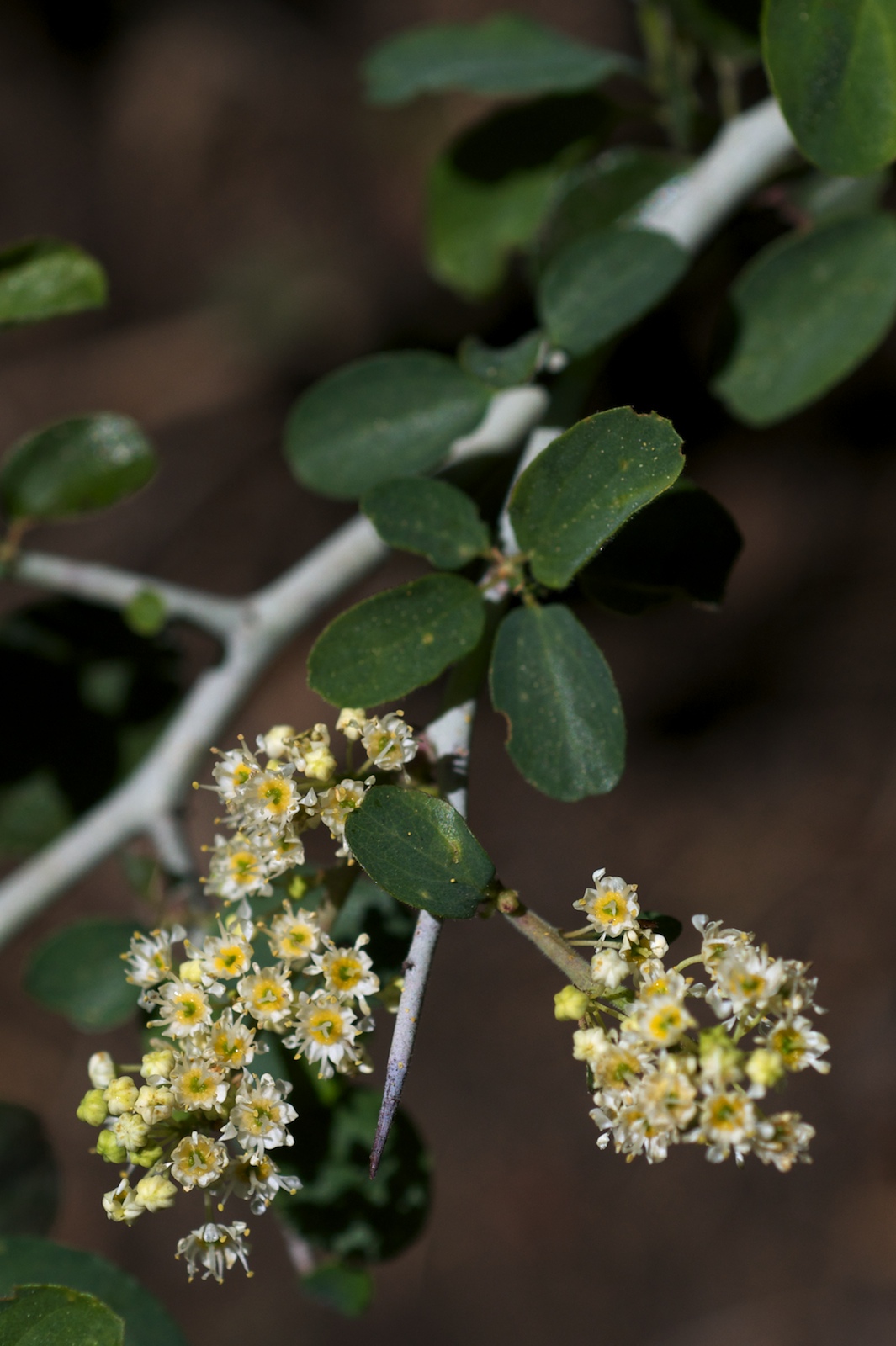

Mountain whitethorn is a shrub in the buckthorn family, Rhamnaceae, and it is one of those plants that looks modest for eleven months and then, for a few weeks in late spring and early summer, turns its whole mountainside white. It is a densely branched, spiny, evergreen, flat-topped native shrub, usually wider than tall, reaching 2 to 5 feet in height, though at high elevations, such as the Lake Tahoe basin, it assumes a low, spreading growth form, and individual plants may spread to form continuous ground cover over areas up to 12 feet across. The stems are gray, with yellow-green, fuzzy twigs when new, and the older bark is whitish, with spiny branchlets that give the plant its whitethorn name. The evergreen leaves are alternately arranged, ovate to elliptical, about an inch long, three-veined, light green to gray-green above and paler below, with entire margins. The flowers form in small, dense, panicle-shaped clusters, 1 to 2 inches long (to about 4 centimeters in the botanical descriptions), white, and famously fragrant, with a heavy, penetrating scent that, during flowering season, can make whole areas appear covered in snow. That is why its other common name is snowbrush, and why a slope of it in bloom is a landmark you can smell before you see.
Its range is the western mountains in one shrub: California and adjacent sections of Oregon, Nevada, and Baja California, growing on mountain ridges, dry open flats, and rocky slopes, in ponderosa pine to red fir forest, at elevations roughly 900 to 2,700 meters in the floras that give them, and in the San Gabriel Mountains at 5,800 to 8,500 feet. It is well suited to dry open flats and rocky slopes with well-drained soils, and it grows well at elevations down to 3,500 feet where precipitation is adequate. Like all Ceanothus, it is a nitrogen-fixing plant, and it is uniquely abundant in old-growth forest conditions compared with similar nitrogen-fixing plants, a detail that hints at its real ecological job: it colonizes open, poor ground after disturbance, fixes nitrogen into the soil, and prepares the way for the forest that follows. Its seeds mature in late August and September, and they wait in the soil for fire or disturbance, because Ceanothus seeds are famously fire-followers, hard-coated and long-lived, germinating in numbers after a burn.
The name needs a small untangling, because whitethorn is a crowded word. Mountain whitethorn is Ceanothus cordulatus, also called whitethorn ceanothus, snowbrush, and snowbush. It is not hawthorn, which is Crataegus, and it is not the chaparral whitethorn, Ceanothus leucodermis, a southern California to Baja species that shares the whitethorn name and some of the same slopes. The epithet cordulatus is sometimes glossed as clubbed, a reference to the shape of the twigs or flower stalks, though the etymology is less certain than the field marks. If a plant label says whitethorn without a Latin name, check it: in the West it could be any of several Ceanothus species, and in the East it is more likely to be a hawthorn. This guide covers cordulatus, and only cordulatus.
How to grow
Plant mountain whitethorn in full sun in medium to coarse, well-drained, rocky soil, and treat it like the chaparral plant it is: lean soil, good drainage, no summer coddling, and room to spread. It is well suited to slopes, terraces, and steep banks, where its spreading, ground-covering form stabilizes soil, and it makes a superb barrier plant, thanks to the spiny branchlets. In its native range, plant container-grown nursery plants in spring or fall, digging a hole two to three times the diameter of the root ball and at least six inches deeper, backfilling with native soil, and watering deeply until established. After establishment, deep watering every one to one and a half months is adequate to maintain uniform growth in the accounts that describe it, which tells you everything about its drought tolerance: this is a plant that expects a dry summer and plans for it.
Here is the honest note this guide owes Florida readers: mountain whitethorn is not a Florida plant. It needs western mountains, cold winters, dry summers, and elevation, and a humid, sea-level Florida garden will not give it any of those. The Ceanothus that belongs in a Florida butterfly garden is New Jersey tea, Ceanothus americanus, the eastern species with its own guide, and the Ceanothus genus guide covers the group as a whole. This species guide exists because the Pacuvius duskywing’s host list names it outright, alongside deer brier (Ceanothus fendleri) and hairy ceanothus (Ceanothus oliganthus), among various wild lilacs, Ceanothus species. Skippers in this group lay their eggs on the host plant, and the caterpillars feed on its leaves while sheltering in nests of leaves tied together with silk, a rolled or folded leaf that is a skipper caterpillar’s house, dining room, and hiding place all at once. Do not spray a host plant because it has caterpillars on it. The caterpillars are the point, and the folded leaf is the evidence that the plant is working.
Propagation is by seed and by cuttings, with the usual Ceanothus cautions: seed needs scarification or heat treatment to break the hard coat, mimicking the fire it evolved with, and cuttings need a well-drained medium and patience. Do not fertilize heavily: like all Ceanothus, this species fixes its own nitrogen, and added nitrogen mostly feeds weeds and produces soft growth that is more vulnerable to drought. Prune lightly, if at all, to remove dead wood after flowering, and never shear it into a formal shape: a sheared whitethorn loses the flat-topped, spreading form that makes it beautiful and useful on a slope.
Water and feeding
Water deeply but infrequently once established, on the dry-summer rhythm the plant evolved with. During the first year, water regularly to establish roots, then taper to deep, occasional watering in dry spells. Overwatering, especially in heavy soil, is the fastest way to lose a Ceanothus, because these plants are adapted to lean, fast-draining ground and their roots resent sitting wet. Feeding is unnecessary and often counterproductive: the nitrogen-fixing root associations supply what the plant needs, and fertilizer, especially nitrogen, produces weak growth and invites disease. A mulch of gravel or coarse bark, kept away from the crown, helps hold the cool, drained root zone the plant likes without the sogginess it hates.
Common problems
Mountain whitethorn has few serious pest problems in its home range, and most of its troubles are siting problems: wet soil, heavy shade, or a humid lowland climate will do what no insect can. Root rot in poorly drained soil is the main killer, and it is preventable by planting on a slope or in a raised, rocky bed. The spines are a practical consideration rather than a plant problem: plant it away from paths where children or dogs will brush past it, and wear gloves when you prune. The caterpillars that fold its leaves are not a problem at all; they are the Pacuvius duskywing’s children, and a whitethorn with folded leaves is a whitethorn doing its ecological job.
Harvest
There is no kitchen harvest from mountain whitethorn, and the Ceanothus tea tradition belongs to New Jersey tea, Ceanothus americanus, not to this species. Do not brew this plant on the strength of its genus. The harvest that matters is the flower show in late spring, the fragrance that carries across a slope, the nitrogen it fixes into poor soil, and the duskywings it raises in folded leaves. If you cut a flowering branch for a vase, cut sparingly, and leave most of the bloom for the pollinators and for the seed that will wait in the soil for the next fire. A chaparral shrub’s generosity is measured in decades, not in bouquets.
Saving seeds
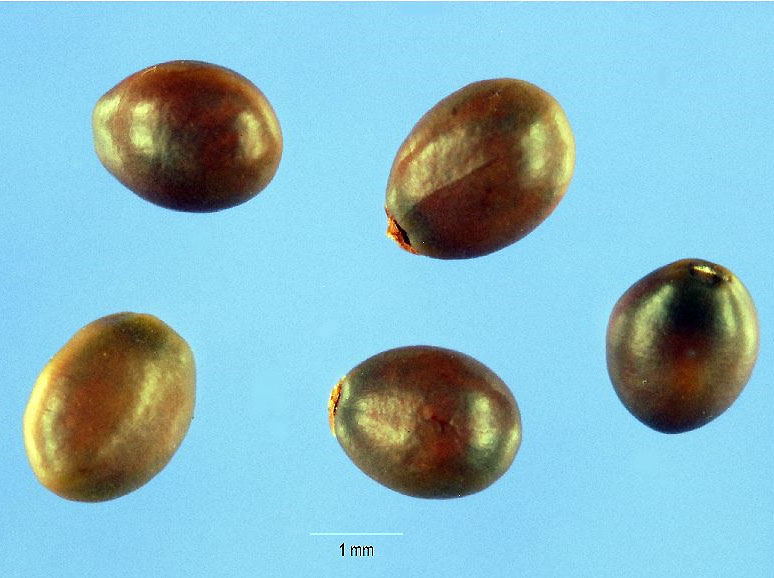
Mountain whitethorn is a fire-follower, and its seed behaves like one: it will sit in the soil for years, refusing to sprout, until heat and cold in sequence tell it that a fire has passed and it is safe to grow. Saving the seed means imitating that fire yourself. Collect the seed pods in fall, when they are brown and dry, and extract the small, hard seeds by rubbing the pods gently between two boards or crushing them in a bag, then winnow out the chaff.
The seed coat is waterproof, so the first step is heat. The classic protocol is to boil the seed for five minutes, then let the water cool and soak the seed for 24 hours; the gentler alternative that many growers prefer is to pour hot water — around 175 to 180°F, not boiling — over the seed and let it soak for a day. Either way, the seed should plump up as it takes in water, and seed that stays flat and hard after soaking was not treated enough. Then comes the cold: stratify the plumped seed in damp perlite or sand in the fridge for three to four months at just above freezing, checking weekly for mold and treating any mold with a weak hydrogen peroxide rinse. One treatment alone does not work — heat without cold, or cold without heat, both fail — and that two-step requirement is the thing most first attempts get wrong.
After stratification, sow the seed shallowly in a well-draining mix and keep it moist and warm. Germination is usually fairly uniform and takes about two weeks once the treatment is done. Seedlings want bright light and protection from frost while young, and they grow fast once they get going.
Cuttings are the alternative for named cultivars, since seed-grown plants vary. And one thing worth knowing about the plant you are growing: like its ceanothus cousins, mountain whitethorn fixes nitrogen in its roots, so the seedling you raise is quietly feeding the soil it grows in. Keep saved seed cool and dry — it stores well in the fridge in an airtight jar — and remember that Florida humidity is the enemy of stored seed, so dry it thoroughly before jarring it.
Varieties
No named garden varieties or cultivars of Ceanothus cordulatus were verified for this guide, and none are claimed. The variation in this species is ecological, not horticultural: low, spreading forms at high elevation, taller, more upright forms lower down, and the usual Ceanothus variability in flower density and fragrance. Related Ceanothus species with their own places in butterfly host lists include deer brier (Ceanothus fendleri), hairy ceanothus (Ceanothus oliganthus), buckbrush (Ceanothus cuneatus), blueblossom (Ceanothus thyrsiflorus), and New Jersey tea (Ceanothus americanus), and the site’s Ceanothus genus guide covers the genus as a whole, including the bare genus-level mentions of mountain lilac and mountain balm in the pale swallowtail’s host list. This guide covers cordulatus, the mountain whitethorn, and only cordulatus. The genus guide listing this species does not cover it, any more than a genus guide covers any species it names: that is the rule this whole project runs on, and it is why this guide exists.