
🌾 Needlegrass
What it looks like
Needlegrasses are the grasses that look like they are up to something. At first glance they are just another bunchgrass: a tuft of fine, narrow leaves rising from a tight crown, swaying in the breeze like it has nowhere to be. Then the seed heads appear, and the whole plant reveals its personality. Each seed — botanists call it a floret — carries a long, bristle-like awn, and that awn is the needle. It is sharp at the base, feathery or twisted along its length, and it can be several inches long, dwarfing the seed it carries. When the seed heads ripen, a whole stand of needlegrass shimmers silver-green and gold, each seed dangling from its own needle like a tiny, extremely determined sewing kit.
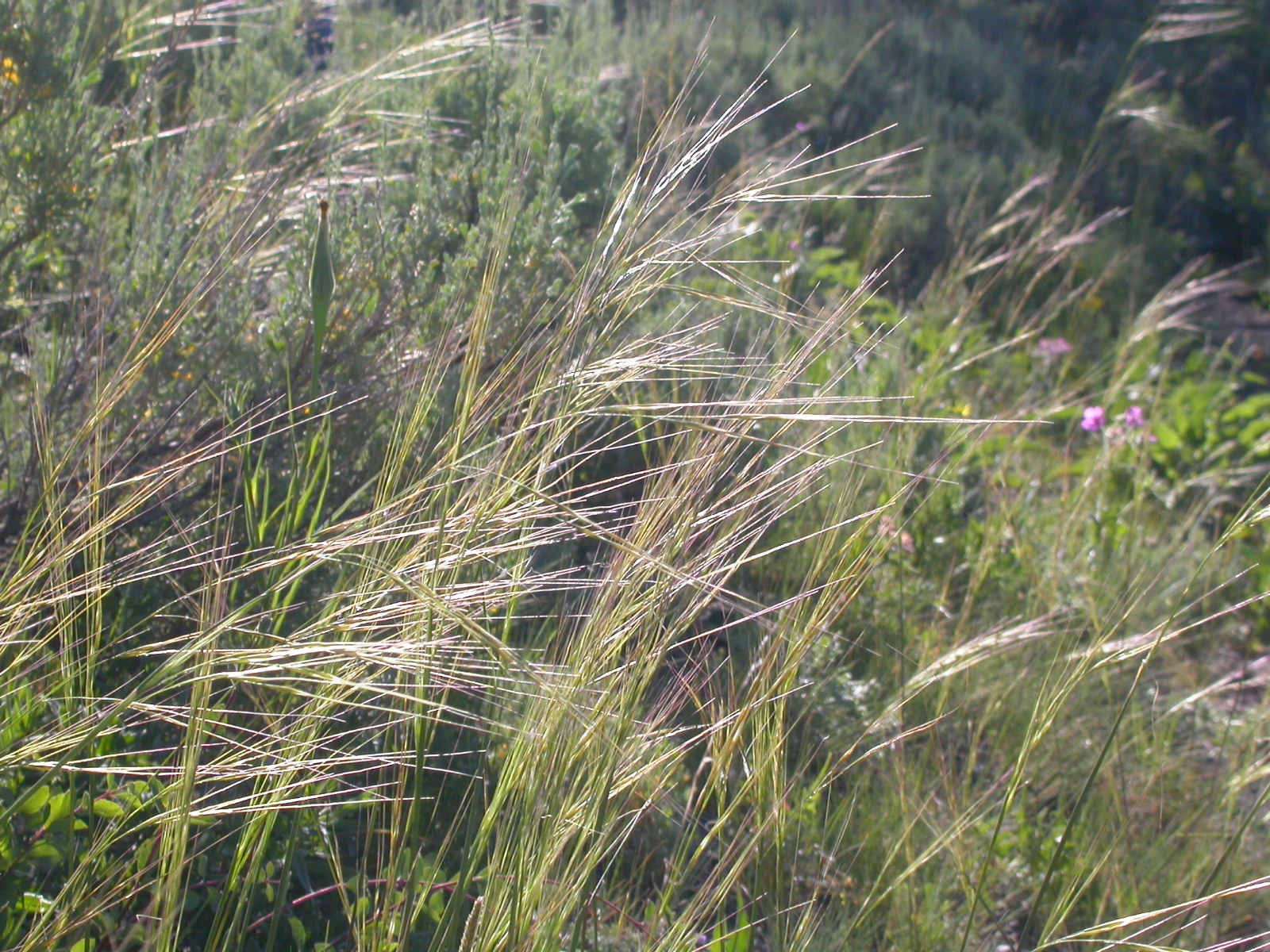
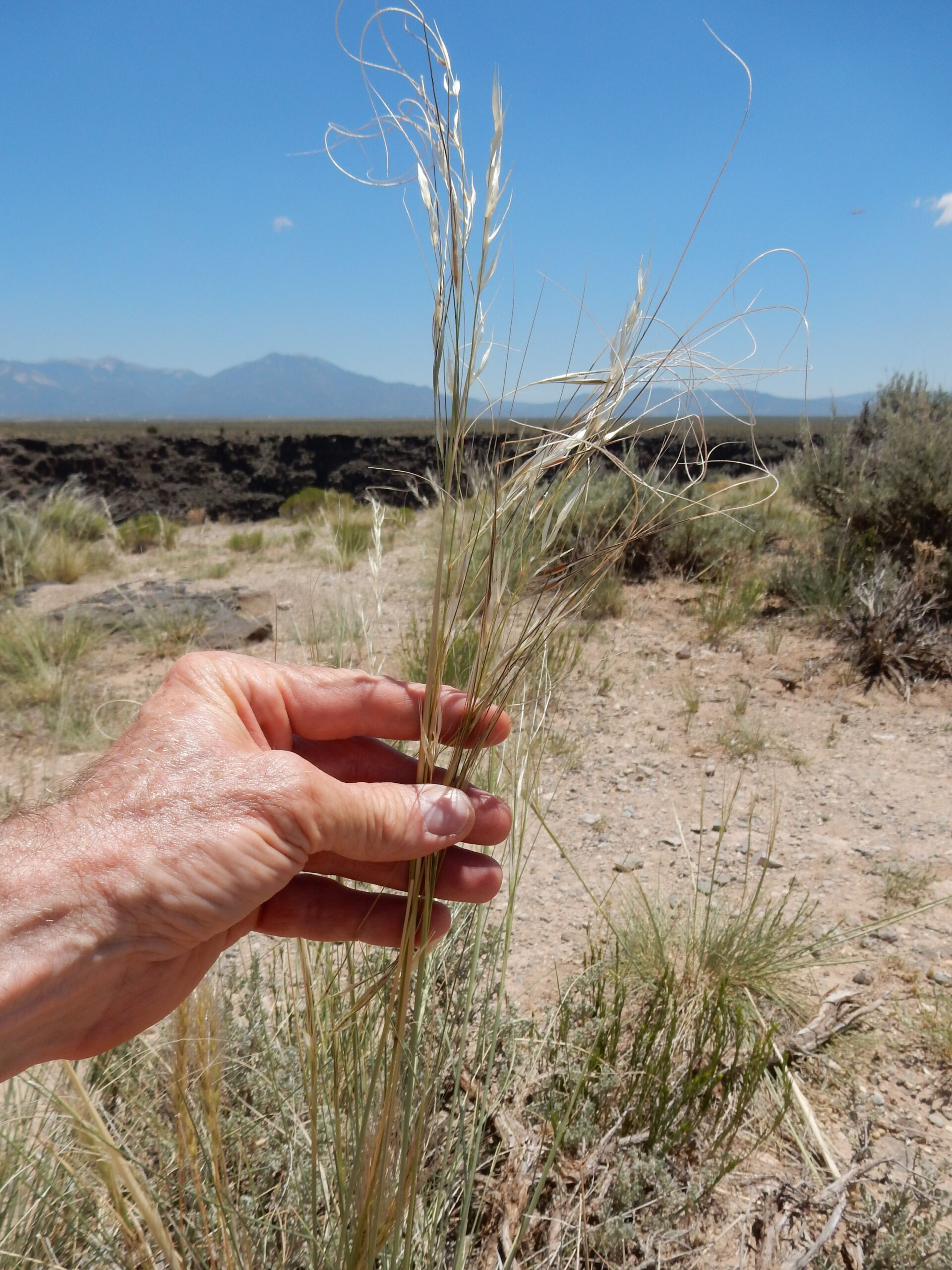
Here is the honest taxonomic tangle, because needlegrass is a common name, not a genus, and the botanists have been rearranging this furniture for decades. For most of the twentieth century, nearly every needlegrass in North America was filed under one big genus, Stipa. Then the splitters arrived. Purple needlegrass, the California state grass, was moved from Stipa pulchra to Nassella pulchra in the Jepson Manual treatment of 1993. Other former Stipa species were reassigned to Achnatherum and Hesperostipa, and more recent molecular work has moved many western American species onward again into genera such as Eriocoma. The Jepson Manual, second edition, went back to calling purple needlegrass Stipa pulchra, while Plants of the World Online keeps it in Nassella. Nobody is wrong exactly; they are just using different editions of the same argument. This guide covers the needlegrass group as gardeners and butterfly guides actually meet it: the genera Stipa, Nassella, and Achnatherum, the three names the butterfly guides and most garden references use, with a plain warning that your seed packet or nursery tag may use any of the newer names for the same plant.
What unites the group is not a genus label but a piece of engineering. The floret has a sharp, bearded callus at its base — the needle point — and a long awn that twists and untwists with changes in humidity. That twisting is not decorative. As the awn coils and uncoils, it literally drills the seed into the soil, point first, like a self-planting screw. It is one of the cleverest seed-planting mechanisms in the grass family, and it is also why you should not walk through a ripe needlegrass stand in shorts. The seeds are very good at drilling, and they are not picky about what they drill into. Socks, shoelaces, and dog fur are all acceptable substrates as far as the grass is concerned.
Florida note: Be straight with yourself here: needlegrasses are creatures of western prairies, dry slopes, and California grasslands, not Florida gardens. They want lean, well-drained soil and dry air, and they sulk in Florida humidity. This guide earns its place because skipper caterpillars across the West eat these grasses, and because a gardener in a dry climate — or a gardener who just loves grasses — will meet them. If you are gardening in Florida, admire needlegrass in a meadow planting up north, and plant a warm-season native grass at home instead.
How to grow
Needlegrasses are bunchgrasses, which is the first thing to understand about growing them. They do not run. They do not form a lawn. They sit in one place, form a handsome clump, and slowly get wider and more beautiful over the years, like a person who has found a good chair and sees no reason to leave it. Plant them in full sun in well-drained soil, and then mostly leave them alone. They are built for lean conditions: dry slopes, clay soils, serpentine soils, and places where fussier grasses give up. Purple needlegrass, for example, grows well on clay and serpentine soils and in grassland, chaparral, and oak woodland, and its roots can reach astonishing depths — reports put the root system of purple needlegrass at up to 20 feet deep, which is why a mature clump shrugs at droughts that kill everything around it.
Sow seed in fall, which mimics the natural cycle: seed drops in late spring and summer, rests through the dry season, and germinates with cool-season rain. Give each clump room to reach its mature width rather than cramming plants together; needlegrass looks best as spaced individuals or loose drifts, where the seed heads can catch the light and move. Do not enrich the soil and do not overwater. Rich, wet soil makes these grasses floppy, short-lived, and prone to rotting at the crown — the plant equivalent of being loved too hard. Lean soil, sharp drainage, and sunshine are the whole recipe. Once established, most needlegrasses need almost no care beyond an annual haircut: cut the old foliage back in late winter before new growth starts, and leave the seed heads standing through fall and winter if you can, because birds eat the seed and the dried awns look spectacular in low winter light.
For a butterfly or wildlife garden, the trick is restraint. Skipper caterpillars feed on these grasses, so a needlegrass patch earns its keep by simply existing and not being mowed to the ground every week. Mow or cut only once a year, after seed has ripened, and leave a patch uncut each year if you can — caterpillars overwinter in grass crowns and leaf litter, and a single annual scalp removes their whole winter address. If you are growing needlegrass for restoration or erosion control, plant in fall, keep competition down in the first year while the deep roots establish, and be patient: these are slow first-year plants that pay off for decades.
Water & feeding
Water to establish, then back off. That sentence is the entire watering manual for needlegrass. In the first season, water when the soil is dry a few inches down so the roots chase moisture downward and build the deep system the plant is famous for. After that, most needlegrasses are drought-tolerant and prefer to be left dry between waterings. Constant irrigation, especially in summer, is how you kill a dry-country grass with kindness. If your climate gives the plant a dry summer rest, let it have it; the foliage may go tawny, and that is not failure, it is the plant doing what it evolved to do.
On feeding: do not. Needlegrasses evolved on lean soils, and fertilizer mostly buys you taller, weaker growth that flops over and shades out the wildflowers around it. If you are restoring a badly degraded site, a soil test is worth more than a bag of anything. The one amendment that genuinely helps in heavy clay is not fertilizer but drainage — plant on a slope, a mound, or a raised bed of gritty soil so water never sits on the crown in winter. A topdressing of gravel mulch around the crown keeps the base dry and looks honest, like the plant’s native hillside.
Common problems
- Seeds in socks, pets, and skin: The needle-like awns and sharp calluses drill into fabric, fur, and occasionally skin. This is not a defect; it is the plant’s reproductive strategy. Keep needlegrass out of paths where dogs run, and do not plant it beside a seating area where people brush past ripe seed heads.
- Crown rot in wet soil: The number one killer in gardens. Needlegrasses need drainage. If your soil stays wet in winter, plant on a mound or choose a different grass.
- Self-seeding enthusiasm: Some needlegrasses self-sow freely, and a few, such as serrated tussock (Nassella trichotoma), are serious invasives outside their native range. Check your local extension list before planting any needlegrass, buy named species from reputable sources, and deadhead if volunteers appear where they are not wanted.
- Taxonomic whiplash: Your plant may arrive labeled Stipa, Nassella, Hesperostipa, or Eriocoma depending on the source and the year. Match the common name and the description, not just the genus on the tag, and keep the tag — future you will want to know which name you actually planted.
- Slow first year: Needlegrass spends its first season growing roots, not top growth. A small, unimpressive first-year clump is normal. Judge it in year two or three, when the seed heads arrive.
Harvest
Needlegrass is not harvested like a vegetable, but it does have a harvest: seed, and timing matters. The seed collection window is short — for purple needlegrass, roughly a two- to four-week window in mid to late spring, when the seed is ripe but before the awns carry it all away. Collect by stripping ripe seed heads into a paper bag, wearing gloves and long sleeves, because you already know what the awns do. Dry the seed thoroughly, clean off the chaff if you plan to sow it, and store it cool and dry. For a wildlife garden, the best harvest is no harvest at all: leave the seed standing for birds, let some of it drill itself into the soil, and cut the old stems only in late winter. The plant has been harvesting itself for millions of years; it does not need your help, just your restraint.
Saving seeds
This guide covers the needlegrass group — Stipa, Nassella, and Achnatherum species — and the seed advice is genus-level for a good reason: these grasses all share the same remarkable trick, and the same handling warning. Each seed carries a long, needle-like awn that twists and untwists with changes in humidity, corkscrewing the seed into the ground like a self-drilling screw. It is one of the cleverest seed designs in the plant world, and it means you should wear gloves when you collect seed — a dry needlegrass awn in a fingertip is a splinter with ambitions.
Collect the seed in late summer or fall, when the seed heads are dry and the seed strips easily from the stem, but before the heads shatter and sow themselves. Strip the heads into a paper bag, let them dry fully, and clean out the chaff. Some needlegrass seed sows best fresh, in fall, letting a real winter do the stratifying; stored seed usually benefits from a cold, moist stratification of four to eight weeks in the fridge before a spring sowing. The sources disagree on the exact length by species, so a fall sowing outdoors is the simplest honest answer, and a month or two in the fridge is the indoor equivalent.
Sow the seed shallowly — barely covered — in a well-draining mix, and keep it moist and bright. Germination is uneven and can take weeks, and the seedlings are fine and grassy at first. Grow them on in pots for a season before planting out, and give them the sharp drainage they want.
One caution that belongs here: some needlegrasses self-seed with enthusiasm, and a few species are weedy outside their home range, so check your local lists and deadhead the seed heads you do not want to keep. Save seed from your strongest, best-formed plants, label the bag — needlegrass seed all looks alike — and keep it dry and cool, because Florida humidity is the enemy of stored seed.
Species in this group
- Purple needlegrass — Nassella pulchra (syn. Stipa pulchra): California’s state grass, named in 2004. A perennial bunchgrass to about 1 metre tall, with a nodding inflorescence up to 60 centimetres long and awns up to 10 centimetres long, twisted and bent twice, purple-tinged when young. Roots can reach 20 feet deep. Grows on clay and serpentine soils in grassland, chaparral, and oak woodland.
- Green needlegrass — Nassella viridula (syn. Stipa viridula): A Great Plains bunchgrass of bottomlands, benches, and stream overflow areas, known as green needlegrass, feather bunchgrass, or green stipagrass. A cool-season perennial valued as forage.
- Foothill needlegrass — Nassella lepida: A California needlegrass of foothill woodlands and grasslands, one of the native Nassella species of the San Francisco region alongside nodding needlegrass.
- Nodding needlegrass — Nassella cernua: Named for its nodding seed heads, a California native closely related to purple needlegrass and long confused with it; the two were only separated as species in 1941.
- Feathergrass / silver needlegrass — Achnatherum calamagrostis: The type species of Achnatherum, a Eurasian needlegrass of temperate regions. Achnatherum holds about 20 species native to temperate Eurasia and North Africa, and its species have been shuffled between Achnatherum and Stipa for two centuries.
- Indian ricegrass — Achnatherum hymenoides: A western American species famous as a grain plant of Indigenous peoples, with plump seeds that were harvested as food. It occasionally hybridizes with green needlegrass, producing a sterile hybrid.
- Richardson’s needlegrass — Achnatherum richardsonii (syn. Stipa richardsonii): Spreading needlegrass of northern meadows and open woods, one of the species moved from Stipa to Achnatherum in the great reclassification.