
🌴 Palmetto
What it looks like

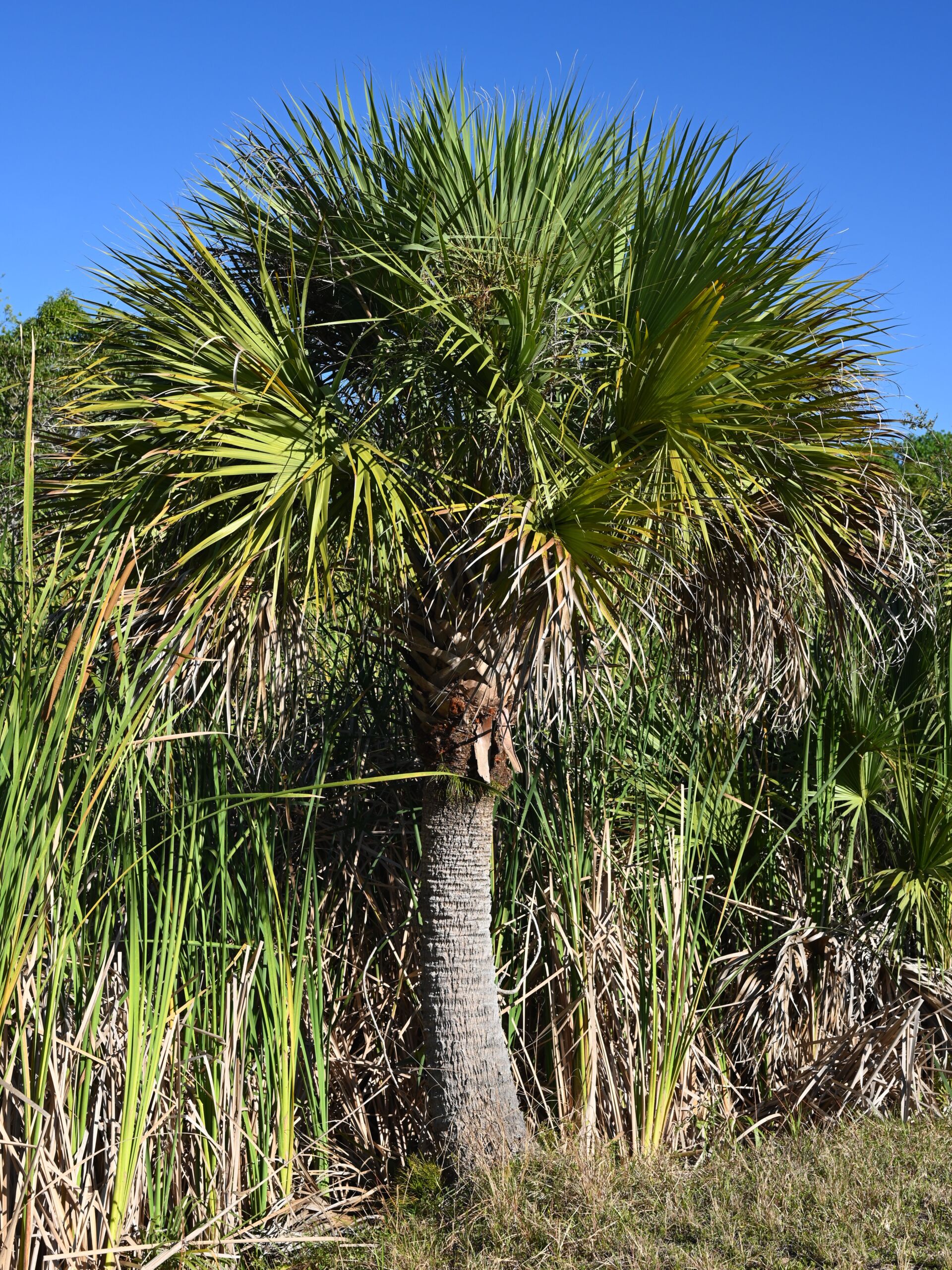

“Palmetto” is not one palm. It is a whole cast of fan palms that share a name, a leaf shape, and a southeastern address — and this guide covers the cast honestly, because the butterfly guides that mention “palmettos” do not mean a single species. The two genera at the heart of the name are Sabal, the cabbage palms and their smaller relatives, and Serenoa, a genus of exactly one species, the saw palmetto (Serenoa repens). Both have fan-shaped leaves — palmate fronds that spread like an open hand — both are native to the southeastern coastal plain, and both show up, singly or together, wherever the word “palmetto” appears in a butterfly guide. A guide that pretended palmetto meant only one of them would mislead half its readers.
Saw palmetto is the low one: a slow-growing, clump-forming palm usually four to six feet tall, occasionally taller, with creeping, branching stems that sprawl along or just under the ground and send up fans of stiff, blue-green to yellow-green leaves. The “saw” in its name is literal and should be respected — the leaf stems, or petioles, are edged with sharp, backward-pointing teeth that saw skin on contact. In spring it sends up branched stalks of small, fragrant, creamy-white flowers that smell of honey and draw bees, butterflies, and flies by the thousand, followed by dark, olive-like berries that feed bears, raccoons, deer, and more than a hundred bird species. A saw palmetto thicket is a dense, evergreen, fire-adapted fortress of a plant, and it can live for centuries.
Cabbage palm, Sabal palmetto, is the tall one: the state tree of Florida and South Carolina, a single-trunked palm that can reach sixty feet or more, with a crown of large fan leaves and, in old specimens, a trunk wrapped in a skirt of old leaf bases. Its smaller relatives — dwarf palmetto (Sabal minor), scrub palmetto (Sabal etonia), and others — fill the middle ground between saw palmetto’s sprawl and cabbage palm’s tower, as low, trunkless or short-trunked fans of pine flatwoods, scrub, and hammock edges. All of them share the fan leaf, the tolerance for sand and fire, and the habit of standing exactly where the Southeast gets hot, dry, and salty.
The butterfly evidence spans both genera, which is why this is a group guide. The Palmetto Skipper guide names its host precisely: “palmettos, including saw palmetto (Serenoa repens)” — the caterpillar shelters in palmetto leaves, feeding from inside a leaf shelter scaled up to palm size. The Palatka Skipper guide is broader, listing “palmettos and related plants of wet habitats” as caterpillar food and urging readers to leave palmettos standing in wet flatwoods. That breadth is honest to the guides, and this guide preserves it — with one plain-text correction in the honest-gaps note: outside sources list swamp sawgrass (Cladium jamaicense), a sedge, as the Palatka Skipper’s primary documented host, so a reader should not plant palmettos expecting a Palatka colony. The palmetto story here belongs first to the Palmetto Skipper and to the flatwoods habitat both skippers share.
Ecologically, palmettos are foundation plants of the Southeast. Saw palmetto alone supports an extraordinary cast — bears denning in its thickets, panthers sheltering in them, birds and mammals eating its berries, bees and butterflies working its flowers, and the Palmetto Skipper and Monk Skipper eating its leaves. Cabbage palm crowns shelter birds and bats, its flowers feed pollinators, and its fallen fronds feed the soil. Both genera are fire-adapted, resprouting vigorously after the prescribed burns that maintain flatwoods and scrub, and both stabilize sandy soil with deep, fibrous root systems. A palmetto landscape is not empty ground waiting for a garden; it is a complete ecosystem wearing a palm costume.
How to grow
Grow palmettos the way the Southeast grows them: in full sun to part shade, in sandy, well-drained soil, and with patience. Saw palmetto is famously slow — a plant can take years to look like much, and decades to form a real thicket — but it is also famously tough once established, tolerating drought, salt spray, poor sand, and fire. Cabbage palm is faster in its early years and wants the same sun and drainage, with more room overhead and a site where a sixty-foot trunk will not meet a roofline or a power line. Dwarf and scrub palmettos fit smaller yards, as low fans that need little more than sun and sand.
Plant in spring or early summer, from nursery-grown container stock — wild-collected palmettos transplant poorly and should not be dug — and water deeply until established, then back off. Space saw palmetto clumps several feet apart and let them merge into a thicket; space cabbage palms 10 to 15 feet apart or as single specimens. Do not bury the growing point, do not over-prune the crown (a palm’s crown is its whole factory, and “hurricane cuts” that strip it to a mohawk weaken the tree), and do not expect instant gratification. A palmetto garden is a long game, and the payoff is a plant that will outlive the gardener.
Florida note: Florida is palmetto country, and this is one group guide where Florida gardeners are the home audience. Saw palmetto is native statewide, cabbage palm is the state tree, and dwarf and scrub palmettos are native across the peninsula and panhandle. Plant them in native, sandy, sunny sites — flatwoods edges, scrub gardens, coastal yards — and let them do what they evolved to do. The Florida cautions are about setting, not climate: keep palmettos out of wet, mucky ground that stays waterlogged (they want drainage, not a swamp), keep saw palmetto’s saw-toothed stems away from bare-legged paths, and never harvest wild berries or plants from natural areas. Nursery stock, planted in sun and sand, is the whole plan.
Management is mostly about restraint. Do not prune palmettos into topiary, do not strip their crowns, and do not fight their slow growth with fertilizer — heavy feeding produces soft, salt-sensitive growth in a plant whose virtue is toughness. Remove only dead, brown fronds, and leave green fronds alone: a palm cannot regrow a frond it loses, and every green frond is feeding the trunk, the roots, and the next year’s flowers. A palmetto left mostly alone, in sun and sand, is a palmetto doing its job.
Water & feeding
Water deeply while establishing, then let the plant prove its drought tolerance. Saw palmetto and cabbage palm both survive dry spells that kill thirstier ornamentals, and both resent constantly wet, poorly drained soil far more than they resent drought. In a normal Florida rainy season, established palmettos need little supplemental water; in a drought, a deep soak every few weeks beats daily sprinkling. Mulch with pine straw or wood chips to hold moisture and to mimic the leaf litter of a flatwoods floor.
Feeding: lean, and palm-aware. Palms need potassium and magnesium more than nitrogen, and a palm-specific fertilizer applied sparingly in spring is the right scale — or, in a native planting, no fertilizer at all. Over-fertilizing with high-nitrogen lawn food produces weak growth and can worsen the potassium deficiency (frizzletop) that plagues overfed palms. In sandy native soil, a palmetto that looks a little lean is usually a healthy palmetto; the plant evolved on sand, not on lawn food.
Soil science note: palmetto soil is alive in a particular way. The deep, fibrous roots of saw palmetto and the mycorrhizal fungi that partner with them stabilize sand, hold organic matter, and support a soil community adapted to fire, drought, and low fertility — a community that lawn fertilizer disrupts. The annual rain of palmetto fronds and berries returns organic matter to that sand, year after year, building the thin, dark topsoil of a flatwoods floor. Planting a palmetto is therefore not just planting a palm; it is installing the anchor species of a soil system that took centuries to form, and the gardener’s best contribution is to leave that system alone.
Common problems
- Saw-toothed stems. Saw palmetto petioles saw skin. Wear gloves and long sleeves when working in a thicket, and site it away from bare-legged paths.
- Slow growth. Saw palmetto is genuinely slow, especially from seed. Buy container stock, be patient, and do not try to force speed with fertilizer.
- Over-pruning. Stripping green fronds weakens palms and invites disease. Remove only dead, brown fronds, and never “hurricane cut” a healthy crown.
- Wet, mucky soil. Palmettos want drainage. Constantly waterlogged ground rots roots; plant in sand or on a rise, not in a swampy hollow.
- Potassium deficiency (frizzletop). Yellow, frizzled new fronds on a palm usually mean potassium shortage, worsened by high-nitrogen fertilizer. Use palm fertilizer sparingly, or none at all in a native planting.
- Wrong expectations for Palatka Skipper. Do not plant palmettos expecting a Palatka Skipper colony — outside sources list sawgrass as its primary host. Plant palmettos for the Palmetto Skipper, the habitat, and the wildlife, and let the Palatka Skipper’s sawgrass marshes be protected where they are.
Harvest
Palmetto’s harvest is berries, fronds, and habitat — with firm boundaries. Saw palmetto berries are famously harvested commercially, and this guide does not recommend wild harvesting: berries belong to the wildlife that depends on them, and commercial harvesting in natural areas is regulated and contested. For home gardeners, the harvest is simpler: collect fallen fronds for mulch, let berries feed the birds and mammals in your own yard, and enjoy the flowers’ honey scent in spring. Cabbage palm hearts — the “cabbage” in its name — were historically eaten, but harvesting a heart kills the palm, so this guide does not recommend it from a garden tree you want to keep.
The real harvest is the habitat itself. Leave a palmetto thicket standing, unsprayed, and unpruned beyond dead fronds, and watch for the Palmetto Skipper’s large leaf shelters, for bees working the spring flower stalks, and for birds and mammals using the thicket as shelter and pantry. A palmetto patch is a harvest that arrives every year without planting, watering, or picking — provided the gardener’s main contribution is restraint.
Browse all plant & pest guides
Saving seeds
This guide covers the palmettos — Sabal species and saw palmetto, Serenoa repens — and the seed advice is group-level: the species differ in their details, but they all play by the same basic rules. Collect the fruit when it is fully ripe and dark — black berries for saw palmetto, dark drupes for Sabal — and clean the flesh off the seed completely. The pulp can inhibit germination and will rot in the pot, so mash the fruit in water, rinse the seed well, and dry it briefly on paper.
Sow the seed fresh. Palmetto seed is recalcitrant, which means it cannot be dried and stored like a bean seed — sow it within days or weeks of harvest, not months. Sow it shallowly in a warm, moist, well-draining mix, and keep it warm and bright: around 80°F is the sweet spot, which in Florida’s warm season is just a sunny spot out of direct scorching sun. Germination is slow — weeks to months is normal, and saw palmetto in particular can take several months — so do not give up on a pot at six weeks, and do not dig the seed up to check on it. Palms germinate root-first, and the shoot follows weeks later.
Seedlings grow slowly, and saw palmetto seedlings are slow even by palm standards — a seedling will spend its first years as a low rosette before it ever thinks about trunking up. Grow them on in pots until they are sturdy, then plant them out in full sun to part shade.
Save seed from a healthy plant, sow more than you need, and keep any stored seed cool and damp, never dry. And one thing worth knowing about the seed you are saving: saw palmetto berries are a wildlife food and a traditional medicine, so harvest modestly and leave plenty for the birds and the bears — the plant feeds more than your garden.
Species
The palmetto group, as this guide scopes it, has two genera and a handful of garden-relevant species. Saw palmetto (Serenoa repens) is the low, clumping, saw-stemmed species and the Palmetto Skipper’s named host, covered in depth by the site’s native-plant profile. Cabbage palm (Sabal palmetto) is the tall, single-trunked state tree, also covered by a native-plant profile. Dwarf palmetto (Sabal minor) is a low, trunkless or short-trunked fan palm of wet flatwoods edges and shady hammocks. Scrub palmetto (Sabal etonia) is a low scrub species of dry, sandy scrub. Miami palmetto (Sabal miamiensis) is a rare, low species of southeastern Florida scrub. No named garden cultivars of the group as a whole were verified for this guide; palmettos are grown as straight species from nursery stock, and the variation gardeners see is between species and between the green and silver-blue forms of saw palmetto, not between catalog varieties. Plant the species that matches your site — saw palmetto for a thicket, cabbage palm for a tree, dwarf palmetto for a small yard — and let the word “palmetto” on a butterfly list mean the group, as it does in the guides.