
🌼 Pearly Everlasting
What it looks like
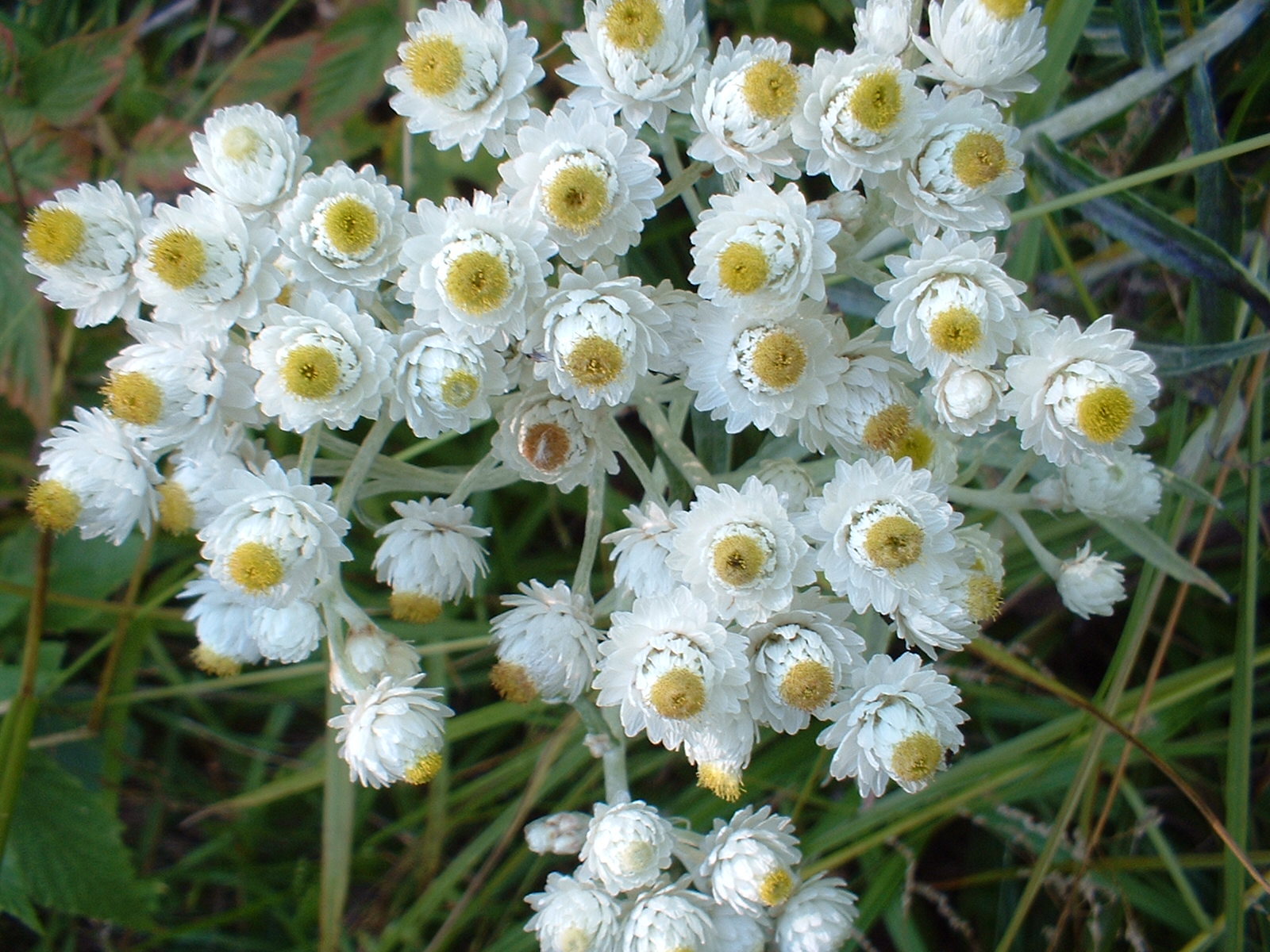
Pearly everlasting is a tall, herbaceous perennial wildflower in the sunflower family (Asteraceae), and it looks like it dressed for winter in the middle of summer. The stems, 1 to 3 feet tall, are covered in white woolly hairs, and the narrow, lance-shaped leaves are grey-green on top and woolly-white underneath, giving the whole plant a soft, frosted look even in July. At the top of each stem sits the reason for the name: a flat-topped to rounded cluster, a corymb, of small flower heads, each one about a quarter of an inch across, wrapped in layer upon layer of pearly-white, papery bracts that surround a tiny cluster of yellow disc florets. From a distance the clusters look like little white buttons or, as one field guide writer memorably put it, fried eggs: a white nest with a central yellow clutch. Up close they look like something made of porcelain. And they keep looking that way long after cutting, which is the entire point of the word “everlasting.”
The species is widespread across most of Canada and the United States, as well as northwestern Mexico, with Asian populations across China, the Russian Far East, Japan, Korea, and the Himalayas — a genuinely continental plant, not a local curiosity. It is also dioecious, which is unusual for a sunflower-family plant and a fun piece of dinner-party botany: the pollen-producing male flowers and the seed-producing female flowers grow on separate plants, so a patch of pearly everlasting is a neighborhood of boys and girls, not a field of hermaphrodites. For butterflies, it plays both sides of the table. In the butterfly guides it appears as a host plant for the American lady, whose caterpillars feed on everlastings, and as a nectar plant for the mariposa copper. That double duty — caterpillar food and adult nectar in the same species — is rarer than it sounds, and it makes a patch of pearly everlasting a small, complete butterfly waystation all by itself.
A word of disambiguation, because the name “everlasting” gets around. This guide claims Anaphalis margaritacea only. It is not the strawflower or the curry plant or any of the other plants sold as everlastings, and it is not a Helichrysum or a Xerochrysum wearing a borrowed name. If the plant in front of you has woolly stems, narrow leaves, and flat-topped clusters of papery white buttons with yellow centers, and it grows wild across North America, you are in the right place. Everything else is a different plant with a similar marketing department.
Only one verified photo could be confirmed for this guide — a second candidate’s file page returned a 403 and was dropped rather than retried — so the single flower portrait above carries the gallery alone, with no substitute species slipped in.
How to grow
Pearly everlasting is a wildflower first and a garden plant second, and it grows best when you treat it like one. Give it full sun to light shade and well-drained soil — it tolerates poor, sandy, rocky, and gravelly ground that would starve a fussy perennial, and it is at home in meadows, open woods, roadsides, and rocky slopes. Sow seed in fall or early spring, or start indoors and transplant out after frost, spacing plants 12 to 18 inches apart. It spreads by rhizomes into patches, which is a feature in a meadow planting and a thing to watch in a small bed: give it room to colonize, or be ready to edit the edges. It needs no pampering, no staking at its modest height, and no rich soil — in fact, overly rich soil produces floppy growth that falls over and looks embarrassed.
The plant’s wool is not decoration. Those white, woolly hairs on stems and leaf undersides are trichomes that reflect sunlight, slow water loss, and make the leaves unpalatable to many insects — one field guide notes that insect foliage feeders are not numerous on this plant, “owing to its protective downy gloss,” which is a polite way of saying the plant wears armor made of fuzz. That same fuzz is part of why it handles poor, dry, exposed sites so well. Grow it where other perennials sulk: a dry bank, a gravelly border, the sunny edge of a meadow. It will not thank you with words. It will thank you by thriving while everything around it wilts.
Florida note: Honesty again, because Florida gardeners keep getting sold cool-climate plants with a smile. Pearly everlasting is a cool-summer perennial, and Florida’s heat and humidity are not its climate. In the Panhandle, in a well-drained, sunny spot with afternoon shade and good air movement, it may persist as a short-lived experiment, but in most of the peninsula it will melt out in summer. This guide exists because butterfly guides list it as a host and nectar plant across its real range, not because it is a reliable Florida garden plant. Plant it in Florida only as a trial, and do not be surprised if the trial teaches you something.
Water & feeding
Water needs are low to moderate once established. Water to establish transplants and during dry spells in the first season, then let it fend for itself in most climates: this is a plant of meadows and roadsides, not of irrigated borders, and it would rather be a little dry than wet. Soggy soil, especially in winter, is the fastest way to lose it. Good drainage matters more than regular watering, and a gravel mulch suits it better than a moisture-holding bark mulch.
Feeding: do not bother. Pearly everlasting grows on poor soils by design, and fertilizer produces soft, floppy stems and fewer of the tight, papery flower heads you actually want. A thin top-dressing of compost in spring, if the soil is truly exhausted, is the upper limit of generosity. The soil science note is simple: this plant trades fast, lush growth for toughness — woolly leaves, rhizome spread, and flowers built out of dry bracts rather than soft petals — and that trade is why it survives where pampered perennials do not.
Common problems
- Melting out in heat and humidity. The big one in warm climates. Pearly everlasting is a cool-summer plant, and hot, humid summers cause it to decline or die outright. Site it for air movement and afternoon shade at the warm edge of its range, and accept that it may be short-lived there.
- Spreading beyond its welcome. Rhizomes make patches, and patches become colonies. In a small bed, divide every few years or edge the planting; in a meadow, let it run.
- Floppy growth in rich soil or shade. Too much nitrogen or too little sun produces tall, weak stems that flop. Lean soil and full sun keep it upright and compact.
- Wet winter soil. Poor drainage in winter rots the crown and roots. Plant high, in gritty soil, and never in a low spot that ponds.
- Confusion with other everlastings. Garden centers sell several plants as everlastings. Check the Latin name: if it does not say Anaphalis margaritacea, it is not this plant, whatever the tag promises.
- Short-lived in the wrong climate. Even in suitable zones it is not immortal. A patch renews itself by rhizomes and self-seeding; individual stems come and go, and that is normal.
Harvest
Harvest is where pearly everlasting earns its name, and it is gloriously simple. Cut the flowering stems when the heads are fully open and the white bracts are bright, then hang them upside down in a dry, airy place out of direct sun. Unlike most flowers, which wilt into a sad apology within days, pearly everlasting heads keep their shape and their pearly color for months, even years, because the showy part of the flower is not a petal at all — it is a dry, papery bract that was already built to last. The dried heads are a staple of dried-flower arrangements, wreaths, and winter bouquets, and a bunch cut in August will still look respectable at Christmas. Leave some heads standing, though: the seeds feed birds, the patch renews itself, and the American lady caterpillars that use this plant as a host need leaves, not just flowers.
The leaves and young plants have also been recorded as edible when cooked, and the plant has a history of medicinal and ceremonial use among Native peoples — but this guide does not present it as a food crop. Grow it for the butterflies, the dried flowers, and the sheer pleasure of a plant that looks like frost in August. That is harvest enough.
Browse all plant & pest guides
Saving seeds
Pearly everlasting is a wildflower whose blooms refuse to wilt, whose leaves wear wool, and whose seed is as easy as the flower is tough. Let a few flower heads ripen fully on the plant: the white, papery bracts dry and the seed inside shakes loose at a touch. Snip the dry heads into a paper bag on a dry day, crush them gently, and winnow out the chaff. The seed is tiny, with a tuft of fluff that carries it on the wind, so work indoors out of the breeze or you will be chasing it across the yard.
The one rule that matters is light. Pearly everlasting seed needs light to germinate, so sow it on the surface of a moist seed-starting mix and press it in gently, but do not bury it. A short cold, moist stratification of about 30 days in the fridge improves germination, though some seed will sprout without it — the sources disagree, so treat the chill as cheap insurance. Sow in spring, keep the mix moist and bright, and expect sprouts within a couple of weeks. The seedlings are small and slow at first; grow them on in pots until they are sturdy, then plant them out in full sun to light shade.
Division is the other route, and the faithful one: pearly everlasting spreads by rhizome, and a chunk of root with a shoot attached, dug in spring, is a guaranteed new plant. Seed is for the adventure, and for the gardener who wants a meadow rather than a clump.
One Florida reality check: pearly everlasting is a cool-summer perennial, and it struggles in hot, humid summers. If you are growing it in Florida, you are growing it as a cool-season curiosity in a pot with afternoon shade, not as a garden staple. Save the seed anyway if you love the plant — just do not expect a Florida summer to be kind to the seedlings. And keep saved seed dry and cool, because Florida humidity is the enemy of stored seed.
Species in this group
Pearly everlasting, typical form (Anaphalis margaritacea var. margaritacea) — the widespread North American and Asian form described in this guide, with pearly-white bracts and yellow disc florets.
Narrow-leaved pearly everlasting (Anaphalis margaritacea var. angustifolia) — an Asian variety with narrower leaves, recognized in some floras.
Western pearly everlasting — the same species under its other common name, used especially in the western United States; not a separate plant, just the same species with a regional nickname.
Other Anaphalis species — the genus holds over a hundred species across Asia, including the Himalayan everlastings, but only Anaphalis margaritacea occurs naturally in North America, and this guide claims that species alone.