
🦋 Privet Senna
What it looks like

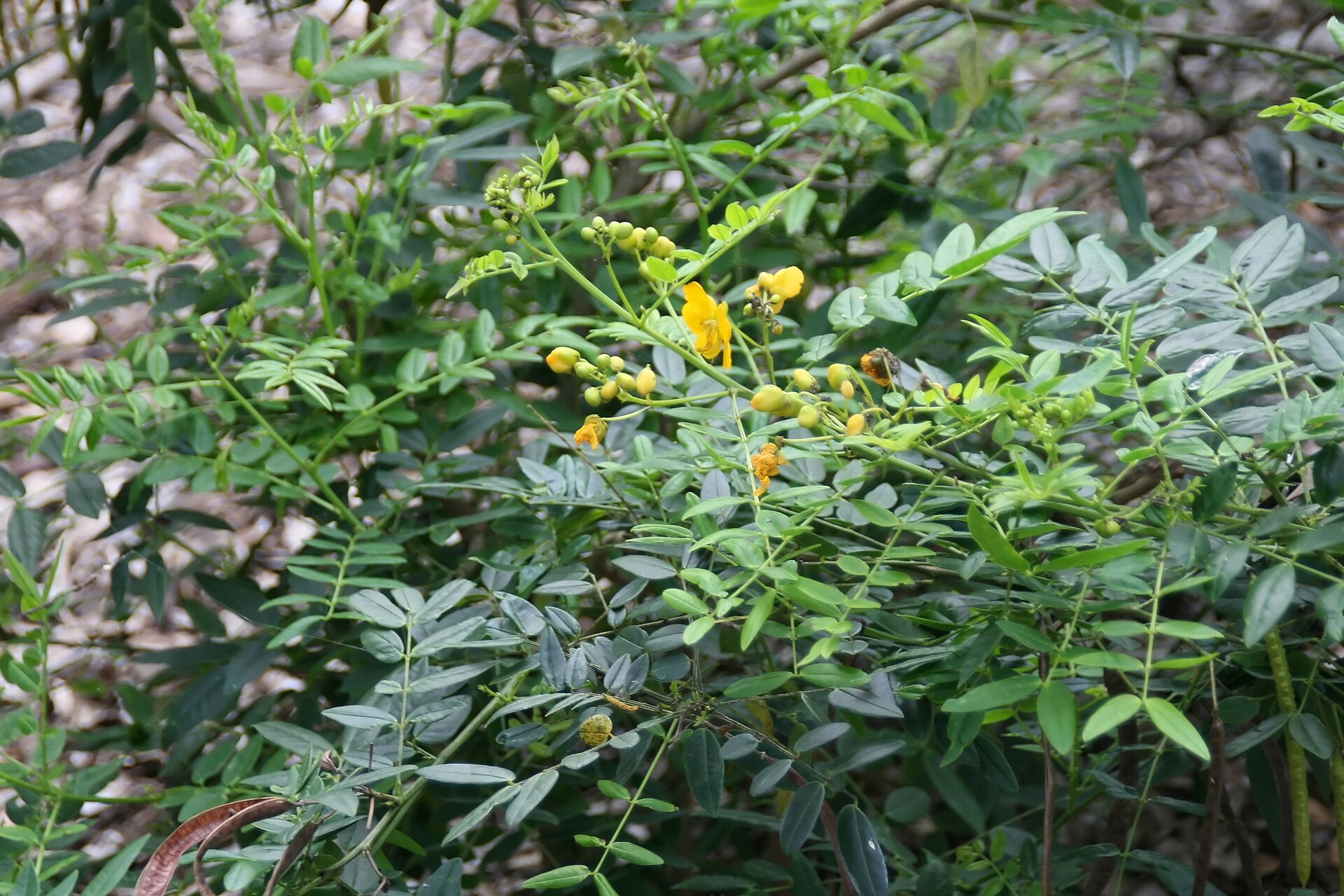
Privet senna is a tall, upright shrub with compound leaves and clusters of bright yellow, five-petaled flowers that bloom through much of the year in south Florida. It grows quickly to 6 to 8 feet, with an open, airy habit that suits the back of a butterfly border.
Its leaves are the point as much as its flowers: sulphur butterfly caterpillars eat them, and a healthy privet senna in summer will often carry caterpillars, chrysalises, and fresh yellow flowers at the same time. A plant that looks a little chewed in August is a plant doing its job.
Why this variety
Choose privet senna when you want a butterfly garden that actually raises butterflies, not just feeds adults. Cloudless sulphurs, orange-barred sulphurs, and sleepy oranges all use sennas as host plants, and privet senna is the longer-lived, taller Florida native to plant when Bahama cassia is too tender or too short-lived for your spot.
It is also a fast, forgiving shrub for a new garden: it grows quickly, flowers in its first year, tolerates a range of soils, and reseeds generously, so a freeze that kills the top often leaves you with seedlings in spring. That resilience is worth more than a perfect shape.
How to grow
Plant in sun to part shade in well-drained to moist soil, in fall or spring. Water deeply at planting and through the first dry season, mulch, and give it room to reach 6 to 8 feet. It can be cut back hard in spring if it gets leggy, and it regrows fast.
Prune after a flush of bloom to keep it bushy, or let it grow tall at the back of a border. If caterpillars defoliate it, leave them alone: the plant regrows, and the caterpillars are the reason you planted it.
Water & feeding
Water deeply once a week while it establishes, then water in dry spells. Privet senna tolerates moist soil and short wet periods better than many sennas, but it does not want to stand in water.
Feed with compost in spring. As a legume it fixes some of its own nitrogen, so heavy fertilizer is unnecessary and can push soft growth that flops.
Common problems
Caterpillar damage: this is not a problem, it is the purpose. If you cannot tolerate chewed leaves, plant privet senna at the back of the border where the butterflies can work unseen.
Freeze damage: a hard freeze can kill the top growth. Wait until spring, cut back to live wood, and watch for seedlings; privet senna reseeds readily.
Self-seeding: it seeds generously. Pull seedlings where you do not want them, and do not let it seed into natural areas.
Short life in the north of its range: in central Florida, treat it as a short-lived perennial that reseeds, not as a permanent shrub, and keep a few seedlings coming.
Harvest
There is no edible harvest. The harvest is butterflies: sulphurs laying eggs, caterpillars eating leaves, chrysalises on stems, and adults nectaring on the yellow flowers, all on one plant.
If you want to enjoy the flowers indoors, cut a few stems in the morning, but leave most of them for the butterflies. A privet senna in full butterfly season is worth more in the garden than in a vase.
Browse all plant & pest guides
Saving seeds
Privet senna — Senna ligustrina, the tall yellow senna that keeps sulphur butterflies in caterpillars for most of the year — saves its seed in flat pods that dry and split when they are ready. Let the pods dry fully on the plant until they turn brown and papery, then snip them into a paper bag and shell the small, dark seed out. One shrub makes plenty of seed, so save from the plant with the healthiest growth and the most flowers, because that is the plant the butterflies already voted for.
The seed coat is hard, and scarification is the step that matters. Rub the seed gently with sandpaper or nick it with a knife, taking care not to damage the embryo inside, then soak it in warm water for 12 to 24 hours — it should swell, and if it does not, scarify a little more and soak again. Sow about a quarter inch deep in well-draining mix, keep it warm — 70 to 80°F — and evenly moist. Germination takes 1 to 2 weeks when conditions are right, and the seedlings grow fast in Florida heat. Once seedlings have two sets of true leaves, pot them up and grow them on until they are sturdy enough to plant out after the last frost.
Privet senna is a Florida native, and that shapes the seed-saving goal: you are keeping a native going in a pollinator garden, a hedgerow, or a wild corner, not filling a pantry. Let a few plants go to seed each year and the patch renews itself — senna reseeds freely in a sunny, well-draining spot, so deadhead the pods you do not want seeding if you are keeping it in bounds. Seedlings vary a little in height and habit, and that variation is fine in a drift.
Store dry seed in a paper envelope in a cool, dry place; it keeps for a few years, though fresh seed germinates best. And plant it where the sulphurs can find it: full sun to part shade, well-draining soil, and room to grow tall. A senna in flower with sulphur caterpillars on it is the whole point of saving the seed in the first place.