
🌳 Scrub Oak
What it looks like
Forget everything you picture when someone says “oak.” Scrub oak is not a stately shade tree with a tire swing. It is a scrappy, deciduous shrub — sometimes a small, gangly tree — that usually stands 6 to 15 feet tall and occasionally stretches to 20 feet when it is feeling ambitious. What it lacks in height it makes up for in attitude: it grows in dense, tangled thickets, throwing up multiple crooked stems from a massive, long-lived taproot that can reach 8 inches thick. One plant becomes a thicket; a thicket becomes a neighborhood.
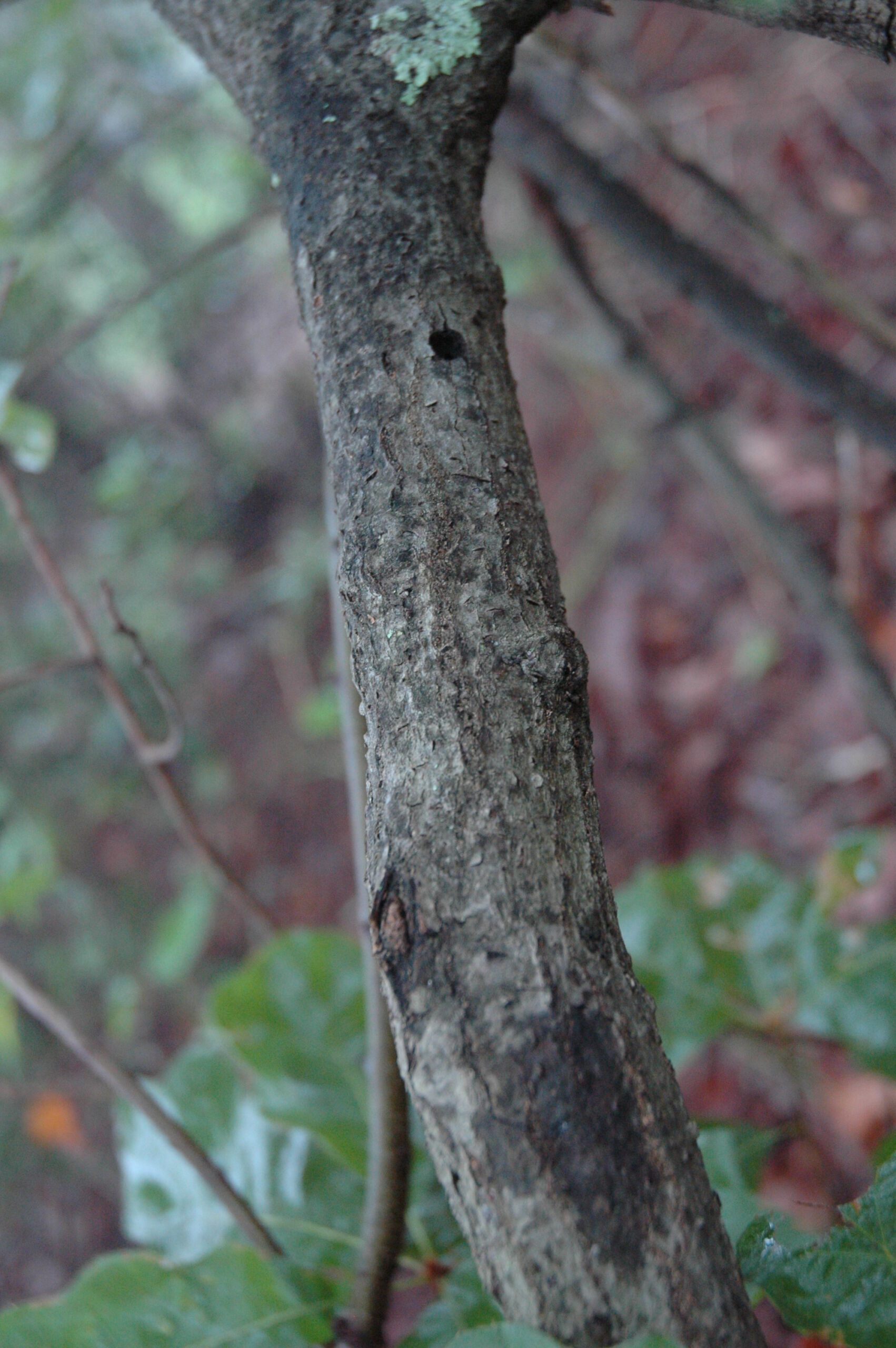
The leaves are the giveaway, and they are the reason for the Latin name: ilicifolia means “holly-leaved.” Each leaf is ovate to elliptic or obovate, 5 to 12 centimeters long, with 3 to 7 acute lobes separated by shallow sinuses and tipped with 5 to 14 little bristle-like awns — holly cosplay, but softer. The upper surface is glossy dark green; the underside is pale green to grey and softly hairy, a two-tone effect you can spot from several feet away. In spring the new leaves emerge pink, set off against dangling yellow catkins. In autumn the foliage turns flamboyant shades of orange to purple, and in winter some leaves hang on, brown above and yellow-grey below, in that half-deciduous habit botanists call marcescent.
Like all oaks, scrub oak is monoecious: one plant carries both the male catkins and the small, solitary or clustered female flowers. The fruit is an egg-shaped acorn, 1 to 2 centimeters long, sitting in a saucer-shaped cap — and here is the patient part. Scrub oak acorns are biennial, maturing in their second year, usually produced in pairs and often in large numbers. They are famously bitter, which does not stop bears from eating them with great enthusiasm in the run-up to hibernation, which is exactly how the tree earned its other common name, bear oak. White-tailed deer eat the acorns and browse the stems and foliage, squirrels cache the nuts, and wild turkeys reportedly prefer them over other foods. If you plant scrub oak, you are planting a pantry.
Florida note: This is not a Florida plant, and this guide does not pretend otherwise. Scrub oak is a northeastern and mid-Atlantic species, native from Maine south to North Carolina, with a few populations in Ontario, Canada. Its southern edge runs through the mountains of Virginia and two known populations in North Carolina, where it is rare and tracked as a state-listed plant. Florida gardeners should admire it from a distance and plant a southern oak instead — this one needs cold winters and the thin soils of the barrens, not subtropical summers.
Butterfly note: Scrub oak is a caterpillar host plant, not a nectar plant. In this site’s butterfly guides it appears as a host for Edwards’ hairstreak, Horace’s duskywing, and the sleepy duskywing. A thicket of scrub oak is a nursery for those species, which is one more reason to let a thicket be a thicket rather than tidying it into a specimen shrub.
How to grow
Start by accepting what scrub oak wants, because it is the opposite of what most garden plants want. It wants poor ground. Dry, sandy, rocky, gravelly, or shallow serpentine soil; a pine barren, a shale barren, a rocky ridgetop, a sandplain. It wants full, blazing sun and it wants to be left alone. Rich garden soil, extra water, and fertilizer do not help it — they help its competitors, the faster-growing trees and shrubs that will shade it out. Scrub oak cannot tolerate shade. Once taller trees close in overhead, it disappears. That is not a flaw; that is its ecological job. It is a creature of open, disturbed, sun-baked places, and it thrives on disturbance itself: wildfire, repeated cutting, even bulldozing all trigger vigorous resprouting from that enormous taproot.
Plant in spring or fall, ideally from nursery-grown stock, and be warned that nursery stock is scarce — older references note it was not procurable in quantity from nurseries and had to be grown from seed, and that is still broadly true. If you grow from seed, collect acorns in their second autumn when ripe, sow promptly, and be patient; oaks do not hurry for anyone. Give each plant 8 to 15 feet of room, because a thicket is the goal, not a hedge. Site it where a thicket is welcome: a wild edge, a bank, a restoration planting, a difficult slope where nothing else will grow. Do not site it in the middle of a manicured bed and then act surprised when it suckers and spreads into a gnarled colony. That is the plant doing exactly what it evolved to do.
Pruning is minimal. Remove dead wood if you must, and otherwise let the contorted, much-branched habit develop — the “flattish head” of stiff branches that older tree books describe is part of the charm. Do not try to train it into a single-trunk tree; you will fight the taproot and the taproot will win. And please do not dig plants from the wild, especially at the southern edge of the range in North Carolina, where populations are rare and declining because fire suppression has let taller forest close over the barrens. Buy it, grow it from seed, or admire it where it grows.
Water & feeding
Water to establish, then step back. Scrub oak is built for droughty ground, and its deep taproot is the reason it can sit on a sun-blasted serpentine outcrop and look perfectly content while everything around it wilts. Once established it needs no supplemental watering in its native range except in a truly exceptional drought, and even then it would probably rather you left it alone than fussed over it. Overwatering is a bigger risk than underwatering: wet feet and rich, moist soil invite root problems and, worse, invite the competition that shades it out.
Feeding? Do not. No fertilizer, no compost heaps, no pampering. Scrub oak grows on nutrient-poor, acidic soils by design, and feeding it is like feeding a marathon runner a diet of cake — it does not make the runner faster, it just makes everything around the runner fatter. If your soil is genuinely alkaline or heavy clay, this is the wrong plant for the site, and no amount of amendment will make it the right one. Match the plant to the barrens you have, not the garden you wish you had.
Common problems
- Shade: The number one killer of scrub oak in cultivation is kindness in the form of taller neighbors. Plant it in full sun with no future canopy above it, or watch it fade as the trees close in.
- Rich soil and irrigation: Both favor competitors and floppy growth. If your bed is rich and moist, plant something else and let scrub oak have the poor corner.
- Hybridization: Scrub oak reportedly hybridizes with scarlet oak, southern red oak, shingle oak, blackjack oak, willow oak, northern red oak, and black oak. Seed collected near other red oaks may not come true, so buy from a reputable native nursery when you need the true species.
- Short lifespan: Compared with a white oak that can outlive its planter by centuries, scrub oak is short-lived above ground — but the taproot lives a long time and keeps sending up new generations of stems. Judge it as a colony, not as a single trunk.
- Scarcity: It is simply hard to buy. If a seller offers “scrub oak” without a Latin name, check it: the common name is also used loosely for several unrelated small oaks, including the southwestern Quercus turbinella. Always buy by the scientific name, Quercus ilicifolia.
- Bitter acorns: Do not plan a human acorn harvest. The nuts are bitter and the wildlife got there first anyway. Consider that a feature: you are feeding bears, turkeys, and grouse, and that is a better story than flour.
Harvest
Scrub oak is not a crop, and this guide does not recommend eating its acorns. What you harvest is ecological: a thicket that feeds an extraordinary number of moths, butterflies, birds, and mammals, shelters small animals in its dense branches, and holds thin soil on slopes where little else will grow. If you want a tangible harvest, gather a few acorns in their second autumn for seed — and leave the rest for the bears, who have a hibernation to prepare for and no patience for gardeners who take it all. Cut out dead stems in late winter if you like, and let the thicket resprout. That resprouting, after fire or cutting, is the oldest harvest trick this plant knows.
Saving seeds
Scrub oak seed is an acorn, and like all acorns it comes with a deadline: sow it fresh, or do not bother. Collect the acorns in fall, when they have turned brown and fall freely from the tree — a gentle shake of a branch should drop the ripe ones. Float-test them in a bucket of water: the ones that sink are full and viable, and the ones that float are usually empty or weevil-damaged, so compost the floaters. Do not let the good ones dry out: scrub oak acorns are recalcitrant, and they die if they dry.
Sow immediately, about an inch deep, in a deep pot of well-draining mix — acorns send down a long taproot first, so a shallow pot will stunt them. Keep the mix moist and cool, and protect the pots from squirrels, who consider a pot of fresh acorns a pantry. Germination usually comes in a few weeks to a couple of months: the root emerges first, and the shoot follows later, sometimes not until spring. If you must hold acorns over winter, keep them in a bag of damp sand in the fridge — cool and moist, never dry, never wet.
Save acorns from a healthy tree with good form, and sow more than you need — germination is uneven, and squirrels will take their share. Scrub oak seedlings vary, and a seedling may not match its parent in size or form, but for a thicket-forming shrub that is part of the point: a scrub oak grown from seed is a wild plant, not a cultivar.
In Florida, scrub oak is a native of the poorest, sunniest ground — sandhills and scrub — and it wants sharp drainage, full sun, and neglect. Start seedlings in deep pots and plant them out once they are sturdy, in a spot with sandy soil and room to spread. And do not overwater: a scrub oak in wet soil is a dead scrub oak.
Varieties
No named garden varieties of scrub oak are verified as widely available, and this guide does not invent any. Scrub oak is sold, when it is sold at all, as the straight wild species, and individual plants vary naturally in height, habit, and autumn color. One compact form has been distributed under the name Quercus ilicifolia ‘Nana’ — a dense shrub reported at 2 meters tall by 5 meters across at Arboretum Trompenberg in the Netherlands — but its current availability is unverified, so treat it as a lead to check with a specialist nursery, not as a plant you can order with confidence. A final naming warning, repeated because it matters: “scrub oak” on a nursery tag without a Latin name may be Quercus turbinella or another small oak entirely. If the tag does not say Quercus ilicifolia, it is not this guide’s plant.