
🤍 Southern Arrowwood
What it looks like

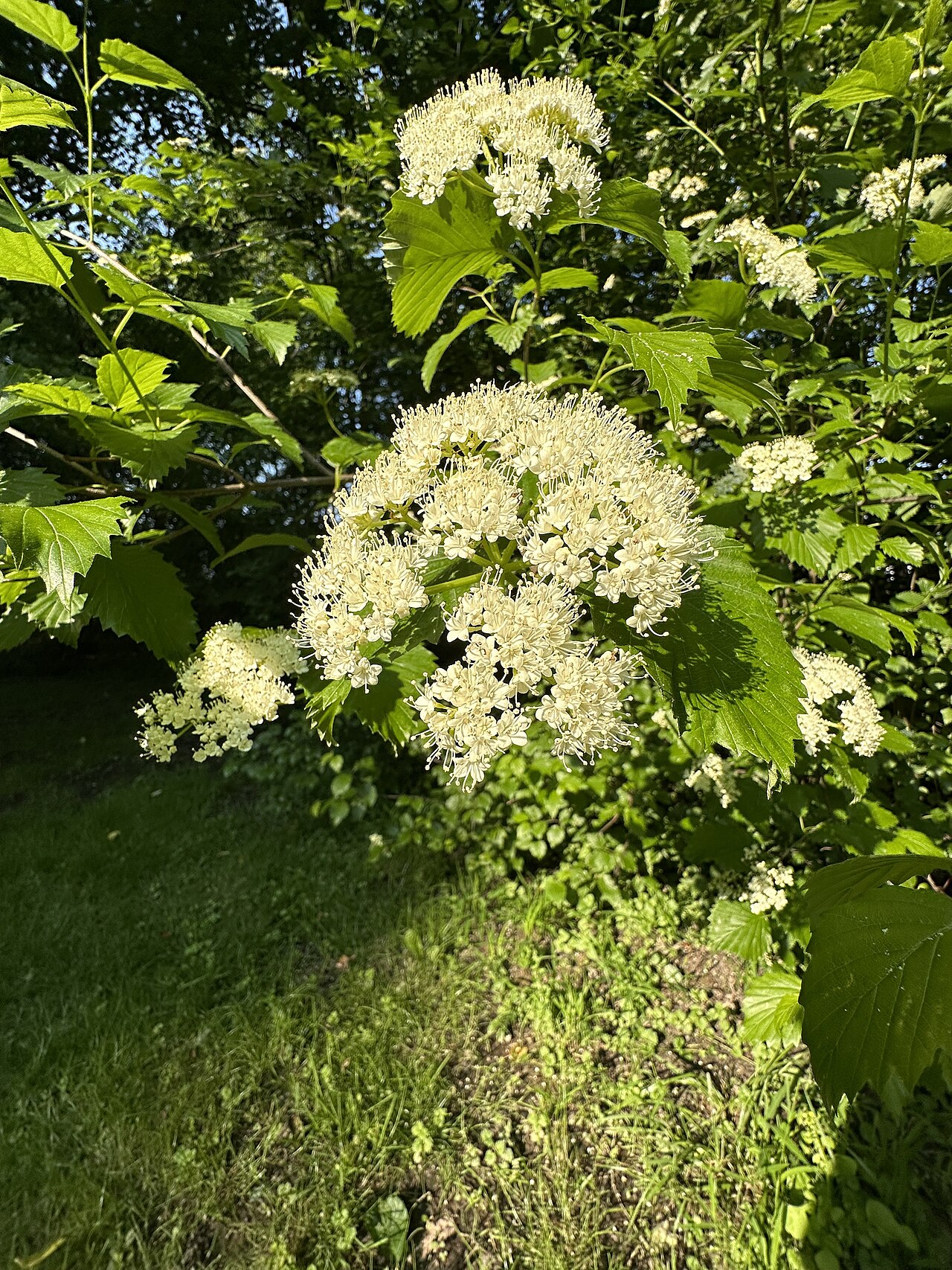

Quick facts
- Type: Deciduous multi-stemmed shrub, Adoxaceae family (viburnums were long filed under the honeysuckle family, Caprifoliaceae)
- Height and spread: 6–8 feet, sometimes to 12 feet, with multiple erect-arching stems in a loose, rounded habit
- Leaves: Opposite, simple, glossy, coarsely toothed — dentatum literally means “toothed” — turning yellow to wine-red in fall
- Flowers: Flat-topped clusters of small creamy-white flowers, spring to early summer
- Fruit: Blue to blue-black drupes ripening late summer to fall; a top fall food for songbirds
- Sun: Full sun, part sun, or shade — one of the most light-flexible native shrubs you can plant
- Soil: Moist, mildly acidic sand; handles wet feet, occasional inundation, and short very dry periods
- Florida: Ask for the ‘Asheii’ form — a southern selection with glossier foliage and better heat tolerance, the one best suited to Florida
See also the Florida native profile: Southern arrowwood (Viburnum dentatum), and the broader Viburnum: Growing Guide.
What it is
Southern arrowwood is the shrub that does three seasons of work without ever asking for applause. In spring and early summer it covers itself in flat-topped clusters of small white flowers that pollinators mob. By late summer those flowers have become drupes in a blue so vivid it looks Photoshopped — UF/IFAS calls the fruits “a more vibrant blue” than other viburnums, and they are not exaggerating. In fall the glossy, pleated, coarsely toothed leaves turn yellow, orange, and wine-red, so the shrub gets a second color show just as the berries are being stripped by birds. Winter is the only season it takes off, and even then its arching, suckering stems hold a tidy shape.
The name is not marketing. Indigenous peoples used the long, straight suckers as shafts for arrows — the stems are that straight, that strong, and that conveniently produced by a shrub that suckers freely from the base. “Arrowwood” is one of those common names that turns out to be a user manual. Plant it, let it sucker, and you will understand why someone looked at this shrub and thought, “that one, for arrows.”
Botanically, a few identification notes help at the nursery. Leaves are opposite (in pairs across the stem), simple, and coarsely toothed with a pleated, almost quilted texture and downy twigs on many forms. Some botanists split off a smooth-twigged northern relative as a separate species, which is why nursery tags and references occasionally disagree about details — but the southern plant you want, the one vouchered for Florida gardens, is Viburnum dentatum in the broad sense, and in Florida the ‘Asheii’ form specifically.
Growing southern arrowwood in Florida — honestly
This is the rare guide where the Florida paragraph is mostly good news. Southern arrowwood is native to the southern United States, found naturally along riverbanks, fertile lands, and swamp borders, and the Florida Native Plant Society lists it for zones 8A through 9B — North and Central Florida, in other words, not a stretch and not a gamble. UF/IFAS’s viburnum summary agrees: unlike other viburnum species, it is deciduous and grows only as a shrub, reaching 12 feet at its highest, making it a good choice for small spaces.
The one Florida-specific instruction comes from the native profile itself: ask for the ‘Asheii’ form (sold as V. dentatum ‘Asheii’), a southern selection with glossier foliage and better heat tolerance. A northern-grown arrowwood will grow in North Florida, but ‘Asheii’ is the form selected for southern heat, and when a native profile hands you a named form that directly, take the hint. It is the difference between a plant that tolerates your summers and a plant that enjoys them.
Natural habitat tells you the rest of the planting brief: mesic to dry-mesic woods, stream and river banks, swamps and swamp borders, fertile uplands. Translation: it likes moisture, forgives wet feet, and does not demand perfect drainage the way so many ornamentals do. If you have a low spot, a rain garden, or a yard edge that stays damp after rain, arrowwood is not merely tolerant of that spot — it is arguably the plant that spot was waiting for.
Planting and spacing
Plant in spring or fall in moist, well-drained to wet soil — “well-drained” here means not a stagnant swamp, not desert-dry sand. It transplants well and suckers freely from the base, so plant it where a slowly widening colony is welcome: a screen, a woodland edge, a native hedge, or the back of a border. Space at mature width, roughly 6–8 feet apart for a screen that fills in, wider if you want each shrub to hold its own rounded shape.
For the berry show, plant two different plants, not two cuttings of one plant. Arrowwood fruits far more heavily with cross-pollination from a genetically different arrowwood blooming nearby. A single plant will flower beautifully and produce only a light scattering of berries; a pair will load up, and the birds will empty the branches by fall — which, as the native profile says, is honestly the whole point.
Sun, soil, water, and feeding
Sun: full sun, part sun, or shade, per the Florida Native Plant Society — and it genuinely means all three. Full sun gives the heaviest flowering and fruiting; part shade gives a slightly looser, woodland-edge look; shade still grows a respectable shrub. If every other shrub on your list demands full sun and your yard has a shady damp corner, arrowwood is your answer to that corner.
Soil: moist, mildly acidic sand is the FNPS listing, but the Lady Bird Johnson Wildflower Center calls it the most soil-adaptable of the viburnums, tolerating dry to wet, acid soils and sands. Both are true: it prefers moist and acidic, and it forgives a wide range around that preference. What it does not forgive is salt. FNPS lists low to no tolerance of salty wind or direct salt spray, and no tolerance of inundation by salty or brackish water — so this is not your beachfront hedge. Inland damp spots, yes. Coastal salt blast, no.
Water: steady moisture gives the best flowering, fruiting, and fall color. It handles occasional inundation and short dry periods, and the Wildflower Center calls it flood tolerant, which is a rare and useful sentence in a Florida garden. Mulch to hold moisture and keep roots cool, and top-dress with compost or worm castings in spring — the standard soil-life-first routine, which suits a woodland-edge native perfectly. No heavy feeding program needed; a shrub that evolved on riverbanks does not want a fertilizer schedule, it wants organic matter and patience.
Pollination and fruit: the two-plant rule, again
Arrowwood’s flowers are pollinated by insects — bees, butterflies, and moths visit the flat-topped clusters — but fruit set depends on having a genetically different arrowwood nearby. The named-cultivar version of this rule is well documented: ‘Blue Muffin’ (the compact selection V. dentatum ‘Christom’, 3–5 feet tall) fruits best with a different arrowwood such as ‘Chicago Lustre’ blooming nearby, and Proven Winners says so directly. The straight-species version is the same rule without brand names: two different plants, blooming at the same time, within insect range.
The fruit is for birds, not for people. Proven Winners puts it plainly — fruit is good for birds but not humans — and the nursery trade agrees: bitter, best left for the birds. Do not let the beautiful blue color talk you into a taste test. Leave the berries on the branches, watch the bluebirds, catbirds, robins, and flickers strip them through fall, and consider that the harvest. It is a better show than anything you would have made from them anyway.
Pruning
Arrowwood blooms on old wood, so timing is everything: prune right after flowering if shaping is needed, because late-summer pruning removes next spring’s flowers. That is the whole pruning calendar in one sentence. For an older shrub, renew it the way the broader viburnum guide advises: remove about a third of the oldest stems each year, letting young suckers replace them. The shrub wants to sucker; renewal pruning just directs that energy instead of fighting it.
Otherwise, leave it alone. A light thinning for airflow, removal of dead wood, and the occasional sucker taken for a new plant elsewhere is the full maintenance program. Shearing it into a box is possible but pointless — you will shear off the flower clusters that make the whole shrub worthwhile, and end up with a green box that never berries. Let it be rounded and slightly wild. That is its shape.
Common problems
- Light berry set. Almost always a missing pollination partner. Plant a second, different arrowwood. One shrub flowers; two shrubs fruit.
- Viburnum leaf beetle. The viburnum-wide watch item: it skeletonizes leaves and is worst in the Northeast and Great Lakes. In the South, arrowwood is generally described as pest-free — the Wildflower Center lists it as flood, insect, and disease tolerant and pest free — so treat the beetle as a regional note, not a Florida expectation.
- Aphids on new growth in spring. The usual viburnum spring visitors. A strong jet of water or patience while predators arrive handles most outbreaks; avoid reaching for sprays that also kill the pollinators the flowers need.
- Powdery mildew in humid, still air. Give the shrub airflow, space at mature width, and avoid overhead watering late in the day. A mildewed arrowwood is usually a crowded arrowwood.
- Salt. Not a pest, but the fastest way to make this shrub unhappy: salt spray and brackish inundation are outside its tolerance. Site it inland.
Wildlife value
This is where arrowwood stops being merely ornamental and starts being infrastructure. The white flower clusters attract butterflies and native bees; the shrub is a larval host for the spring azure butterfly (Celastrina ladon), which means caterpillars eat its leaves on purpose and the garden is better for it. The blue-black drupes are a top fall food for songbirds — gamebirds, songbirds, and small mammals all use the fruit, with bluebirds, flickers, catbirds, and robins among the named customers. Deer generally leave it alone, though they may nibble flowers on younger plants, which is also a reason to protect a young shrub until it is big enough to share.
Plant it as a specimen, a screen, or an understory shrub, and you have built a three-season wildlife station: pollinator flowers in spring, bird berries in fall, and caterpillar forage all summer. The fall color is the bonus you get for doing the right thing ecologically, which is how native gardening is supposed to work.
Propagation
The easy way is division: arrowwood spreads by suckers, and the Florida Native Plant Society lists propagation by seed and divisions. Dig a sucker with roots attached, replant it, water it in, and you have a new shrub — remembering, again, that a division is genetically identical to its parent and does not count as a pollination partner.
Seed is the project route. Collect fruit as soon as it turns dark blue-black, and be ready for stratification: one seed-house source describes germination as moderately difficult, needing months of warm stratification followed by cold stratification. That is a winter project for a patient gardener, not a shortcut. For most people, divisions and nursery plants are the sane path, and seed is the story you tell later about how you grew a hedge from berries the birds missed.
Cultivars worth knowing
The straight species and the ‘Asheii’ southern form are the Florida picks. Beyond those, the compact ‘Blue Muffin’ (‘Christom’, 3–5 feet) is the small-space star, with intensely blue berries and a tidy rounded form — pair it with ‘Chicago Lustre’ or another arrowwood for fruit. Larger selections exist for northern gardens, but in Florida the question to ask at the nursery is simpler: is this ‘Asheii’ or a southern-grown arrowwood, and do I have two different plants for berries? Answer those two and the cultivar catalog mostly takes care of itself.
Florida native profile
Southern arrowwood is a Florida native plant, profiled in our native-plant library: Southern arrowwood (Viburnum dentatum). That profile covers its landscape uses, wildlife value, and the ‘Asheii’ recommendation in brief; this guide is the full growing version, with the pollination rule, pruning timing, and salt caution the profile does not have room for.
Sources
- Florida Native Plant Society, Plant Database: Viburnum dentatum, southern arrowwood — fnps.org
- Lady Bird Johnson Wildflower Center: Viburnum dentatum (Southern arrowwood) — wildflower.org
- UF/IFAS Extension viburnum summary (via Gardening Solutions / EDIS viburnum publications)
- Proven Winners: Blue Muffin® Viburnum dentatum — provenwinners.com
- Living Root Garden: Viburnum: Growing Guide and the Southern arrowwood native profile