
🌾 Tall Tumble Mustard
What it looks like
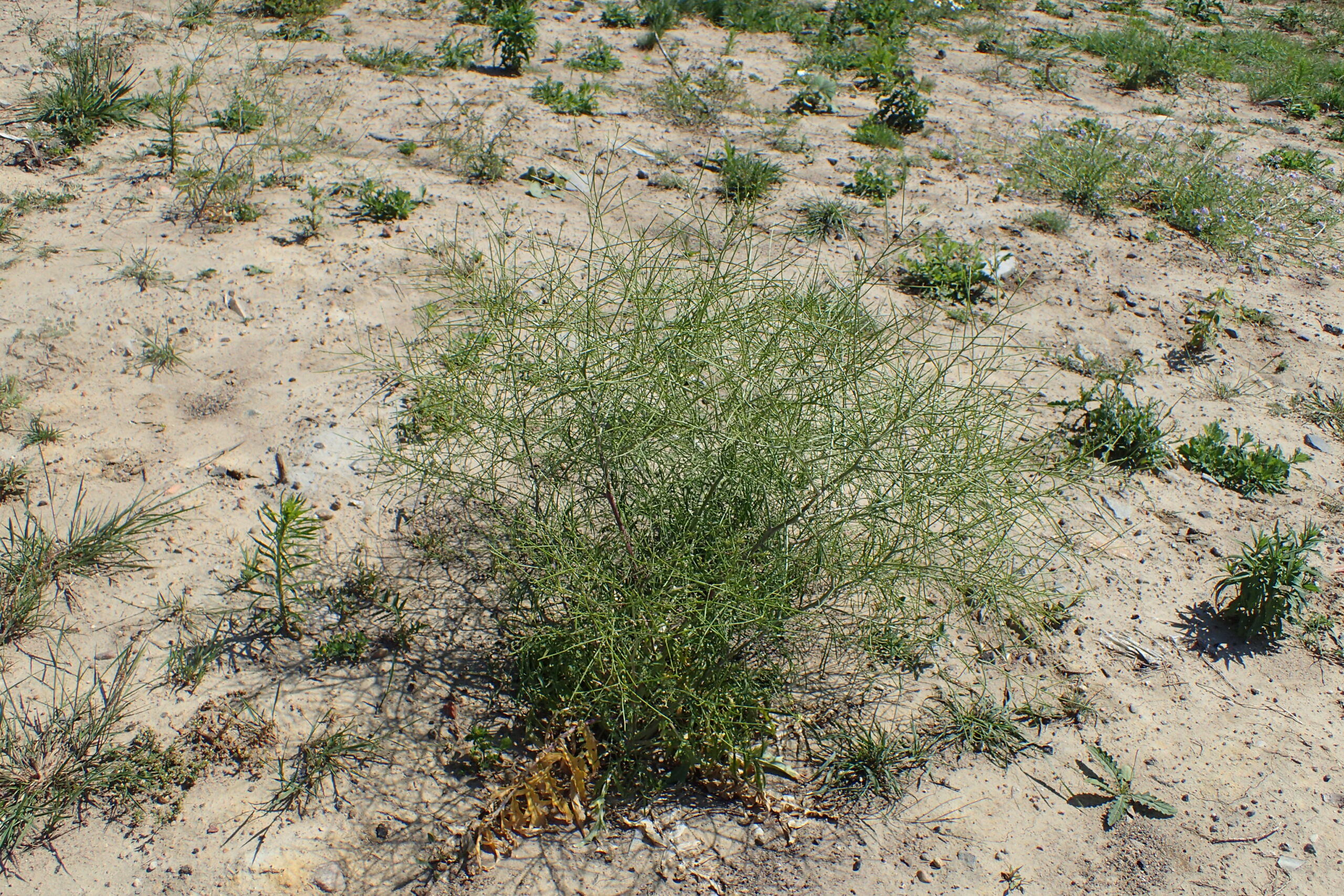
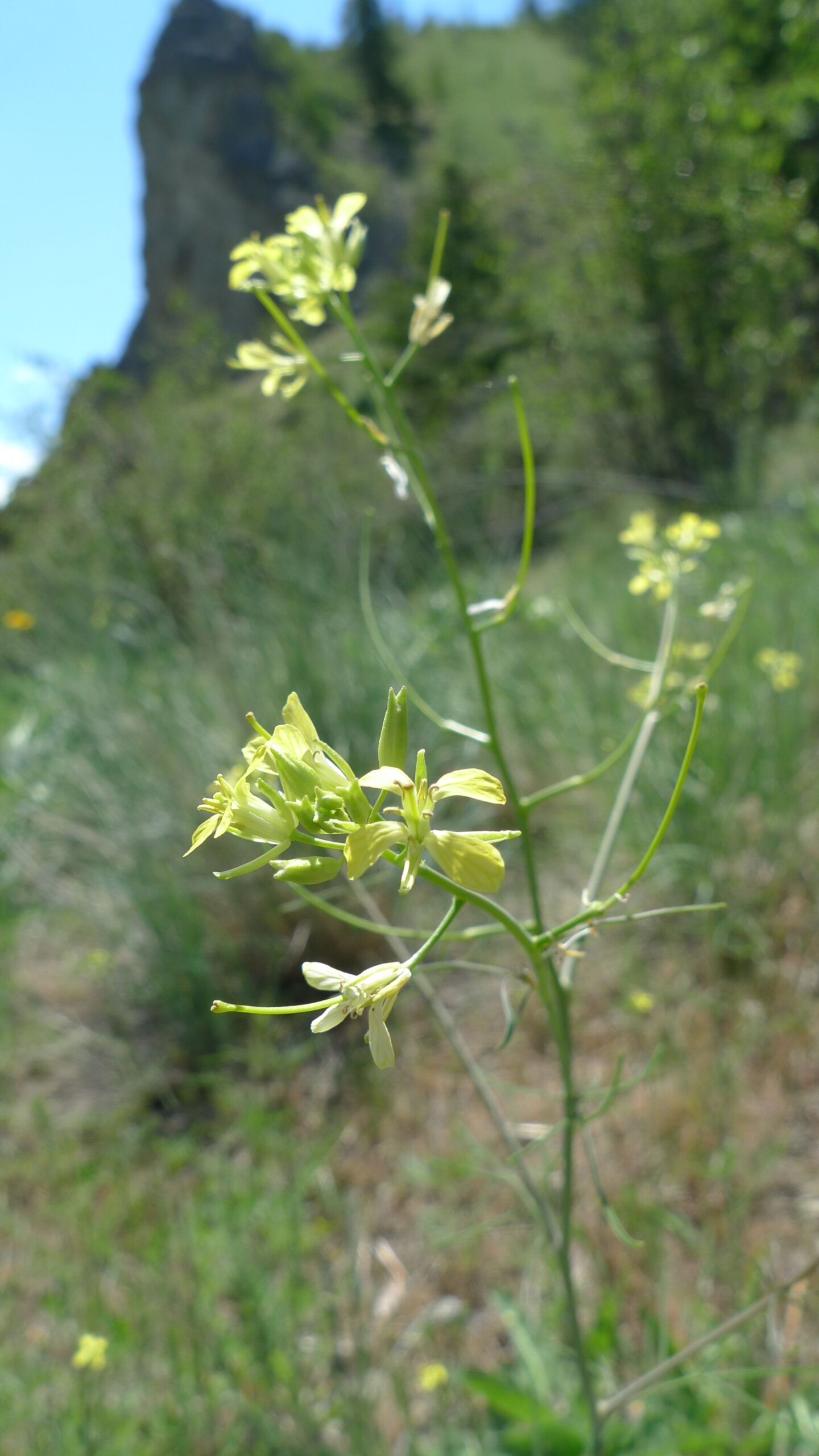

Tall tumble mustard is a mustard-family plant (Brassicaceae) that looks like it was sketched in a hurry and then told to grow as fast as possible: an upright, delicate-looking plant with slender, much-branched stems, growing up to about 1.5 metres — five feet — tall. It is native to the western Mediterranean Basin of Europe and northern Africa, and it is now widely naturalized throughout most of the world, including all of North America, where it probably arrived as a contaminant of seed crops. It answers to a whole shelf of names — tall tumblemustard, tumble mustard, tumbleweed mustard, tall mustard, tall hedge mustard, tall sisymbrium, and Jim Hill mustard — and every one of them is describing the same gangly plant.
Identification starts with the leaves, which change their mind as they climb the stem. The basal leaves are broader and pinnately compound, while the stem leaves are divided into thin, linear lobes, giving the upper plant a feathery, almost skeletal look. The flowers are mustard minimalism at its most inconspicuous: only about 6.4 millimetres — a quarter of an inch — wide, with four usually yellow petals (sometimes pale yellow to white) and four narrow, curved sepals. The seedpods are the giveaway: slender, long siliques, 5 to 10 centimetres (2 to 4 inches) long, held spreading outward from the stem rather than pressed flat against it. The plant germinates in winter or early spring, blooms over a long season, and then performs its signature trick: at maturity it dies, uproots, and tumbles in the wind, spreading its seeds as it rolls. That is not a metaphor. The dead plant is the dispersal mechanism.
For butterflies, tall tumble mustard is a host plant, not a garden flower. In the butterfly guides it appears as a host plant for Becker’s white and the large marble, two whites whose caterpillars feed on mustards. Becker’s white lists it simply as tumble mustard (Sisymbrium altissimum), and the large marble lists it as tall tumble mustard (Sisymbrium altissimum). The caterpillars eat the buds, flowers, and fruits as they develop — which is exactly what a plant that makes pods by the thousand is built to tolerate. A patch of tumble mustard on a dry roadside is not a garden failure. It is a nursery, and it got there without anyone’s help.
Do not confuse this plant with its mustard cousins. The small tumbleweed mustard (Sisymbrium loeselii) is a separate, shorter species that grows in the same disturbed places, and the tansymustards (Descurainia species) are a different genus entirely, with much shorter, club-shaped pods. If the pods are long and slender and the dead plant looks ready to roll away, you are looking at tall tumble mustard. If the pods are short, you are looking at something else, and this guide is not about it.
How to grow
Here is the honest framing, and it matters more for this plant than for most: tall tumble mustard is an introduced, weedy, widely naturalized plant, and this guide does not recommend planting it. It plants itself. It grows in soils of all textures, even sand, and it is most at home in waste places, roadsides, fields, and disturbed open ground — the places gardeners usually call “the part I haven’t gotten to yet.” If you have open, sunny, disturbed ground in its range, it will very likely arrive on its own, and the gardener’s job is recognition and management, not cultivation.
If it is already there and you want to keep a patch for the whites — Becker’s white and the large marble do use it — the method is gloriously simple and slightly alarming: do nothing, and then manage the seed. Let a few plants flower for the caterpillars, and pull or mow the rest before the pods ripen if you do not want it everywhere. Because it reproduces only by seed, preventing seed set is complete control — there are no rhizomes sneaking under the fence — but the seed is the whole point of the plant, and a single tumbling plant scatters seed across a roadside as it rolls. Thin volunteers to 12 to 18 inches apart if you want sturdy, well-branched plants rather than a crowded thicket, and leave some bare ground each year: like most disturbance plants, it is shaded out once perennials and grasses close over a patch.
Florida note: Tall tumble mustard is a plant of temperate, disturbed, open ground, and it is not a Florida garden plant. Florida gardeners should not plant it, should not expect it to behave as a landscape plant in summer heat and humidity, and should treat any plant found in the state as a weedy roadside mustard to identify and manage, not as a crop. The butterfly connection in this guide belongs to the western and northern ranges of Becker’s white and the large marble, not to a Florida planting plan. In Florida, the honest butterfly move is to protect native mustards and wildflowers, not to import a tumbleweed.
Water & feeding
Water needs are low. Tall tumble mustard is adapted to dry, disturbed ground and grows in soils of all textures, even sand. It needs moisture mainly to germinate with winter or early-spring rains; after that, it thrives on neglect. In a garden setting where it has volunteered, water only to establish seedlings in a dry spell, and then stop. Overwatering produces soft growth and invites competitors that crowd it out. Well-drained soil is the rule, and poor soil is not a handicap here. It is the habitat.
Feeding: do not feed it. This is a plant of nutrient-poor, disturbed soils, and fertilizer helps its competitors more than it helps the tumble mustard. The soil science note is the plant’s whole story: as a fast-growing, seed-heavy colonist, it turns bare, poor ground into caterpillar food and then into seed, and its biomass, left in place, returns organic matter to ground that had little. It is not a crop to feed. It is a pioneer to let work — and then to keep from rolling into the neighbor’s field.
Common problems
- It spreads by seed — a lot of seed, delivered by tumbling. A mature plant uproots and rolls in the wind, scattering seed as it goes. If you do not want it everywhere, pull or mow plants before the pods ripen. Because it has no rhizomes, seed control is total control — but only if you catch it before it starts rolling.
- It is an introduced weed, not a native wildflower. Tall tumble mustard is native to the Mediterranean, not to North America. Do not plant it deliberately, do not share its seed, and do not mistake its butterfly value for a reason to spread it. The whites that use it also use native mustards.
- Confusion with other mustards. The mustard family is full of small yellow-flowered lookalikes. Check the long, slender, spreading pods and the thin, linear upper-leaf lobes, and do not assume every yellow mustard is this species. Small tumbleweed mustard (Sisymbrium loeselii) and the tansymustards (Descurainia) are the usual mix-ups.
- It looks weedy — because it is. In a formal border it will look out of place, and it will look out of place while also trying to leave. Grow it nowhere on purpose; manage it in a wild corner or roadside, where scruffy is a style and rolling is not a surprise.
- It dies and disappears. As an annual or winter annual, it finishes, sets seed, and dies — and then the dead plant may literally leave. That is not failure. That is the life cycle, and the seed bank is next year’s patch, possibly several fields away.
- Spicy leaves, modestly. The leaves are reported as spicy enough to suggest wasabi and usable mixed into salads, but this guide does not present an introduced roadside weed as a food crop. Wild-mustard foraging belongs to people who can identify it confidently, and roadside plants carry roadside risks.
Harvest
Harvest, for this plant, is mostly a management verb. If you want seed — for identification, for a herbarium sheet, or simply to prove to yourself that the pods really are that long — gather the pods before they shatter and before the plant starts its tumbling act, because after that the harvest is wherever the wind took it. The leaves, for the adventurous and confident identifier, are reported as spicy, wasabi-like greens best mixed into salads rather than eaten alone. This guide does not recommend a food harvest from a weedy, introduced roadside plant: the harvest this guide recommends without reservation is the ecological one, and it is a restrained one. Let a patch flower for the whites where it already grows, let a few plants set seed if you want it to return to that same patch, and cut or pull the rest before the pods ripen. A patch managed that way gives you caterpillar food in spring and a self-renewing patch next year, without donating a tumbleweed to the whole county.
Browse all plant & pest guides
Saving seeds
Tall tumble mustard is a tumbleweed with a mustard’s attitude, and its seed is as easy as the plant is gangly. Let the pods ripen on the plant until they are dry and brown — a single plant sets a thousand pods — then collect them into a paper bag before the plant dies and rolls away down the road scattering its own future. No cold treatment is needed; sow in spring in moist soil, barely covered, and germination usually comes in one to two weeks.
It self-seeds aggressively, which is the whole point of a tumbleweed: the dead plant breaks off at the base, rolls with the wind, and drops seed for miles. If you are growing it on purpose — for the butterflies, which love the yellow flowers — deadhead before it sets seed, or give it a contained spot. A patch you planted is a butterfly garden; a patch you ignored is a weed problem, and this one rolls.
Save from the tallest, most vigorous plants and dry the seed thoroughly before storing; it keeps several years in a cool, dry jar. Sow more than you need, since germination is good but not total, and thin to the strongest seedlings.
In Florida, tall tumble mustard is a winter annual of open ground and roadsides, widespread across North America and not zone-limited by hardiness. It is a plant that feeds white and orangetip caterpillars and then, having done its job, dies and rolls away — a mustard with a plan.
Species in this group
Tall tumble mustard (Sisymbrium altissimum) — the species described in this guide, also called tumble mustard, Jim Hill mustard, and tall hedge mustard; synonym Norta altissima.
Hedge mustard (Sisymbrium officinale) — a related Sisymbrium species, historically valued as a throat remedy and food plant, but a different plant from tall tumble mustard.
London rocket (Sisymbrium irio) — a related Sisymbrium species, famous for proliferating in London after the Great Fire of 1666, but a different plant from tall tumble mustard.
Small tumbleweed mustard (Sisymbrium loeselii) — a related, shorter Sisymbrium species of roadsides and trails, and the most likely confusion species; it is not tall tumble mustard.
Tansymustards (Descurainia spp.) — a different mustard genus entirely, with much shorter pods; the pinnate tansymustard species guide covers Descurainia pinnata, and the tansymustard genus guide covers the genus. Neither is a Sisymbrium.