
🌺 Tube-tongue
What it looks like
Tube-tongue is not one plant. It is a genus — Justicia — and it is a big one: the largest genus in the acanthus family (Acanthaceae), with well over 900 accepted species by most current counts (Plants of the World Online lists 959; some listings give 915; one older treatment said “around 600,” which shows how fast this genus has grown as botanists have studied it). They are native to tropical and warm-temperate regions of the Americas, Africa, and Asia, from the deserts of Arizona to the Atlantic Forest of Brazil to the stream banks of the eastern United States. If a genus guide seems ambitious, that is why: Justicia is less a plant and more a continent-spanning family reunion.
What unites them is the flower. Justicia flowers are tubular and two-lipped, borne in spikes or clusters, in white, cream, yellow, orange, violet, pink, or red depending on the species. Leaves are opposite, often strongly veined, sometimes strikingly patterned. Growth forms range from small herbs to woody shrubs to small trees, from aquatic perennials that stand in flowing water to desert plants that wait out drought in rocky canyons. The genus is named for James Justice (1698–1763), a Scottish horticulturist and gardener whose enthusiasm for plants was, by all accounts, considerable. Common names include water-willow, shrimp plant, and tube-tongue — the last from the long, narrow, tongue-like floral tube of species like the long-flower tubetongue, whose white flowers can reach 2 inches long.
Butterfly note: In this site’s butterfly guides, Justicia appears as a host plant — never merely as nectar — for five butterflies: the banded peacock (Justicia), the Elada checkerspot (Mexican honeysuckle, Justicia spicigera), the mimic butterfly (Justicia betonica), the Texan crescent (tube-tongues, Justicia), and the vesta crescent (tube-tongues, Justicia). That is the reason this genus guide exists at all: five butterflies need these plants as caterpillar food, and their guides link here. If you are planting for butterflies, plant the species that matches your butterfly and your climate — a shrimp plant in a Florida garden and a water-willow in a Tennessee stream are both Justicia, but they are not interchangeable.
Taxonomy note, stated plainly: The best-known North American species, American water-willow, was long listed as Justicia americana. Current treatments, including Plants of the World Online and Wikipedia, place it in a separate genus as Dianthera americana, with Justicia americana retained as a synonym. This guide keeps the Justicia name as its organizing name because that is the name under which the butterfly guides list it, and it says so openly rather than silently renaming the plant out from under the links. Gardeners searching for water-willow may find it sold under either name.
How to grow
There is no single “Justicia care sheet,” and any guide that pretends otherwise is selling you a shrimp plant and calling it a genus. The honest approach is to match the species to the site, and the genus divides neatly into three gardening personalities.
First, the water-willow: American water-willow (Justicia americana, now Dianthera americana) is a herbaceous aquatic perennial that grows in shallow standing water, along stream banks, and in wet muddy, sandy, or gravelly soil. It spreads by rhizomes into colonies, stands 1 to 3 feet tall, and is the cold-hardiest Justicia in North America, hardy to zone 4. Plant it at the edge of a pond or stream, in water up to about 3 feet deep, or in a bog garden that never dries out, spacing plants 18 to 24 inches apart and giving them room to colonize. It will do the rest, including stabilizing banks and clarifying water as its roots trap sediment.
Second, the tropical garden shrubs: Mexican shrimp plant (Justicia brandegeeana), Brazilian plume flower (Justicia carnea), and Mexican honeysuckle (Justicia spicigera) are warm-climate shrubs for zones 8b to 11, grown as perennials in the South and as annuals or container plants further north. Give them full sun to part shade, rich, well-drained soil, and regular water, and they will bloom for months — the shrimp plant’s salmon-red bracts and the plume flower’s pink plumes are among the longest-lasting shows in a tropical border. The shrimp plant is naturalized in Florida and tolerates a light freeze, recovering in spring after freezing back in zone 8a, but do not mistake that for hardiness: a hard freeze will kill it outright, and north of zone 8 it belongs in a pot that comes indoors.
Third, the desert species: long-flower tubetongue (Justicia longii) and Arizona water-willow (Justicia candicans) are Southwestern plants of canyons, rocky slopes, and foothills that bloom mainly after the monsoon rains. They want sun, excellent drainage, and restraint with the hose — treat them like desert plants, not like the shrimp plant, and they will reward you with tubular flowers that hawk-moths visit at dusk.
Water & feeding
Water follows the species, not the genus. Water-willow needs constant moisture — shallow standing water, wet mud, or a bog bed that never dries. Let it dry out and you have lost it. The tropical shrubs want regular, even watering and rich, moist (not waterlogged) soil, with a light feeding in spring and again in midsummer to keep the blooms coming. The desert species want the opposite: water to establish, then sparing water, with long dry intervals between drinks, in soil that drains fast. If you remember one rule for Justicia watering, make it this: find out which of the three personalities your species has before you pick up the hose.
Feeding is similarly species-dependent. The tropical shrubs are the only heavy feeders in the group, and even they need only a balanced, light feeding — a plant in rich soil with regular water will flower without much help. Water-willow feeds itself from the stream and the sediment its roots trap, and needs no fertilizer at all (and in a pond, fertilizer is the last thing you want). Desert species need none. In all cases, overfeeding produces soft, leggy growth that attracts aphids and flops, which is the plant’s way of telling you to stop.
Common problems
- Frost — the big one: Most Justicia species are frost-tender tropicals. Only American water-willow is reliably hardy to zone 4; the tropical shrubs are perennial only in zones 8b to 11 and must be treated as annuals or container plants elsewhere. A single hard freeze can kill a shrimp plant that has been thriving for years.
- Spreading: Water-willow spreads by rhizomes into colonies that can cover large areas — one account describes a colony of about 90 square meters. That is a feature on a stream bank and a problem in a small pond. Give it room, or contain it with a buried barrier.
- Drying out: Water-willow cannot tolerate drought, and the tropical shrubs sulk badly if they dry out repeatedly. Match the species to a site that stays as wet as it needs to be, rather than trying to irrigate your way out of a mismatch.
- Aphids and whitefly: Soft new growth on container-grown and greenhouse plants can attract aphids and whitefly. Check the undersides of leaves, and remember that a plant grown as a butterfly host should never be sprayed with insecticide — the caterpillars are the point.
- Taxonomy whiplash: Nurseries and references may sell the same plant under two names (Justicia americana versus Dianthera americana, Justicia brandegeeana versus Beloperone guttata, Justicia carnea versus Jacobinia magnifica). Buy by the common name and the description together, and do not panic when the tag disagrees with the book — both names may be correct.
- Weediness abroad: White shrimp plant (Justicia betonica) is regarded as an environmental weed in Queensland, Australia, and invasive in Hawaii. Outside its native range, do not let Justicia species self-seed unchecked, and check local lists before planting an unfamiliar species.
Harvest
Justicia is not a food crop, and this guide makes no medicinal recommendations, even though some species — notably Justicia adhatoda in Ayurvedic tradition — have long histories of medicinal use. What you harvest is ornamental and ecological: long-lasting bracts and flowers for cutting (the shrimp plant’s bracts hold their color well), bank stabilization and water clarification from water-willow colonies, and, above all, caterpillar food for the banded peacock, Elada checkerspot, mimic butterfly, Texan crescent, and vesta crescent. Cut back tropical shrubs in late winter to keep them bushy, and divide water-willow colonies in spring if they outgrow their space — a division is a gift for another pond, not a chore.
Saving seeds
Genus-level honesty first: tube-tongue is not one plant. It is Justicia, the largest genus in the acanthus family, with well over 900 accepted species — from desert tubetongues to shrimp plants and stream-side water-willows — and seed needs vary by species. This is the genus playbook: most Justicia seed wants warmth and light, so sow on the surface of moist mix and do not bury it, and keep it warm — germination usually comes in one to two weeks. No cold treatment is needed for most species.
Let the seed capsules ripen on the plant until they are dry and beginning to split, then collect them into a paper bag — the capsules pop open and scatter, so check them often once they start to dry. Dry the seed thoroughly before storing; it keeps a few years in a cool, dry jar.
Cuttings are the faithful route for named forms — stem cuttings root readily in warm, moist mix, and every cutting is a clone of the parent. Seed is for the species itself and for the patient gardener. A seedling will be a Justicia, but it will not be a named cultivar.
In Florida, several Justicia species are native or naturalized, happiest in sun or part shade with moist soil. Save seed only from a species you can identify, and label the packet — a bag marked “tube-tongue” is a mystery, not a plan.
Species in this group
American water-willow — Justicia americana (now Dianthera americana): The cold-hardiest Justicia in North America, a herbaceous aquatic perennial 1 to 3 feet tall, hardy to zone 4, growing in shallow standing water or wet soil along streams and pond margins. White to pale-purple, orchid-like flowers about 1.3 centimeters across, blooming from June through September (some sources say May through October). Rhizomatous and colonial; excellent for bank stabilization.
Mexican shrimp plant — Justicia brandegeeana (syn. Beloperone guttata): The famous shrimp plant, an evergreen shrub 3 to 4 feet tall and wide, native to Mexico and naturalized in Florida. Overlapping salmon-red bracts shaped like a shrimp’s tail, with small white tubular flowers peeking out. Hardy to about minus 4 degrees Celsius, recovering in spring after freezing back in zone 8a. Named for the botanist Townshend Stith Brandegee.
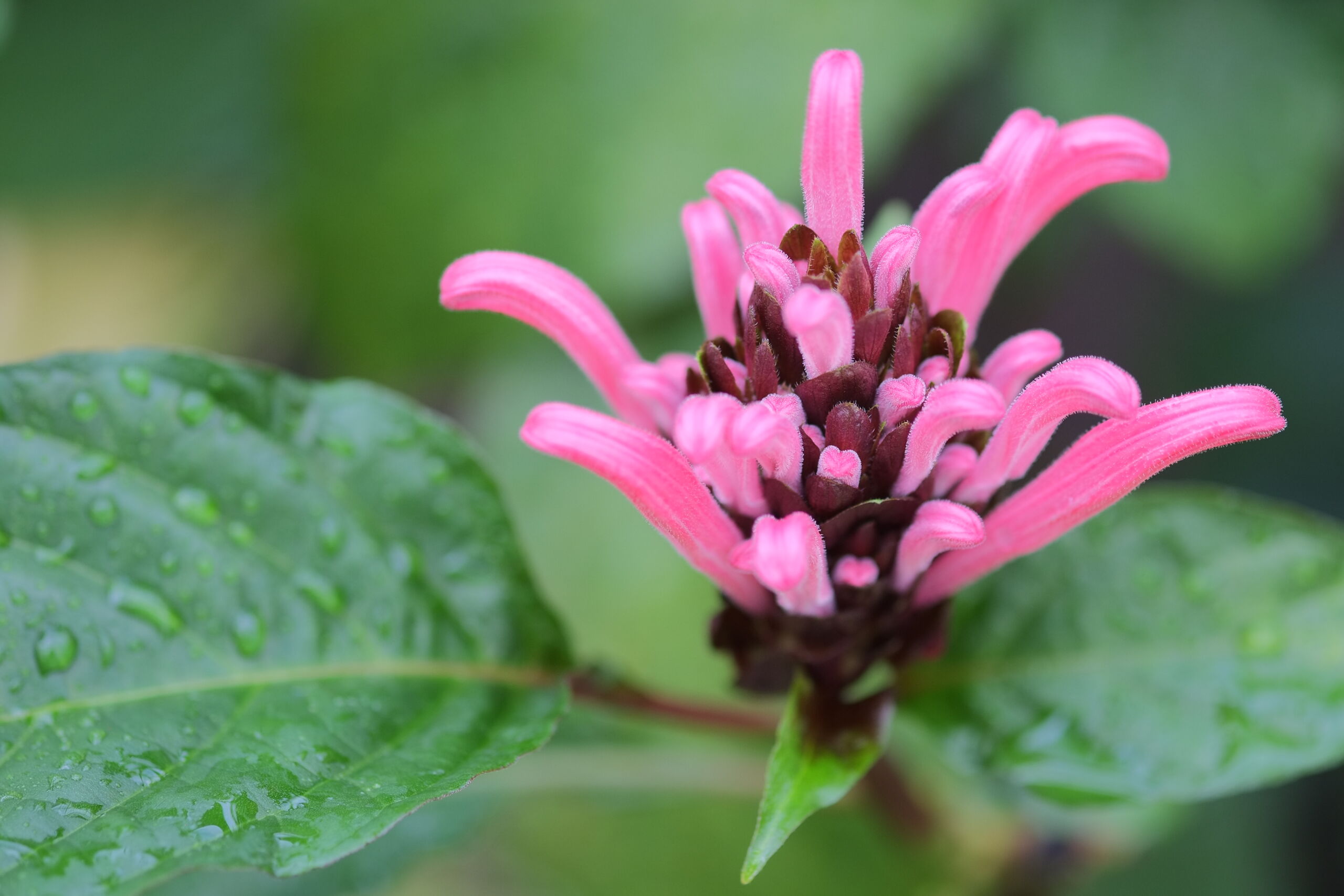
Brazilian plume flower, flamingo plant — Justicia carnea (syn. Jacobinia magnifica): An upright evergreen shrub 3 to 7 feet tall and wide, hardy in zones 8B to 11, native to the Atlantic Forest of eastern Brazil and neighboring regions. Plumes of tubular flowers in rose-purple, red, yellow, orange, apricot, or white depending on the selection, from early summer to fall.
Mexican honeysuckle — Justicia spicigera: A shrub about 4 feet tall and wide with orange tubular flowers, grown in Florida and the Gulf South. Host plant for the Elada checkerspot.
White shrimp plant, paper plume — Justicia betonica: A shrub 2 to 7 feet tall with white bracts veined in green over lavender flowers, blooming year-round in Hawaii. Host plant for the mimic butterfly. Regarded as an environmental weed in Queensland and invasive in Hawaii — plant with care outside its native range.
Long-flower tubetongue — Justicia longii: A small Sonoran Desert species about 1 to 1.5 feet tall, with white tubular flowers 2 inches long, growing in canyons, rocky slopes, and foothills, blooming mainly after monsoon rains from April through October.
Arizona water-willow — Justicia candicans: A semi-evergreen shrub about 3 feet by 3 feet with reddish-orange tubular flowers borne almost any time of year, a noted nectar-gap plant in the Southwest.
Cooley’s waterwillow — Justicia pringlei: A Florida native known on this site only through an Academy profile, not a plant-guide growing guide. Included here as part of the genus, and as a reminder that Florida’s Justicia flora is larger than the famous garden species.
Lance-leaf water-willow — Justicia ovata var. lanceolata: A southeastern wetland form with lance-shaped leaves, mentioned in wetland plant references alongside American water-willow, and another reminder that the genus hides quiet natives behind its showy tropical cousins.