
🐸 Turkey Tangle Frogfruit
What it looks like
Turkey tangle frogfruit is a groundcover with a name that sounds like a folk tale and a habit that sounds like a promise. It is a low, mat-forming perennial in the verbena family (Verbenaceae) that creeps along the ground, rooting wherever its stems touch soil, and knits itself into a dense green carpet. Unmowed it stands about 2 to 6 inches tall — some sources say 3 to 6 inches, one says up to 12 inches in flower in lush conditions — and it spreads fast, with individual plants reported to cover 3 feet or more in a single growing season and older plants reaching 8 to 10 feet across. It is the plant you plant when you want a lawn that flowers, a bank that holds, and a garden that feeds butterflies without asking you to mow it into submission every Saturday.
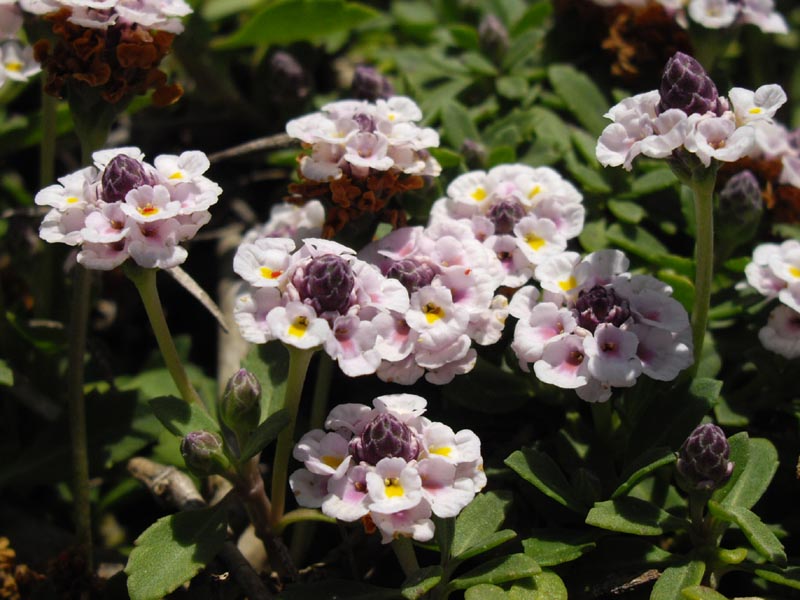
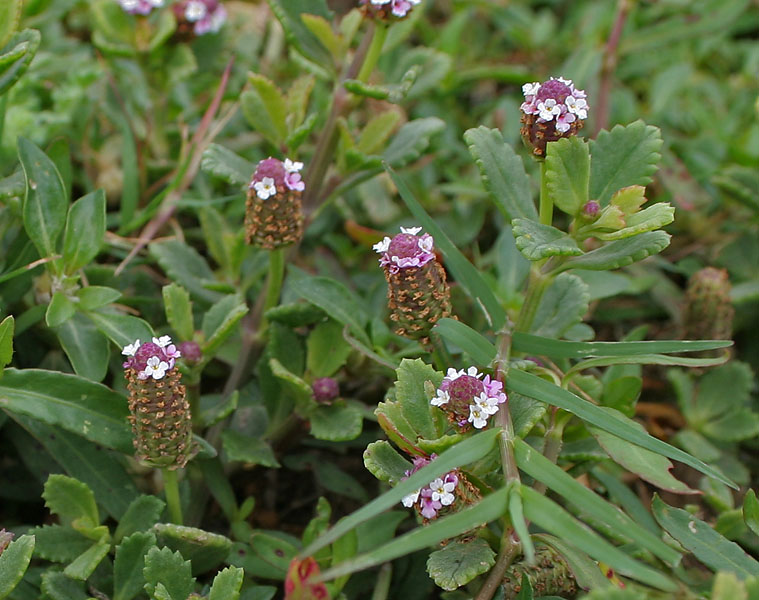
The leaves are opposite, teardrop- to wedge-shaped, and toothed only near the tip — a detail that matters, because it is how you tell turkey tangle from its close cousin lanceleaf frogfruit (Phyla lanceolata), whose leaves are toothed over more than half their length. The flowers are the real show, and they are worth watching up close. Dense heads form at the stem tips, starting round and then elongating into little cylinders as they bloom, with a ring of small white to pale lavender-pink flowers around a purple cone in the center. As the head lengthens, the ring of open flowers rides upward like a halo, which is why the plant is also called matchweed or matchsticks — each head looks like a tiny match with a purple tip. Bloom runs from May through October in most of its range, and in zones 9 to 11 it can flower nearly year-round.
The name needs untangling, because folk names have made a tangle of it. The species was long called Lippia nodiflora, and older books still use that name; its other scientific synonym is Verbena nodiflora. Common names include frogfruit, fogfruit, turkey tangle, Texas frogfruit, sawtooth frogfruit (or fogfruit), capeweed, matchweed, and creeping vervain. “Fogfruit” is said to be a corruption of the older folk name “frogfruit,” though the two spellings now circulate side by side and refer to the same plant. And one more naming trap: this site’s Lippia growing guide covers the genus Lippia, which once included this species but no longer does — the plant moved to Phyla, and this species guide covers Phyla nodiflora specifically, not the Lippia genus.
Florida note: Turkey tangle frogfruit is a Florida native, found throughout almost all of the state, and it is one of the best lawn substitutes and living mulches for Florida gardens. It tolerates the state’s sand, its summer downpours, its droughts, and its poor, compacted roadside soils with equal indifference. If you are replacing a patch of thirsty turf in Florida, this is one of the first plants to consider — and it comes with butterflies included.
Butterfly note: Under its exact name, turkey tangle frogfruit appears in this site’s butterfly guides as a host plant for the phaon crescent. Under the plain name “frogfruit” it also appears as a nectar plant for the dainty sulphur. Beyond this site, reference sources widely list it as a host for the common buckeye and the white peacock as well as the phaon crescent. A flowering mat of frogfruit is a caterpillar nursery and a nectar bar at the same time, which is a rare combination in a plant you can walk on.
How to grow
Plant plugs or rooted cuttings 12 to 18 inches apart in full sun to part shade, and give them at least 3 to 4 hours of direct sun a day — frogfruit will survive in more shade, but it will flower less, and the flowers are half the point. It is famously unfussy about soil: sand, loam, clay, caliche, limestone, compacted roadside soil, poor drainage, even saline soils are all tolerated, which makes it one of the few plants that genuinely means it when the tag says “adaptable.” Water to establish, and then decide what you want it to be. As a lawn substitute, mow it occasionally to about an inch and it will stay a tight, walkable mat. As a bank or bed groundcover, leave it unmowed and it will rise to 5 or 6 inches and flower continuously. As a living mulch under shrubs, let it creep and it will suppress weeds while feeding pollinators.
Propagation is almost embarrassingly easy. Stems root at the nodes wherever they touch soil, so a patch expands on its own, and cuttings or divisions root readily at any time in warm weather. That vigor is a feature on a bank and a management question in a small bed, so edge it, mow the margins, or let it have the space it clearly intends to take. In cold winters at the northern edge of its range it dies back to the ground and resprouts in spring; in mild winters it stays evergreen and keeps creeping. North of zone 7, grow it as an annual groundcover or in a container that overwinters indoors — it will not thank you for a hard freeze, and it will not survive one.
Water & feeding
Water is where frogfruit earns its reputation as a plant of contradictions, because it tolerates both wet and dry soils — a combination most groundcovers cannot claim. It handles poor drainage and seasonal flooding, and it handles drought once established, though it looks fuller and flowers more with regular water. The practical rule: water to establish, then water when you want a lusher mat, and do not worry when you forget. It will forgive a dry spell that kills a lawn, and it will forgive a downpour that drowns one.
Feeding is unnecessary. Frogfruit grows in poor, compacted, and saline soils without fertilizer, and feeding it mostly produces faster spreading, which is not always what you want from a plant that already spreads 3 feet a season. If your soil is genuinely depleted, a light compost top-dressing in spring is more than enough. Save the fertilizer for plants that actually need it.
Common problems
- Vigor: Frogfruit’s greatest strength is also its greatest management issue. It will creep into beds, lawns, and paths if you let it. Mow the edges, install a simple edging strip, or plant it where spreading is welcome. It is easy to pull out where it is not wanted, which is the saving grace of a vigorous groundcover.
- Foot traffic — stated honestly, because sources disagree: Some sources describe frogfruit as tolerating light foot traffic and mowing, and it is widely used as a lawn substitute. At least one source, however, warns that it does not tolerate regular foot traffic and should be treated as a visual lawn substitute rather than an active-use surface. The honest summary: fine for occasional walking and light play, not a substitute for a sports field or a daily dog run. If your lawn gets heavy, daily use, keep turf in the wear paths and frogfruit in the rest.
- Lookalikes: Lanceleaf frogfruit (Phyla lanceolata) has leaves toothed over more than half their length, versus teeth only near the tip in turkey tangle. Wedgeleaf frogfruit (Phyla cuneifolia) and diamondleaf frogfruit (Phyla fruticosa) are close relatives with different leaf shapes and ranges, and hairy fogfruit (Phyla canescens) is a different species often confused with this one in nurseries. Check the leaf teeth and the Latin name before you buy.
- Cold: At the northern edge of its range, hard freezes kill top growth. In zones 6 and colder it is not reliably perennial — one reference gives zones 6 to 11, others give 7 to 10, 7A to 11B, or 8 to 12 — so northern gardeners should treat it as an annual or overwinter cuttings indoors.
- Caterpillars eating it: That is the point. Phaon crescent, common buckeye, and white peacock caterpillars all eat frogfruit. If the leaves have holes, the garden is working. Do not spray your butterfly host plants.
Harvest
Frogfruit is not a vegetable crop, and its “harvest” is mostly mowing and cuttings: mow it to an inch for a tight lawn look, or cut back wandering stems in spring and stick the cuttings straight into moist soil, where they will root. The flowers are the real harvest, and they belong to the butterflies — a flowering mat in May through October feeds phaon crescents, buckeyes, white peacocks, and a parade of small pollinators. Some references note the leaves have been used as a tea substitute, but this guide makes no recommendation for that use; grow it for the ground it covers and the butterflies it feeds, and let the tea remain a footnote.
Saving seeds
Turkey tangle frogfruit is easy seed. Let the tiny flower heads ripen on the plant until they are dry, then strip the seed into a paper bag. Sow on the surface of moist mix and do not bury the seed at all; it needs light to germinate. Keep it warm, and germination usually comes in one to two weeks. No cold treatment is needed.
It spreads by runners that root wherever they touch soil, so division is just as easy — lift a rooted runner in spring or fall and replant it, and every piece is a clone of the parent. Seed is for starting from scratch and for the genetic shuffle; runners are for the plant you already love.
It self-seeds freely in the right spot, which is a gift if you want a native groundcover and a chore if you do not — frogfruit is a butterfly host and a lawn alternative, and the seedlings will pop up wherever the seed lands. Deadhead if you want to keep it in bounds, or let it go and pull the volunteers you do not want.
Turkey tangle frogfruit is a Florida native for sun and moist soil, a low, tough groundcover that feeds butterflies and tolerates foot traffic. Plant it where you want a living carpet, and let it be the native it wants to be.
Varieties
One named selection is verified, and the rest of the story is the straight species. The cultivar ‘Campagna Verde’ (plant patent PP20120, registered in 2005, hybridized by Kuramochi) is a named selection of Phyla nodiflora listed in nursery and plant databases, selected for groundcover use. Beyond that, turkey tangle frogfruit is usually grown as the unselected species, and it is a highly variable one — botanists recognize several infraspecific taxa, including Phyla nodiflora var. incisa, a Texas form listed by nurseries at 3 to 12 inches tall, though this guide does not present var. incisa as a widely available garden variety without stronger nursery evidence. In practice, buy the species, or the ‘Campagna Verde’ selection if you can find it, and let the plant’s natural variability do the rest. It will fill the space, flower for months, and feed the butterflies either way.