
🌿 Two-leaved Toothwort
What it looks like
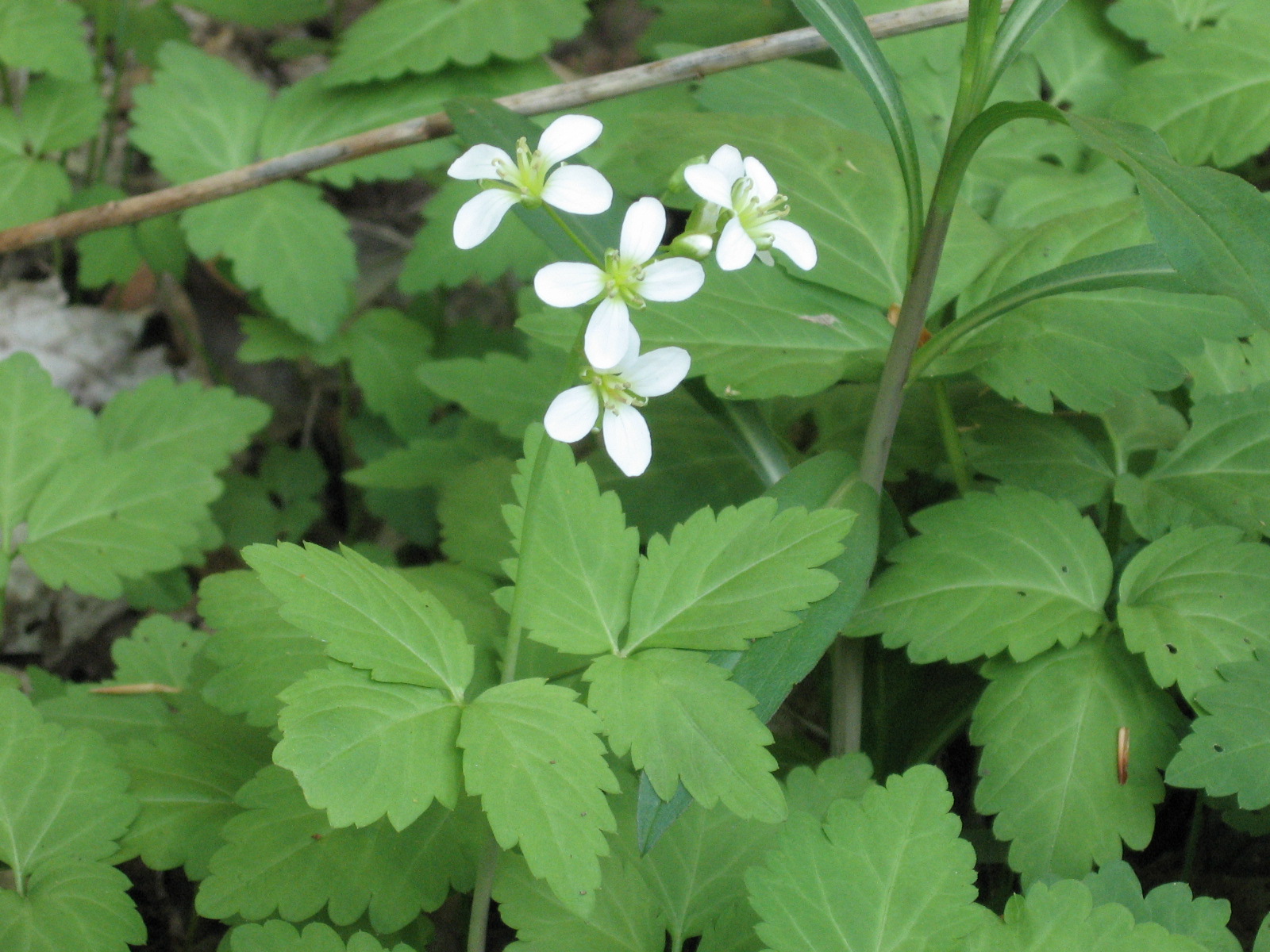
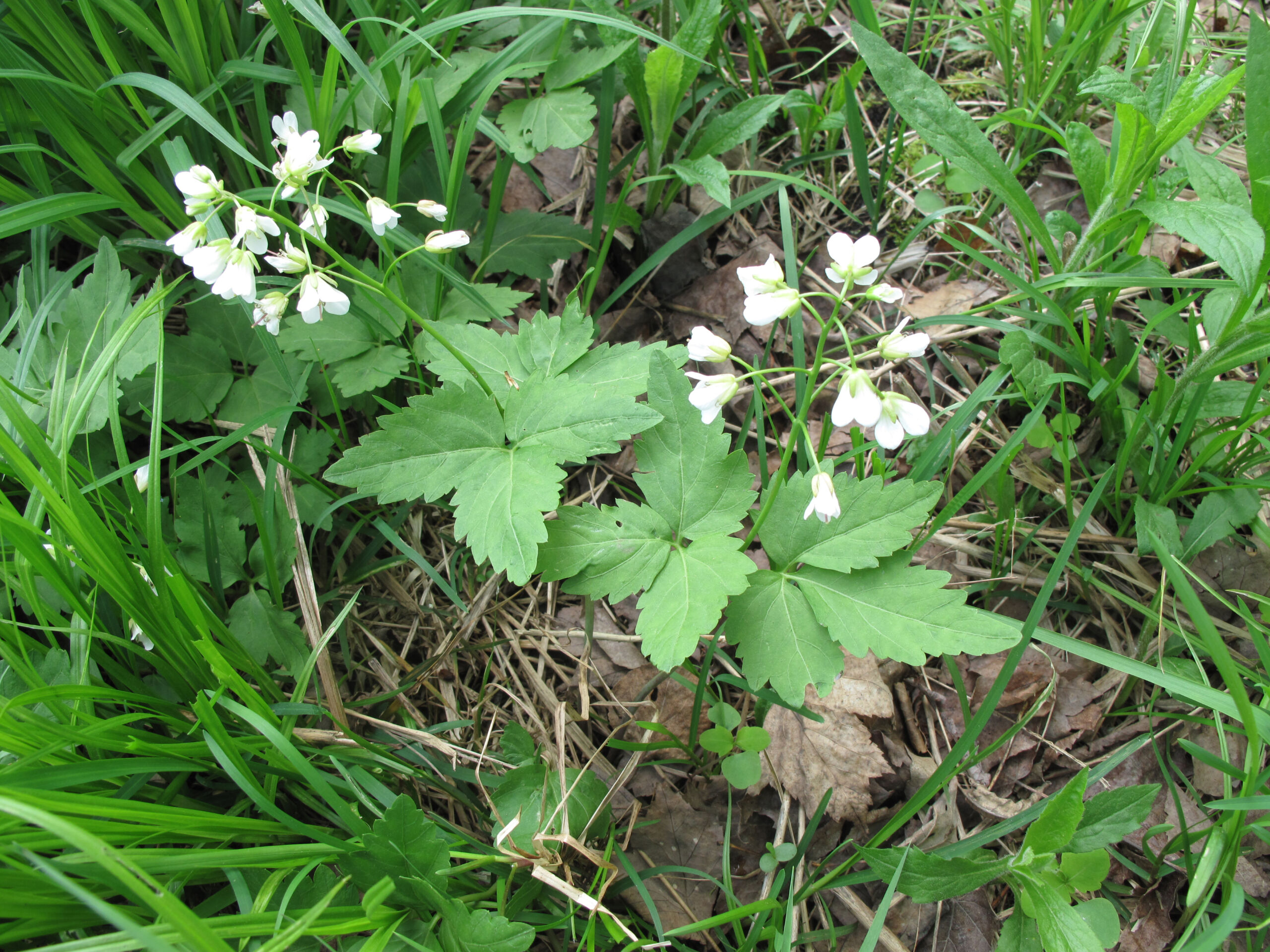
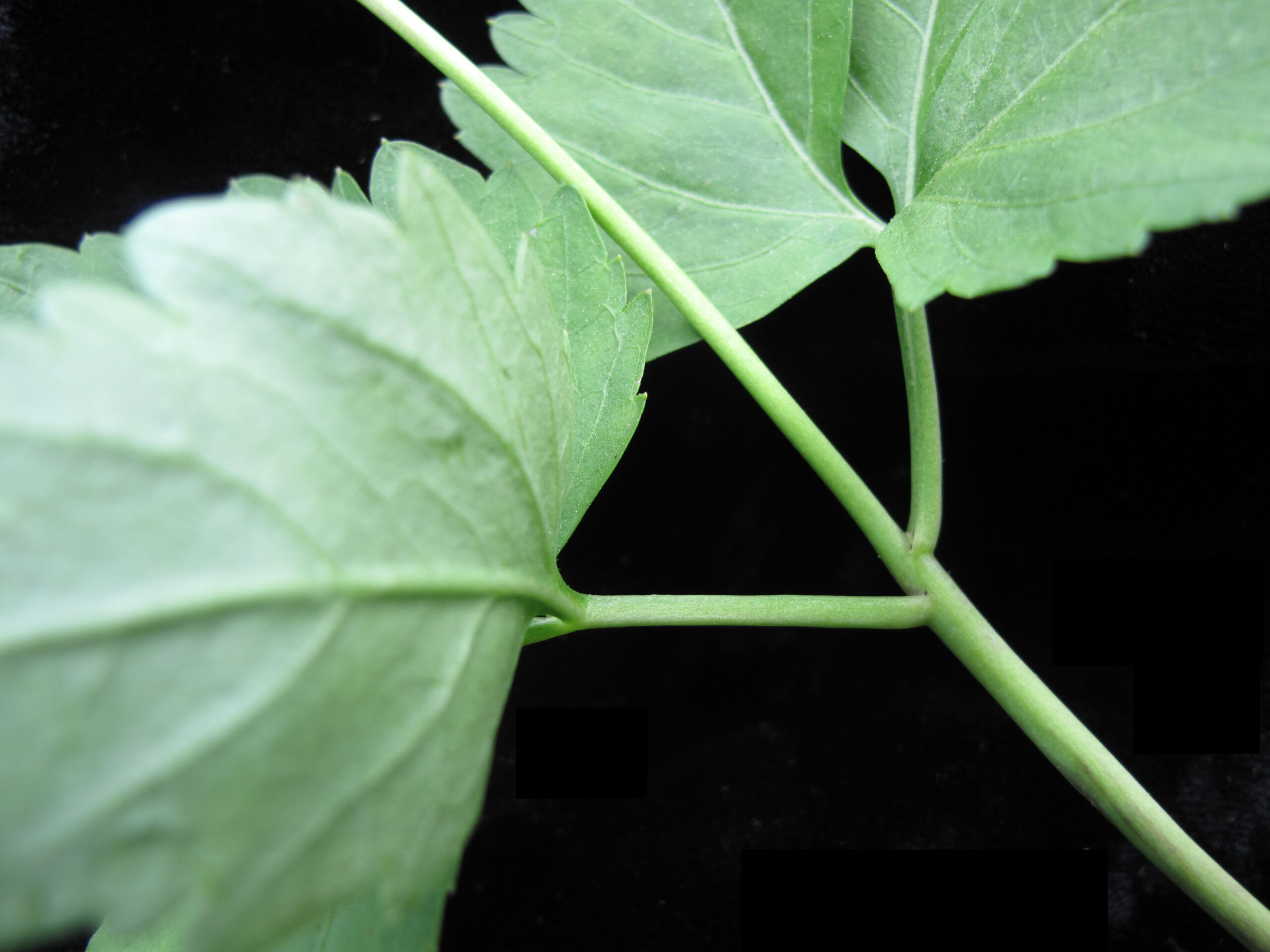
Two-leaved toothwort is a spring ephemeral of the mustard family, Brassicaceae, native to the rich deciduous woodlands of eastern North America. It is a small plant with a big tell: each flowering stem carries exactly two leaves — diphylla means two-leaved — set opposite each other partway up the stem, each leaf divided into three toothed leaflets. In spring, before the trees leaf out fully, it sends up a cluster of four-petalled white to pale pink flowers above those two leaves, like a flag run up while the woodland light is still good.
Underground, the plant keeps its other namesake feature: a long, fleshy, toothed rhizome, knobbly with tooth-like scars where old stems broke off, which is where toothworts got their name. The old doctrine of signatures said a plant that looked like teeth must cure toothache; the rhizome is in fact peppery, mustard-hot when nibbled, which is a more honest credential. The plant spreads slowly by that rhizome into drifts and colonies, flowers in spring, sets seed in slender pods, and then quietly goes dormant as the woodland canopy closes and summer deepens. By midsummer it has largely vanished above ground, which is not death — it is the plant’s annual disappearing act, and the reason spring ephemerals reward gardeners who mark where they planted them.
Older books call this plant Dentaria diphylla, and the butterfly guide that names it as a host pairs the old genus with the new species in the same way other toothwort guides do: Cardamine diphylla, formerly Dentaria diphylla. If you find it under Dentaria, you have found the same plant wearing its old jacket. It is a woodland plant through and through — rich, moist, humusy soil under deciduous trees, dappled spring light, and a leaf-litter mulch it can rise through — and it is not a Florida plant: this is a cool-temperate woodland species for gardeners north of the subtropics, or for Florida gardeners to admire in the abstract and plant something else in practice.
How to grow
Start with shade, and the right kind of shade: the high, deciduous shade of a woodland edge, where spring sun reaches the ground before the canopy closes and summer brings cool shadow. Two-leaved toothwort wants part shade to full shade in summer, and it wants the leaf litter left alone. A woodland garden, a shaded border under deciduous trees, or a north-facing slope with humus-rich soil are all right. A sunny bed, a hot dry corner, or a spot that gets tilled every year are all wrong.
Soil is everything for this plant. It wants rich, moist, well-drained woodland soil with plenty of organic matter — the kind of soil that smells like a forest floor after rain. Work in leaf mould or compost before planting, and mulch with shredded leaves each autumn, which is what the woodland does for itself. It does not want to dry out in spring while it is growing and flowering, and it does not want to sit in waterlogged ground in winter either. Good drainage with steady moisture is the combination, and a slope or raised woodland bed helps where the soil is heavy.
Plant rhizomes in autumn or very early spring, shallowly, an inch or two deep, about 6 to 12 inches apart, and let them form a drift rather than a row. Nursery plants go in at the same depth they grew in their pots. Water well at planting and through the first spring; after that, in a suitable woodland spot, rainfall and leaf litter usually do the job. Do not expect a summer show: the plant will go dormant, and the space it leaves is best filled by later woodland plants — ferns, hostas in the north, or wild ginger — that take over as the toothwort bows out. Mark the spot with a small, unobtrusive stake the first year so you do not dig it up by accident while it sleeps.
Propagation is by division of the rhizome in autumn, when the plant is dormant, or by seed sown fresh in summer — seed that dries out loses viability quickly, so sow it where it falls or in a shaded seed bed and be patient; woodland plants keep their own timetable. A happy colony spreads slowly and steadily, and after a few years a drift in flower is one of the quiet triumphs of a shade garden.
Water & feeding
Water like a woodland: steady moisture in spring while the plant is growing and flowering, then let it rest. New plantings need watering through their first spring and into early summer if the weather turns dry; established colonies in humus-rich soil usually manage on rainfall, with a deep soak in a spring drought the only intervention worth making. Do not water it into growth in autumn — it is dormant, and wet feet in winter are the enemy.
Feeding is leaf litter, not fertiliser. A top-dressing of compost or shredded leaves each autumn is the whole feeding programme, and it mimics exactly what the woodland floor provides. Liquid feeds and granular fertilisers are unnecessary and can push soft growth that slugs love. If your soil is genuinely poor, build it with organic matter over a season or two before planting rather than trying to feed your way out of a bad site.
Maintenance is mostly leaving it alone. Do not rake the leaf litter away in autumn — that litter is its mulch, its insulation, and its food. Do not divide it every year; let a colony build. The main seasonal job is removing competing weeds in spring before the toothwort emerges, and keeping garlic mustard out of the whole woodland bed (see below), which is a job worth doing for every native mustard in the garden, not just this one.
Common problems
- It never comes up. Usually it was planted too deep, dried out in its first spring, or dug up while dormant. Plant shallowly, water the first spring, and mark the spot.
- It vanishes by July. Normal. Spring ephemerals go dormant in summer. It is not dead; it is asleep until next spring.
- Slugs and snails. The soft spring growth is slug food, especially in wet springs. Encourage ground beetles and frogs, keep the bed free of slug harbourage like boards and dense debris, and accept some nibbling as the price of a woodland garden.
- Garlic mustard. The serious one. Garlic mustard is an invasive mustard that smells like dinner to toothwort-eating butterflies and acts like poison to their caterpillars, and it also crowds native mustards out of the woodland floor. Pull it before it seeds, every year, and do not compost seed heads.
- Dry shade. Toothwort wants moist shade, not the dry shade under a thirsty maple or a roof overhang. If the soil dries to dust in spring, the site is wrong; choose a moister woodland pocket or a different plant.
Harvest & wildlife
The traditional harvest is the rhizome, nibbled fresh for its peppery, mustard-like bite — the old toothwort condiment, used sparingly like horseradish, which is a close mustard cousin. This guide does not recommend digging wild plants, and garden plants are better left to form their drift; a taste from a divided piece at replanting time is the honest extent of it. The leaves are also peppery, but they are small, the plant is slow, and the butterflies need them more than you do.
And the butterflies do need them. The Mustard White’s caterpillars eat toothwort, and the butterfly guide’s Host plants section names two-leaved toothwort as the main food: the caterpillars feed mainly on two-leaved toothwort (Cardamine diphylla). That “mainly” is doing real work — it is not a casual qualifier but the butterfly’s documented preference, in a woodland where garlic mustard, its invasive lookalike, is quietly starving the species by luring females to lay eggs on a plant their caterpillars cannot survive on. Planting and protecting real toothwort, and pulling garlic mustard out of the same woods, is the most useful thing a northern woodland gardener can do for this butterfly. It will not work in Florida, and this guide says so plainly — but for gardeners in its range, a drift of two-leaved toothwort in flower is a small, white, four-petalled argument for keeping the woodland floor intact.
Browse all plant & pest guides
Saving seeds
Two-leaved toothwort seed is a patience test with double dormancy: it wants a warm spell and then a cold spell before it will sprout. Sow fresh seed in summer in a pot of moist mix and leave it outside — the warm months satisfy the first dormancy, winter satisfies the second, and sprouts usually come in the second spring. Or mimic it indoors: a few months warm and moist, then a few months in the fridge, then sow warm. Either way, do not throw the pot out after a year of nothing.
Let the seed pods ripen on the plant until they are dry and beginning to split, then collect them into a paper bag — the pods pop open and scatter, so check them often once they start to dry. Sow fresh if you can; toothwort seed does not store well, and dried seed may never germinate.
Division is the practical route: lift the rhizome in spring or fall, cut it into pieces with a growing point each, and replant. Every division is a clone of the parent, and it flowers far sooner than a seedling — which takes two to three years to bloom. Seed is for starting from scratch and for the patient gardener.
And the Florida honesty: two-leaved toothwort is a woodland wildflower for zones 3 to 8 that wants cool summers, rich soil, and deep shade, so it does not grow in Florida. This section is for the reader in a colder climate — in Florida, plant something that likes the weather.
Varieties & relatives
No named garden varieties of two-leaved toothwort are in general cultivation; gardeners grow the species, and a good drift of the species is the whole point. Related toothworts in the same genus, listed here in plain text only and not claimed as this plant, include cut-leaved toothwort (Cardamine concatenata, butterfly guides: Dentaria laciniata), a different species with deeply cut leaves and its own growing guide, and the broader Cardamine genus guide, which covers bittercresses and toothworts as a clan. Slender toothwort (Cardamine angustata) and other eastern toothworts are separate species again. If a plant labelled toothwort has more than two leaves on its flowering stem, or leaves cut into narrow segments, it is not this species — check the stem before you trust the label.