
🌸 Voodoo Lily
Some plants ask to be admired. The voodoo lily asks to be investigated. It spends the winter as nothing — no leaf, no stem, just a corm asleep in dry soil — and then, late in spring, it erupts. Either a single enormous divided leaf on a mottled stem that looks like a small tropical tree, or, if the corm is old enough, a flower: a pale pink shell of a spathe wrapped around a short cream spadix, smelling, unmistakably, like something died. It is a corpse flower’s little cousin, and it knows exactly what it is doing. The smell is bait. Flies and carrion beetles are the pollinators, and they do not show up for perfume.
Amorphophallus bulbifer comes from the warm, wet summers and dry winters of Asia — northeastern India, Bangladesh, Bhutan, Nepal, and Myanmar, up into the Himalayan foothills. The species name gives away its best trick: bulbifer means “bulb-bearing.” As the season goes on, the leaf grows small potato-like bulbils right where its branches meet, and when they drop, they root and grow into new plants. One plant becomes a colony while you are not looking. It is one of the easiest exotic plants in the world to propagate and one of the strangest to explain to visitors.
Two name warnings before you buy one. First, “voodoo lily” is a nickname the trade throws at several Amorphophallus species, most often this one and A. konjac — check the Latin name on the tag, because they are different plants with different flowers. Second, this plant is sometimes sold as “snake plant.” On this site, snake plant means Dracaena trifasciata, the houseplant — a completely different plant. If a tag says “snake plant” and the picture shows a pink flower and a mottled stem, you are looking at a voodoo lily wearing the wrong name.
What it looks like
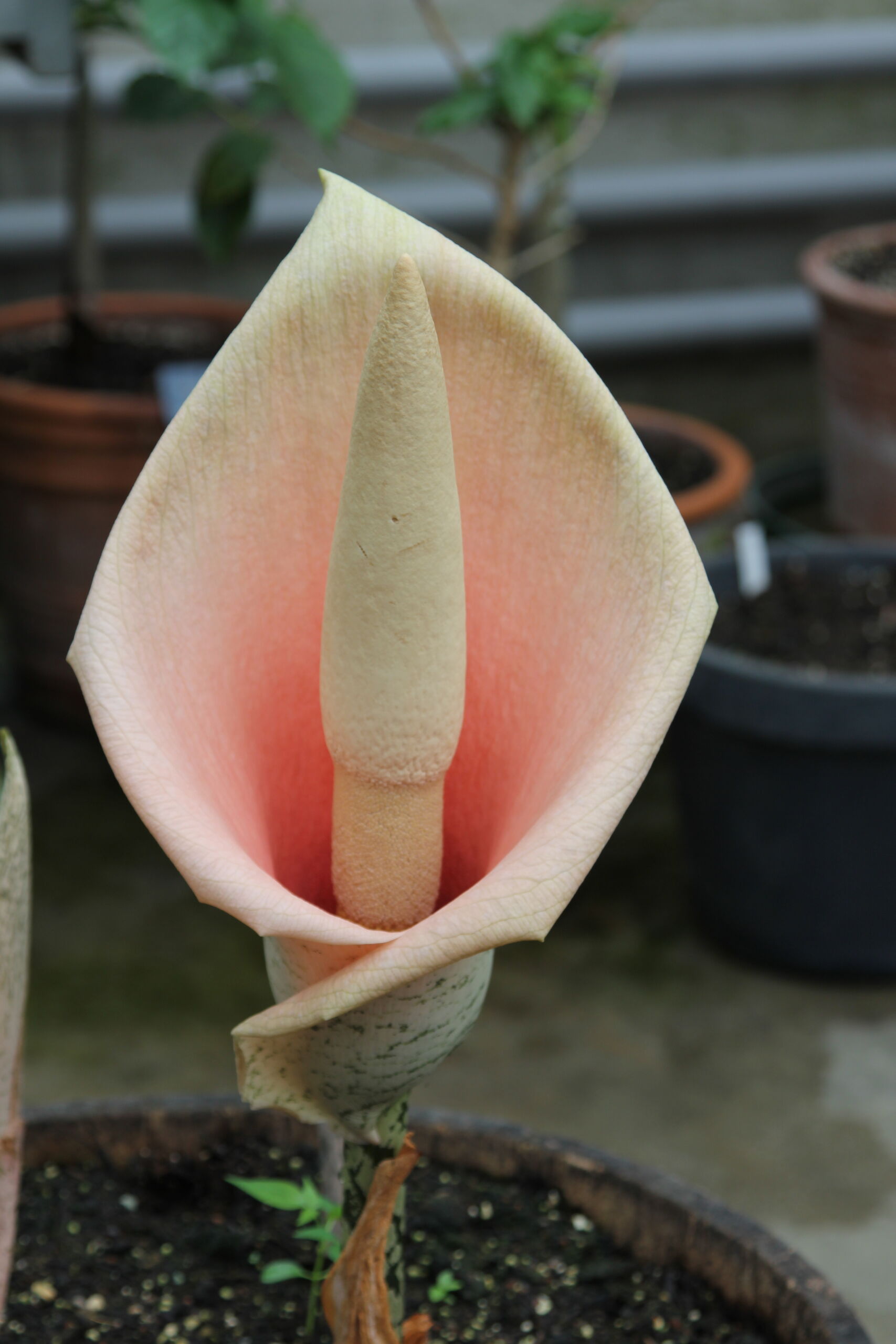
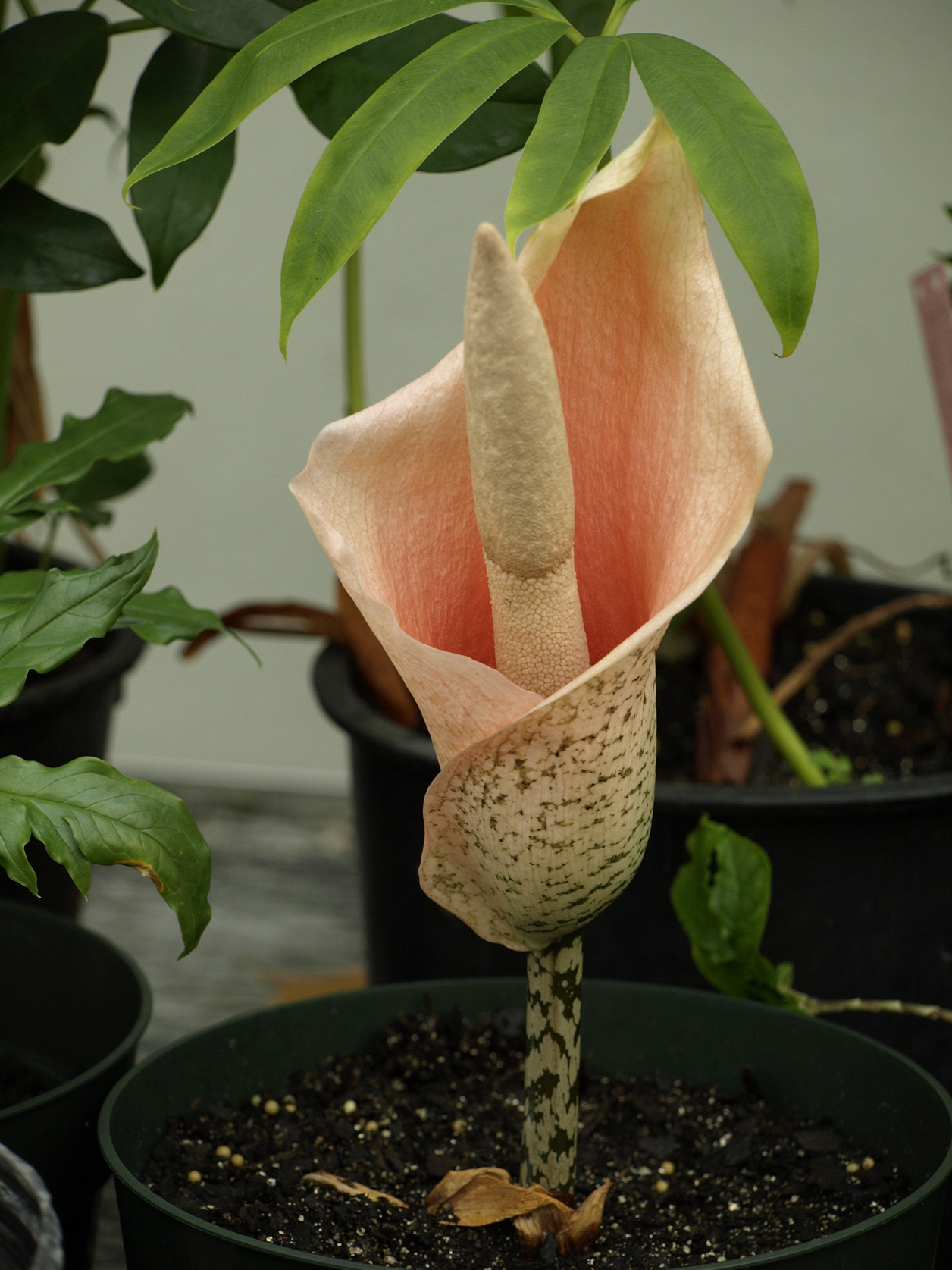
The plant has two acts, and it never performs both at once. In spring, a mature corm sends up either a flower or a leaf — never both in the same season. The flower comes first in the plant’s year when it blooms: a stalk up to about 2 feet tall, topped by the spathe, a smooth shell-pink hood, paler above and deeper pink to red at the base inside, with a pale pink spadix sitting in the cup at about the same height as the spathe. The whole inflorescence stands up to about 70 cm tall. If the flower is pollinated, it turns over the following months into a heavy stalk of berries that ripen from green to glowing scarlet red.
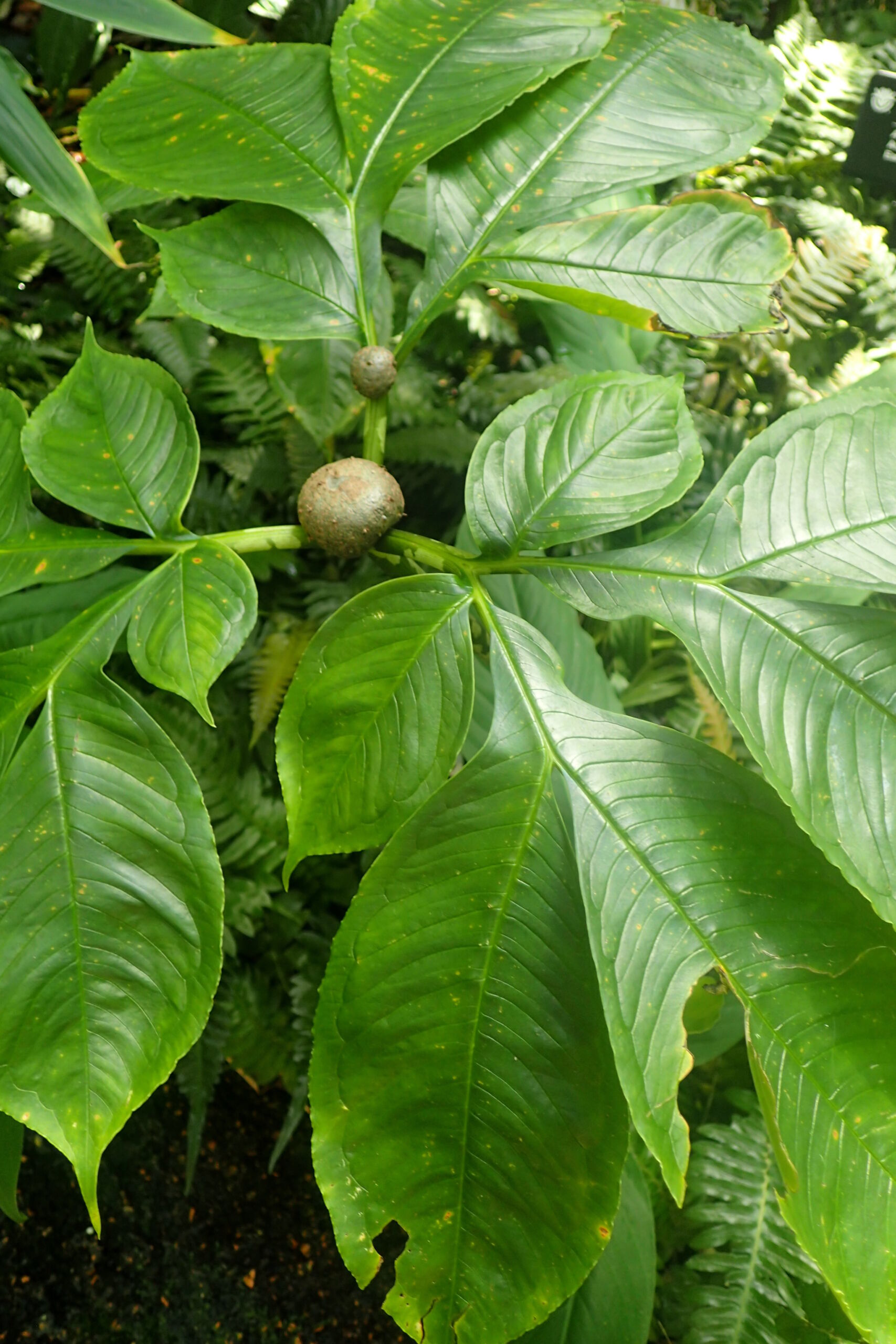
The leaf is the act most growers see most years. A single stem rises from the corm — dark green mottled with pale areas, like a snakeskin pattern — and opens into one large, deeply divided leaf that can reach 3 feet tall and looks for all the world like a small tree. It is a convincing disguise: visitors will ask what kind of tree you are growing in a pot. The answer is that it is not a tree at all, and it will be gone by winter.
Then there are the bulbils, the plant’s signature move. Where the leaf’s branches meet at the top of the stem, small greyish-brown warts appear as the season progresses — miniature corms, each one a clone of the parent. When they mature they drop to the soil, root easily, and grow into entirely new plants. The species name is literal: it bears its own bulbs, up in the air, on its leaf.
How to grow it
Give it what its home climate gives it: a warm, wet summer and a dry winter, in bright shade. That is the whole recipe, and most failures come from getting one of the three words wrong — warm, wet, or shade.
Light: Bright shade or dappled sunlight is ideal — under a live oak, on a shaded porch, or in a greenhouse. Morning sun is tolerated, but hot afternoon sun scorches the leaf. Indoors, a bright window with indirect light works. This is a shade plant, and it is one of the best answers to the hardest spot in a Florida garden: the dry shade under trees where nothing else wants to grow.
Soil and pot: Rich, loose, well-draining soil with plenty of organic matter — a good potting mix with compost mixed in, or a mix made for African violets. Drainage matters more than richness: the corm rots in soil that stays soggy, and Florida’s summer downpours will test any pot without drainage holes. Grow it in a pot, not in the ground, unless you are in zones 10–11 with excellent drainage — a pot lets you move it out of a freeze and out of the house when it blooms (more on that below). Plant mature corms about 8 inches deep, smaller ones about 3 inches deep, in a pot wide enough for the corm to grow into.
Water: Regular, generous water while it is growing — keep the soil evenly moist through spring and summer, but never waterlogged. When the leaf yellows and collapses in autumn, stop: reduce watering and keep the plant almost dry all winter while it sleeps. Watering a dormant corm is the fastest way to rot it.
Feeding: A balanced fertilizer (10-10-10) every 4 to 6 weeks during the growing season is plenty, or a liquid seaweed feed weekly if the potting mix is lean. Do not feed while dormant.
Patience: A voodoo lily is very late to break ground in spring — one of the last plants to emerge in the shade garden. Do not dig it up in April to check whether it is alive. It is alive. It is just on its own schedule. Flowering takes a mature corm, usually 2 to 5 years from a bulbil, and even then it may not flower every year. The leaf years are not failures; they are the plant building the corm that will flower later.
The flower and the smell
The bloom lasts only a few days, and it spends them smelling like rotting meat. That is not a defect. It is the pollination strategy, and it is remarkably effective: blowflies and carrion beetles follow the scent into the spathe, blunder around among the tiny flowers clustered at the base of the spadix — female flowers below, male flowers above — and carry pollen out with them. The smell fades once the flower is pollinated.
It is worth saying plainly that the smell is strong but not the strongest in the genus. A. bulbifer is noticeably less intense than its cousins A. konjac and the giant A. titanum, and a few Florida growers report a form circulating in the trade that smells faintly citrusy or gingery rather than foul. Even so, plan for the classic version: when a bloom opens indoors, move the pot outside at night or away from windows and doors, and enjoy it from a respectful distance. Your neighbors will understand. Probably.
Nerdy fact: The flower is not one flower at all. The spathe is a modified leaf, a hood; the spadix is a spike carrying hundreds of tiny real flowers. The whole structure is an inflorescence — a flower spike wearing a costume — and the costume is doing the advertising while the tiny flowers do the reproducing.
Dormancy: the disappearing act
In autumn, the leaf yellows, collapses, and dies. This is not a problem. It is the plan. The plant is adapted to dry winters: it pulls its energy back into the corm, drops the leaf, and sleeps until the warmth and rains return. Reduce watering to almost nothing, keep the pot somewhere it will not freeze, and leave it alone. Each dying leaf leaves its bulbils behind — detach them and press them about 3 cm deep in potting mix, and they will sprout the following summer.
In Florida, dormancy is the season that makes this plant easy. While the rest of the garden is demanding water and attention through the dry months, the voodoo lily wants to be ignored. The danger is the opposite of neglect: a well-meaning gardener who keeps watering a sleeping corm through winter will rot it. Dry is safe. Wet is not.
Voodoo lily in Florida
This is a tropical Asian plant, and Florida is the closest thing to home it will find in the United States — with two catches. The first is cold. It is hardy in USDA zones 9–11, which covers most of the state in the ground, but a hard freeze will damage or kill the corm. In North Florida, grow it in a pot and bring it inside or into a greenhouse when a freeze is forecast. In Central and South Florida it can stay out with a sheltered spot and a mulch layer, but a pot is still the safer choice: it lets you move the plant when it blooms, and a blooming voodoo lily is not something you want parked by the front door.
The second catch is water. Florida’s humidity is a gift to this plant — it loves moist air — but Florida’s summer downpours are a test. A pot without drainage, or a low spot that holds water, will rot the corm. Raised beds, pots with big drainage holes, and a loose mix solve it. Shade is the easy part: Florida has no shortage of it, and the dappled light under a live oak is exactly what this plant wants.
It is not an invasive plant here. It spreads only by bulbils dropped near the parent and by a corm that slowly makes new tubers underground — easy to contain in a pot, easy to share with friends, and not a plant that runs away into natural areas.
Is it poisonous?
Yes — treat it with respect. Like nearly all aroids, the voodoo lily contains calcium oxalate crystals, needle-shaped raphides that cause irritation and swelling in the mouth and throat if the plant is eaten. The corm is poisonous when raw, and the berries and sap can irritate skin. Keep it out of reach of children and pets, wear gloves when handling cut stems or berries (the juice can stain and irritate), and wash your hands after repotting. This is a look-but-don’t-taste plant, and that is a fair trade for a flower that smells like roadkill: the whole plant is telling you, in every way it can, that it is not food.
Common problems
- Corm rot: The number-one killer. Caused by soggy soil or watering during dormancy. Prevention is drainage and a dry winter; there is no cure for a rotted corm, so get the soil right from the start.
- It never comes up in spring: It is late, not dead. Voodoo lilies are among the last plants to emerge. Wait until late spring before declaring anything, and do not dig the corm up to check — that disturbs the roots it is trying to grow.
- It never flowers: The corm is not mature yet (2 to 5 years from a bulbil), or it flowered last year and is taking a leaf year. Leaf years build the corm; flowers follow.
- Mealybugs, spider mites, aphids: The usual suspects on the leaf in hot, dry spells. Inspect regularly and treat with insecticidal soap or neem oil.
- Leaf scorch: Too much direct sun. Move it into brighter shade.
- Bulbils everywhere: Not a problem — a gift. Pot them up and give them away.
🌾 Saving seeds & propagation
This plant is almost embarrassingly easy to multiply, and seeds are the least of it. The bulbils are the story: detach the greyish-brown bulbils from the dying leaf’s joints in autumn, press them about 3 cm deep in potting mix, keep them barely moist through winter, and they will sprout the following summer. Water and feed them like seedlings, and pot them on individually after a year. One leaf can produce a dozen new plants.
The corm also makes new tubers underground, so a mature pot will slowly fill with offsets — divide them when you repot during dormancy in late winter or early spring, giving each piece a growing point and letting cut surfaces dry for a day before replanting.
Seeds are possible but slower: if a flower is pollinated, the berries ripen from green to scarlet red over the following months. When they soften, press them about 1 cm deep in propagating mix, wearing gloves — the juice can stain and irritate. Grow them on for a year before potting individually. For the adventurous, staff at the Royal Botanic Gardens, Sydney, found that leaf wedge cuttings work too: slice a mature leaf tip with a razor so each wedge includes a section of a large vein, dip the wound in rooting hormone, and keep it warm and moist in shade — cuttings root in about a month. Bulbils are easier. Start there.
Lookalikes: the corpse flower family
The voodoo lily’s closest lookalikes are its own cousins, and telling them apart is a matter of two or three features you can check in one look at the flower.
Mueller’s Corpse Flower (Amorphophallus muelleri): The classic confusion. Muelleri’s spathe carries large white polka-dot spots, and its spadix is distinctly longer than the spathe — a bumpy, cream-white finger towering 8 to 40 cm above a low, broad cup. Bulbifer’s spathe is plain shell-pink with no bold white spots, and its spadix is about the same height as the spathe, sitting in the cup rather than towering over it. Check two things: spots, and whether the tall part is the spathe (bulbifer) or the spadix (muelleri). This is the pair that photo-ID tools get wrong — even at high confidence — so check it yourself.
Devil’s Tongue (Amorphophallus konjac): Darker in every way. Both the spathe and the spadix are deep maroon to purple, where bulbifer is pale pink and cream. Konjac is also hardier and more commonly sold; if the flower is dark purple, it is not bulbifer.
Giant Corpse Flower (Amorphophallus titanum): Scale settles this one. Titanum’s bloom is several feet tall with a deep-red interior — a plant you measure in feet, not inches. Bulbifer’s whole inflorescence is under 70 cm. If the flower is taller than you are, it is not bulbifer.
Elephant Foot Yam (Amorphophallus paeoniifolius): A bigger, coarser plant grown for its edible corm, with a large, foul-smelling, purplish flower. Bulbifer is smaller, pinker, and grown for the flower and the foliage, not the table.
Frequently Asked Questions
Why does it smell like roadkill?
Because its pollinators are flies and carrion beetles, and they follow the smell of dead things. The flower imitates a carcass — scent included — so the insects blunder in, pick up pollen, and carry it to the next flower. It works beautifully. Your nose is not the target audience.
Will it stink up my house?
Only for a few days while it blooms, and only if you let it. Move the pot outside or away from doors and windows when a bloom opens. The smell fades once the flower is pollinated. Some plants in the trade smell faintly citrusy or gingery instead of foul, but plan for the classic version.
How long until it flowers?
Usually 2 to 5 years from a bulbil, and even a mature plant may not flower every year. It alternates: a flowering year, then leaf years while the corm rebuilds. The leaf years are not a failure.
Is it poisonous?
Yes. It contains calcium oxalate crystals that irritate the mouth and throat if eaten, and the raw corm is poisonous. Keep it away from children and pets, wear gloves when handling sap or berries, and wash your hands after repotting.
Why did my plant disappear in winter?
It went dormant, on purpose. The leaf dies back in autumn and the corm sleeps in dry soil until spring. Keep it almost dry all winter and do not dig it up to check — it is one of the last plants to emerge in spring.
Can I grow it in the ground in Florida?
In zones 10–11 with excellent drainage, yes. In North Florida, grow it in a pot so you can bring it in for freezes. Either way, give it bright shade and soil that drains.
What are the little balls on the leaf?
Bulbils — miniature clones. They form where the leaf branches meet, drop when mature, and root into new plants. Detach them in autumn and pot them up, or let them fall and watch the colony grow.
Is this the same as a corpse flower?
A cousin, not the same plant. The giant corpse flower (Amorphophallus titanum) is a different species with a bloom several feet tall. The voodoo lily is its smaller, pinker, far more growable relative — and the one you can actually fit in a pot.
Does it need full sun?
No — bright shade or dappled sun. Hot afternoon sun scorches the leaf. Under a live oak or on a shaded porch is ideal.
How do I get more plants?
Collect the bulbils. One leaf can make a dozen new plants, and they are exact clones of the parent. Pot them up and give them away — every gardener you know needs one, whether they know it yet or not.
🌱 Keep learning
Three related guides worth reading next:
- Elephant Ear: Growing Guide — A fellow aroid with the same shade-and-moisture tastes, and a leaf you could park a car under.
- Peace Lily: The Drama Queen That Droops, Then Forgives You — Another shade-loving aroid for indoors — this one droops theatrically when thirsty, then forgives you.
- Snake Plant: The Houseplant That Thrives on Neglect — The plant this one is sometimes sold as — and why the name belongs to Dracaena trifasciata.