
🌿 Yerba Santa
What it looks like

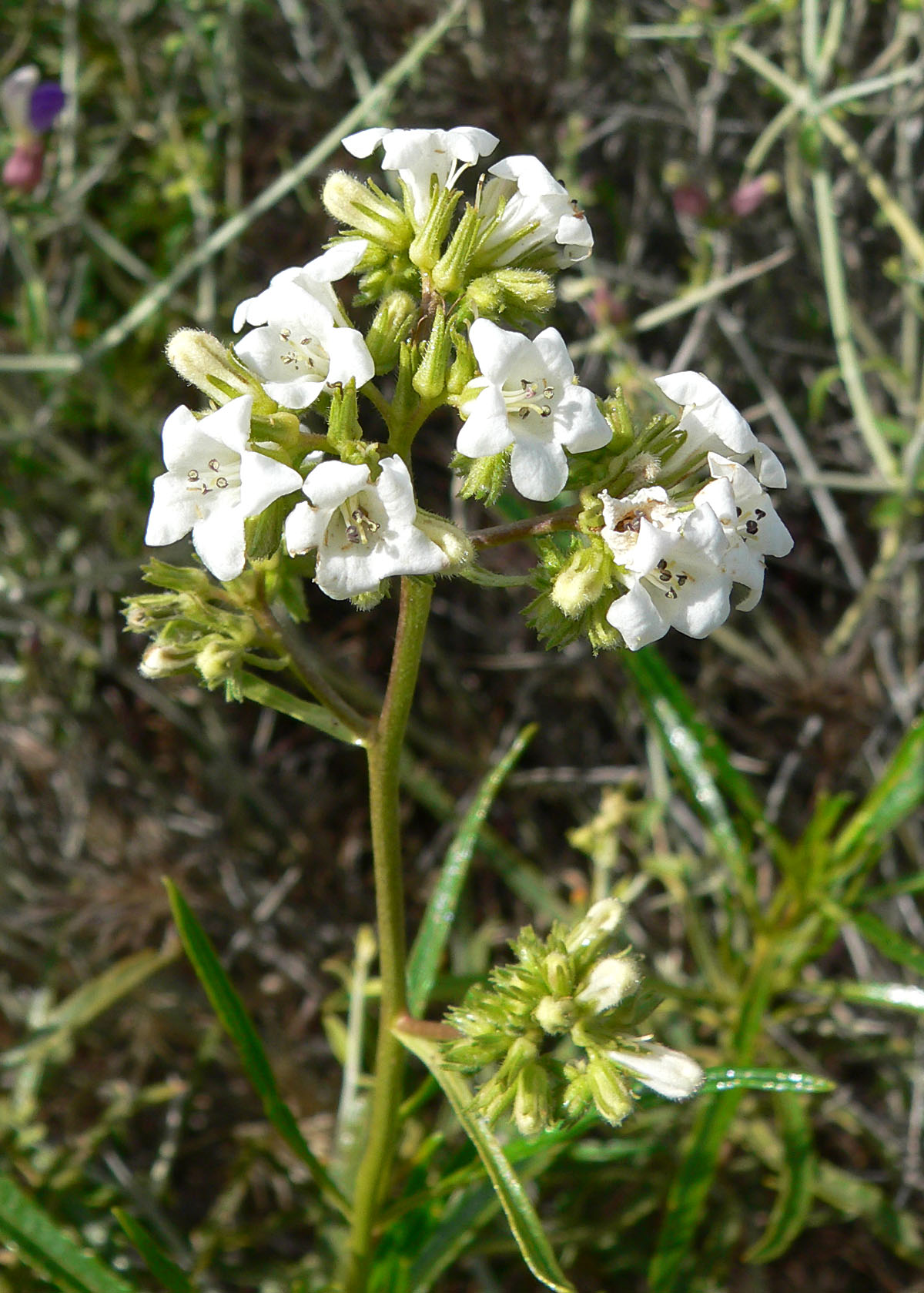
Yerba santa means “sacred herb” in Spanish, and the name fits: this is a plant people have noticed, named, and used for a very long time. The genus Eriodictyon — now placed in the family Namaceae, though older books file it under the waterleaf or borage families — holds about ten species native to the southwestern United States and northwestern Mexico, with the greatest diversity in California. They are aromatic, resinous, evergreen shrubs (occasionally perennial herbs), and they smell like they mean it: crush a leaf and you get a balsamic, medicinal, slightly sweet scent that explains why so many cultures reached for it.
California yerba santa, Eriodictyon californicum, is the best-known species and the one most gardeners will meet. It is an erect, much-branched evergreen shrub, typically 3 to 4 feet tall in clonal stands, though garden and nursery sources report plants reaching 6 to 10 feet in favorable conditions — height varies with site, water, and age, so do not plant it under a window and expect it to stay polite. Its leaves are dark green, leathery, narrow and oblong to lance-shaped, up to about 15 centimeters long, coated in a shiny resin that can look dusted with black fungus (a harmless sooty-looking fungus that commonly grows on the resin). The flowers are the payoff: clusters of bell-shaped, white to lavender-purple tubes, each 1 to 2 centimeters long, carried at the branch tips, mostly in spring. Bees, butterflies, and other pollinators work them eagerly, and California yerba santa has been documented as a primary nectar source for variable checkerspot butterflies at one California preserve — which is exactly why it shows up in butterfly nectar lists.
Other species trade on the same theme with different textures. Thick-leaved yerba santa, Eriodictyon crassifolium, is the soft, woolly one of southern California. Hairy yerba santa, Eriodictyon trichocalyx, is, as advertised, hairy. Narrow-leaved yerba santa, Eriodictyon angustifolium, is the widespread desert-edge species, the only yerba santa found in Arizona, with narrow, sticky leaves and white flowers. All of them share the resin, the scent, and the chaparral attitude: sun, heat, poor soil, and not much water, thank you very much.
How to grow
Grow yerba santa like a chaparral plant, because that is what it is. Full sun is essential — it cannot grow in shade, by every source that mentions it — in well-drained soil of almost any texture, from sandy loam to heavy clay, as long as water does not sit around the roots. It tolerates poor, nutrient-lean soil and even serpentine soil, and it prefers dry to moist conditions with a long, hot, dry summer, the Mediterranean pattern of its home. Published hardiness for California yerba santa is generally zones 7 to 10, hardy to roughly 23°F, and it grows on dry, rocky hillsides, ridges, chaparral slopes, and canyon edges below about 1,600 meters elevation. Space plants about 3 feet apart at planting, and then give them room to become a colony: yerba santa spreads by woody underground rhizomes, and a well-established plant can send up new shoots at a distance, sometimes several feet away. This is a feature on a bank you want held together, and a surprise in a small, formal bed. Plant it where a spreading shrub is welcome, not where you will resent it.
Yerba santa is also a fire plant, in the best sense. It resprouts vigorously from its rhizomes after wildfire, and its seeds can wait in the soil for a disturbance cue. In a garden, that translates to toughness: it can be cut back hard and will return, and it is a good choice for erosion control on dry slopes and for revegetating disturbed ground. It is not a plant for humid, wet-summer gardens, and it is not a Florida plant at all — this guide makes no Florida recommendation for yerba santa, because its native range, its climate needs, and Florida’s humidity point in opposite directions. Western gardeners in zones 7 to 10 with sun and drainage will love it; everyone else should admire it from a distance.
Propagation is by seed or by cuttings, and by division of rhizome shoots if you have a colony to spare. Seed-grown plants vary, and germination can be slow or uneven; cuttings give you a known plant. Buy from a native-plant nursery in the West, and avoid wild-collecting: some yerba santa relatives are rare — Lompoc yerba santa, Eriodictyon capitatum, is federally listed as endangered, and Indian Knob mountainbalm, Eriodictyon altissimum, is also listed — so never take plants from the wild, and be sure of the species you are buying.
Water & feeding
Water to establish, then water like a Californian: deeply and infrequently, and mostly not at all in summer once the plant is settled. Yerba santa is drought-tolerant and can be harmed by summer overwatering, which keeps its roots wet when the plant expects a dry rest. In its first year, water when the soil is dry a few inches down; after that, occasional deep watering in extended drought is enough, and in many western gardens it needs no summer water at all. Do not feed it. It evolved in lean soil, and fertilizer produces soft, rank growth that flops and invites pests. If the soil is truly dreadful, a mulch of gravel or coarse organic matter around the base — kept off the crown — helps hold moisture without feeding the plant into floppiness.
Pruning is simple: remove dead or crossing wood in late winter or early spring, and cut back hard if a plant gets leggy or if you want to rejuvenate a colony. It will resprout from the base. Wear gloves if you are sensitive to resins: some people develop skin irritation from contact with yerba santa resin, and the thick-leaved species in particular is noted for causing dermatitis in sensitized people. That is not a reason to fear the plant — it is a reason to wear gloves, like you would with any resinous shrub.
Common problems
- Too much water, especially in summer. The top killer in gardens. Wet roots rot, and summer irrigation in a Mediterranean-climate plant’s dry season invites trouble. Drainage first, hose second.
- Shade. Plants in shade grow weak, flower poorly, and stretch. Yerba santa wants full sun; there is no shade-tolerant workaround.
- Spreading beyond its welcome. Rhizomes travel. Site it where a colony is an asset, or install a root barrier, or plan to dig out wandering shoots each year. This is maintenance, not failure.
- Resin and sooty fungus. The shiny resin is normal, and the black dusting of fungus on it is common and generally harmless to the plant. It looks alarming and is mostly cosmetic.
- Wrong climate. In humid, wet-summer regions, yerba santa sulks, rots, or simply refuses to thrive. That is not a pest problem; it is a plant in the wrong postcode. Grow something local instead.
Harvest
There is no vegetable harvest, and this guide makes no medicinal promise. Yerba santa leaves have a long history of traditional use among Indigenous peoples of California and the Southwest, and later in pharmacy and flavoring, and that history is worth knowing and respecting. But traditional use is not a prescription, and this guide is a growing guide, not a medicine guide. If you are interested in the plant’s traditional uses, consult reputable ethnobotanical sources and qualified practitioners, and do not harvest from wild populations, especially rare species. In the garden, the real harvest is ecological: nectar for butterflies and bees, evergreen structure on a dry slope, erosion control from a spreading root system, and a shrub that asks for almost nothing and gives back scent, flowers, and toughness.
For garden propagation, take semi-ripe cuttings in summer, or lift rhizome shoots with roots attached in the cool season. Dry seed can be stored and sown in fall or spring in well-drained mix. Whatever you propagate, label it by species — the genus has several look-alikes, and “yerba santa” on a label without a Latin name is a guess, not an identification.
Browse all plant & pest guides
Saving seeds
Yerba santa seed is a fire-follower’s seed. In the wild it germinates after wildfire, and in the garden it wants the same signal: nick each seed with a file or rub it with sandpaper, then soak it overnight in warm water, and give it a cold, moist chill — a few weeks is the common figure — or sow in fall outdoors and let winter do it. Some growers add a smoke treatment — soaking the seed in water that has had smoke bubbled through it, or sowing it in soil mixed with char — and it helps, though it is not required. Germination usually comes in a few weeks after treatment, and it is slow and uneven.
Let the seed heads ripen on the plant until they are dry and brown, then strip them into a paper bag. Dry the seed thoroughly before storing; it keeps a few years in a cool, dry jar. Sow more than you need, since germination is uneven even after scarifying.
Seedlings will vary, and the named forms come only from cuttings or division. Division is easy for the clump-forming kinds — lift and split in spring or fall, and every piece with roots and shoots attached becomes a plant.
And the Florida honesty: yerba santa is a dry-land native of the California chaparral, for zones 8 to 10, and it does not grow in Florida. This section is for the reader in a dry, western climate, where yerba santa comes back year after year.
Species in this group
California yerba santa (Eriodictyon californicum) — The classic yerba santa: evergreen, resinous, 3–10 feet depending on site, white to lavender bell flowers, native to California and southwestern Oregon; the most widely grown species.
Eriodictyon trichocalyx — Hairy yerba santa of southern California: hairy stems and leaves, lavender flowers, a chaparral and coastal-sage plant of dry slopes and disturbed ground.
Eriodictyon angustifolium — Narrow-leaved yerba santa: narrow, sticky leaves and white flowers, ranging from California through Nevada, Utah, and Arizona to Baja California; the only yerba santa found in Arizona.
Eriodictyon crassifolium — Thick-leaved yerba santa of southern California: soft, woolly, thick leaves and showy lavender flowers; a felt-leaved beauty that can irritate sensitive skin on contact, so wear gloves.