
The Monarch is the butterfly everyone knows, and it earns that fame honestly: it is a large, orange-and-black milkweed butterfly whose life story includes a multi-generational migration, a winter spent clustered in mountain forests, and a caterpillar that eats poison for a living and wears stripes to prove it. In Florida it is both a migrant and a year-round resident, which makes it the monarch most gardeners actually meet — and the one whose garden advice matters most.
At a glance
- Latin name: Danaus plexippus — family Nymphalidae, subfamily Danainae, the milkweed butterflies
- Wingspan: about 9 to 10 cm (roughly 3.5 to 4 inches)
- Florida range: statewide; Florida hosts both migratory monarchs and a non-migratory resident population, especially in the south
- Host plants: milkweeds (Asclepias species) — the only plants monarch caterpillars eat
- Flight: year-round in Florida; migratory flights pass through in spring and fall
- Also found: across North America, from southern Canada to Mexico, with migratory and resident populations
How to recognize it
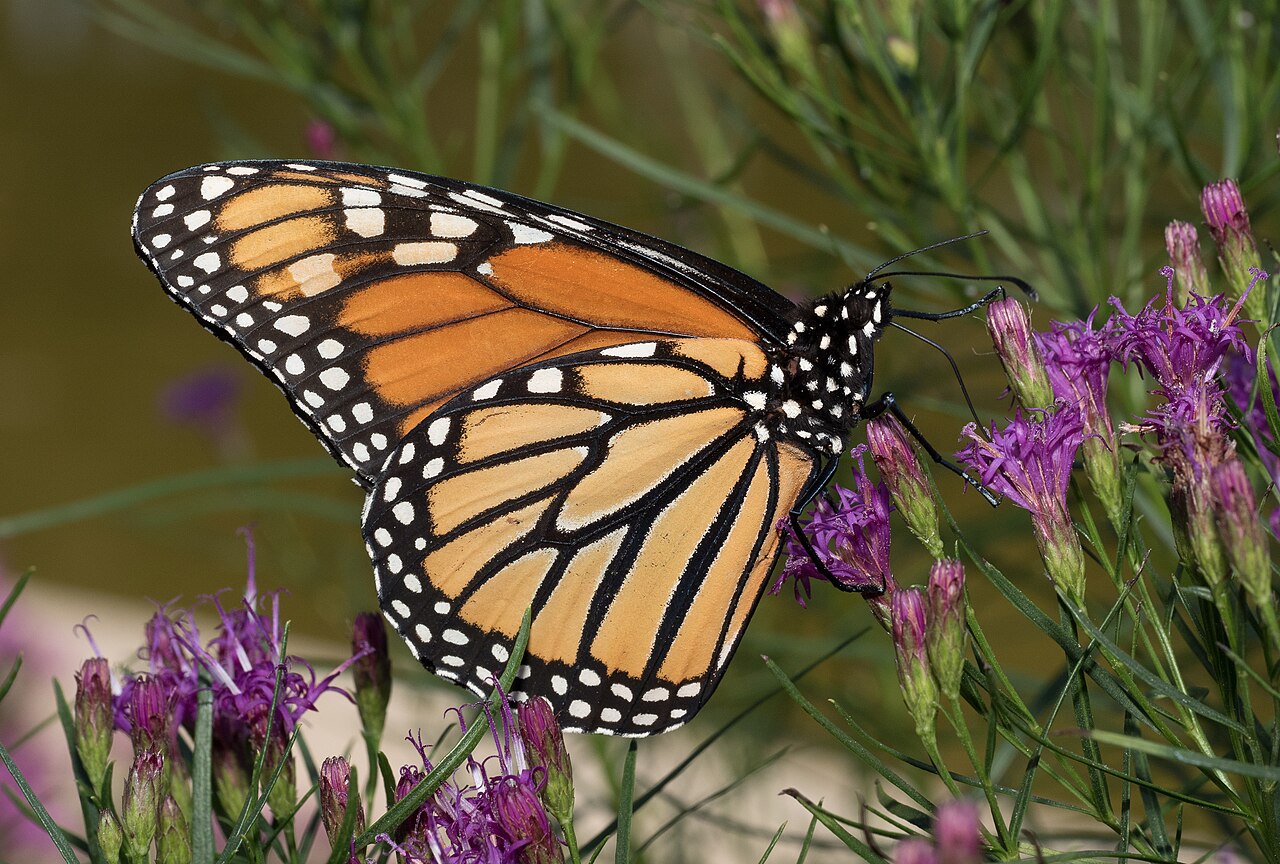
The adult is unmistakable: bright orange wings with heavy black borders and black veins drawn boldly across both surfaces, white spots in the black borders, and a black body with white dots. Males carry a dark scent spot on a vein of each hindwing. The underside is paler orange-yellow but keeps the black veining. In flight it is large, slow, and sailing, with deep wingbeats and long glides — a butterfly that looks like it is going somewhere, because very often it is. The Viceroy mimics it, but the Viceroy is smaller and carries a black line across its hindwing that the Monarch lacks.
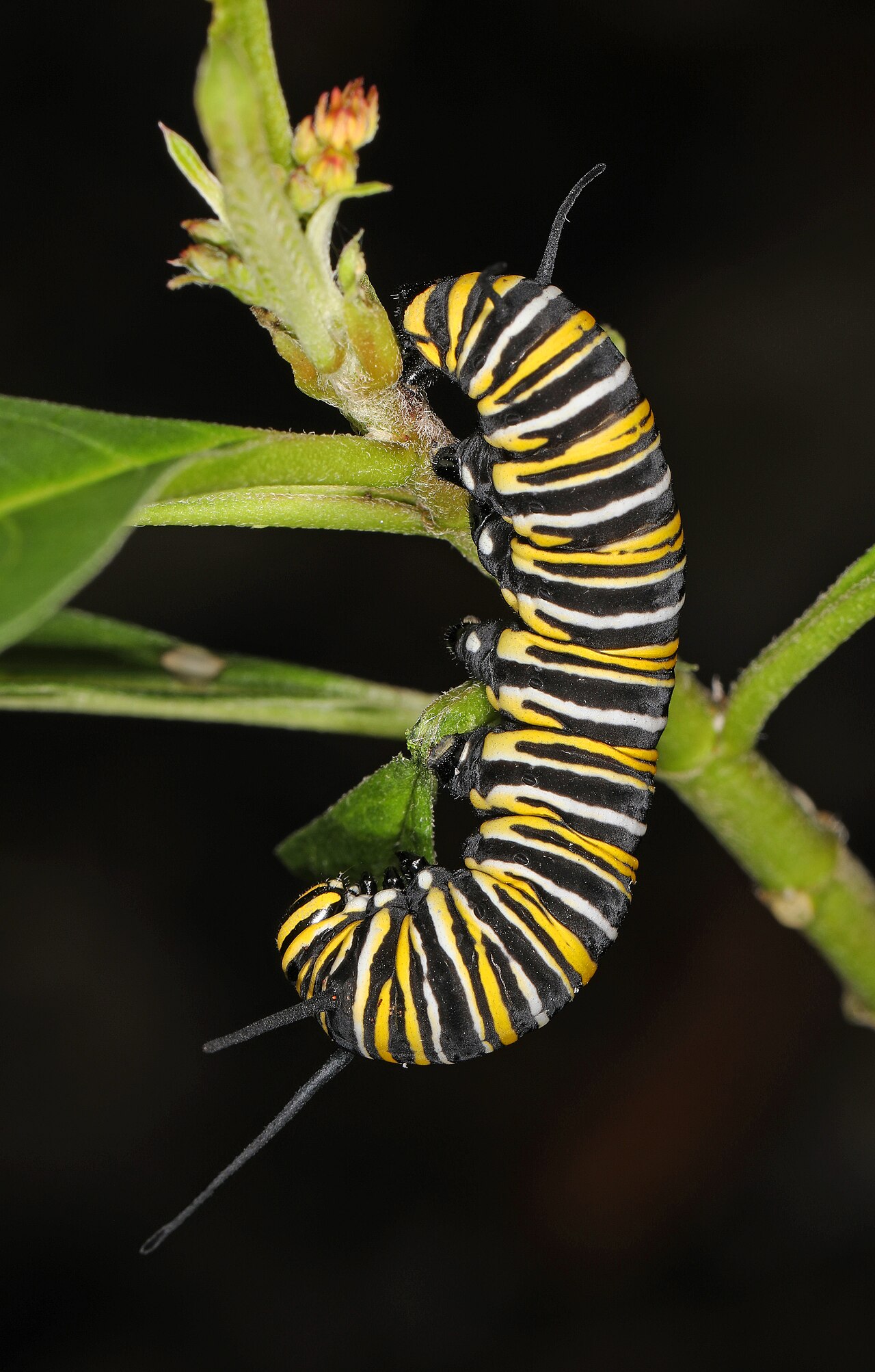
The caterpillar is just as famous as the adult: a plump larva banded in yellow, black, and white, with two pairs of long black filaments — one pair near the head, one near the rear — that it waves when disturbed. It eats milkweed leaves and nothing else, storing the plant’s cardenolides, bitter heart poisons, in its body as chemical defence. The chrysalis is jade green with gold dots, one of the most beautiful objects in the insect world, and it hangs from a silk button wherever the caterpillar found a suitable spot — a leaf, a stem, a fence, a wall.
Host plants
Monarch caterpillars eat only milkweeds, plants of the genus Asclepias and their close milkweed relatives. In Florida, native milkweeds are the right choice: butterfly milkweed (Asclepias tuberosa), swamp milkweed (Asclepias incarnata), and aquatic milkweed (Asclepias perennis) are among the species recommended for Florida gardens, because they naturally die back each year. The site’s own milkweed guide covers the genus, and the swamp milkweed profile covers one of the best Florida natives. Tropical milkweed (Asclepias curassavica), the species most often sold in nurseries, is a problem in Florida: it stays green and blooming through fall and winter, encouraging monarchs to keep breeding instead of migrating, and it is linked to higher transmission of OE, a protozoan parasite that weakens monarchs. If you have tropical milkweed, cut it back in fall so it dies back like a native would — or, better, replace it with natives.
Nectar plants and how to attract it
Adults nectar on a wide variety of flowers, and a monarch garden needs nectar as well as milkweed: migrating monarchs fuel their flight on nectar, and breeding monarchs need it daily. Plant a spread of native nectar flowers that bloom across the seasons, including goldenrod, blazing star, and aster relatives, and keep something blooming in fall, when migrants pass through Florida. Nectar plants are for the adults; milkweed is for the caterpillars; a garden with only one of the two is half a garden.
Plant native milkweed, plant fall nectar, skip insecticides entirely, and leave the caterpillars alone — a monarch caterpillar stripping a milkweed plant is the garden working, not failing. In Florida, the single most important choice is the milkweed species: natives that die back in winter support the migratory cycle and limit OE, while evergreen tropical milkweed disrupts both. Cut tropical milkweed back hard in fall if you keep it, and plan to replace it with natives. Do not buy or release monarchs: wild monarchs find milkweed on their own, and released butterflies can spread disease and dilute the wild population’s migratory behavior.
Predators and defence
Milkweed butterflies are chemically defended, and they advertise it. Caterpillars store cardenolides, bitter heart poisons from their milkweed host plants, and carry them into adulthood, so a bird that grabs one usually learns a memorable lesson and drops it. That defence is not absolute: some predators, including certain orioles and grosbeaks at overwintering sites, have learned ways around it, and spiders, wasps, and other invertebrates still take eggs and caterpillars. Warning coloration only works if predators survive the lesson, which is why these butterflies fly slowly and openly instead of hiding.
Life cycle
The monarch life cycle is the story of a relay race run by generations. In spring, monarchs leave their overwintering grounds and fly north, laying eggs on milkweed along the way; those eggs hatch into caterpillars that become the next generation, which flies farther north, lays eggs, and dies; and the relay continues through the summer generations until, in fall, a special long-lived generation emerges. That fall generation delays reproduction, lives far longer than summer monarchs, and migrates to the overwintering grounds — in the forested mountains of central Mexico for the eastern population, and in coastal California groves for the western population — where it spends the winter in reproductive diapause, clustered on fir trees, living on stored fat, before flying north in spring to start the relay again. No single monarch makes the whole round trip: the migration is completed by several generations, each flying a leg of it, and the fall generation’s knowledge of the route is inherited, not learned. In Florida, the picture is more complicated, because the state hosts both migrants passing through and a resident population that breeds year-round where milkweed stays green — which is exactly why native, die-back milkweed matters here. Eggs hatch in a few days in warm weather; caterpillars pass through five stages in roughly two weeks in summer; the chrysalis stage lasts about two weeks; and summer adults live only a few weeks, while the migratory generation lives for months.
US range and flight period
Monarchs occur across North America, from southern Canada through the United States to Mexico, with the eastern population breeding east of the Rockies and overwintering in central Mexico, and the western population breeding west of the Rockies and overwintering in coastal California. Florida sits at a crossroads: migrants pass through the state in spring and fall, and a resident population breeds year-round, especially in the south. Monarchs are also found in other parts of the world, but the North American migration is the phenomenon this guide describes.
Year-round in Florida, with migratory peaks in spring and fall. In the north, the flight season runs from spring through fall, with the migratory generation moving south in fall and the return relay moving north in spring.
Fun facts
- No individual monarch completes the whole migration: the journey north is a relay of several generations, and the southbound fall generation is the one that lives long enough to overwinter and start the next relay.
- Monarch caterpillars eat only milkweed, and the poisons they store from it protect them as caterpillars and as adults — a chemical defence borrowed from a plant.
- The overwintering sites in Mexico were unknown to science until the 1970s, when researchers finally tracked the migration to its mountain-forest destination — one of the great detective stories in natural history.
- OE (Ophryocystis elektroscirrha) is a protozoan parasite spread when spores shed by infected adults onto milkweed leaves are eaten by caterpillars; year-round tropical milkweed increases its transmission, which is why native, die-back milkweed is the Florida recommendation.
- Monarchs are the only butterfly in North America with a regular, multi-generational, two-way migration on this scale — and Florida is one of the few places where you can see both the migrants and the residents in the same garden.
Conservation notes
Monarch populations face serious pressures, and this guide states them plainly without inventing numbers: loss of milkweed and nectar habitat, pesticide exposure, loss and disturbance of overwintering forest, disease including OE, and climate shifts that alter migration timing and breeding seasons. The migratory monarch has been assessed as endangered by the International Union for Conservation of Nature, and its status under US law has been the subject of ongoing review — check current listings rather than relying on any single year’s headline. What helps, in Florida and everywhere: plant native milkweed, plant diverse native nectar, avoid insecticides, cut back or replace tropical milkweed, and protect the wild, migratory population by not releasing purchased butterflies.
🪱 Your Soil Needs This
Reading about healthy soil is great. Growing in it is better. Our small-batch, traceable worm castings are the shortcut your garden deserves.
Shop Worm Castings Subscribe & SaveEvery bag comes with a lot certificate. Know what's in your soil.