
🌿 Pothos
Every houseplant person has a pothos story, and most of them start the same way: someone gave them a cutting in a jar of water, they forgot about it for a month, and it was still alive. Epipremnum aureum — golden pothos, devil’s ivy, the plant that launched a thousand dorm rooms — is the vine that made houseplants feel possible. It trails, it climbs, it roots in a glass of water on a windowsill, and it shrugs off the kind of care that would kill a fern in a week.
It is a hemiepiphyte from the islands of the South Pacific, native to Mo’orea in French Polynesia, which means it evolved to start life on the forest floor and then climb the nearest tree, gripping the bark with aerial roots and reaching for the canopy light. That climbing instinct is the key to everything about it. Given something to climb, pothos leaves get dramatically bigger — from the small, heart-shaped leaves you know from a hanging basket to dinner-plate leaves a foot across, sometimes with splits like a monstera’s. Given nothing to climb, it trails, and the leaves stay small and neat. Same plant, two completely different looks, depending on whether you give it a pole or a shelf.
The variegation is part of the charm. Golden pothos has creamy yellow marbling; ‘Marble Queen’ is mostly white; ‘Neon’ is electric chartreuse; ‘N’Joy’ has crisp white edges. That marbling is not paint — it is patches of leaf tissue with no chlorophyll, which means those patches cannot photosynthesize. The whiter the leaf, the more light it needs to pay its own way, which is why a Marble Queen in a dark corner slowly turns green: the plant is abandoning the expensive white patches to survive. Light is not decoration for a pothos. It is the budget.
What it looks like
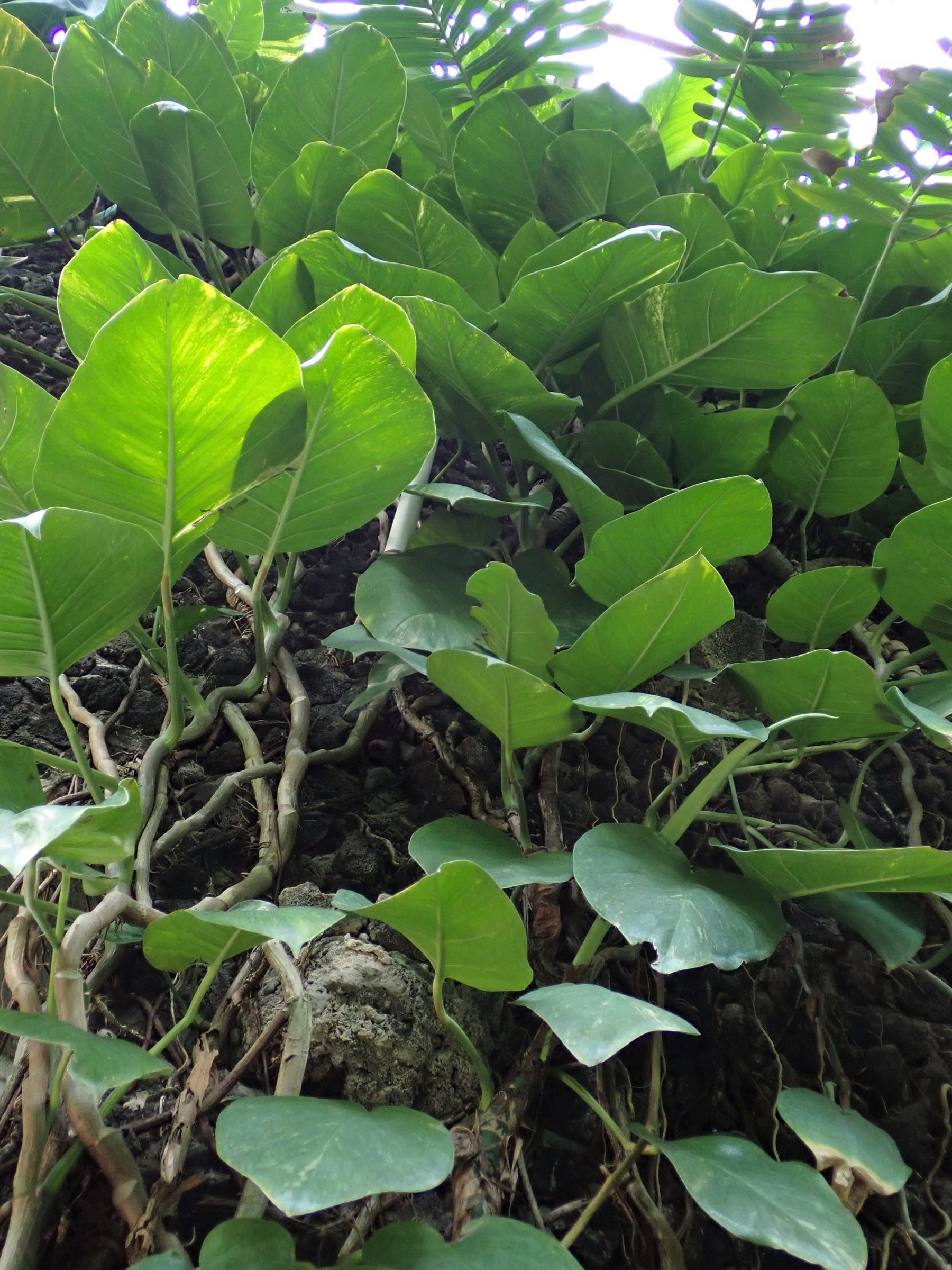
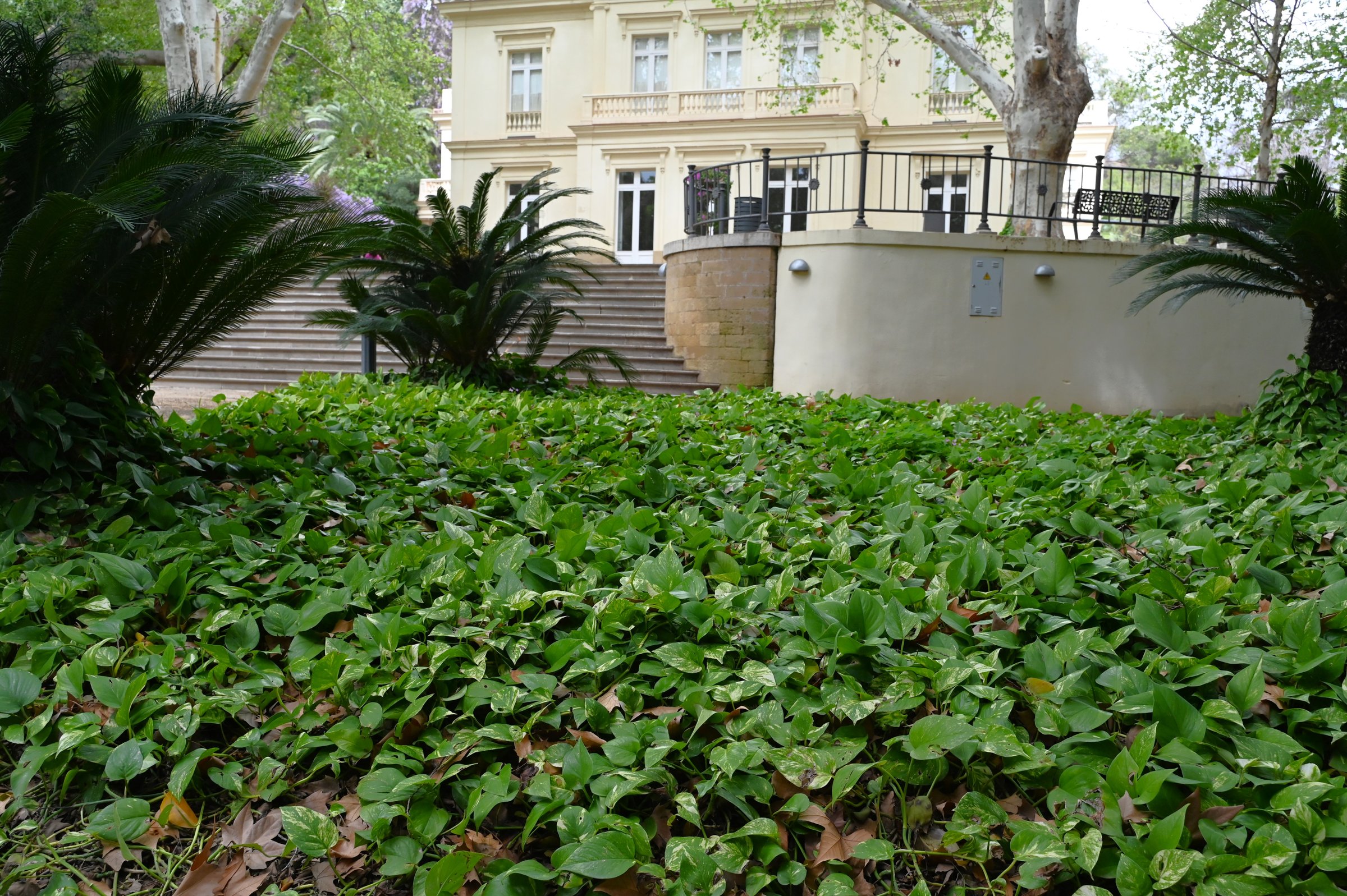
The leaves are heart-shaped, glossy, and slightly waxy, on long stems that alternate along a trailing or climbing vine. Young leaves are a few inches across; mature leaves on a climbing plant can reach a foot or more, with a thicker, leathery texture. Along the stem, at every leaf joint (each node), you will find a small brown nub — an aerial root, waiting for something to grip. In the wild those roots glue the vine to a tree trunk; in your house they will happily grip a moss pole, a wall, or the side of a bookshelf if you let them.
Stems can grow 10 feet or more indoors in a season, and far longer outdoors in the tropics, where pothos has been known to climb 60 feet into the canopy. Indoors, you decide the shape: let it trail from a hanging basket, train it up a pole, or pin it along a shelf. It rarely flowers indoors — the flowers are small, cream-colored, and unremarkable, and the plant has to reach maturity (which usually means climbing high in a tropical climate) before it bothers. You are growing it for the leaves, and the leaves are the whole point.
Light
Bright, indirect light is ideal: near a sunny window but out of the direct beam, or a few feet back from an east-facing window where it gets gentle morning sun. In bright light the plant grows fast, the leaves stay big, and the variegation stays bold. It will survive in low light — this is one of its famous talents — but survival has a price: growth slows, the spaces between leaves stretch out (botanists call this etiolation, and it looks exactly like it sounds: a long, bare, leggy vine with small leaves spaced far apart), and variegated forms fade back to green as the plant drops its expensive non-photosynthesizing patches.
Direct sun is the one light mistake that hurts. A few hours of harsh afternoon sun through a south- or west-facing window will scorch the leaves, leaving bleached, papery patches. Florida sun is not a joke — even an indoor plant a foot from a west window can burn in July. If the leaves are fading or bleaching, move the pot back a few feet or hang a sheer curtain. If the vine is getting leggy and the new leaves are smaller than the old ones, it wants more light.
Water
Water when the top inch or two of soil is dry. In a Florida home that usually means once a week in summer and every ten days to two weeks in winter, but the finger test beats the calendar every time: push a finger into the soil, and if the top two inches are dry, water thoroughly until it runs out the drainage hole, then empty the saucer. If the top is still damp, wait. Pothos likes consistent moisture but hates sitting in water, and the line between the two is drainage, not drought.
Yellow leaves are the plant’s way of telling you the watering is off, and they usually mean too much rather than too little. A pothos that is genuinely thirsty wilts dramatically — the leaves go limp and sad — and then perks up within hours of a good watering, like nothing happened. It is one of the most forgiving wilts in the houseplant world. A pothos that is overwatered does not perk up; its leaves yellow from the oldest ones inward, the stems go soft at the base, and the roots rot. When in doubt, wait a day. The plant would rather be thirsty than drowned.
Florida’s humidity is a gift here. Pothos comes from a humid forest, and our air keeps its aerial roots happy and its leaf edges from crisping. You do not need to mist it — misting does almost nothing for humidity and can spread leaf-spot fungi — but a humid room, a bathroom window, or a summer on a shaded porch will make it visibly happier.
Soil & pot
Pothos is not fussy about soil, but it wants two things: drainage and air. Ordinary houseplant potting mix with a handful of perlite or orchid bark mixed in is perfect. Heavy, peaty mix that stays soggy is the enemy; if your bag of mix feels like wet sponge, cut it with perlite until water runs through freely. Soil pH around 6.1 to 6.5 is ideal, which is where most bagged mixes land anyway.
Any pot with a drainage hole works. Hanging baskets are the classic choice because they show off the trailing habit, but a pot on a shelf with the vine trained up a moss pole gives you the big-leaf mature form that stops visitors in their tracks. If you use a moss pole, keep it damp — the aerial roots will grow into it, and the leaves above the grip point get noticeably larger. Repot every year or two in spring, when roots are circling the bottom of the pot, going one size up. Pothos tolerates being slightly root-bound, but a plant that has not been repotted in three years is living on borrowed nutrients and will show it with small, pale leaves.
Feeding
Feed lightly in spring and summer — once a month with a balanced liquid houseplant fertilizer at half strength is plenty — and not at all in fall and winter. Or skip the bottle and top-dress with a thin layer of worm castings each spring; the castings release nutrients slowly, feed the soil microbes, and will not burn the roots. Overfeeding shows up as brown leaf tips, a white salt crust on the soil, and leggy growth. If you see that, flush the pot with plain water and take a break from feeding for a few months.
One honest note: a pothos that is growing fast in bright light and getting fed regularly will outgrow its space in a season. That is not a problem. That is the plant doing its job — and it is why the propagation section below exists.
Common problems
Yellow leaves: usually overwatering, especially if the oldest leaves yellow first. Let the soil dry out more between waterings and check that the pot drains. A single yellow leaf now and then is normal aging — the plant sheds its oldest leaves as it grows. A dozen yellow leaves at once is a watering problem.
Leggy vine with small leaves: not enough light. Move the plant closer to a bright window, and prune the bare vine back to a node with leaves — the cutting you remove is propagation material, so nothing is wasted.
Brown leaf tips or edges: dry air, inconsistent watering, or fertilizer salts. In Florida, dry air is rarely the cause, so check watering and feeding first. Trim the brown edge with clean scissors if it bothers you.
Variegation fading to green: not enough light. Move the plant brighter, and prune back the fully green growth — once a vine reverts, the new growth from that stem usually stays green, so cut back to a variegated node to encourage variegated growth.
Pests: mealybugs, spider mites, and scale all visit pothos occasionally. Mealybugs look like tiny cotton balls in the leaf joints; mites leave fine webbing and stippled leaves; scale looks like small brown bumps. Wipe mealybugs and scale off with rubbing alcohol on a cotton swab, rinse mites off with a strong spray of water, and repeat weekly until they are gone. A healthy, well-watered pothos in humid Florida air is rarely bothered.
Propagation
Pothos is the easiest propagation in the houseplant world, and the reason half the plant people you know got their first plant for free. Like the spider plant, it practically propagates itself — you just have to get out of its way.
Stem cuttings in water: cut a stem just below a node — the knobby joint where a leaf meets the stem, usually with a little brown aerial root nub. The cutting needs at least one node and one leaf. Put it in a jar of water so the node is submerged and the leaf is above the water line, and set it in bright, indirect light. Roots appear in one to three weeks. Change the water weekly so it stays fresh. Once the roots are a couple of inches long, pot the cutting in moist potting mix and keep the soil damp for the first week while it adjusts from water to soil.
Stem cuttings in soil: same cut, but push the node directly into moist potting mix and keep it damp (not soggy) for a few weeks. This skips the water-to-soil adjustment and usually gives a stronger plant faster, though you cannot watch the roots grow, which is half the fun of the jar method.
Single-node cuttings: for a plant you want to multiply fast, cut the vine into pieces with one node and one leaf each. Each piece becomes a plant. Lay them on moist mix with the node buried, or root them in water. One long vine becomes a whole pot in a season.
The only rule that matters: no node, no plant. A leaf without a node will root and sit there forever, a botanical dead end. Cut below the node, keep the node wet, and you will have more pothos than you have shelves for.
In Florida
Here is the part of this guide that matters most, and it is not optional. In Florida, pothos is a Category I invasive plant — the Florida Invasive Species Council’s most serious listing, reserved for plants that are actively displacing native species. Escaped pothos climbs trees in South and Central Florida, smothering native vegetation under a mat of vines, and its huge mature leaves shade out everything below. It is one of the most damaging ornamental escapes in the state.
That means two hard rules. Never plant pothos in the ground outdoors in Florida — not in a shady corner, not “just this once,” not where you can keep an eye on it. A vine that escapes will climb a tree and fruit, and birds spread the seed. And never dump pothos trimmings in the yard, in a ditch, or in a compost pile near natural areas. A single node can root and take off. Bag trimmings and put them in the household trash, or hot-compost them where the pile genuinely gets hot enough to kill them. Our Florida invasive swaps guide has native and well-behaved alternatives for every spot pothos tempts you to fill outdoors.
None of that makes pothos a bad houseplant — it is a wonderful one, and it belongs indoors, in a pot, where you control it. A summer vacation on a shaded porch is fine, and Florida humidity will make it grow like it means it, but bring it in before the first cold snap: pothos is damaged below about 50°F and killed by frost, which is the one thing that keeps it from taking over North Florida the way it has South Florida. Enjoy it inside. Keep it there.
Frequently asked questions
Why are my pothos leaves turning yellow?
Usually overwatering — the soil is staying wet. Let the top two inches dry out between waterings and make sure the pot drains. A single yellow leaf now and then is normal aging; many at once is a watering problem.
Can I grow pothos in water forever?
Yes, for a surprisingly long time — it will live in a jar for months or years. But it grows slowly in water, the leaves stay small, and it eventually runs out of nutrients. Add a drop of liquid fertilizer now and then, or pot it up when you want real growth.
Why is my pothos leggy with bare stems?
Not enough light. The vine is stretching toward the nearest window. Move it brighter and prune the bare sections back to a leafy node — the cuttings will root, so you lose nothing.
How do I get bigger leaves?
Give it something to climb. A moss pole, kept damp, lets the aerial roots grip and triggers the plant to produce much larger, mature leaves. Trailing plants keep small juvenile leaves; climbing plants grow up — literally.
Is pothos safe for cats and dogs?
No — it contains calcium oxalate crystals, which irritate the mouth and stomach if eaten. Pets usually stop after one bite because it hurts, but keep it out of reach and call your vet if a pet eats a significant amount.
Can I plant pothos outside in Florida?
No. It is a Category I invasive plant in Florida that climbs and smothers native trees. Grow it indoors in a pot, and dispose of trimmings in the trash, never in the yard.
🌱 Keep learning
Three related guides worth reading next:
- Plant This, Not That: Florida’s Invasive Swaps — Pothos is on Florida’s invasive list — here is what to plant instead, outdoors.
- Spider Plant: The Houseplant That Makes Its Own Babies — Another trailing classic that roots from its own babies — and this one is safe around cats.
- Plants for Black Thumbs — More plants that survive beginners, Florida summers, and the occasional forgotten month.