
🌿 Eastern Silver Aster
What it looks like
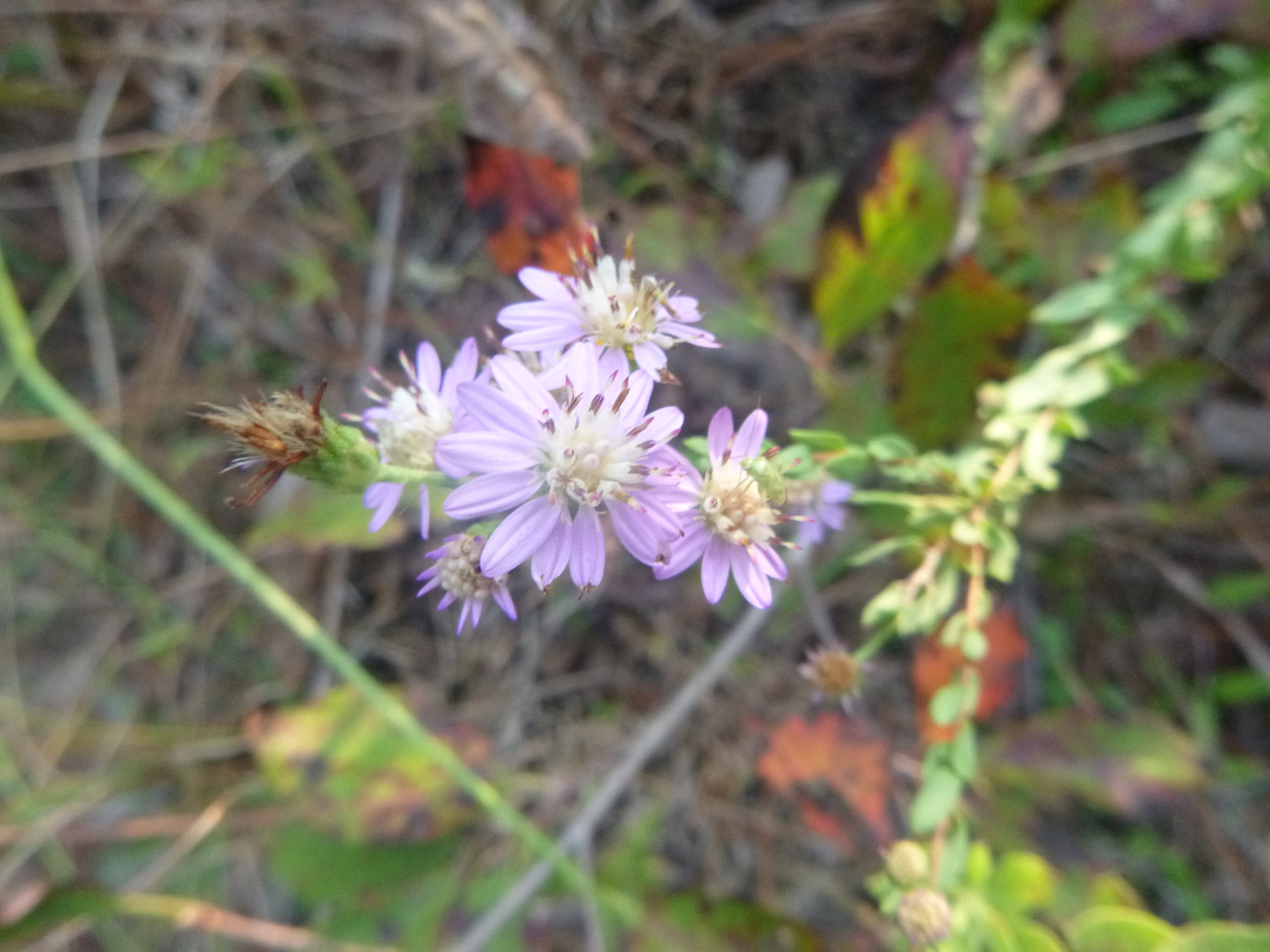
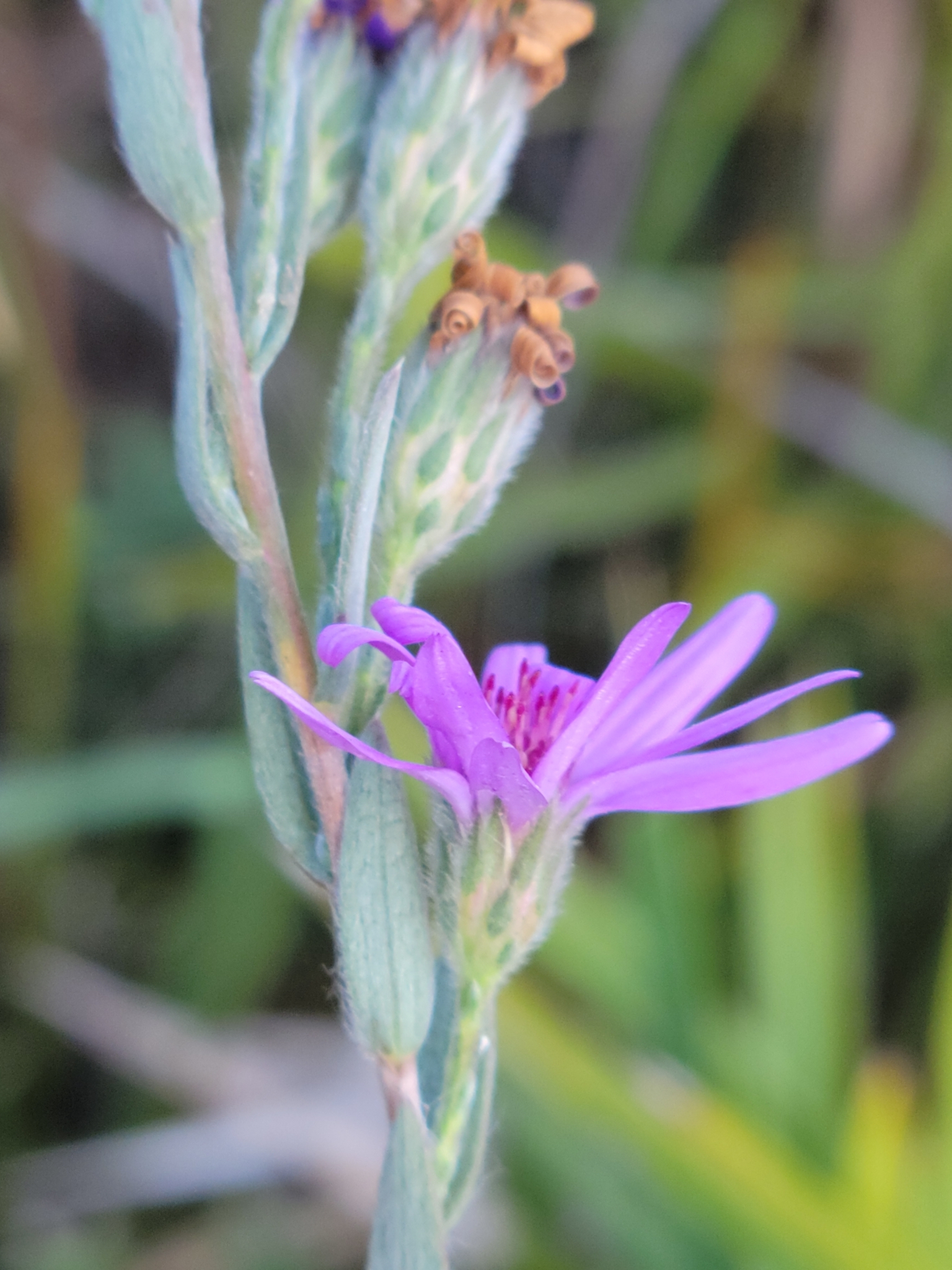
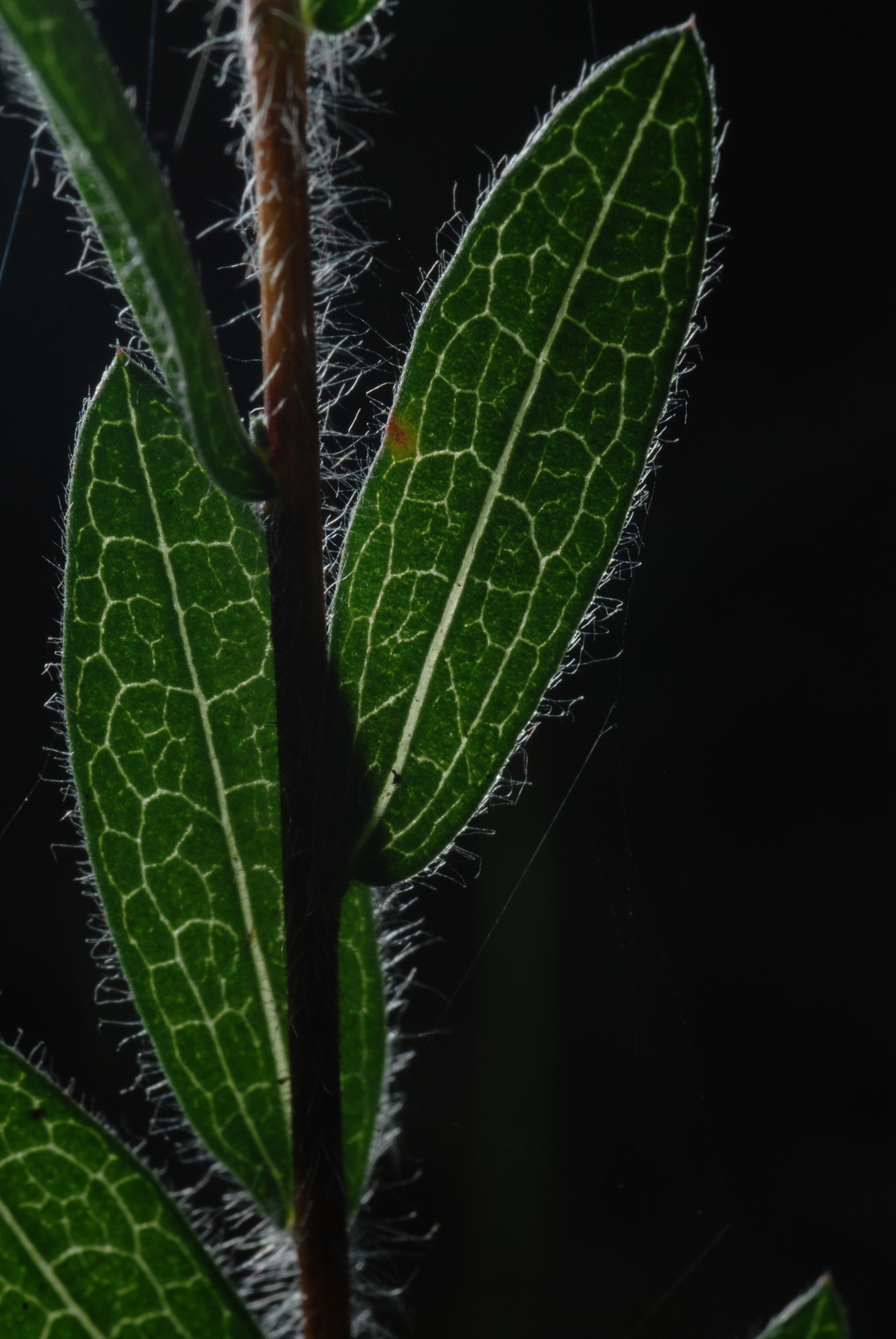
Eastern silver aster is a clump-forming perennial, one to three feet tall, growing from a corm-like woody rootstock — a swollen underground stem base that stores resources and helps the plant resprout after fire and drought. It carries one to ten or more ascending to erect stems, and the whole plant reads as silver-green even before it flowers, because the leaves and the bracts under the flower heads are covered in fine, silky hairs. Run a finger along a leaf and it feels soft, almost like felt; hold it to the light and the hairs catch the sun and turn the leaf silver. That is the plant’s name, and it is not subtle about it.
The flowers come in narrow, wand-shaped arrays — the heads lined up along mostly unbranched stems like beads on a wand, rather than spread out in a broad branching spray. Each head carries 7–12 violet-purple ray florets (very rarely white) around 9–21 disk florets, and the involucres are small, 5–7 mm, with appressed phyllaries. It blooms in fall — August through November, sometimes into December, and year-round in South Florida according to the Florida Wildflower Foundation. The basal leaves wither by flowering time, so by the time the wands are purple the plant is mostly stem leaves: small, oblong to lance-shaped, silky on both faces. After pollination the flowers darken to a deeper purple, a neat trick that tells pollinators which heads are still worth visiting.
The silver is not decoration. Those dense silky hairs — the botanical word is silky-pilose — slow water loss, reflect harsh sun, and make the leaf surface a less welcoming landing pad for small herbivores. It is the same strategy desert plants use, deployed here by a plant of dry sandy pinelands: dress in silver, keep your water, bloom late when the competition has given up.
Where it grows in Florida
Eastern silver aster grows nearly throughout Florida, with its heaviest concentration in the Panhandle and the north and north-central peninsula, according to the Florida Wildflower Foundation. Beyond Florida it ranges up the Atlantic coastal plain and Piedmont from Massachusetts to Florida, west to southern Kentucky and eastern Louisiana, with an outpost population in the Bahamas.
Its Florida haunts are dry, sunny, sandy places: sandhills, pine flatwoods, oak scrub, roadsides, and fields, on sandy and loamy soils — the Florida Wildflower Foundation specifies moist, well-drained sandy or calcareous soil. It is a plant of open, fire-shaped landscapes, and like many flatwoods plants it benefits from controlled burns, which keep the canopy open and the competition down. In the wild it is most at home among grasses and taller wildflowers, which help support its somewhat lax stems when it is in full flower.
How to grow
Eastern silver aster is one of the Florida asters a gardener can genuinely grow, and the Florida Wildflower Foundation lists it as suitable for naturalistic landscapes and restorations across North, Central, and South Florida. Plant it in full sun to minimal shade in moist but well-drained sandy or calcareous soil, and then — this is the important part — leave it lean. It grows in low-nutrient soils and is very drought tolerant once established; rich soil and fertilizer produce floppy stems and a plant that needs staking, which is the opposite of what you want from a wildflower. Plant it with grasses and taller wildflowers that help hold its stems upright when it blooms, and site it where its silver foliage can catch the light — against dark green shrubs, or at the front of a sunny native bed.
It is winter-dormant and primarily a fall bloomer, so plan for it as a late-season plant: the garden’s spring and summer stars carry the show, and eastern silver aster takes the stage in September and October when the light goes gold. It spreads slowly from its corm-like base rather than running, so it stays where you put it. Do not water it like a vegetable — established plants tolerate drought, and wet feet in heavy soil are a bigger risk than dry spells. If you are in a fire-adapted landscape, it benefits from the same open, sunny conditions fire maintains; in a garden, an annual cut-back after dormancy and a thin mulch of leaves are enough.
Buy it by Latin name from a native-plant nursery. Garden centers sometimes sell asters under loose common names, and “silver aster” could mean several plants; Symphyotrichum concolor is the one with the corm-like rootstock, the silky silver leaves, and the narrow wand of violet heads.
Water & feeding
Water to establish, then back off. Eastern silver aster wants moist, well-drained sandy soil — not wet soil, and not a soggy bed. Once its corm-like rootstock is down, it is very drought tolerant, and overwatering in heavy soil is the fastest way to lose it. In a rainy Florida summer, plant it on a slight rise or in a sandy bed that drains fast, and it will be happier than in a rich, irrigated border.
Feeding: none. It evolved in low-nutrient sand, and fertilizer mostly buys you tall, floppy stems that fall over in the first autumn rain. If your soil is decent sandy loam, that is already more than it asks for. A thin leaf mulch in winter is plenty, and the soil science here is the silver-leaf bargain: the plant spends its energy on hairs instead of height, trading size for survival, and then spends its whole summer’s savings at once on a wand of violet flowers, because in a sandhill the pollinators that matter in October are generalists, and a hundred small flowers beat ten big ones when your customers are small, cold, and in a hurry.
Varieties
Two varieties are recognized, and Florida is where they meet — which makes this the variety story that matters for Florida gardeners.
- Var. concolor — the typical, eastern form. Upper stem leaves and phyllaries moderately to densely silky: the full silver treatment, leaves and flower bracts alike. It ranges across the eastern United States, and in Florida it is the form found through most of the peninsula.
- Var. devestitum — the Gulf Coast form, sometimes called Gulf Coast silvery aster. Upper stem leaves and phyllaries glabrous or only sparsely hairy: the silver rubbed off, so to speak. It is a Florida Panhandle plant at its core — its type specimen was collected at Lynn Haven in Bay County in 1921 — and it is largely confined to the western Panhandle, with sparsely hairy individuals also reported in southern Mississippi, Alabama, Georgia, and South Carolina. Its involucres tend to be larger than the typical variety’s.
The two varieties also differ underground, in a way you can only see with a microscope and a chromosome count: most eastern silver aster is diploid (2n = 8), but the Florida Panhandle holds tetraploids (2n = 16), and those tetraploids are the var. devestitum plants. Tetraploids are currently unknown outside Florida. And here is the honest conservation footnote: the species as a whole is Secure (G5) — it is a common plant across the East — but var. devestitum is ranked G5T2, imperiled at the variety level, with a Florida state rank of S2. The panhandle form is a rarer thing than the species, and if you garden in the western Panhandle, the smooth-leaved plant in your sandhill may be exactly that form. No standalone variety guides are needed — the two forms differ in hairiness, range, and chromosome number, not in how they grow — but if you buy a plant labeled var. devestitum, know you are holding the rare one.
How to tell it from its lookalikes
Several Florida asters wear purple, but only one wears silver. The combination to check is: corm-like rootstock, silky silver leaves and phyllaries, narrow wand-shaped arrays, and 7–12 ray florets.
- Plumose aster (Symphyotrichum plumosum) is the closest relative and the easiest confusion — it is also a Florida endemic with a corm-like rootstock and silvery silky leaves. The split is in the shape of the plant: plumose aster has branched stems and open, panicle-like arrays, with 13–36 ray florets per head. Eastern silver aster has narrow, wand-shaped arrays and only 7–12 rays. Count the rays and look at the branching: wand and few rays means concolor; open spray and many rays means plumosum.
- Silky aster (Symphyotrichum sericeum var. microphyllum) is another silky-leaved aster, but it is a plant of different ground — and its leaves and heads do not share concolor’s wand-shaped array. When in doubt, the wand shape and the ray count are the deciders.
- Georgia aster (Symphyotrichum georgianum) also blooms purple in fall, but its leaves clasp the stem with broadened, ear-like bases, its leaf margins roll under, and its phyllaries are sticky-glandular — none of which eastern silver aster has. Georgia aster is also a bigger, coarser plant with much longer rays (14–24 mm).
- S. pratense appears next to eastern silver aster in the Flora of North America key — same narrow wand-shaped arrays, same 7–12 rays — but it is not a Florida species. If you are keying a wand-shaped silver aster in Florida, it is concolor; pratense is the neighbor you will not meet here.
Pollinators and wildlife
Eastern silver aster is a documented nectar plant. The Florida Wildflower Foundation notes that its many flowers provide nectar for a variety of butterflies, and the Florida Native Plant Society lists it as a nectar plant for many butterfly species, visited by other native insect pollinators as well. It blooms in fall — and in South Florida, potentially year-round — at a season when nectar is scarce, which makes a patch of it a late-season fuel stop for butterflies, native bees, and other insects. Deer browse it, to the extent that browsing is a noted issue in some states — a backhanded compliment from the local herbivores, and a reason to protect young plantings where deer are thick.
Common problems
- Flopping. Rich soil, shade, or too much water makes tall, lax stems that sprawl when they bloom. Grow it lean, sunny, and dry, and plant it among grasses and taller wildflowers that hold it up.
- Wrong aster, wrong tag. The nursery trade is loose with aster names. Check the Latin name — Symphyotrichum concolor — and check the leaves: if they are not silky-silver, it is not this plant.
- Wet feet. Heavy, slow-draining soil rots the corm-like rootstock. Sandy, fast-draining soil is non-negotiable.
- Deer. Deer browse it. In deer country, plant it where it has some protection, or accept that the deer are also pollinator-adjacent stakeholders.
- Spraying the nectar patch. This is a fall nectar plant for butterflies and bees. Spraying it for insects empties it of the very thing this guide exists to feed.
Frequently asked questions
Is eastern silver aster the same as eastern silvery aster?
Yes — same plant. “Eastern silver aster” is the common name used by the Flora of North America and the Florida Wildflower Foundation; “eastern silvery aster” is a variant spelling you will also see. The Latin name, Symphyotrichum concolor, is the same either way.
What are the two varieties, and which one is in my yard?
Var. concolor has moderately to densely silky upper leaves and phyllaries — the full silver look — and ranges across the eastern United States including most of peninsular Florida. Var. devestitum has glabrous or sparsely hairy upper leaves and phyllaries, and is a western Panhandle plant. If your plant is smooth-leaved and you are in the western Panhandle, it is likely var. devestitum; if it is silvery all over, it is var. concolor.
Is var. devestitum rare?
The species as a whole is Secure (G5), but var. devestitum is ranked G5T2 — imperiled at the variety level — with a Florida state rank of S2. It is a genuinely uncommon plant, confined mostly to the western Florida Panhandle. Do not collect it from the wild.
When does it bloom?
Fall is the main season: August through November, sometimes into December. The Florida Wildflower Foundation notes it may bloom in summer and early winter too, and year-round in South Florida.
Can I grow it in South Florida?
Yes — the Florida Wildflower Foundation lists North, Central, and South Florida all as regions of landscape suitability, and it can bloom year-round in the far south. Give it full sun and well-drained sandy soil, and keep it lean.
Does it need a lot of water?
No. It grows in low-nutrient sandy soils and is very drought tolerant once established. Water to establish, then back off — wet feet are a bigger risk than dry spells.
How is it different from plumose aster?
Count the rays and look at the branching. Eastern silver aster has narrow wand-shaped arrays and 7–12 ray florets per head. Plumose aster has branched stems, open panicle-like arrays, and 13–36 rays. Both have silvery silky leaves and corm-like rootstocks — the flower arrangement is the split.
Is it a good pollinator plant?
Yes. It is a documented nectar plant for many butterfly species and other native insect pollinators, and it blooms in fall when nectar is scarce. A patch of it is a late-season fuel stop.
Will deer eat it?
Yes — deer browse it, and browsing is a noted issue in some states. Protect young plantings in deer country.
Does it spread aggressively?
No. It grows from a corm-like base and forms clumps; it does not run by rhizomes the way some asters do. It stays where you put it, which is part of its charm in a small native bed.
Species
Eastern silver aster (Symphyotrichum concolor (L.) G.L. Nesom; formerly Aster concolor) is the species this guide covers, in both its varieties: var. concolor, the silky eastern form, and var. devestitum (S.F.Blake) Semple, the smooth-leaved Gulf Coast form. Plumose aster, silky aster, and Georgia aster are different species and none is covered here; S. pratense is not a Florida species and is not covered here. No named garden varieties of the wild species were verified, and none is claimed here. This guide covers Symphyotrichum concolor only.
Keep learning 🌱
Where to go next: