
🌿 Annual Saltmarsh Aster
What it looks like
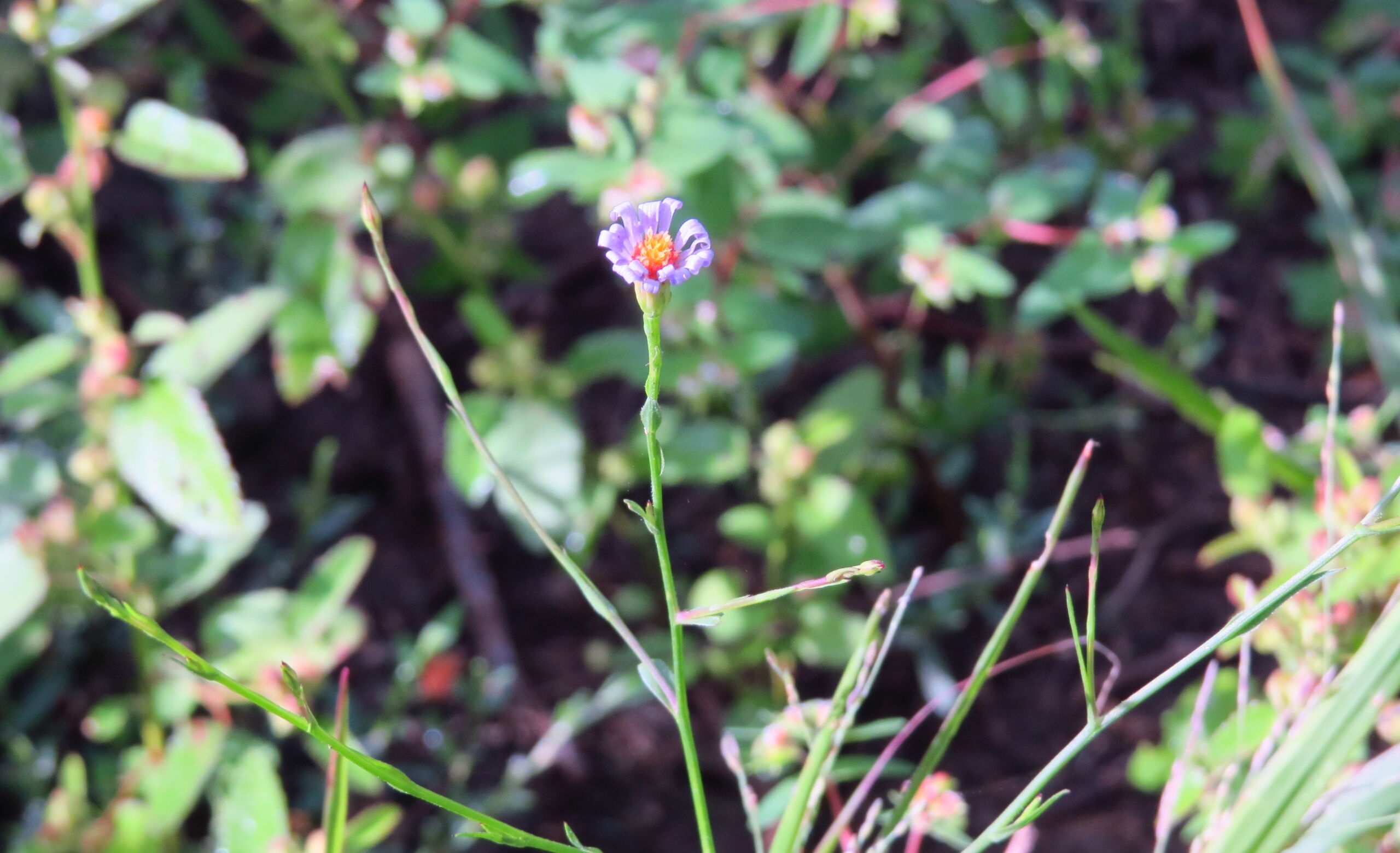
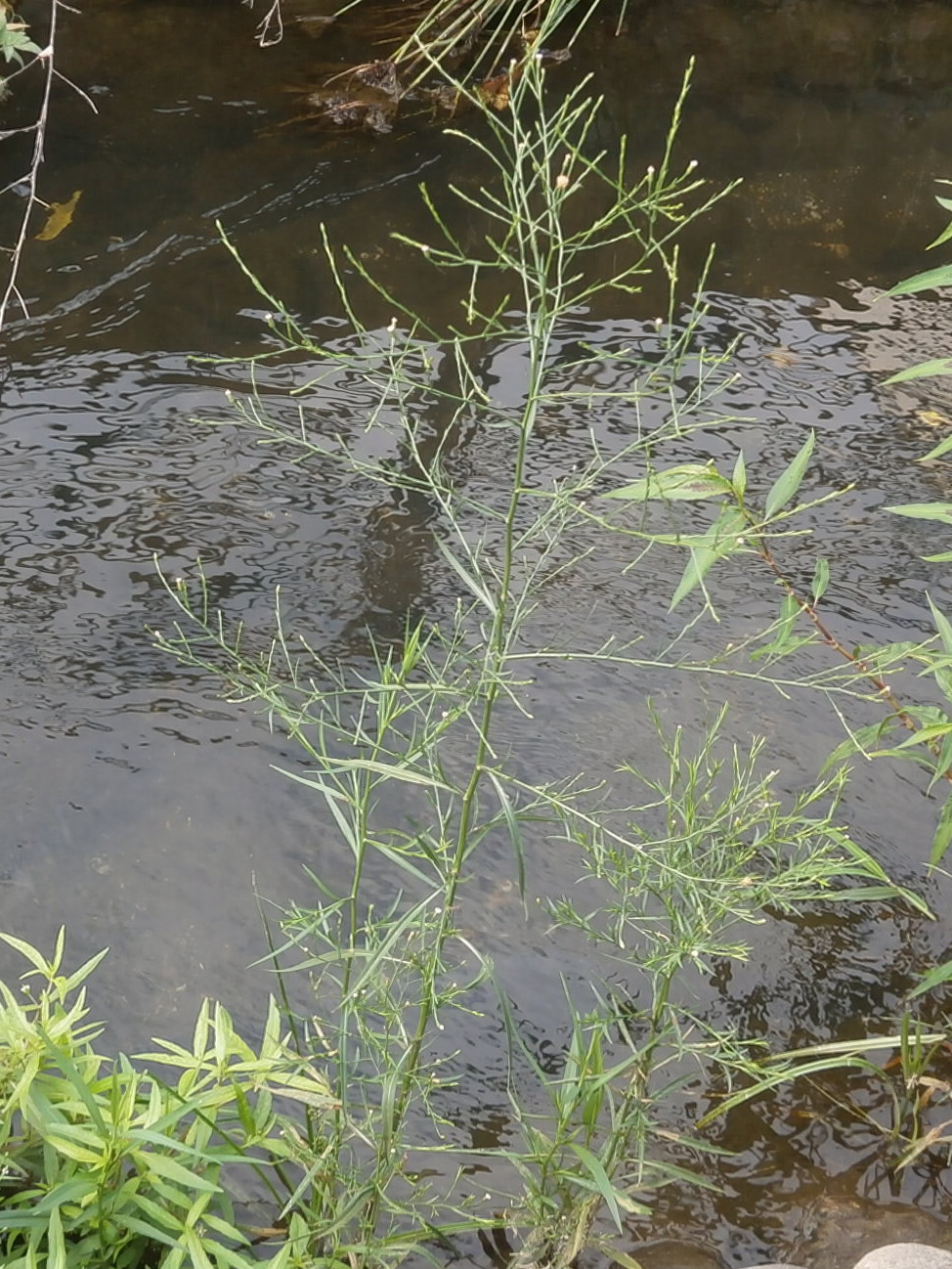
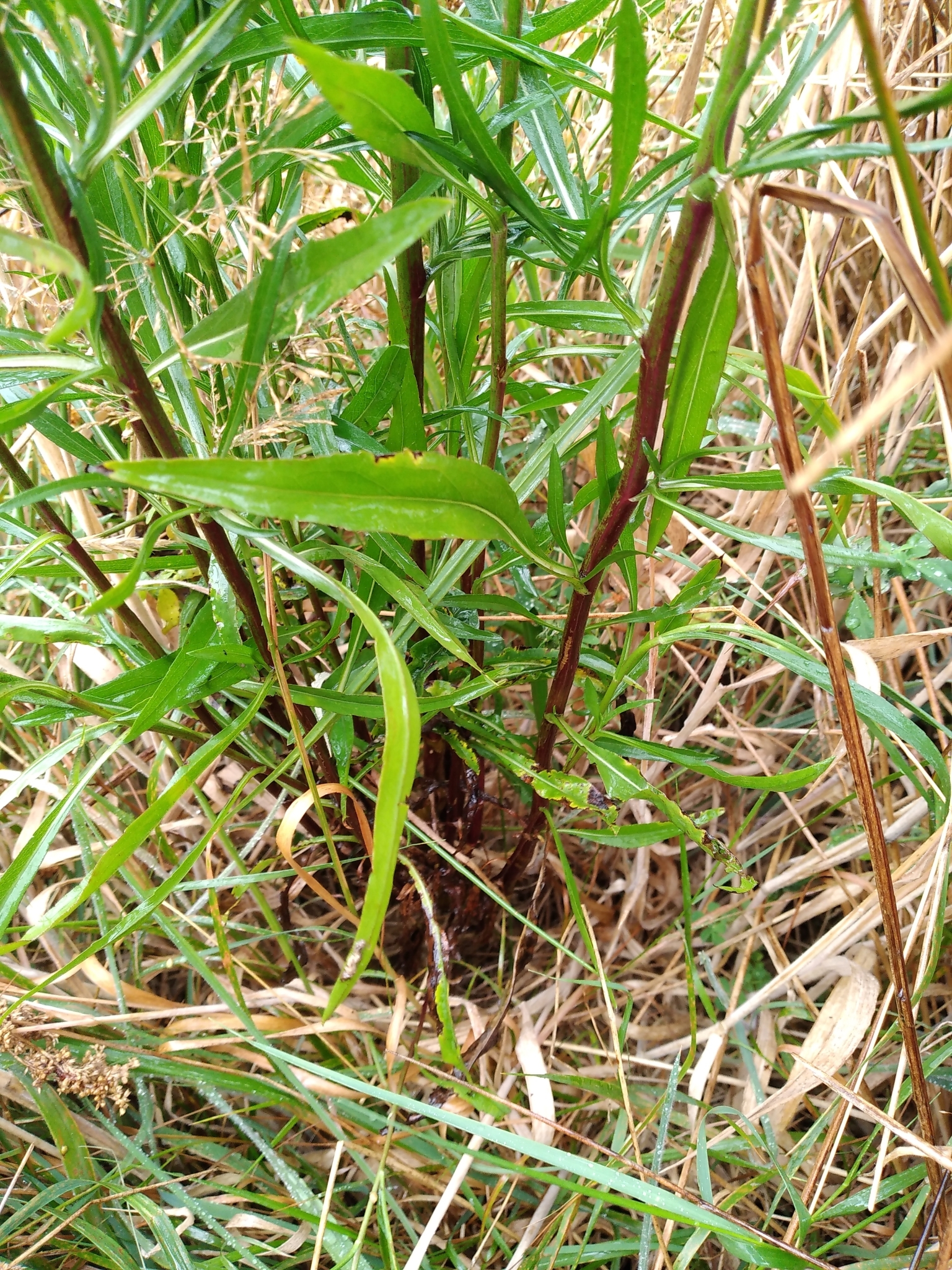
Annual saltmarsh aster is an annual — one season, seed to seed — growing from a fibrous taproot to one to five feet tall. A single upright stem, smooth or nearly so, branches into an open, diffuse spray that can carry thirty to a hundred and fifty small flower heads. The leaves are thin and narrow, lance-shaped to almost awl-shaped (that is what subulatum means), and the lower ones wither by flowering time, leaving the plant looking a little bare-legged by the time it blooms. The heads are small — involucres five to seven millimeters tall — with sixteen to thirty ray florets in two rows, usually white, rarely pink or lavender, each a tiny strap about a sixteenth of an inch long that curls into a single coil as it dries. Inside are just four to fifteen disc florets, yellow and sometimes purple-tinged. It blooms from midsummer into autumn, sometimes into winter.
The field mark to carry is the phyllaries, the little bracts wrapping each head: their green zones run the full length of the bract, tip to base. That single character separates it from its introduced lookalike, southeastern annual saltmarsh aster, whose green zones fade out before reaching the base. The plant is small-flowered on purpose. In a salt marsh, the customers are small — tiny bees, flies, and other generalists — and a hundred small flowers beat ten big ones when the wind never stops and the ground is salty.
How to tell it apart from its cousins
Annual saltmarsh aster sits in the middle of the Symphyotrichum subulatum group — Franck’s 2025 Flora of Florida counts Bahama aster, southwestern annual saltmarsh aster, and southeastern annual saltmarsh aster in the group alongside it. The group as a whole has generally straight stems, leaves that are sometimes ciliate along the edge, and ray florets in one to three series with very narrow laminae. Within the group, the differences are small and exact, and they are worth learning, because three of the four grow in Florida.
- Southeastern annual saltmarsh aster (Symphyotrichum squamatum). The introduced one. Its phyllary green zones are nearly absent from the lower portion of the bract, its rays sit in two to three series (not two), it has 7–14 disc florets, and its chromosome count is 2n = 20 where annual saltmarsh aster is 2n = 10.
- Bahama aster (Symphyotrichum bahamense). Its rays are pink to lavender and dry in two to three coils (annual saltmarsh aster’s white rays curl in one coil), and it has 11–23 disc florets.
- Southwestern annual saltmarsh aster (Symphyotrichum expansum). Its heads carry 30–42 phyllaries (annual saltmarsh aster carries 18–30), and its ray laminae are longer than the pappus bristles.
- Perennial saltmarsh aster (Symphyotrichum tenuifolium) and Brace’s aster (S. bracei). A different group entirely, and easy to separate once you know the trick: they are perennials with zig-zag stems and rays in a single series with much wider laminae (1.2–2 mm), where annual saltmarsh aster is an annual with straight stems and narrow rays. If the plant comes back from a rhizome next year, it was not this one.
One honest complication: the varieties intergrade. The Flora of North America notes that intermediates between varieties occur in Florida, so a plant in a south Florida marsh may not key out cleanly. When the rays, coils, and phyllary counts disagree with each other, say so — the plant is an intermediate, and the flora expects that.
Where it grows in Florida
Annual saltmarsh aster is native to Florida, and the Atlas of Florida Plants marks it as an obligate wetland plant (OBL) — in practice, it almost always grows in wetlands. Its habitat is the edge of the sea: salt marshes, brackish marshes, tidal marshes, and even the margins of salted highways inland, where road salt mimics the marsh. The Flora of the Southeastern United States gives its range as southern Maine to northeastern Florida and the Panhandle, west to Louisiana; the Flora of North America adds that the variety subulatum grows along the Atlantic coast from New Brunswick to northern Florida and along the Gulf Coast from central Florida to east Texas, with a gap in southern Florida where other varieties take over.
It is a plant of the high marsh and the marsh edge rather than the drowned middle: places that flood on the tides and dry between them, where the soil is salty and the competition is thin. That is the whole trick of its life history. As an annual, it does not need to survive the winter — it needs to make seed before the marsh drowns it, and the tide does the seed dispersal for free. Populations can be patchy from year to year: an annual in a dynamic marsh may be abundant one autumn and scarce the next, reappearing wherever the seed landed.
Grow it or leave it
Leave it. Annual saltmarsh aster is a wildflower of tidal marshes, and a tidal marsh is not a thing you can reproduce in a garden bed. It needs salt and brackish water, tidal flooding, and the bare muddy edges where its seed germinates — conditions a flower bed cannot honestly provide, and conditions that make transplanting from a marsh both futile and, in many places, unlawful without permission. It is an annual, so even a successful transplant would die with the season; the plant’s whole strategy is to live fast and let the tide carry its children.
The way to enjoy it is to walk a marsh edge in late summer, find the wiry white-flowered spray above the cordgrass, and appreciate a plant that solved the salt problem by refusing to be perennial at all. If you garden near the coast and want aster nectar, plant one of Florida’s widespread native asters in the dry ground above the marsh, and let the marsh keep its own.
Pollinators & wildlife
The flowers are small, white, and numerous, and their customers are correspondingly small: native bees, syrphid flies, and small butterflies working the marsh edge in late summer and fall, when few other plants are still blooming in the salt. Asters as a group are caterpillar hosts for the Pearl Crescent butterfly, and the late bloom makes this one a fuel stop for insects moving through the marshes in autumn. The fluffy seed that follows — each seed wearing a tuft of pappus bristles — rides the wind and the tide, which is how an annual colonizes a marsh that rearranges itself with every storm. The plant feeds the marsh’s small things, and the marsh, in return, moves its seeds to the next bare patch of mud.
Varieties
This is the one guide in the batch where the Varieties section does real work, because the species is genuinely variable. The Flora of North America recognizes five varieties of Symphyotrichum subulatum, separated by chromosome number, ray color and size, head shape, and floret counts; Franck’s Flora of Florida treats three of them as full species instead (Bahama aster, southwestern annual saltmarsh aster, and southeastern annual saltmarsh aster each get their own guide in this project). No standalone variety guides are built — the standing rule for this project covers varieties inside the species guide — and here is what matters in Florida:
- Var. subulatum (eastern annual saltmarsh aster) — the plant this guide describes: white rays in 2 series, green zones running the full phyllary, 2n = 10. Salt marshes of the Atlantic and Gulf coasts, including northern and central Florida.
- Var. elongatum (= Bahama aster, S. bahamense in Franck’s treatment) — pink to lavender rays drying in 2–3 coils, 11–23 disc florets, 2n = 20. Florida and the West Indies.
- Intermediates — the Flora of North America records intermediates between var. elongatum and var. parviflorum, and between var. elongatum and var. subulatum, occurring in Florida. A marsh plant that will not key out cleanly is usually one of these, not a misidentification.
The other two varieties — var. ligulatum (lavender-blue rays, south-central United States) and var. parviflorum (western United States) — do not occur in Florida as named varieties, though their names appear in the synonymy of the species Franck treats as S. expansum. No named garden varieties of the wild species are verified, and none is claimed here.
Frequently asked questions
Is annual saltmarsh aster native to Florida?
Yes. The Atlas of Florida Plants lists it as native, and as an obligate wetland species — it almost always grows in wetlands. It is native along the Atlantic coast from Maine to Florida and along the Gulf Coast to Texas.
Why is it called “annual” saltmarsh aster?
Because it lives one season. It grows from seed, flowers, sets seed, and dies — unlike its perennial cousins, perennial saltmarsh aster and Brace’s aster, which come back from rhizomes. The annual habit is its whole survival strategy in a marsh that floods and rearranges itself.
What does subulatum mean?
“Awl-shaped,” for the narrow, almost awl-like leaves and phyllaries. The species was first described as Aster subulatus by Michaux in 1803.
How do I tell it from southeastern annual saltmarsh aster?
Check the phyllaries with a hand lens: annual saltmarsh aster’s green zones run the full length of the bract; the introduced southeastern annual saltmarsh aster’s green zones are nearly absent from the base. Annual saltmarsh aster also has its rays in 2 series and only 4–10 disc florets.
Can I grow it in my garden?
No, honestly. It needs salt marsh conditions — tidal flooding, brackish water, bare mud — that a garden bed cannot provide. It is an annual, so even a transplant would die with the season. Enjoy it on a marsh walk instead.
Where in Florida does it grow?
In salt and brackish marshes along the coast, including northeastern Florida and the Panhandle, and along the Gulf Coast of central Florida. There is a gap in southern Florida where other varieties of the group take over.
Why do some plants have pink rays?
Rays are usually white and only rarely pink or lavender in var. subulatum. Consistently pink-to-lavender rays that dry in two to three coils point to var. elongatum — Bahama aster — or to an intermediate between the varieties, both of which occur in Florida.
Is it the same as Bahama aster?
It depends which flora you are holding. The Flora of North America treats Bahama aster as a variety of this species (var. elongatum); Franck’s Florida flora treats it as its own species. This project follows Franck, so Bahama aster gets its own guide — and this guide notes the connection so readers using either flora stay oriented.
What pollinators visit it?
Small native bees, syrphid flies, and small butterflies working the marsh edge in late summer and fall. Asters as a group also host Pearl Crescent caterpillars.
Why are populations patchy from year to year?
Because it is an annual in a dynamic marsh. Seed lands where the tide puts it, and a patch that was thick last autumn may be thin this one. That is not decline — it is how the species moves.
Keep learning 🌱
Where to go next: