
Under a loose slab of bark on a rotting log in a Florida hammock, in the damp dark underneath where the wood is soft and the insects are thick, there lives an animal that has been called by the wrong name more often than almost any other centipede in America. The eastern bark centipede, Hemiscolopendra marginata, is a blue-grey bark centipede, up to three inches long, with blue marks on pale yellow legs and rusty red fangs — and it is also called the Florida blue centipede, and sometimes the eastern red centipede, while the name “eastern red” is more often used for a different animal entirely. This guide sorts out all three names, because getting the name right is the only way to get the animal right.
And if you are reading this in the eastern United States because you just found a fast, blue-grey centipede under a log and want to know whether to panic — stay with us. The short answer is no, with one rule attached: do not pick it up. It can deliver a painful bite, it is fast enough to surprise you, and everything else in this guide — what it eats, what it does for your garden, how to keep it out of your house — follows from that one rule.
What it looks like
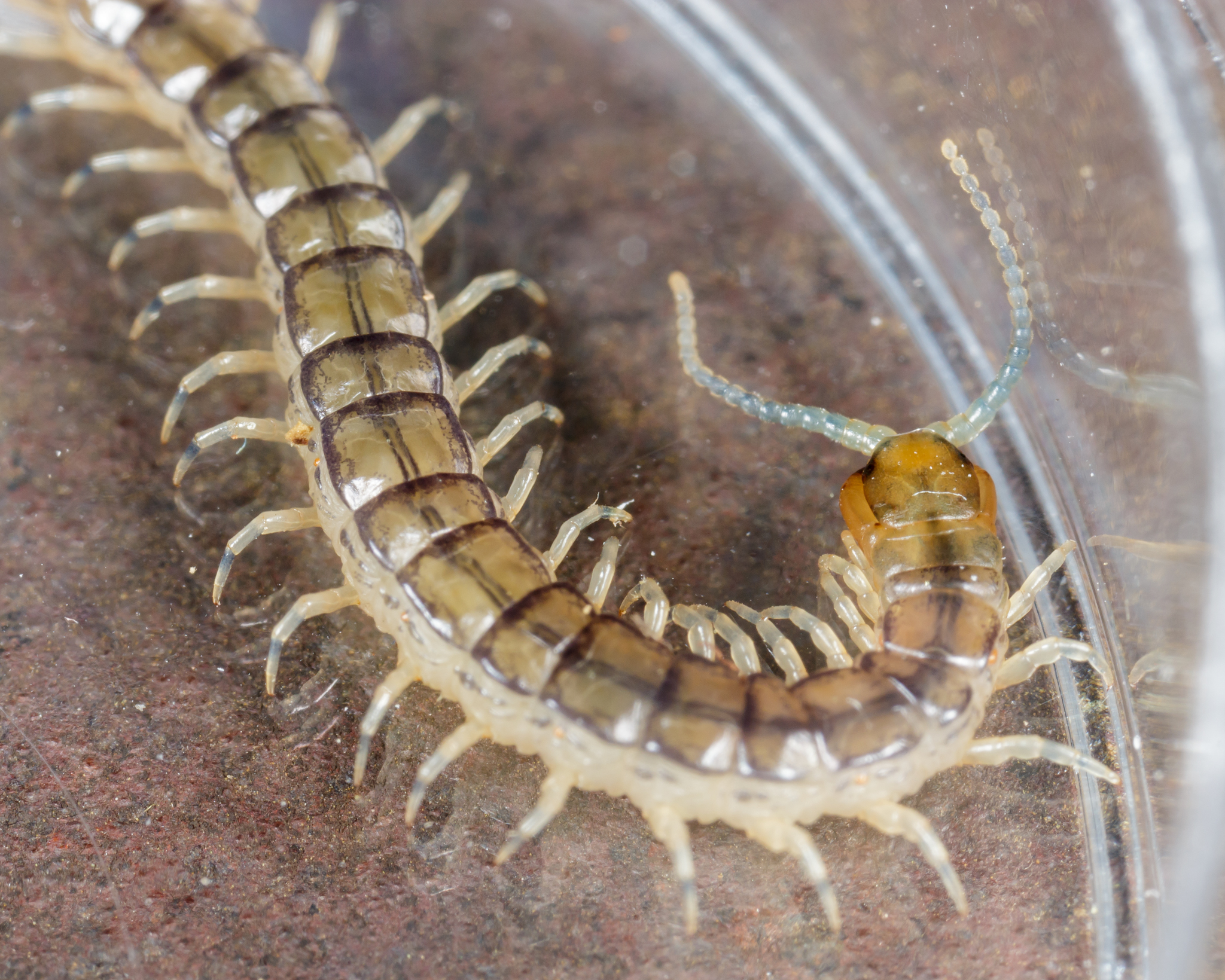
Start with the size, because the size is the first check against the animals it is confused with. An adult eastern bark centipede reaches up to 3 inches long, about 75 millimeters. That makes it one of the larger centipedes in the eastern United States, but it is half the length of the Florida Blue Centipede at its largest, and less than half the length of the Giant Red-Headed Centipede. It has 21 pairs of legs. For scale: it is roughly the length of your thumb, and about as thick as a pencil.
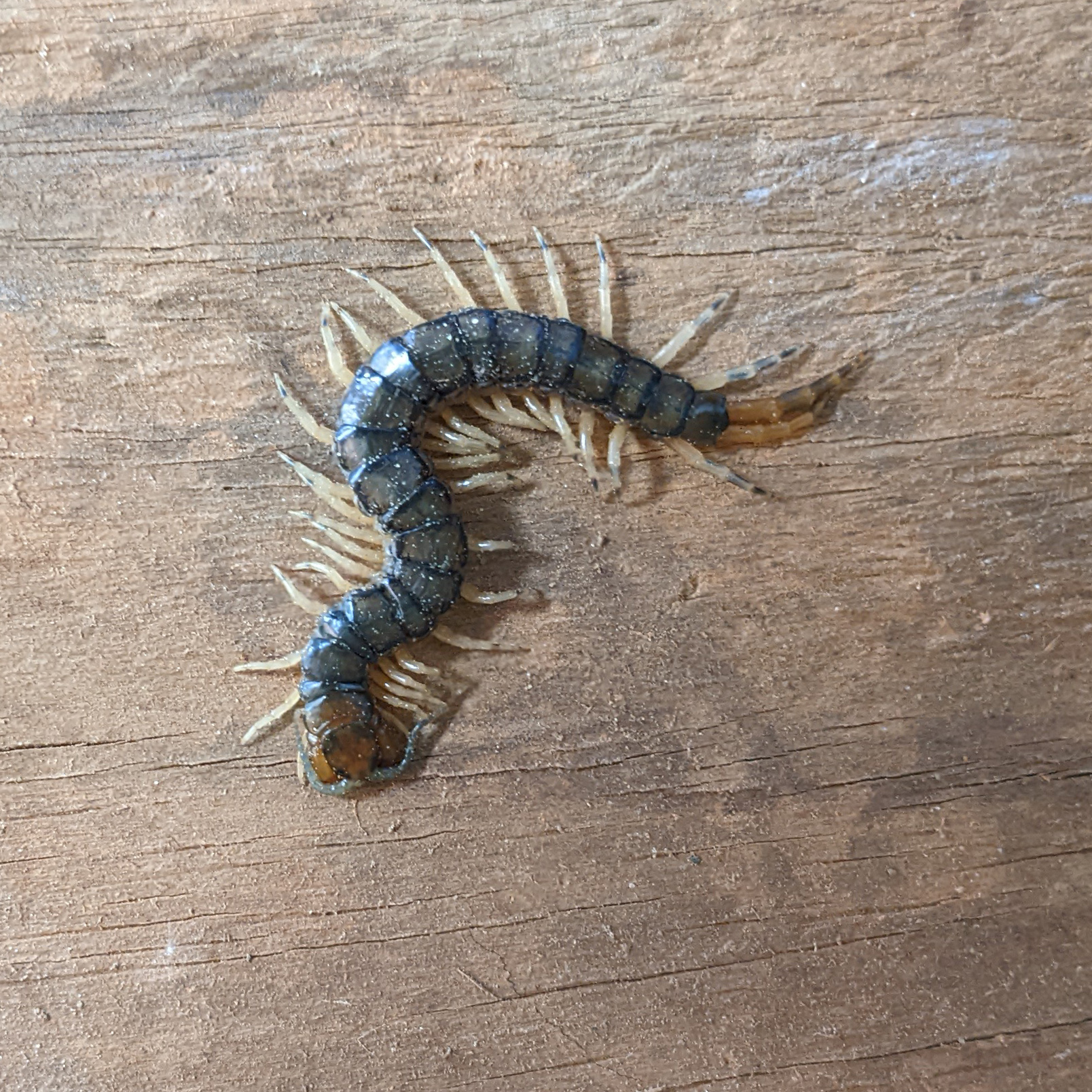
The color is the field mark, and it is a strange one — because this animal is blue, not red, despite one of its nicknames. The Missouri Department of Conservation describes it best: a bluish cast overall, with blue marks on pale yellowish legs, blue antennae, orangish hind legs, and rusty red forcipules — the venom fangs. BugGuide’s description agrees: a full bluish back, with blue “tick” marks on the legs. Other descriptions add that the plates are olive-colored with a thin black stripe running down the body and a black fringe, the head is brownish-red, and the legs and antennae are delicate, translucent yellow. The color varies a good deal between individuals, from light to dark blue or greyish-brown, with the armor plates edged in black, green, or blue — but the blue cast, the pale yellow legs with blue ticks, and the orangish hind legs are the combination to look for. The “red” in one of its nicknames comes from the rusty red fangs and the brownish-red head, not from the body — which is why that nickname misleads everyone who meets the animal for the first time.
The body is flattened top-to-bottom, as all centipedes are, with long legs sticking out sideways from each segment — flattened enough to squeeze into narrow spaces under bark and between logs, which is where it lives. The last pair of legs is longer than the rest and trails behind like a second set of antennae. The real head is the end with the short antennae and the brownish-red color. Just behind the head sits the pair of venom fangs called forcipules: modified front legs, hollow like hypodermic needles, connected to venom glands in the body trunk — rusty red in this species, and the one part of the animal that actually matches the “red” nickname. Those are the business end. Everything else about this animal — the speed, the armor, the blue — exists to get those fangs onto prey.
The name game (three names, two animals, one correction)
Here is the confusion, stated up front, because this guide is useless if it does not sort it out.
This animal, Hemiscolopendra marginata, is called the eastern bark centipede by BugGuide and by the Missouri Department of Conservation, and that is the most standard common name for it — the name this guide uses. It is also called the Florida blue centipede — the same name as Scolopendra viridis, the larger blue-and-orange centipede covered in the Florida Blue Centipede guide. And it is sometimes called the eastern red centipede — the name in the original brief for this guide — but that name is more commonly used for a different animal, Scolopocryptops sexspinosus, a bright red to orange-red bark centipede that the Missouri Department of Conservation itself calls the eastern red centipede. So the name “eastern red centipede” belongs, by the most standard usage, to another species, while this species’ most standard name is “eastern bark centipede.” This guide uses the standard name, and it says why, rather than publishing the confusion under the wrong title.
If you are searching for this animal, search for all three names. If a source says “eastern red centipede” and describes a bright red, completely blind animal with 23 pairs of legs, it is talking about Scolopocryptops sexspinosus, not this one — this one has 21 pairs of legs, has eyes, and is blue-grey, not red. The look-alikes section below walks through the full check.
The taxonomy, for the nerds in the back, is a good story in its own right. The animal was first described as Scolopendra marginata by Thomas Say in 1821, from specimens collected in Georgia and east Florida — one of the first scolopendrids ever described from North America, and the second-oldest name for an endemic North American scolopendrid. Say’s original specimens are lost, and the name spent more than a century buried in synonymy, treated as a junior synonym of other species. In 1996, Richard Hoffman and Rowland Shelley resurrected it, designated a neotype from Picolata in St. Johns County, Florida — the probable type locality, on the St. Johns River about 16 miles west of St. Augustine — and placed it in the genus Hemiscolopendra as Hemiscolopendra marginata, the senior name for the animal that had been known for decades as Hemiscolopendra punctiventris. The full taxonomy: kingdom Animalia, phylum Arthropoda, class Chilopoda (the centipedes), order Scolopendromorpha, family Scolopendridae, genus Hemiscolopendra. A name that was lost for 175 years, found again in a Florida river town, and still fighting over its common name today.
Range: the Southeast, from Virginia to Florida and west to Texas
Here is the range, stated plainly, from the two best sources — Hoffman and Shelley’s 1996 revision, and BugGuide’s species account, which agree. Hemiscolopendra marginata is widespread over much of the unglaciated forested region of the southeastern United States, except for the Blue Ridge. It occurs statewide in Florida, although it has not been recorded from the Florida Keys; in the Piedmont and Coastal Plain of North Carolina; in the Cumberland Mountains and south of the James River in the Piedmont and Coastal Plain of Virginia; and in the southern tip of Illinois. Its northern limits are the James River in central Virginia, just north of the Ohio River in southern Ohio, Indiana, and Illinois, and the northern periphery of Arkansas — the northernmost known locality is Bloomington, Monroe County, Indiana. Westward it extends onto the Edwards Plateau and the eastern part of the Chihuahuan Desert in central and western Texas, as far as Presidio County west of Big Bend National Park, where it lives in forests at high elevations rather than in the arid desert floor.
BugGuide states the same range in one line: “James River, Virginia, to southern peninsular Florida, ranging westward to Oklahoma and Presidio Co., TX, west of Big Bend National Park.” That is the range this guide uses. Two honest notes about it. First, it does not occur in the Blue Ridge Mountains — a gap in the middle of its range that Hoffman and Shelley specifically note, and a useful check: a large blue bark centipede in the Blue Ridge is something else. Second, it does not occur in the Florida Keys, even though it occurs throughout the rest of Florida — the Keys have their own giant centipede, Scolopendra alternans, instead.
Within its range it is a creature of forests: found under logs and loose bark, in leaf litter, and in rotting wood — the classic bark-centipede habitat. It is a strong climber for a centipede, and it squeezes into the narrow spaces under bark that flatter, wider animals cannot reach. In Texas it is a high-elevation forest animal, living in the wooded uplands rather than the desert below. It does not live in houses the way the house centipede does; an eastern bark centipede indoors is a visitor that wandered in, usually at night, usually following prey or shelter, and usually through a gap at ground level.
What it eats: the night hunter of the bark and the soil
The eastern bark centipede is a predator, and a generalist one. Its diet is smaller soil arthropods, insects, earthworms, nematodes, and gastropods — slugs and snails — hunted in the leaf litter, under bark, and down in the soil. It is a nocturnal hunter, about 8 centimeters at full size, using its antennae to feel and smell its way along the ground and through the bark crevices, and it strikes fast: it grabs prey with its front legs, drives the forcipules in, injects venom, and holds on while the venom works. The venom is a mix of toxins that paralyze prey and begin breaking down tissue, and it is fast-acting on small animals. The centipede then eats its prey in pieces, using its mouthparts to tear off manageable chunks.
There is an elegant detail about this species’ venom that scientists have actually measured: its venom is sexually dimorphic, meaning that the toxins produced by males and females are different. Venom researchers studying this species found that the two sexes carry different toxin mixtures — an unusual finding, and a reminder that even in a single species, “the venom” is not one thing. For a gardener, the practical meaning is nil — a bite is a bite, whichever sex delivers it — but for the science, it is one of the more interesting facts about this animal, and one of the reasons researchers keep coming back to it.
What it does not like is just as useful to know. It does not like heat and dry air: like all centipedes, it loses water through its cuticle and dries out fast in open, sunny conditions, so it hunts at night and shelters under cover by day — under bark, in rotting logs, in damp leaf litter. It does not like being exposed — it is a target for birds and other predators, and its first response to disturbance is usually to run for cover, fast. And it does not eat plants, dead or alive: it has no interest in your garden beds as food. It is interested in your garden beds as hunting ground, because that is where the insects, the earthworms, and the slugs are.
The bite: honest, plain, and not sensational
Let us be direct, because this is the section people actually need. The eastern bark centipede can deliver a painful bite. It punctures the skin with its two forcipules, leaving two small puncture marks, and injects venom. The pain is immediate and sharp — most people who have felt it describe it as a mild sting rather than a severe one, more like a bee sting than like the bite of its giant Texas cousin — with redness, swelling, and tenderness around the bite. It is not considered life-threatening to a healthy adult: the National Capital Poison Center’s guidance for centipede bites in general is that symptoms most often last less than 48 hours, and Clemson Cooperative Extension states flatly that bites from U.S. centipedes are not toxic enough to be deadly to adults or children.
That is the honest scale of it: a painful bite, milder than the big Scolopendra species, not a dangerous one for most people, that still deserves to be taken seriously — especially in children, older adults, and anyone with an allergy to insect venom. Allergic reactions to centipede venom are possible, and they are the reason the first-aid section below includes the emergency signs. A bite from this species is also, in the honest accounting, a bite you almost certainly earned by picking the animal up or trapping it against your skin: it does not go looking for people to bite.
If you are bitten: what to do
This is first-aid guidance from MedlinePlus (U.S. National Library of Medicine) and the National Capital Poison Center, not folk wisdom. Wash the bite with soap and water right away. Place ice wrapped in a clean cloth on the bite for 10 minutes, then off for 10 minutes, and repeat. Take an over-the-counter pain reliever such as acetaminophen or ibuprofen for the pain. Centipede venoms are sensitive to heat, so soaking the area in warm water may also help reduce pain and swelling. Make sure your tetanus shot is current — a centipede bite is a puncture wound, and the Poison Center specifically advises checking that you have had a tetanus shot in the previous 10 years.
Call Poison Control at 1-800-222-1222 — free, private, available 24 hours a day — if you have any questions at all about a bite; MedlinePlus says to contact poison control just to be sure, even if the bite seems mild. Seek medical care promptly if the swelling or pain keeps getting worse instead of better, if redness spreads, if you develop fever or pus at the site, or if the bite is on a child, an older adult, or someone with a health condition. Call 911 immediately — do not drive yourself — if there is trouble breathing, swelling of the lips, tongue, mouth, or throat, widespread hives, dizziness, confusion, or fainting. Those are signs of a serious allergic reaction, which can happen with any venomous bite or sting even in someone with no known allergy, and they need emergency treatment. If the person has a prescribed epinephrine auto-injector, use it according to their emergency plan and then call 911.
What not to do: do not apply a tourniquet, do not try to suck out the venom, do not cut the wound, and do not apply alcohol or home remedies to the puncture. Soap, water, ice, pain relief, and a phone call are the whole list, and they are enough for the great majority of bites.
Life cycle: born small, guarded by its mother
Like other scolopendromorph centipedes, the eastern bark centipede reproduces by laying eggs, and the female guards them. She lays a clutch in a sheltered chamber under bark or in a rotting log, then coils her body around the eggs and stays with them, cleaning them and defending them until they hatch — weeks of maternal care that is unusual among arthropods and one of the more likeable facts about an otherwise intimidating animal. The hatchlings start small, with fewer segments and legs than an adult, and earn the rest by molting: shedding the exoskeleton, adding segments and leg pairs, and hardening up again, bigger than before.
The details beyond that — exactly how long it lives in the wild, how many eggs a female lays, how many years it takes to reach full size — are thinly studied for this species specifically, and this guide will not invent them. What is certain is the rhythm: warm-season activity from roughly spring through fall, with the most encounters on warm, humid nights, and a retreat deep under bark and logs during cold snaps and dry spells. In Florida it can be active for much of the year; at the northern edge, in Indiana and Ohio, the season is shorter and winter is spent deep in shelter.
The Florida angle: the blue centipede under the Florida log
Here is the honest Florida story. The eastern bark centipede — the other Florida blue — is a native, not an invader. It occurs statewide in Florida, except for the Keys, and it is one of the two animals a Florida gardener means when they say “Florida blue centipede.” It lives under logs and loose bark, in leaf litter, in rotting wood, and in the damp corners of gardens, and it is most often met when a gardener lifts a log or peels bark off a fallen oak — the same moment the Florida Blue Centipede shows up, because the two share the habitat.
There is a nice piece of Florida history tucked into this animal’s name, too: its neotype — the specimen that now officially defines the species — comes from Picolata, in St. Johns County, on the St. Johns River about sixteen miles west of St. Augustine. The species was first described from Georgia and east Florida in 1821, lost for 175 years in synonymy, and then re-founded on a Florida specimen in 1996. It is, in a real sense, a Florida animal twice over: first described from here, and re-described from here. Finding one in your yard is not a problem to solve. It is a sign that your leaf litter has a food web in it — and that a piece of Florida natural history is still functioning under your logs.
Is it a pest?
Plainly: it is not a plant pest, but it is not an animal to welcome into your living room either. It does not eat plants, does not damage structures, does not eat stored food, and does not spread disease. What it does is hunt — and the things it hunts are mostly things gardeners want gone. An eastern bark centipede in the yard is a sign that your garden has a healthy population of insects, slugs, and other small animals for it to eat, and it is doing free pest control in the bark and leaf litter where few other predators hunt.
Against that, weigh the bite. This is a centipede with a painful bite, and it is a genuine reason to keep it out of the house and away from small children and pets — even though its bite is milder than the big Scolopendra species. The goal is not to exterminate it from your property — it is a native predator doing a native job, and killing every one you see will not reduce the population, because more will move in from the surrounding leaf litter. The goal is separation: let it hunt outside, keep it outside, and give it no reason to come in.
Effects on the garden
On the plus side, the eastern bark centipede is a serious predator of garden pests. It eats insects, slugs, snails, and other centipedes, and it hunts the bark and leaf-litter layer — under logs, in rotting wood, through the mulch — that most other predators do not patrol at night. In a Florida garden, where the slug pressure comes from the damp ground up, a predator that eats slugs is a genuinely useful animal to have around.
On the minus side, it is indiscriminate. It eats beneficial insects and spiders as readily as pests, and it eats earthworms — the animals this whole site is built around — as readily as it eats slugs. That is the honest trade-off, and it is worth stating plainly on a site that loves earthworms: the eastern bark centipede eats earthworms. It does not eat plants, so there is no direct crop damage to warn about, and it does not disturb soil or roots. The honest accounting is that it is a net wash for the garden as a whole — a predator that removes pests and beneficials alike, including some of the good guys — and the decision about whether to tolerate it should turn on safety, not on garden economics. In a yard where children and pets play barefoot, the safety answer wins, and the centipede should be kept out of the play area. In a damp back corner nobody walks through, leaving it alone is the better call.
Effects on other garden animals
The eastern bark centipede sits in the middle of the garden food web, and it pulls in both directions. As a predator it eats insects, earthworms, nematodes, slugs, snails, and smaller soil arthropods — anything it can catch and hold under bark and in the leaf litter. Its competition is with other nocturnal predators: ground beetles, spiders, and night snakes all hunt the same ground, and in a rich yard there is usually enough prey for all of them. It does not compete with millipedes for food, because it does not eat dead plant matter — but it does eat millipedes themselves, occasionally, if it catches one out in the open.
As prey, it is a defended meal. Its speed, armor, and venom put off most predators, but it is still eaten: birds, raccoons, opossums, and some snakes all take bark centipedes. For pets, the risk is real and worth stating plainly: a dog or cat that grabs an eastern bark centipede is likely to be bitten on the mouth, and the bite is painful enough to cause swelling, drooling, pawing at the face, and distress. It is rarely life-threatening to a healthy adult pet, but a small dog, a cat, or a pet that is bitten repeatedly should be seen by a veterinarian promptly. Keep pets from investigating one, and if your pet does get bitten, watch for swelling of the face or mouth, difficulty breathing, or vomiting, and call your vet.
Look-alikes: the concrete checks
Large centipedes all look alike until you know what to check, and the checks are wonderfully simple — size, color, leg count, and where you are. Work through them in order and you will rarely go wrong. The hard one in this guide is the first cousin, so start there.
Florida Blue Centipede (Scolopendra viridis) — the other Florida blue, and the hardest check in Florida. The two share the name “Florida blue centipede,” they share the state, and they share the leaf litter — and half the photos labeled “Florida blue” online are this one. Check the size first: S. viridis is 3 to 4 inches and up, with large adults to about five and a half inches; H. marginata tops out around 3 inches. Check the color: S. viridis has blue centers with orange or reddish segment margins and orange-yellow legs; H. marginata is olive to blue-grey overall with a dark or blue margin on each segment and blue “tick” marks on the legs, with orangish hind legs and rusty red fangs. Leg count does not separate them — both have 21 pairs of legs — so size and color do the work. Read the full guide: Florida Blue Centipede.
Eastern red centipede (Scolopocryptops sexspinosus) — the animal that owns the “eastern red” name by the most standard usage. This is the bright red to orange-red bark centipede of the eastern United States, up to about 2.7 inches, with 23 pairs of legs, and it is completely blind — no eyes at all. Check: bright red all over and blind means Scolopocryptops; blue-grey with blue tick marks on the legs and visible eyes means Hemiscolopendra. Check the legs: 23 pairs means Scolopocryptops, 21 pairs means Hemiscolopendra. If a source calls a bright red, eyeless centipede the “eastern red centipede,” it is talking about this one, not the animal in this guide. Read the full guide: Eastern Red Centipede.
Giant Red-Headed Centipede (Scolopendra heros) — the bigger cousin you will not meet in the East. The giant red-headed is 6.5 to 8 inches, red-headed with a black body and yellow legs, and it is the largest centipede in North America. Check: six inches or more and a red head means giant red-headed; three inches or less and blue-grey means eastern bark. Check the range: the two overlap only in Texas and Oklahoma, and the giant red-headed does not occur anywhere east of Arkansas and Louisiana. Read the full guide: Giant Red-Headed Centipede.
Common Desert Centipede (Scolopendra polymorpha) — the southwestern cousin. The desert centipede is 4 to 7 inches, tan to orange with one dark tiger stripe down each segment, and it lives in the deserts of the Southwest. Check: tiger striping and four to seven inches means desert centipede; blue-grey with blue leg ticks and three inches or less means eastern bark. Check the range: the two overlap only in Texas and Oklahoma, and the desert centipede does not occur anywhere in the eastern United States. Read the full guide: Common Desert Centipede.
Florida Keys giant centipede (Scolopendra alternans) — the one that is bigger in the wrong place. This Caribbean species occurs in the Florida Keys and the far southern tip of Florida, and very large adults can reach 7 to 10 inches. Check the range: H. marginata has not been recorded from the Florida Keys at all, so a large centipede in the Keys is alternans, not this species. No guide yet — its story is still to come in this library.
Florida Ivory Millipede (Chicobolus spinigerus) — the millipede that shares the leaf litter. The Florida ivory is a large native millipede, black on top and pale ivory underneath, up to three and a half inches — and it lives under the same logs as the eastern bark centipede. Check: two pairs of legs per segment, slow movement, and curling up when disturbed means millipede; one pair of legs per segment, fast movement, and running when disturbed means centipede. The millipede cannot bite at all. Read the full guide: Florida Ivory Millipede.
Millipedes in general — the ones that look similar and are not centipedes at all. A large millipede can alarm a gardener the same way, but millipedes have two pairs of legs per segment, move slowly, curl up when disturbed, and cannot bite. Centipedes have one pair of legs per segment, move fast, and run when disturbed. Check: count the legs per segment, then watch the speed. If it curls, it is a millipede. If it darts, it is a centipede. Read the full guide: Garden Centipedes.
How to keep it out (not how to attract it)
This is a helper outdoors and a hazard indoors, so the question is not how to attract it — it is how to keep the separation. The eastern bark centipede needs exactly three things, and all three are things you can manage at the edges of your property:
Seal the house at ground level. Door sweeps, weatherstripping, and caulk around windows, pipes, and foundation gaps, looking low, where the wall meets the ground. A centipede needs a gap, not a door — but a gap under a garage door or around a pipe is enough. Keep the gaps closed and the animal stays outside, where it belongs.
Clear the cover next to the house. Flat stones, boards, firewood piles, and dense mulch stacked against the foundation are centipede hotels, and they are also cockroach and cricket hotels — which is what the centipede is hunting. Move firewood away from the wall, keep mulch a few inches back from the foundation, and clear log and rock piles from the immediate perimeter. You do not need to clear your whole yard. You need to clear the ten feet around the house.
Reduce the prey at the door. Outdoor lights attract the insects that attract the centipedes, so consider motion-sensor lights or yellow “bug” bulbs near entrances instead of white lights left on all night. Fix dripping outdoor faucets and standing water, which draw the insects and the centipedes both. A yard with fewer insects at the foundation has fewer centipedes at the foundation.
Do not spray the yard for it. Broad insecticide sprays do not distinguish between a pest and a predator, and a sprayed yard is a dead yard — the centipede will die, and so will the spiders, the ground beetles, and the other hunters that were keeping the actual pests down. If one is inside, the fix is a long pair of tongs or a large jar with a lid, used from arm’s length, tipped outside far from the house — or a call to a pest professional who will relocate it. Never use bare hands.
If you want it in the yard, leave the back corners alone. A damp, log-strewn back corner away from the house is exactly the habitat this animal wants, and a resident centipede there will hunt slugs and cockroaches all night for free. The deal is simple: it gets the back corner, you get the house. That is the whole arrangement, and it works.
Frequently asked questions
Is the eastern bark centipede dangerous?
Its bite is painful — a sharp sting with redness and swelling, usually described as milder than the bite of the big Scolopendra species — but it is not considered life-threatening to a healthy adult. Clemson Cooperative Extension states that bites from U.S. centipedes are not toxic enough to be deadly to adults or children. Children, older adults, and anyone with an insect-venom allergy should take a bite more seriously, and anyone with difficulty breathing after a bite needs emergency care immediately. Do not handle it.
Does it bite?
Yes. It has a pair of venom fangs called forcipules and will bite if handled, cornered, or stepped on. It does not go looking for people to bite — bites happen when a person picks one up, rolls onto one, or puts on a shoe it is hiding in. Shake out shoes and clothing left on the floor.
How big does it get?
Adults reach up to 3 inches (75 mm) long, with 21 pairs of legs. It is one of the larger centipedes in the eastern United States, but half the length of the Florida blue centipede at its largest.
Is it the eastern red centipede?
It is sometimes called that, but the name “eastern red centipede” more commonly means a different animal, the bright red, blind Scolopocryptops sexspinosus. This species’ most standard name is the eastern bark centipede, and it is also called the Florida blue centipede. The “red” in the nickname refers to its rusty red fangs and brownish-red head, not its blue-grey body.
Is it the same as the Florida blue centipede?
It is one of two animals called the Florida blue centipede. The other is Scolopendra viridis, which is larger — 3 to 4 inches and up — with blue centers and orange segment margins. This one tops out around 3 inches and is olive to blue-grey with blue tick marks on the legs. Both occur throughout Florida, except that this one has not been recorded from the Florida Keys.
What does it eat?
Insects, earthworms, nematodes, slugs, snails, and smaller soil arthropods. It is a nocturnal predator that hunts live prey under bark and in the leaf litter and subdues it with venom. It does not eat plants — but it does eat earthworms, which is worth knowing on a site that loves them.
Will it hurt my plants?
No. It eats no plant matter at all. It hunts in garden beds because that is where the insects, the slugs, and the earthworms are, not because it wants your plants. It is a predator, not a pest, as far as your plants are concerned.
Will it hurt my dog or cat?
A pet that grabs one is likely to be bitten on the mouth, which is painful and can cause swelling, drooling, and distress. It is rarely life-threatening to a healthy adult pet, but a small pet, or one bitten repeatedly, should be seen by a veterinarian promptly. Watch for swelling of the face or mouth, difficulty breathing, or vomiting, and call your vet.
What should I do if I am bitten?
Wash with soap and water, apply ice wrapped in a cloth for 10 minutes on and 10 minutes off, and take an over-the-counter pain reliever. Make sure your tetanus shot is current. Call Poison Control at 1-800-222-1222 with any questions. Seek medical care if swelling or pain keeps getting worse, or if there are signs of infection. Call 911 immediately for trouble breathing, throat or mouth swelling, widespread hives, or fainting.
Should I kill it if I find one in my yard?
No — not as a rule. Outdoors, away from the house, it is a native predator doing free pest control, and killing it will not reduce the population, because more will move in from surrounding leaf litter. Keep it out of the house, keep it out of the play area, and let it hunt the back corners. If one is inside, relocate it with long tongs or call a professional. Never handle it with bare hands.
🌱 Keep learning
Three related guides worth reading next:
- Florida Blue Centipede — The other Florida blue: the larger blue-and-orange Scolopendra that shares the nickname, the leaf litter, and the state — and how to tell the two apart.
- Giant Red-Headed Centipede — The bigger cousin: eight inches of red head and black body, the largest centipede in North America, and the one that does not live in the East at all.
- Garden Centipedes — The whole family at a glance: house centipedes, soil centipedes, stone centipedes, and the one leg-count check that separates them all from millipedes.
🪱 Your Soil Needs This
Reading about healthy soil is great. Growing in it is better. Our small-batch, traceable worm castings are the shortcut your garden deserves.
Shop Worm Castings Subscribe & SaveEvery bag comes with a lot certificate. Know what's in your soil.