
Pull apart a rotting log in an eastern wood, and something red will pour out of the heartwood and run for the dark. That is the eastern red centipede, Scolopocryptops sexspinosus — up to about two-and-three-quarter inches of rust-red hunter, blind, fast, and armed with twenty-three pairs of legs and a bite that feels like a wasp sting. It is one of the most common large centipedes in eastern North America, from Florida and the Gulf Coast to Ontario, and it is also one of the most misunderstood, because it shares its color with millipedes, its nickname with another centipede, and its name with what may turn out to be two species instead of one. This guide sorts all of that out, honestly, and tells you what to do when you meet one — which, in a Florida garden with a log pile, is only a matter of time.
And if you are reading this in Florida because you just found a red centipede under a log — stay with us. It is almost certainly this species, it is not out to get you, and everything in the “what to do” section works for yours too.
What it looks like
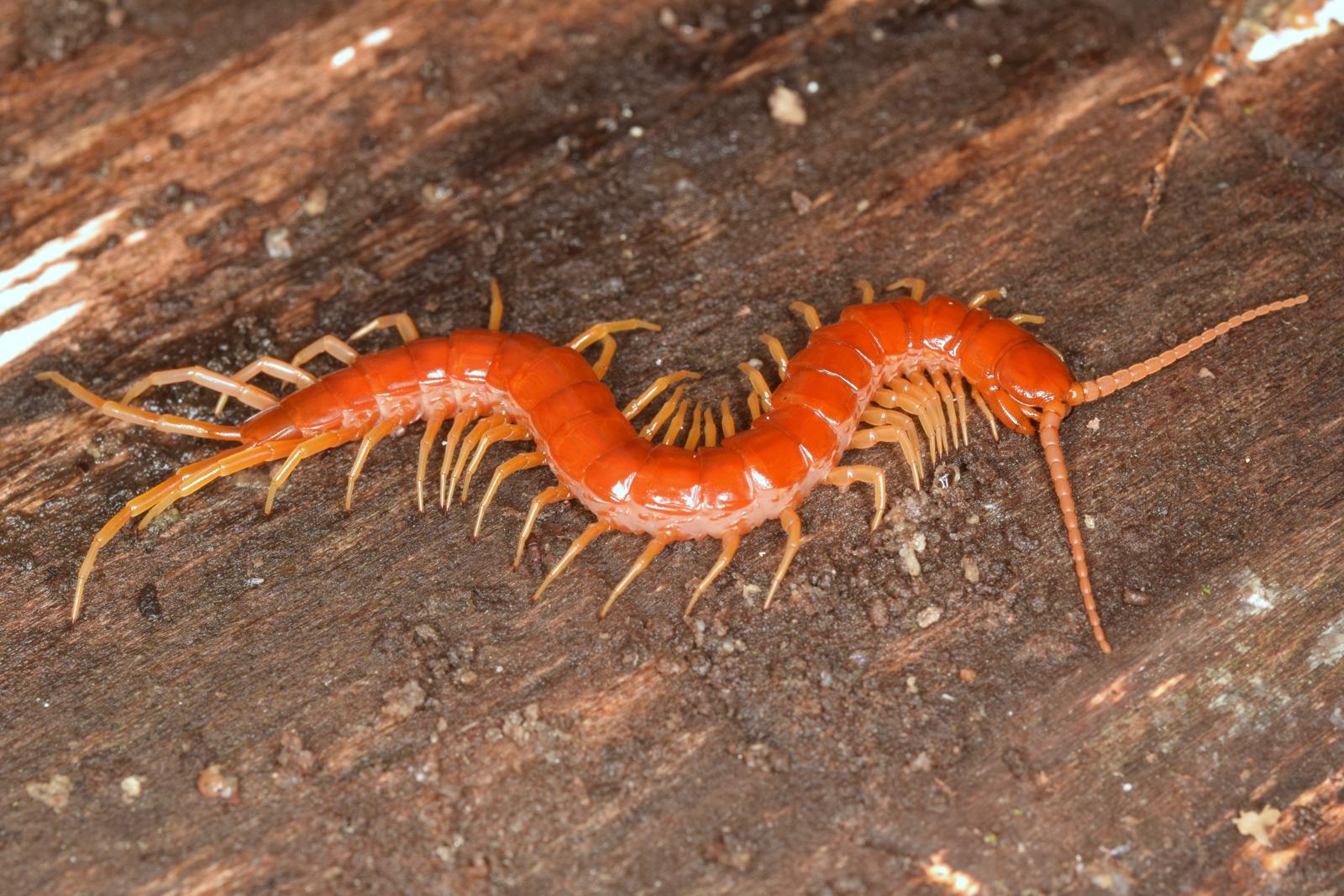
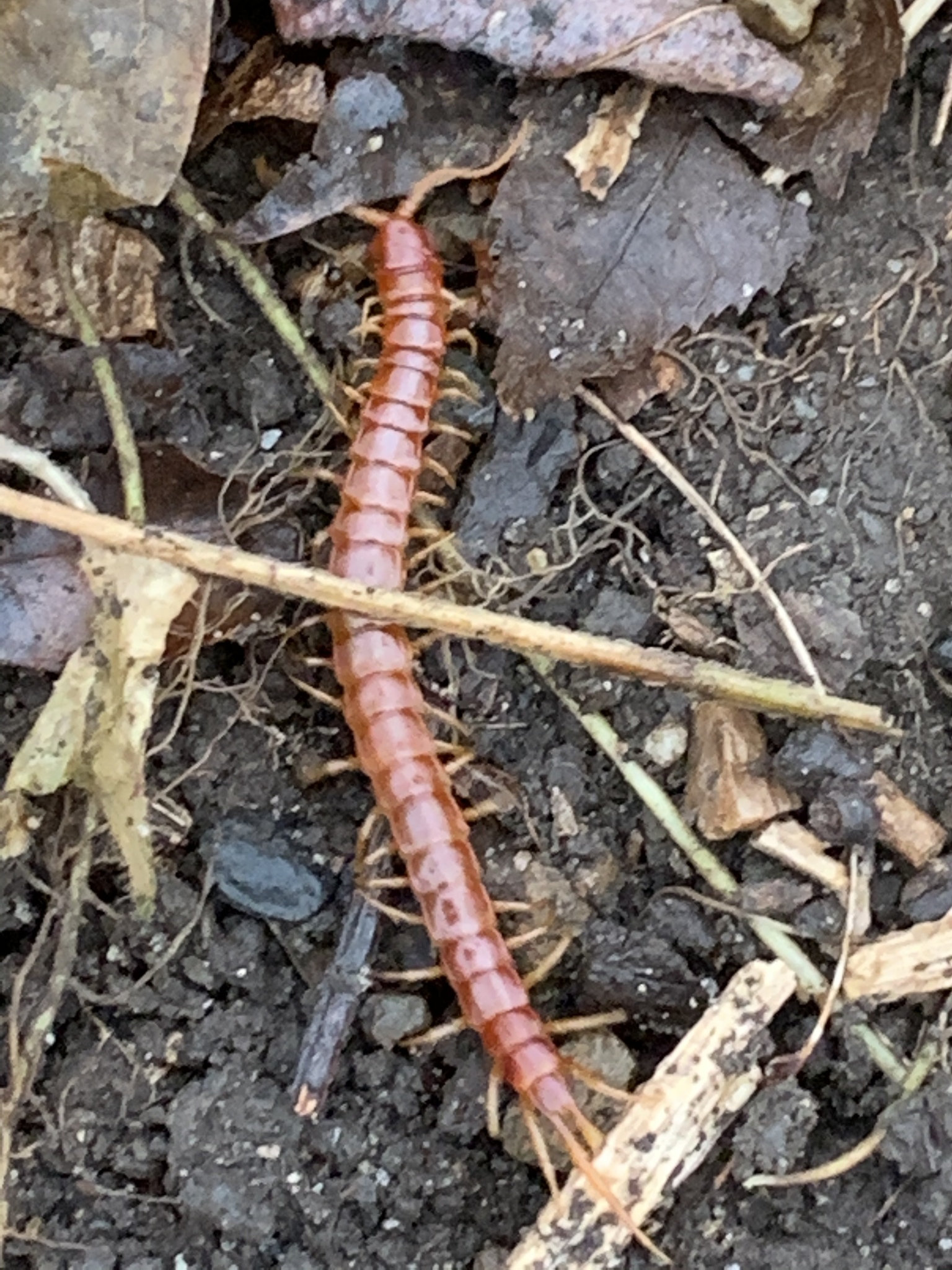
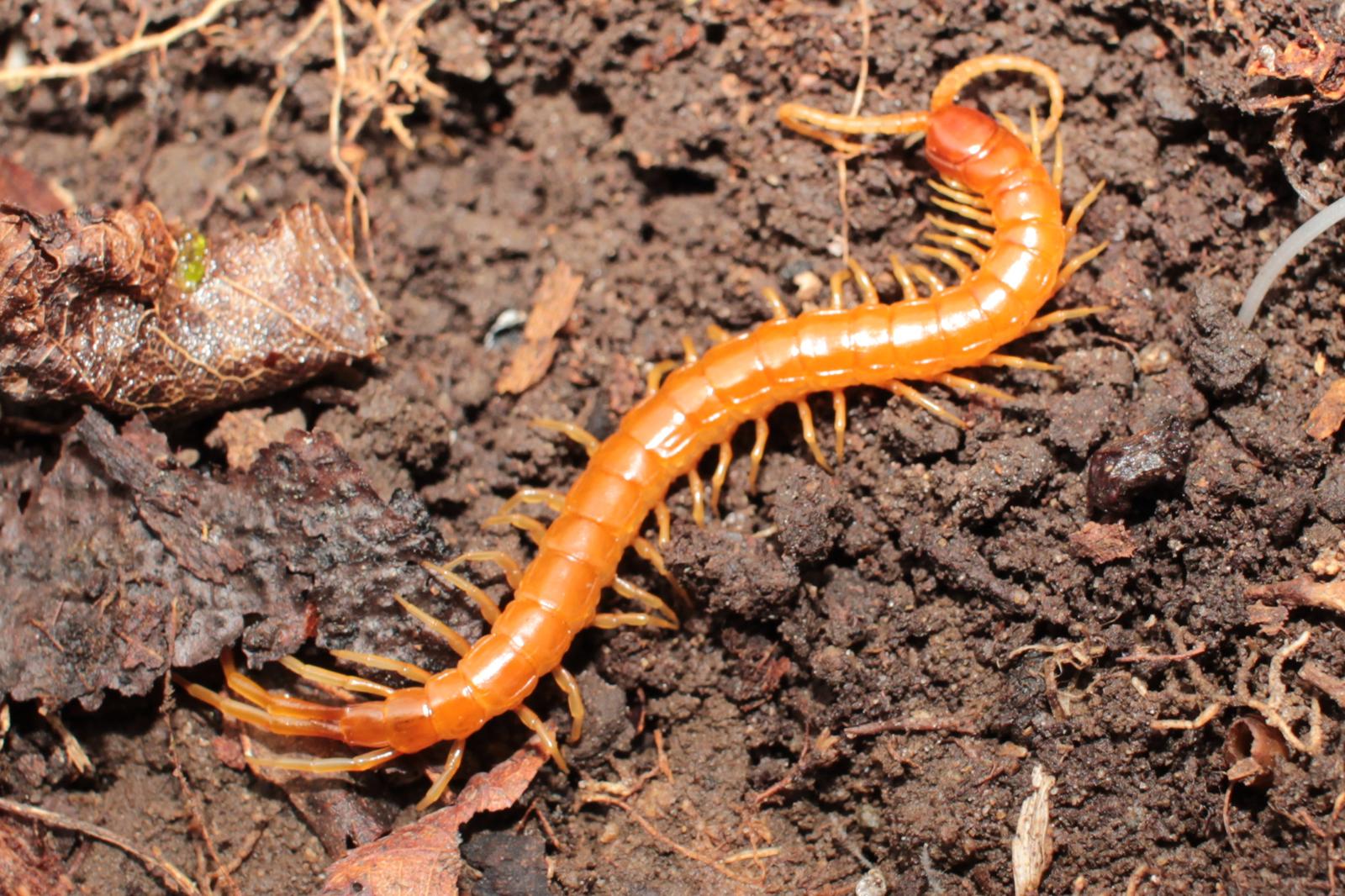
The eastern red centipede is a big, unmistakable animal once you know what to look for — and the first thing to look for is the color. The whole animal is red to rust-colored: head, body, and legs all the same deep red-brown, with no stripes, no bands, and no pale markings. An adult reaches about 69 millimeters, roughly two-and-three-quarter inches, though most of the ones you meet will be smaller. The body is long and somewhat flattened, built for slipping through the cracks of rotting wood, and the last pair of legs is longer than the rest, pointing backward and used to grab prey — and to give a sharp pinch if the animal is handled.
Count the legs and you get the second field mark: twenty-three pairs, one pair per segment, which puts it in the order Scolopendromorpha — the bark centipedes and tropical giants — and separates it at a glance from the fifteen-pair stone and house centipedes and the twenty-one-pair cryptops. The third field mark is the one you cannot see: it has no eyes at all. The eastern red centipede is completely blind, and it navigates its world by touch and smell, feeling its way through the dark heartwood of a rotting log with its long antennae. That blindness is also a clue to its habits — it lives where light never reaches, inside logs and under bark, and it comes out mostly at night.
It is fast, too — not house-centipede fast, but fast enough that a log pulled apart in daylight empties in seconds, the red bodies pouring out and vanishing into the leaf litter before you can count them. And it is strong for its size: the forcipules, the venom fangs just behind the head, are powerful, and the animal can subdue prey larger than you would expect from its size. Young eastern reds are smaller and paler than adults, darkening to the full rust-red as they grow, so a small pale-red centipede in a log is very likely a youngster of this species, not a different one.
The name game (eastern red — and the name it is not)
Here is a correction this guide makes on purpose, because the confusion is widespread and it matters. This animal, Scolopocryptops sexspinosus, is the eastern red centipede. It is sometimes called the eastern bark centipede in casual sources — and our own project census listed it that way — but that name properly belongs to a different animal, Hemiscolopendra marginata, the blue-green bark centipede of the eastern United States that is also known as the Florida blue centipede. Two different centipedes, two different genera, two different colors, one tangled pile of nicknames. This guide uses the name the taxonomic sources use: eastern red centipede, for the red one; eastern bark centipede, for the blue-green one under the bark.
The scientific name is a mouthful with a story in it. Scolopocryptops joins Scolopendra, the giant centipede genus, with the Greek kryptos, hidden — the hidden Scolopendra, a fair description of an animal that spends its life inside logs. Sexspinosus means “six-spined,” a reference to the spines on its legs that a specialist can count under a microscope. The species was described by Thomas Say in 1821, as a Cryptops, and moved to Scolopocryptops by George Newport in 1845. The taxonomy, for the nerds in the back: kingdom Animalia, phylum Arthropoda, class Chilopoda, order Scolopendromorpha, family Scolopocryptopidae, genus Scolopocryptops. The genus has six species in the United States and Canada, and this is the common eastern one — the one you will actually meet.
One more name warning, because it is a trap: Hemiscolopendra marginata, the eastern bark centipede, is also called the Florida blue centipede, and it is sometimes called the eastern red centipede too, because some individuals are reddish. If you find a blue-green centipede with yellow legs under bark in Florida, that is the bark centipede, not this one. Color first, then leg count: red with twenty-three pairs is this species; blue-green with twenty-one pairs is the other.
Range: Florida to Ontario, and a species that may be two
The eastern red centipede is widespread across eastern North America, from Florida and the Gulf Coast north to Ontario in Canada, up the East Coast into New England, and as far west as eastern Texas and Nebraska. In Canada it is known only from the Niagara Gorge. It is found from sea level to as high as 1,950 meters — about 6,400 feet — in the mountains, and it occurs in a wide variety of habitats, though it is almost always found in the same place: under decaying logs, under bark, or in leaf litter, in the damp heartwood where the wood is soft enough to burrow into. It is a forest animal first and a garden animal second, and its numbers drop sharply at forest edges — it wants deep cover, not open ground.
Now the honest complication, because this project has been bitten by range claims before and this one is important. A 2018 genetic study of specimens from the southern Appalachian Mountains found that S. sexspinosus is a species complex: the sampled population contained two deeply divergent lineages, a northern lineage ranging to West Virginia and Virginia, and a more southern lineage ranging to Georgia and South Carolina, with the two overlapping in the Bankhead National Forest in Alabama and in the Great Smoky Mountains. No formal split has been published — as of this writing, there is still one named species — but the genetic evidence says the animal you meet in New York and the animal you meet in Georgia may not be the same species in the end. This guide treats it as one species with a known split coming, and says so, rather than pretending the question is settled.
Its genus-mates are worth a sentence, because they are the animals you will confuse it with. The other eastern Scolopocryptops are S. rubiginosus, reddish and ranging from the southern Great Lakes to northern Texas; S. nigridius, brownish, from central Pennsylvania south to the Florida Panhandle; and S. peregrinator, pale yellowish, from New York City to eastern Kentucky and northwestern North Carolina. Telling them apart takes a microscope and a key — the differences are in the hairs on the antennae and the grooves on the back plates. In the field, a red scolopocryptops in the East is most likely sexspinosus, and this guide is the one to read.
What it eats: the log’s top predator
Inside a rotting log, the eastern red centipede is the top predator. It hunts insects and their larvae, spiders, earthworms, and other small invertebrates, moving swiftly through leaf litter and through the soft heartwood of the log, feeling its way with its antennae and striking with its forcipules. The venom is fast and effective on prey its own size and smaller, and the long hind legs help pin prey while the fangs do their work. It can also pinch sharply with those hind legs — a second weapon that surprises people who pick one up.
What it does not eat is the list that makes it a friend rather than a problem. It does not eat living plants, leaves, stems, roots, or seeds, and it does not eat wood — it lives in rotting wood, but it hunts in it, it does not consume it. It does not eat stored food, fabric, or houses, and it does not spread disease. It is a predator of the small animals of the log, and the log is better for it: the insects it eats include wood-boring larvae and other small animals that would otherwise multiply unchecked in the damp wood.
What it does not like is the other half of the management story. It does not like dry conditions: it loses water fast in open air, and it stays inside damp logs and under bark for that reason. It does not like bright light or open ground — its numbers fall sharply at forest edges, and it will not cross a sunny lawn by choice. And it does not like being disturbed: pull its log apart and it runs, fast, for the nearest dark cover. Damp, dark, and covered is everything it wants, and that is the whole strategy for keeping it where it belongs — in the log pile, not in the house.
The bite: the honest answer
The eastern red centipede has the most serious bite of any centipede in this wave of guides, and the honest answer is to say so plainly and then put it in proportion. It is venomous, its forcipules are powerful, and its bite is painful — comparable to a wasp sting, with immediate local pain, redness, and swelling. The centipede specialist Rowland Shelley, who spent a career handling these animals, recorded his own bite from an inch-long individual of this species: the finger swelled up and throbbed for about an hour, “thus being similar to a wasp sting.” That is the best first-hand description there is, and it is reassuring in its modesty: an hour of throbbing, then done.
It is not medically significant in the ordinary sense. There are no confirmed human deaths from centipede bites, and the bite of this species, while painful, passes in hours to a day or two without treatment beyond washing the area and keeping it clean. It bites only when handled or trapped against skin — pull a log apart with bare hands and grab a red centipede, and you have given it every reason to bite. Wear gloves when you move logs, do not pick one up, and it will not bite you. Seek medical advice if you have an allergy to insect stings, if the swelling spreads, if the bite is on a child, or if you are worried — the same advice as for a wasp sting, because the situation is the same. Do not panic, and do not reach for antivenom, because none is indicated. Respect it, glove up, and leave it alone.
Life cycle: a mother that stays
Here is a fact the sources support at the level of the order, and this guide labels it as such rather than pretending it was studied in this exact species: scolopendromorph centipedes are among the most attentive mothers in the arthropod world. The female lays her eggs — fifteen to sixty of them — in a nest in soil or rotten wood, and she stays with them, curling her body around them, grooming them to keep fungi and bacteria off, and guarding them until they hatch. She remains with the young after hatching, guarding them until they are ready to leave. If she is disturbed, she may abandon the eggs, or eat them; abandoned eggs quickly fall prey to fungi. It is a long way from the lay-and-leave strategy of the stone centipedes, and it is one reason scolopendromorphs are slow to recover from disturbance: a destroyed nest is a lost generation.
Centipede reproduction, in general, does not involve coupling: the male deposits a spermatophore for the female to take up, and in temperate areas egg laying happens in spring and summer. The young hatch as small versions of the adults and add segments and legs as they molt. How long this species lives is not well documented — the honest answer is that nobody has published a lifespan for it, and this guide will not invent one. What is documented is the pattern: a long-lived, slow-breeding forest predator that needs its log, and that repays the log by keeping the log’s insect population in check.
The Florida angle: under your logs, right now
In Florida, the eastern red centipede is at home. It occurs through the state, from the Panhandle to the Peninsula, in the same place it occurs everywhere: under rotting logs, under bark, and in deep leaf litter, in the damp heartwood where the wood is soft. Florida gardeners with a log pile, a brush pile, or a bed edged with rotting wood are the most likely in the state to meet one, and the meeting usually happens the same way it happens everywhere else — you lift a log, and something red runs for cover.
Florida is also where the nickname tangle is worst, so here is the field check again, in Florida terms. Red, blind, twenty-three pairs of legs, in a rotting log: eastern red centipede, this guide. Blue-green with pale yellow legs and orange hind legs, under bark, twenty-one pairs: eastern bark centipede, also known as the Florida blue centipede, a different animal. Small, dark, and slow, curling into a spiral when poked: a millipede, not a centipede at all — check the Garden Centipedes guide for the leg-count test. And wear gloves when you move logs in Florida, not just for this centipede but for everything else that lives in a Florida log pile.
Is it a pest?
Plainly: no, with one honest qualification. The eastern red centipede is not a pest of plants, houses, or people. It does not eat living plants, does not damage structures, does not eat stored food, and does not spread disease. It is a forest predator that lives in rotting logs, and its presence in a garden is a sign of a healthy, damp, woody habitat, not a problem to solve. The qualification is the bite: it is the one centipede in this wave whose bite genuinely hurts, and a gardener who grabs logs with bare hands will eventually be reminded of that. That makes it an animal to respect, not an animal to exterminate. The goal is not to remove it from the garden. It is to keep it in the log pile, where it belongs, and to keep your hands out of the log pile without gloves.
Against the bite risk, weigh the day job: it is the top predator of the rotting log, hunting the insects and larvae that live in damp wood, and it does that job for free, for years, in a habitat you were going to leave alone anyway. A log pile with eastern red centipedes is a log pile with fewer wood-boring pests, and a garden with a log pile is a garden with more life in it. That is a trade worth making.
Effects on the garden
On the plus side, the eastern red centipede is a genuine garden helper, in the specific habitat where it lives. It hunts in rotting logs, under bark, and in deep leaf litter, taking insects and their larvae, spiders, earthworms, and other small invertebrates — including the larvae of wood-boring insects that damage trees and shrubs. It does not eat living plants, does not chew leaves or stems, and does not disturb roots. It is a predator of the log, and the log is a part of the garden that most gardeners leave alone — which is exactly why it works so well there.
On the minus side, there is the bite, and the fact that it eats earthworms and spiders as well as pests — a generalist predator takes the good with the bad, and the net effect is still positive. It also eats other centipedes, including smaller ones, which is the usual arrangement among predators. None of this makes it a garden pest. It makes it a wild animal with a job, doing the job in the one corner of the garden where you are least likely to notice it, until you lift the log.
Effects on other garden animals
The eastern red centipede sits near the top of the log’s food web. As a predator it eats insects and their larvae, spiders, earthworms, and other small invertebrates, which puts it in competition with the other hunters of the log — ground beetles, spiders, and other centipedes — and in conflict with them, since it will eat smaller centipedes too. It helps the trees by keeping wood-boring larvae down, and it helps the soil by turning prey biomass into droppings that feed the microbes of the log.
As prey, it is food for anything big enough and fast enough to catch it: birds, toads, lizards, and small mammals all take large centipedes when they can, and its red color is a warning as much as a uniform — predators learn that red centipedes bite back. Its defenses are speed, a painful bite, and a sharp pinch from the hind legs, and it uses all three. For pets, the risk is real but small: a dog or cat that picks one up will get a painful nip and learn not to do it again. It is not a veterinary emergency in the ordinary run of things, but call a vet if a pet is drooling, pawing at its mouth, or clearly distressed after a bite — and keep pets away from log piles you know hold red centipedes.
Look-alikes: the concrete checks
Red centipedes and red millipedes all look alike until you know what to check, and the checks are wonderfully simple — leg count, eyes, speed, and what it does when poked. Work through them in order and you will rarely go wrong.
House Centipede (Scutigera coleoptrata) — the striped sprinter indoors. Yellowish-grey with three dark stripes, fifteen pairs of long banded legs, big compound eyes, and a sprint across open floors. Check: striped and sprinting indoors means house centipede; red, blind, and under a log means eastern red. Read the full guide: House Centipede.
Brown Centipede (Lithobius forficatus) — the small brown one under the stone. Uniformly chestnut-brown, about an inch long, with fifteen pairs of short legs and clusters of simple eyes. Check: brown and fifteen pairs means brown centipede; red and twenty-three pairs means eastern red. Read the full guide: Brown Centipede.
Common Cryptops (Cryptops hortensis) — the small blind one in the soil. Pale reddish-brown, about an inch long, with twenty-one pairs of legs and no eyes. It is the closest look-alike in the soil, and the leg count settles it: twenty-one pairs means cryptops, twenty-three means eastern red — and the eastern red is much bigger and redder. Check: small, pale, and twenty-one means cryptops; big, red, and twenty-three means eastern red. Read the full guide: Common Cryptops Centipede.
Eastern Bark Centipede (Hemiscolopendra marginata) — the other half of the name puzzle. This is the blue-grey bark centipede of the eastern US, up to about 3 inches, and it is sometimes called the “eastern red centipede” too — even though it is blue, not red — and it shares the “Florida blue” nickname with the Florida Blue Centipede. Check: bright red all over and blind means Scolopocryptops; blue-grey with blue tick marks on the legs and visible eyes means Hemiscolopendra. Check the legs: 23 pairs means Scolopocryptops, 21 pairs means Hemiscolopendra. Read the full guide: Eastern Bark Centipede.
Rusty Millipede (Trigoniulus corallinus) — the red, round one on the patio. Reddish-brown all over and cylindrical, about the same size as a young eastern red, but slow-moving and harmless, curling into a spiral when poked. The leg count settles it: two pairs per segment means millipede, one pair means centipede. Check: round, slow, and curled means rusty millipede; flattened, fast, and running means eastern red. Read the full guide: Rusty Millipede.
Cyanide Millipede (including Asiomorpha coarctata) — the flat-backed red one. Flat-backed millipedes are flattened top-to-bottom with wide flanges on each segment, and many are red or black with bright markings. They are slow, they curl rather than run, and some defend themselves with cyanide compounds. Check: flat with flared edges and slow means flat-backed millipede; round-backed, fast, and red means eastern red. Read the full guide: Cyanide Millipede.
Centipedes in general — the split that matters. Every centipede has one pair of legs per body segment, moves fast, and can bite; every millipede has two pairs per segment, moves slowly, curls up, and cannot bite. If you are not sure which you have, count the legs on one segment and watch what it does when poked. Read the full guide: Garden Centipedes.
How to attract it — and how to keep it out of the house
The eastern red centipede is a forest animal, and the way to attract it is to give it forest: damp, dark, rotting wood, left alone.
Keep a log pile. A pile of rotting logs at the edge of the garden, in shade, kept damp and undisturbed, is the eastern red centipede’s ideal home. It is also a home for ground beetles, spiders, toads, and fungi, and the whole pile is better for having a top predator in it.
Leave the leaf litter. Deep leaf litter under trees is the hunting ground between the logs. Raking it all away starves the log’s food web, centipedes included.
Do not spray the log pile. Broad insecticides kill the eastern red centipede and the other predators first, because they are slow to breed back, while the pests return in weeks. If you must deal with a pest, deal with that pest, not with the whole log.
Keep it out of the house by keeping the log pile away from the foundation — a log pile against the house wall is an invitation — and by sealing gaps at ground level, fitting door sweeps, and clearing leaf litter back from the walls. An eastern red centipede indoors is almost always a stray that followed damp and cover too close to the house, and it does not want to be there. Catch it in a jar, slide a card underneath, and carry it back to the log pile. And wear gloves when you move logs: this is the one centipede in this wave whose bite you will remember, and gloves are the whole prevention.
Frequently asked questions
Is the eastern red centipede dangerous?
It is the most serious biter in this wave of guides, and the honest answer is to respect it without fearing it. Its bite is painful, like a wasp sting, with swelling and throbbing for about an hour, fading over a day or two. It is not medically significant for a healthy adult, and there are no confirmed human deaths from centipede bites. Wear gloves when you move logs, do not pick one up, and it will not bite you.
Does it bite?
Yes, if handled or trapped against skin — and it can also pinch sharply with its long hind legs. Its first response to a threat is to run, not to fight. Give it room and it will use it.
Is it the same as the eastern bark centipede?
No, and the confusion is widespread. This animal, Scolopocryptops sexspinosus, is the eastern red centipede. The eastern bark centipede is Hemiscolopendra marginata, a blue-green animal with yellow legs that is also called the Florida blue centipede. Red with twenty-three leg pairs is this species; blue-green with twenty-one is the other.
Why is it in my log pile?
Because a rotting log is its home and its hunting ground. It lives in the damp heartwood, hunts the insects and larvae that live there, and comes out at night. A log pile with eastern red centipedes is a log pile with a working top predator.
How big does it get?
Adults reach about 69 millimeters, roughly two-and-three-quarter inches. Young ones are smaller and paler, darkening to the full rust-red as they grow.
Is it blind?
Yes, completely. It has no eyes at all, and it navigates by touch and smell, feeling its way through the dark inside logs with its long antennae.
What does it eat?
Insects and their larvae, spiders, earthworms, and other small invertebrates. It is the top predator of the rotting log. It does not eat living plants, wood, or stored food.
Will it hurt my plants?
No. It does not eat living plants at all. In the garden it is a helper, hunting the small animals that live in damp wood and leaf litter.
Will it hurt my dog or cat?
A pet that picks one up will get a painful nip and learn not to do it again. It is not a veterinary emergency in the ordinary run of things, but call a vet if a pet is drooling, pawing at its mouth, or clearly distressed after a bite — and keep pets away from log piles you know hold red centipedes.
How do I get rid of it?
You almost certainly should not — it is a beneficial forest predator. Keep the log pile away from the house, seal gaps at ground level, and wear gloves when you move logs. If one strays indoors, catch it in a jar and return it to the log pile.
🌱 Keep learning
Three related guides worth reading next:
- Garden Centipedes — The general guide: how to tell a centipede from a millipede, which ones bite, and what to do about the one under your log.
- Cyanide Millipede — The flat-backed red millipede that shares the eastern red’s logs and color — slow, curled, and chemically defended in a completely different way.
- Rusty Millipede — The other red invader: slow, round, harmless, and the first millipede in history to have its genome sequenced.
🪱 Your Soil Needs This
Reading about healthy soil is great. Growing in it is better. Our small-batch, traceable worm castings are the shortcut your garden deserves.
Shop Worm Castings Subscribe & SaveEvery bag comes with a lot certificate. Know what's in your soil.