
It is past midnight, you are barefoot on the way to the bathroom, and something the size of a spider with far too many legs sprints across the tiles, stops dead, and then sprints again — straight at you, or so it feels. Meet the house centipede, Scutigera coleoptrata: one to one-and-a-half inches of yellowish-grey body, three dark stripes down its back, and fifteen pairs of long banded legs that make the whole animal look three or four inches across. It is the fastest centipede you will ever meet indoors, the only centipede that lives and breeds inside American houses, and — here is the twist that changes everything about how you feel about it — it is on your side. It eats cockroaches, silverfish, bed bugs, termites, spiders, and ants. It does not eat your house, your food, your clothes, or your plants. It is a guard dog that looks like a nightmare.
And if you are reading this in Florida because one just ran across your bathroom floor — stay with us. It is almost certainly a house centipede, it is almost certainly harmless, and everything in the “what to do” section works for yours too, including the option of leaving it alone and letting it work.
What it looks like
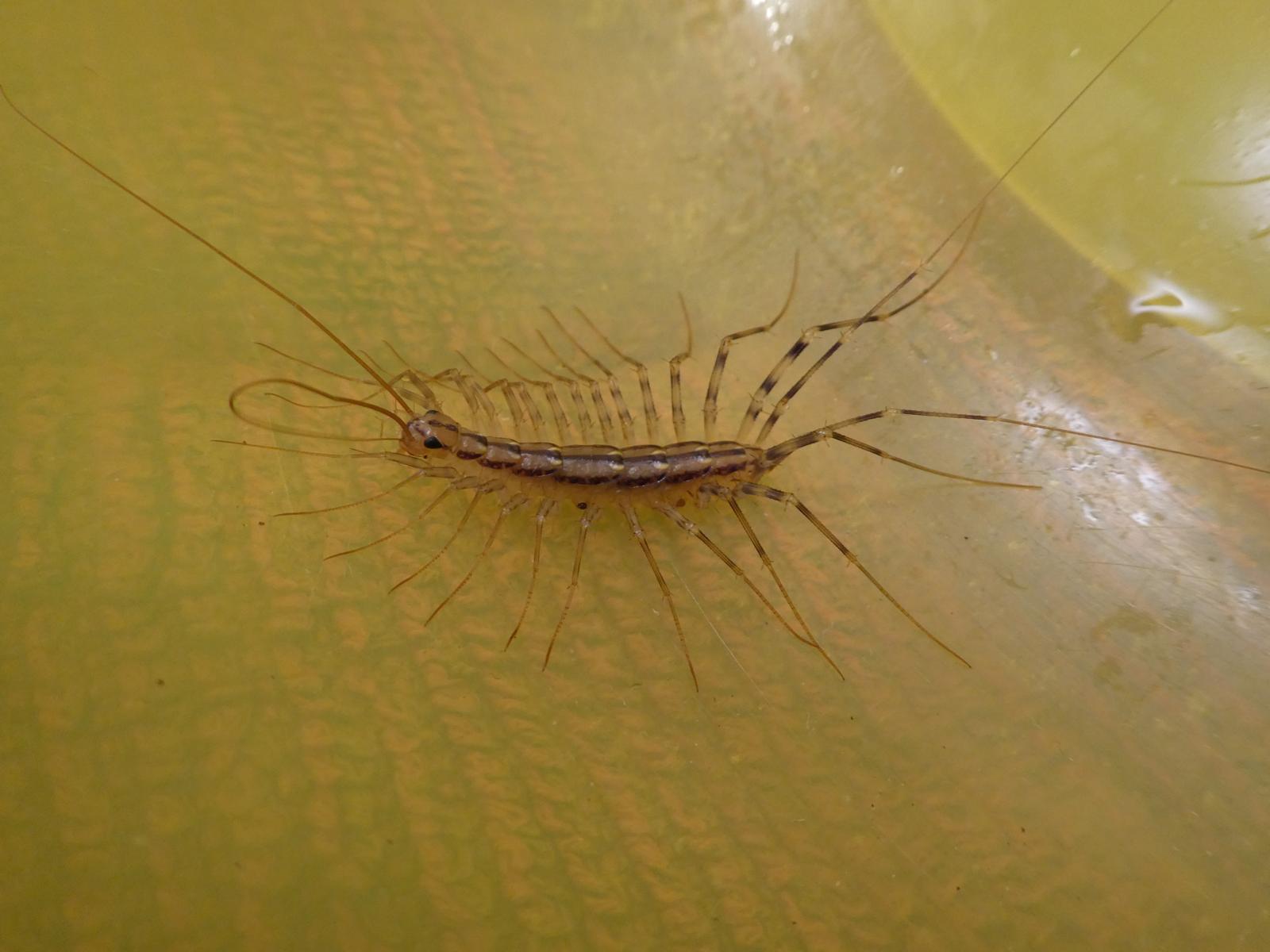
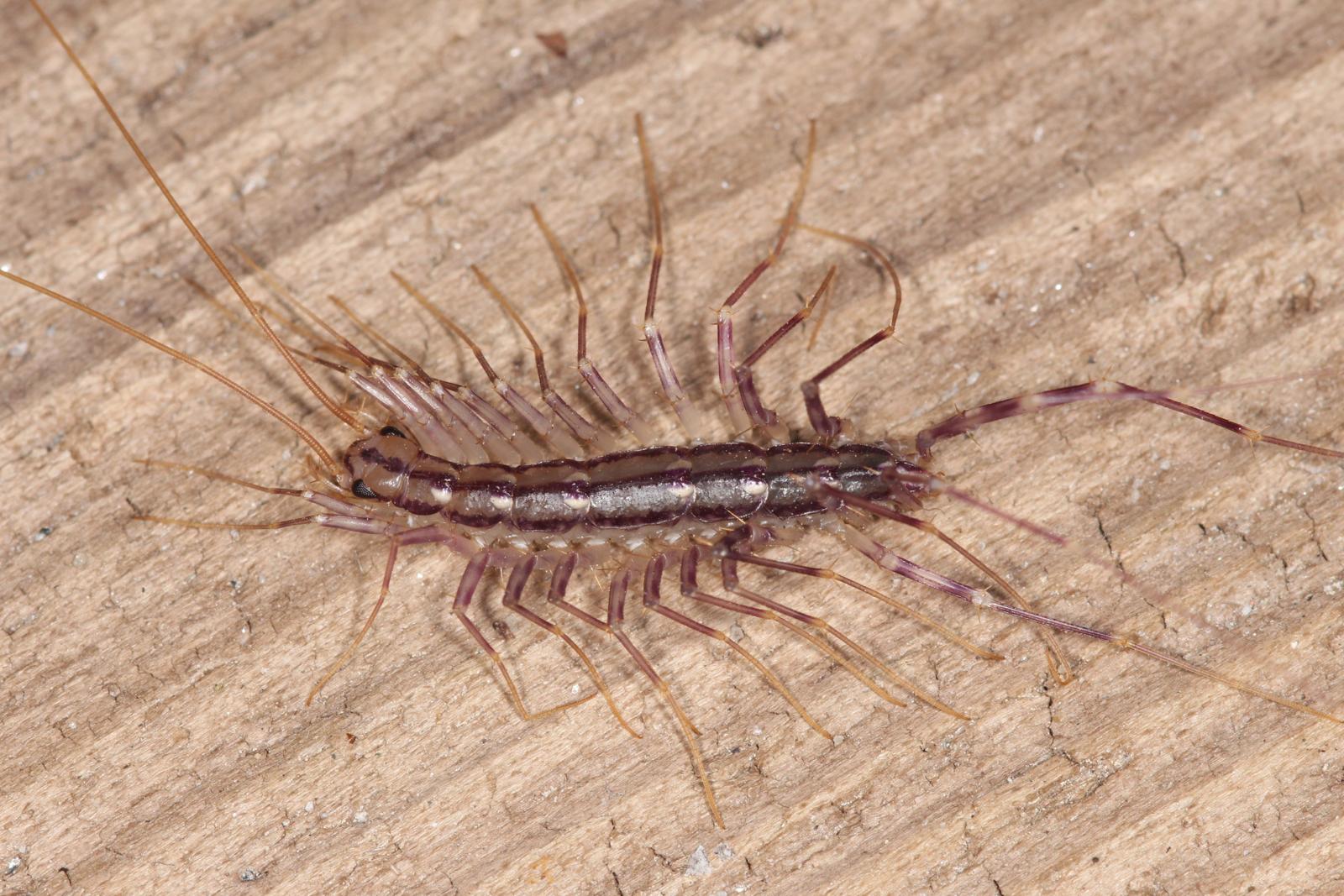
The house centipede is built like no other centipede in your house, and once you know the field marks you will never confuse it with anything else. The body is yellowish-grey to light brown, somewhat flattened, and marked with three dark stripes running the full length of the back. The legs are the giveaway: fifteen pairs, each pair longer than the one in front of it, so the animal tapers toward the head and flares toward the rear, and each leg is banded in dark and light like a barber’s pole. The last pair of legs is the longest of all — in females it can be nearly twice the length of the body — and it sticks out behind like a second pair of antennae, which is why people so often cannot tell which end is the head. The real antennae, at the front, are very long too, whipping around and tasting the air. The whole animal, legs included, can span three to four inches, even though the body itself is only about an inch to an inch and a half long.
It also has something most centipedes do not: real, working compound eyes. Most centipedes are blind or nearly so, feeling their way through the dark under logs. The house centipede hunts in the open, on walls and ceilings and across open floors, and it watches where it is going. That is part of why it seems so unnervingly aware of you — it is, in a small arthropod way, actually looking. And it is fast: the long legs are built for sprinting, and a house centipede can cross a bathroom floor in a blink, stop dead without warning, and then sprint again. The stop-start dash is the behavior that startles people most, and it is also the behavior that gives it away. Nothing else in a house moves like that.
Young house centipedes look like small, pale versions of the adults, but with a surprise: they hatch with only four pairs of legs. They earn the rest one molt at a time — four pairs, then five, then seven, nine, eleven, thirteen, and finally fifteen — which means a half-grown house centipede with, say, nine pairs of legs is a juvenile, not a different species. They keep molting even as adults, growing a little bigger each time, and they can regrow a lost leg over successive molts, which is useful for an animal that escapes predators by leaving a leg behind.
The name game (house, shield-bearer, beetle-back)
The common name tells you the whole story: this is the centipede of the house. Its scientific name, Scutigera coleoptrata, was given by Linnaeus in 1758, and it is gloriously nerdy. Scutigera roughly means “shield-bearer,” from the Latin scutum, a shield; coleoptrata means “sheath-winged,” the same word that gives beetles their order name, Coleoptera — a nod to the hard, shield-like plates down the animal’s back. The taxonomy, for the nerds in the back: kingdom Animalia, phylum Arthropoda, class Chilopoda (the centipedes), order Scutigeromorpha, family Scutigeridae, genus Scutigera. The order Scutigeromorpha is the house-centipede order — the fast, long-legged, big-eyed branch of the centipede family tree — and S. coleoptrata is its famous member.
It is also, remarkably, one of only two scutigeromorphs found north of Mexico, the other being Scutigera linceci, a much rarer southwestern species. So if you find a long-legged, striped, sprinting centipede anywhere in a house in the United States, the identification is essentially settled before you even count the legs. There is no other animal it could be.
Where it came from, and how it conquered the American house
The house centipede is not native to North America. It is thought to be native to the Mediterranean region, and from there it spread through Europe, Asia, and eventually the Americas — a stowaway in the damp corners of human trade, in soil, in potted plants, in the holds of ships and the boxes of commerce. In North America it likely made landfall in Mexico and the southern states first, then spread north up the East Coast. The dates are on the record: it was observed in Pennsylvania as early as 1849, in New York in 1885, and in Massachusetts by about 1890. By 1902 the USDA’s C. L. Marlatt could write that it was “now very common through New York and the New England States, and extends westward well beyond the Mississippi.” Today it is found across the United States, from Virginia to the coast of California, and in Hawaii too — everywhere people keep damp basements and bathrooms, which is to say, everywhere.
What makes the conquest remarkable is that the house centipede did not just move into the American outdoors. It moved into the American indoors, and it is the only centipede that can live and breed inside a house. Other centipedes wander in by accident and die in the dry air within days. The house centipede stays. It breeds in the cracks of your foundation, hunts in your basement, and raises its young behind your baseboards. It is a wild animal that has become, without anyone inviting it, a domestic one — the way pigeons became city birds and house sparrows became house sparrows. Your house is its habitat now, and it is very good at it.
Outdoors, in warm months, you can find it under boards, logs, and rocks, and in leaf litter — the same damp, dark places every centipede likes. But indoors is where it does its real work, and indoors is where you will meet it: basements, bathrooms, crawl spaces, laundry rooms, and the damp corners of ground-floor rooms. It follows the humidity the way a plant follows light. A dry house has no house centipedes; a damp one almost always does, whether you have seen yours yet or not.
What it eats: the free pest-control service
Here is the part that should change your mind about the animal sprinting across your bathroom. The house centipede is a carnivore, and its menu is a list of everything you do not want in your house: cockroaches, silverfish, bed bugs, termites, ants, clothes moths, earwigs, houseflies and their larvae, and spiders — including, yes, the spiders you were already afraid of. Outdoors it takes worms, small snails, and other small arthropods as well. It is a generalist predator with a fast metabolism and a large appetite, and a single house centipede can eat a surprising number of household pests in a night.
How it hunts is a small marvel. It does not build a web or set a trap. It runs its prey down — it is faster than almost anything it hunts — and grabs it with its long legs, pinning it while the forcipules do their work. The forcipules are the centipede’s famous weapon: the first pair of legs, just behind the head, modified over millions of years into curved, hollow fangs with a venom gland inside each one. They are not mouthparts — strictly speaking, a centipede stings rather than bites — but the effect is the same: venom injected into the prey, prey stops moving, centipede eats. The venom is fast-acting on small arthropods and, as the next section explains, almost irrelevant to you.
What it does not eat is equally important, because it is the list of things people worry about for no reason. It does not eat wood, so it cannot damage your house the way termites do. It does not eat fabric, paper, stored food, or pantry goods. It does not eat living plants, seedlings, or garden crops. It does not eat pet food. It does not spread disease — it is not a cockroach, it does not walk through filth and then across your kitchen counter, and there is no record of it transmitting anything to anyone. It is a predator of pests, and nothing else on its menu belongs to you.
What it does not like is just as useful to know, because the dislikes are the levers you pull if you want it gone. It does not like dry air: it loses water through its body surface and dries out fast in a dry room, which is why it hugs the damp rooms of the house. It does not like bright light: it is a creature of dark corners and night hunting, and it flees light when you switch it on. It does not like the cold: in cold climates it lives exclusively indoors from the first frost to the last, and it does not like being disturbed — its first response to a threat is always to run, not to fight. Dry, bright, and cold is the opposite of everything it wants, and that is the whole eviction strategy in one sentence.
The bite: the honest answer
Every centipede is venomous. That sentence sounds alarming until you add the three that matter: venomous is not the same as dangerous, a house centipede’s venom is made for animals the size of a silverfish, and its fangs are usually too weak to break human skin at all. Extension entomologists at Clemson, Kentucky, and Ohio State all say the same thing in different words: house centipedes rarely bite people, and when they do it is because they were trapped against skin or picked up by hand. Ohio State puts a rough line on it — centipedes larger than about two inches of body can bite, and smaller ones very rarely manage it. A house centipede’s body is one to one-and-a-half inches. The numbers are on your side.
If one does get through your skin, the honest description is a bee sting: immediate local pain, redness, and mild swelling around two small puncture marks, fading over hours to a day or two. It is not medically significant for a healthy adult, and deaths from centipede bites in the United States are essentially unheard of. Treat it the way you would treat a bee sting — wash the area, keep it clean, watch it — and seek medical advice if you have an allergy to insect stings, if the swelling spreads, or if a child or pet is bitten and you are worried. Do not panic, and do not reach for antibiotics or antivenom, because neither is indicated. The animal is not aggressive. It does not chase people to bite them — Marlatt’s 1902 description of house centipedes darting “directly at inmates of the house” was describing an animal running for the nearest dark hiding place, which happened to be under a dress. It wants the crack in the wall, not you.
For pets, the same calm applies. A cat that catches a house centipede may get a nip and learn not to do it again; a dog that snaps at one will get a mouthful of legs and a bad taste. Neither is a veterinary emergency in the ordinary run of things, but if a pet is drooling, pawing at its mouth, or clearly distressed, call a vet the way you would for any sting. And teach children the same rule that works for every wild animal in the house: look, do not touch, and let an adult deal with it.
Life cycle: born with four pairs of legs, living for years
House centipedes live a long time for an animal their size — three to seven years, by most accounts — and they take their time growing up. Mating happens in the warmer months, and it is a strange, delicate affair: the male and female circle each other, touching antennae, and the male deposits a packet of sperm on a small silk pad on the ground, then coaxes the female into position to pick it up. There is no coupling, no embrace — just a silk pad and a careful dance.
The female then lays her eggs in soil or in cracks in floors and foundations, covering them with a sticky substance, and she lays a lot of them over her lifetime: in laboratory observations, females laid an average of 63 eggs and a maximum of 151. The eggs hatch after about a week or two into tiny young with only four pairs of legs, and the young stay near their mother for about two weeks after hatching — some degree of maternal protection, unusual for an animal most people think of as a loner. From there it is a slow climb: five larval instars, gaining leg pairs at each molt, and it can take up to three years to reach adulthood with the full fifteen pairs. Then the adult keeps molting and growing for the rest of its long life. A house centipede you see this year may have been hunting your basement for three years already, and may hunt it for three more.
That longevity matters for the “what to do” question, because it means the house centipede in your bathroom is not a random visitor. It is a resident. It knows the territory, it has a hunting route, and it has probably been eating your silverfish for longer than you have lived there. Killing it does not solve a pest problem — it removes a pest-eater, and the pests it was eating will notice before you do.
The Florida angle: year-round, indoors and out
In Florida, the house centipede is a year-round animal, indoors and out. The warm, humid climate suits it perfectly — no winter forces it fully indoors, so in Florida you can meet it under a log in the garden in January and on the bathroom wall in July. That is the Florida difference: in the Northeast, a house centipede is a winter indoor animal; in Florida, it is an all-year animal with an outdoor life as well, hunting in leaf litter, under pots, and along the damp shaded side of the house whenever it is warm enough, which in Florida is almost always.
Florida gardeners should also know the outdoor cousin they are most likely to confuse it with — not a millipede, but the eastern red centipede, a red, slow, log-dwelling hunter that lives under rotting wood in the same gardens. The two could hardly be more different in behavior: the house centipede sprints across open floors in the light, while the eastern red centipede stays under cover and moves at a walk. If it is red and under a log, it is not a house centipede. Read the full guide: Eastern Red Centipede.
One more Florida note: the house centipede is sometimes blamed for things it did not do. It does not eat seedlings, it does not chew leaves, and it does not damage plants in any way — if something is eating your garden, look at the millipedes and the slugs first, not the centipede sprinting across your patio. And if you find one in the garden, leave it: it is hunting the same small pests out there that it hunts in your house.
Is it a pest?
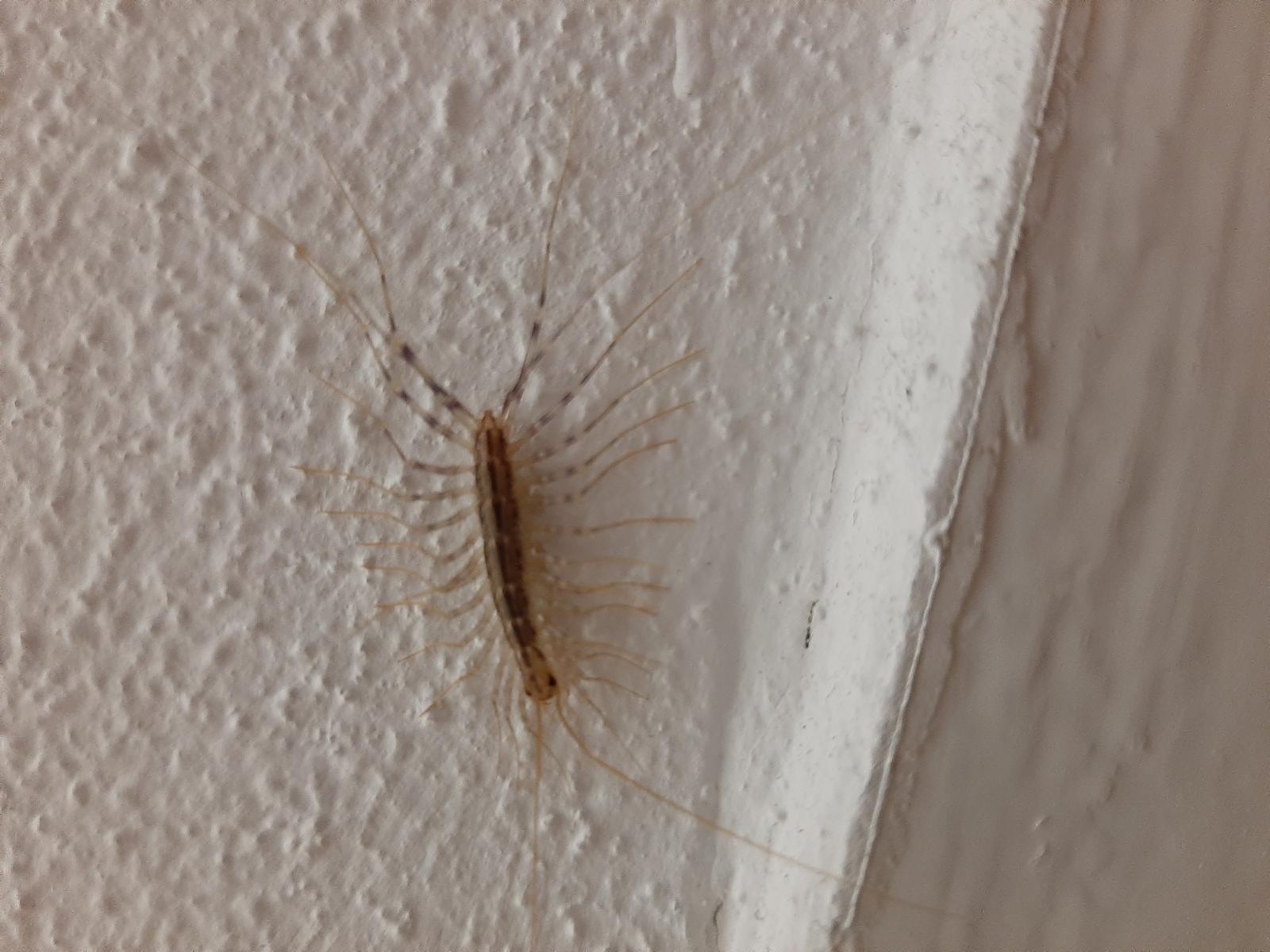
Plainly: it is a household pest by address and a beneficial predator by behavior, and the honest answer holds both halves at once. Yes, it is a pest in the sense that most people do not want a large, fast, many-legged animal running across their bathroom floor at midnight, and yes, it is listed as a household pest by extension services. But it is not a pest in any of the ways that matter for your house, your health, or your garden. It does not damage structures, does not eat stored food or fabric, does not spread disease, does not bite unless trapped against skin, and does not eat living plants. What it does is eat the animals that actually are pests — cockroaches, bed bugs, termites, silverfish, ants — and it does it for free, every night, for up to seven years.
So the question is not “is it a pest?” but “is it a pest you want to keep?” Many entomologists will tell you the same thing: a house with house centipedes is a house with fewer cockroaches, and the centipede is the reason. If you can live with the sight of it, it is the best pest control you will never have to pay for. If you cannot, the eviction below is humane, cheap, and effective — but go in knowing what you are giving up.
Effects on the garden
In the garden, the house centipede is a quiet helper. It hunts at night in leaf litter, under pots, and along damp edges, taking small insects, spiders, fly larvae, and other small invertebrates — including some of the small soil pests that bother seedlings. It does not eat living plants, does not chew leaves or stems, does not damage roots, and does not disturb the soil the way digging animals do. It is, in garden terms, a pure predator: it takes pests and gives nothing back but droppings and, eventually, a body that feeds the decomposers.
The one garden cost is psychological, not ecological: people who find a house centipede in the garden sometimes assume the garden is infested with something dangerous, and reach for a spray. Do not. A spray that kills the house centipede also kills the ground beetles, the spiders, and the other predators that keep your garden in balance, and the pests come back faster than the predators do. A house centipede in the garden is a sign of a damp, prey-rich, living soil — the same sign as a worm in the compost. Leave it to its work.
Effects on other garden animals
The house centipede sits in the middle of the garden food web, and it pulls in both directions. As a predator, it eats spiders, silverfish, cockroaches, ants, moths, and other small arthropods — which means it competes with the other hunters, especially spiders and ground beetles, for the same prey. It does not eat earthworms as a rule indoors, but outdoors it will take small worms and snails, so it is a minor competitor of the decomposers too. Its hunting helps the plants by keeping pest numbers down, and it helps the soil by turning pest biomass into centipede droppings, which feed the microbes.
As prey, it is fast food for anything that can catch it: birds, toads, lizards, and small mammals all take house centipedes when they can, and cats are famous for catching them indoors — which is one reason the centipede’s first response to anything large is to run. It has no chemical defense like a millipede, no curl, no stink — only speed and a willingness to leave a leg behind. For pets, the risk is small: a pet that eats one may get a nip and a bad taste, and learn from it. The house centipede’s place in the web is simple: it eats the pests, and the bigger animals eat it.
Look-alikes: the concrete checks
Most of the time, the house centipede is unmistakable — nothing else in a house has fifteen pairs of banded legs and moves like a sprinting spider. But a few animals get confused with it, and the checks are simple: count the leg pairs, watch the speed, and look at the color.
Brown Centipede (Lithobius forficatus) — the small brown one under the stone. The brown centipede is uniformly chestnut-brown, about an inch long, with fifteen pairs of legs — the same leg count as the house centipede — but its legs are short, stout, and unbanded, and it stays close to the ground under rocks and logs rather than sprinting across walls and ceilings. Check: short legs and uniform brown means brown centipede; long banded legs, three stripes, and a sprint across the bathroom floor means house centipede. Read the full guide: Brown Centipede.
Eastern Red Centipede (Scolopocryptops sexspinosus) — the red one under the log. Red to rust-colored all over, up to about two-and-three-quarter inches, with twenty-three pairs of legs and no eyes at all. It lives under rotting logs in eastern woods and moves at a walk, not a sprint. Check: red, blind, and slow under a log means eastern red; striped, big-eyed, and sprinting across the floor means house centipede. Read the full guide: Eastern Red Centipede.
Common Cryptops (Cryptops hortensis) — the small blind one in the soil. Pale reddish-brown, about an inch long, with twenty-one pairs of legs and no eyes, living under stones and logs in gardens. It is a soil animal, not a house animal, and it is much smaller and slower than a house centipede. Check: twenty-one leg pairs and no eyes, found in soil, means cryptops; fifteen pairs, big eyes, and a sprint means house centipede. Read the full guide: Common Cryptops Centipede.
Greenhouse Millipede (Oxidus gracilis) — the small, slow one people call a centipede. Under an inch long, dark brown to black on top with pale legs, and it moves slowly in a steady wave and curls up when disturbed. The leg count settles it: millipedes have two pairs of legs per segment, centipedes have one. Check: slow, curls up, two pairs per segment means millipede; fast, runs, one pair per segment means centipede. Read the full guide: Greenhouse Millipede.
Rusty Millipede (Trigoniulus corallinus) — the red invader on the patio. Reddish-brown all over, about the same size as a house centipede’s body, but slow-moving, cylindrical, and harmless — it curls into a spiral when poked and cannot bite at all. It shows up in numbers on patios after rain, while the house centipede shows up alone, indoors, at speed. Check: red, slow, and curled means rusty millipede; striped, fast, and sprinting means house centipede. Read the full guide: Rusty Millipede.
Centipedes in general — the split that matters. Every centipede has one pair of legs per body segment, moves fast, and can bite; every millipede has two pairs per segment, moves slowly, curls up, and cannot bite. If you are not sure which you have, count the legs on one segment and watch what it does when poked. Read the full guide: Garden Centipedes.
How to get rid of them — and how to keep them, if you want the help
First, the honest framing: you do not have a house centipede problem, you have a damp-house-with-prey problem, and the centipede is the symptom that tells you so. Kill the centipedes without fixing the damp and the prey, and new ones will move in. Fix the damp and the prey, and the centipedes leave on their own. Here is how, in order of what actually works:
Dry the house out. This is the single most effective step. Run a dehumidifier in the basement, fix leaking pipes and dripping taps, vent the bathroom properly, and keep the humidity below about 50 percent if you can. House centipedes lose water fast in dry air, and a dry house is a house they cannot live in. The same step also discourages the silverfish and cockroaches they eat.
Take away the prey. Vacuum regularly, especially in basements and along baseboards; store pantry goods in sealed containers; fix the cockroach or silverfish problem and the centipedes lose their reason to stay. No prey, no predator.
Seal the gaps. Caulk cracks in the foundation, seal around pipes and windows, fit door sweeps, and clear leaf litter and mulch back from the foundation by a foot or two. Look low — at ground level, where the wall meets the soil — because that is where they come in.
Declutter the damp corners. Cardboard boxes on a basement floor are a centipede hotel: damp, dark, and full of silverfish. Get boxes off the floor, onto shelves, or into plastic bins, and the basement stops being a habitat.
Catch and release, don’t spray. If one is on your wall, put a large jar over it, slide a stiff card underneath, and carry it outside — in warm months, to a damp, sheltered spot near the foundation or a log pile, where it can keep hunting. In cold weather, a garage or shed is kinder than the open yard. Broad insecticide sprays indoors are a poor tool here: they kill the centipede you can see and leave the damp and the prey that brought it, and they put chemicals where your children and pets live. Sticky traps can tell you where they travel, but they are a monitor, not a solution.
If you want to keep one — yes, really. Some gardeners do, deliberately: they leave the basement corners undisturbed, do not spray, and let the house centipede work as free pest control. If that is your choice, the care is simple: keep a damp corner, do not use broad insecticides, and accept that you will see it sometimes, sprinting across the floor at midnight, doing its job. It will eat your cockroaches for up to seven years and ask for nothing in return.
Frequently asked questions
Is the house centipede dangerous?
No, not in any practical sense. It is venomous, like all centipedes, but its fangs are usually too weak to break human skin, and a bite that does get through feels like a bee sting — local pain, redness, and mild swelling that fades in hours to a day or two. It is not medically significant, and deaths from centipede bites in the United States are essentially unheard of.
Does it bite?
Almost never. It bites only when trapped against skin or picked up by hand. Its first response to a threat is always to run. Do not pick one up with bare hands, and it will not bite you.
Why is it in my house?
Because your house is damp and full of prey. House centipedes follow humidity and food — cockroaches, silverfish, bed bugs, ants — into basements, bathrooms, and crawl spaces. It is the only centipede that lives and breeds indoors, so a house centipede is a resident, not a lost wanderer.
Why does it run at me?
It is not running at you. It is running for the nearest dark hiding place, and you happen to be standing between it and the crack in the wall. It is faster than you think and worse at steering than it looks.
How big does it get?
The body is one to one-and-a-half inches long, but the legs make the whole animal look three to four inches across. Females have a hind pair of legs nearly twice the body length.
How long does it live?
Three to seven years, which is long for an animal its size. It takes up to three years to reach adulthood, and it keeps molting and growing for the rest of its life.
What does it eat?
Household pests: cockroaches, silverfish, bed bugs, termites, ants, clothes moths, earwigs, flies and their larvae, and spiders. Outdoors it also takes worms, small snails, and other small arthropods. It does not eat wood, fabric, stored food, or living plants.
Will it hurt my plants?
No. It does not eat living plants at all. In the garden it is a helper, hunting small pests in leaf litter and under pots.
Will it hurt my dog or cat?
Almost certainly not. A pet that catches one may get a nip and a bad taste and learn not to do it again. It is not a veterinary emergency in the ordinary run of things, but call a vet if a pet is drooling, pawing at its mouth, or clearly distressed after a bite.
How do I get rid of them?
Dry the house out, take away the prey, seal the gaps, and declutter damp corners. Catch the ones you see in a jar and release them outside in warm weather. Do not spray broad insecticide indoors — fix the damp and the prey, and the centipedes leave on their own.
🌱 Keep learning
Three related guides worth reading next:
- Garden Centipedes — The general guide: how to tell a centipede from a millipede, which ones bite, and what to do about the one on your floor.
- Rusty Millipede — The other red invader that shows up indoors and on patios after rain — slow, harmless, and the first millipede in history to have its genome sequenced.
- Greenhouse Millipede — The small, bumpy millipede people most often mistake for a baby centipede, and the leg-count check that settles it.
🪱 Your Soil Needs This
Reading about healthy soil is great. Growing in it is better. Our small-batch, traceable worm castings are the shortcut your garden deserves.
Shop Worm Castings Subscribe & SaveEvery bag comes with a lot certificate. Know what's in your soil.