
Flip a flat stone in a damp garden, and something chestnut-brown and fast will sprint for cover before you have finished the sentence. That is the brown centipede, Lithobius forficatus — also called the common stone centipede and the garden centipede — an inch-long hunter that lives in the top layer of the soil, under rocks and rotting logs, and eats the small animals that eat your plants. It is one of the most common centipedes in Europe, an introduced immigrant in North America since the 1800s, and a quiet piece of the pest-control crew in any garden it lives in. It is venomous, like every centipede, and it is also, honestly, harmless to you: its fangs are too small to break your skin except in the rarest of accidents, and a bite that does land amounts to brief local pain.
And if you are reading this in Florida because you just flipped a log and found a small brown centipede — stay with us, but read the Florida section carefully. This species’ American stronghold is the Northeast and the eastern seaboard, and the small brown centipede under a Florida log is more likely one of its native cousins. This guide tells you how to tell them apart, and what to do either way.
What it looks like
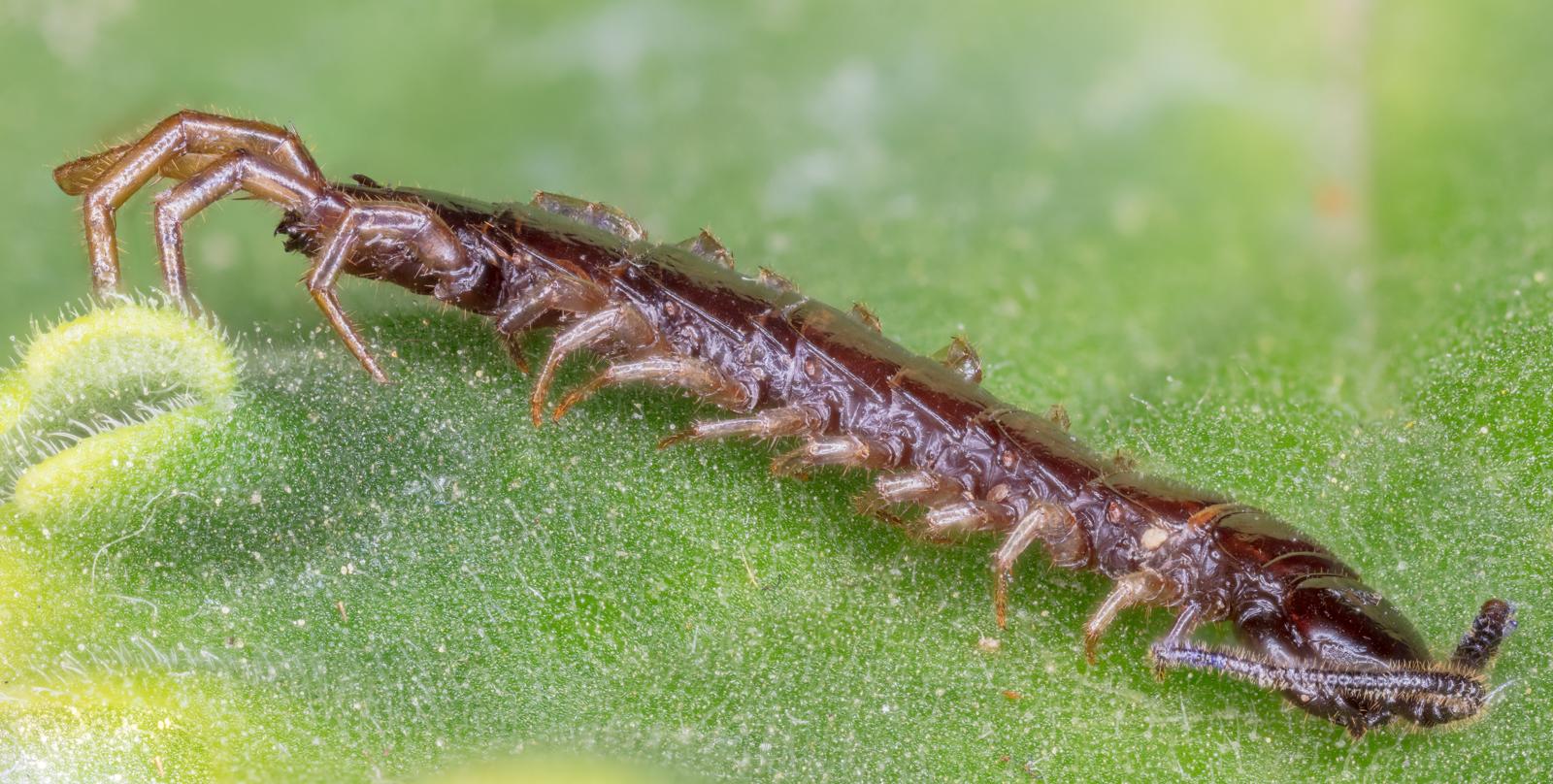
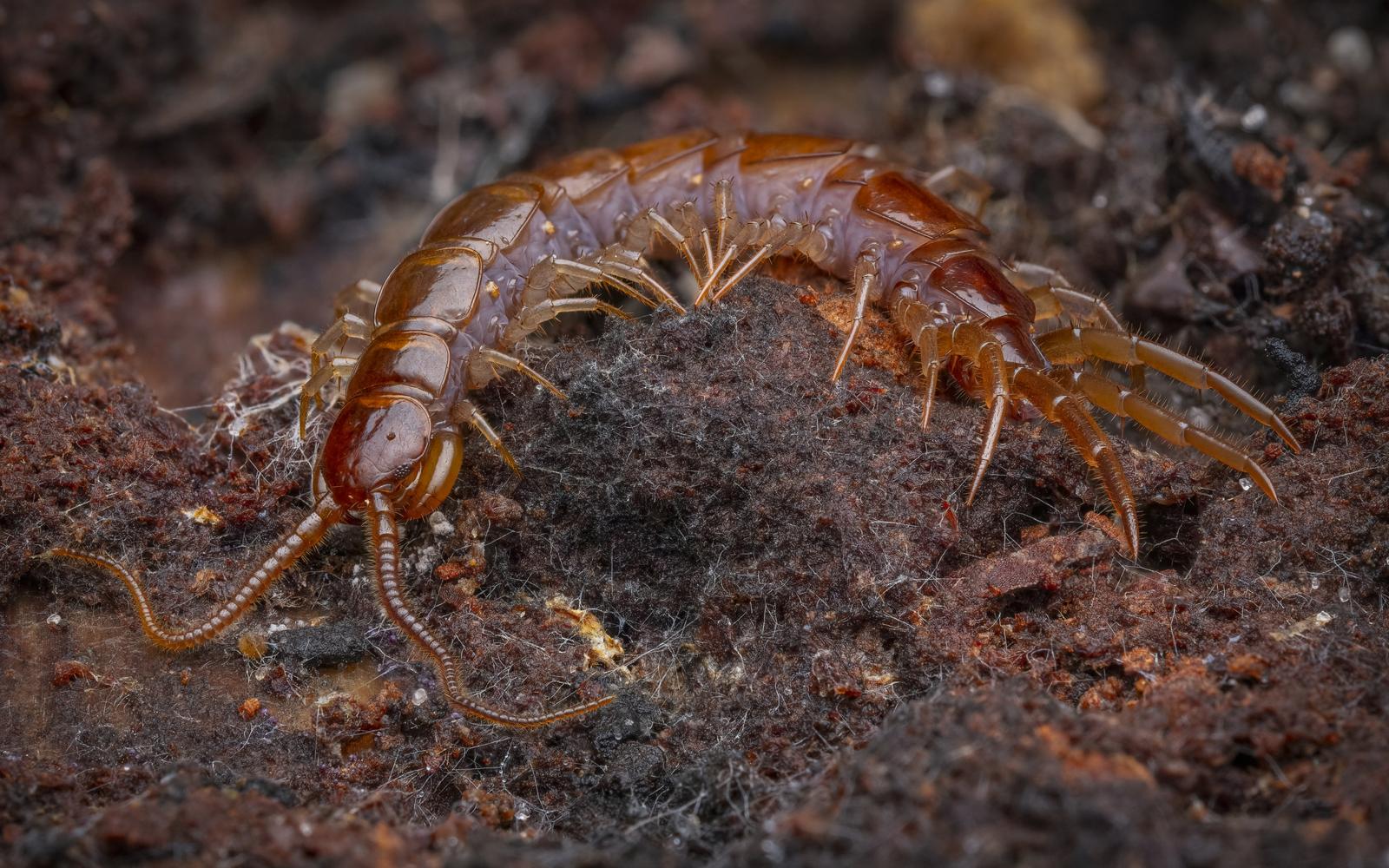
The brown centipede is a small, neat, fast animal, and its plainness is the field mark. An adult is 18 to 30 millimeters long — about three-quarters of an inch to just over an inch — and up to 4 millimeters broad, with a glossy chestnut-brown body that looks polished, as if it had been varnished. The body is flattened top to bottom, divided into segments, and each segment carries exactly one pair of legs: fifteen pairs in total, short and stout compared with the house centipede’s stilts, and built for sprinting short distances under cover rather than running across open floors. The antennae are long and constantly moving, tasting the air, and the animal has clusters of simple eyes — ocelli — on the sides of its head, enough to tell light from dark and movement from stillness, but not much more.
The color is the thing to learn. It is uniformly brown — head, body, and legs all the same chestnut shade, with no stripes, no bands, no red legs, and no pale markings. That uniformity separates it from almost everything else you will find under the same stone: the house centipede is striped with banded legs, the eastern red centipede is red all over, the greenhouse millipede is dark on top with pale legs, and the rusty millipede is redder and rounder. If it is plain brown, glossy, flattened, fast, and about an inch long, you are looking at a brown centipede — or at one of its close Lithobius cousins, which look so similar that even specialists need a microscope and a key to be sure. That is an honest caveat worth stating up front: Lithobius is a large genus, and a field identification to species from a photograph alone is often a best guess. The animal in your garden is certainly a stone centipede; whether it is exactly L. forficatus is a question for the microscope.
Young brown centipedes hatch with only seven pairs of legs and seven fully formed trunk segments, and they add segments and legs with each molt until they have the full fifteen pairs after about four molts. They keep molting after that, growing slowly toward adult size over one to two years. A half-inch brown centipede with fewer than fifteen leg pairs is a juvenile, not a different species.
The name game (stone-living, scissor-fanged)
The brown centipede has three common names, and each one describes a different true thing about it. “Brown centipede” is the literal one. “Stone centipede” is the habitat one — flip a stone and there it is. “Garden centipede” is the address one, and it is the name that causes the confusion on this site, because our general guide to all the centipedes a gardener might meet is called Garden Centipedes. That guide covers the whole group; this guide is about one species that happens to share the nickname.
The scientific name is the nerdy one, and it is a good one. Lithobius comes from the Greek lithos, stone, and bios, life — “stone-living,” which is exactly what it does. Forficatus comes from the Latin forfex, a pair of shears or scissors, a nod to the scissor-like venom fangs at the front of the animal. The taxonomy, for the nerds in the back: kingdom Animalia, phylum Arthropoda, class Chilopoda, order Lithobiomorpha, family Lithobiidae, genus Lithobius. The order Lithobiomorpha is the stone-centipede order — the short-legged, soil-dwelling branch of the family — and L. forficatus is its most widespread member. Linnaeus described the species in 1758, in the same great work that named the house centipede.
Where it came from, and where it lives now
The brown centipede is a European native. In Europe it is one of the most common centipedes of all, found from the British Isles to the Mediterranean and east into Russia, in woodlands, gardens, grasslands, and towns — anywhere there is damp soil and something to hide under. From Europe it has travelled with people to much of the rest of the temperate world: North America, Hawaii, South America, New Zealand, Iceland, and Greenland. In North America it arrived in the 1800s, by way of Europe, associated with human disturbance — in soil, in potted plants, in the ballast and cargo of a colonizing continent — and it has since spread far beyond the gardens it arrived in. The Encyclopedia of Arkansas notes that it has now invaded forested areas and likely occurs in Arkansas, a long way from any garden gate.
In North America it is most likely to be found on the eastern seaboard — Washington, Philadelphia, and New York are the places it is most often recorded — but its range is wider than that, and it turns up across the northern United States and in the West as well. It is a creature of the upper layers of soil, particularly under rocks and rotting logs, in leaf litter, in compost piles, in the damp corners of gardens, and sometimes in basements, cellars, and garden sheds, especially among stored items in dark, damp places where there is little disturbance. It is a night hunter: by day it hides, by night it comes out to run the soil surface and the underside of stones, looking for prey.
One range note matters for honesty. Because Lithobius is a large genus full of look-alikes, and because a small brown centipede under a stone is hard to identify to species without a microscope, published range maps for L. forficatus in North America are softer than they look. The species is certainly widespread in the north and east; the further south and west you go, the more likely the animal under your stone is a native cousin rather than this European immigrant. The guide says so rather than pretending every brown centipede in America is this species.
What it eats: the soil’s night hunter
The brown centipede is a predator, and an aggressive one for its size. It does not ambush and it does not trap — it chases. It runs down small invertebrates in the soil and leaf litter, relying on sheer speed, and when it catches something it seizes it with the forcipules, the modified front legs that carry the venom glands, and injects venom that paralyzes the prey. Then it eats, using its mouthparts to cut the prey into pieces. Its menu is the small life of the soil: insects and their larvae, spiders, woodlice, earthworms, slugs, and flies — anything small enough to catch and soft enough to subdue. It is a generalist, and that is what makes it useful: it eats a little of everything, including several things that eat your plants.
What it does not eat is the list that makes it a friend rather than a problem. It does not eat living plants, leaves, stems, roots, or seeds. It does not eat stored food, fabric, or wood, and it does not damage structures. It does not eat your compost in the way a millipede does — it is not a decomposer, it is a hunter, and the compost pile interests it only because the compost pile is full of prey. It is, in the simplest terms, a small lion loose in the leaf litter, and the leaf litter is better for it.
What it does not like is the other half of the management story. It does not like dry conditions: like all centipedes it loses water through its body surface, and it dries out fast in open air, which is why it stays under stones and in damp soil and only hunts at night. It does not like bright light — it is photophobic, and it runs for cover the moment you lift its stone, which is why you almost always meet it in flight rather than at rest. And it does not like being exposed: open ground, dry mulch, and bare soil are deserts to it. Damp, dark, and covered is everything it wants, and that is the whole strategy in the “how to attract it” section, in one sentence.
The bite: the honest answer
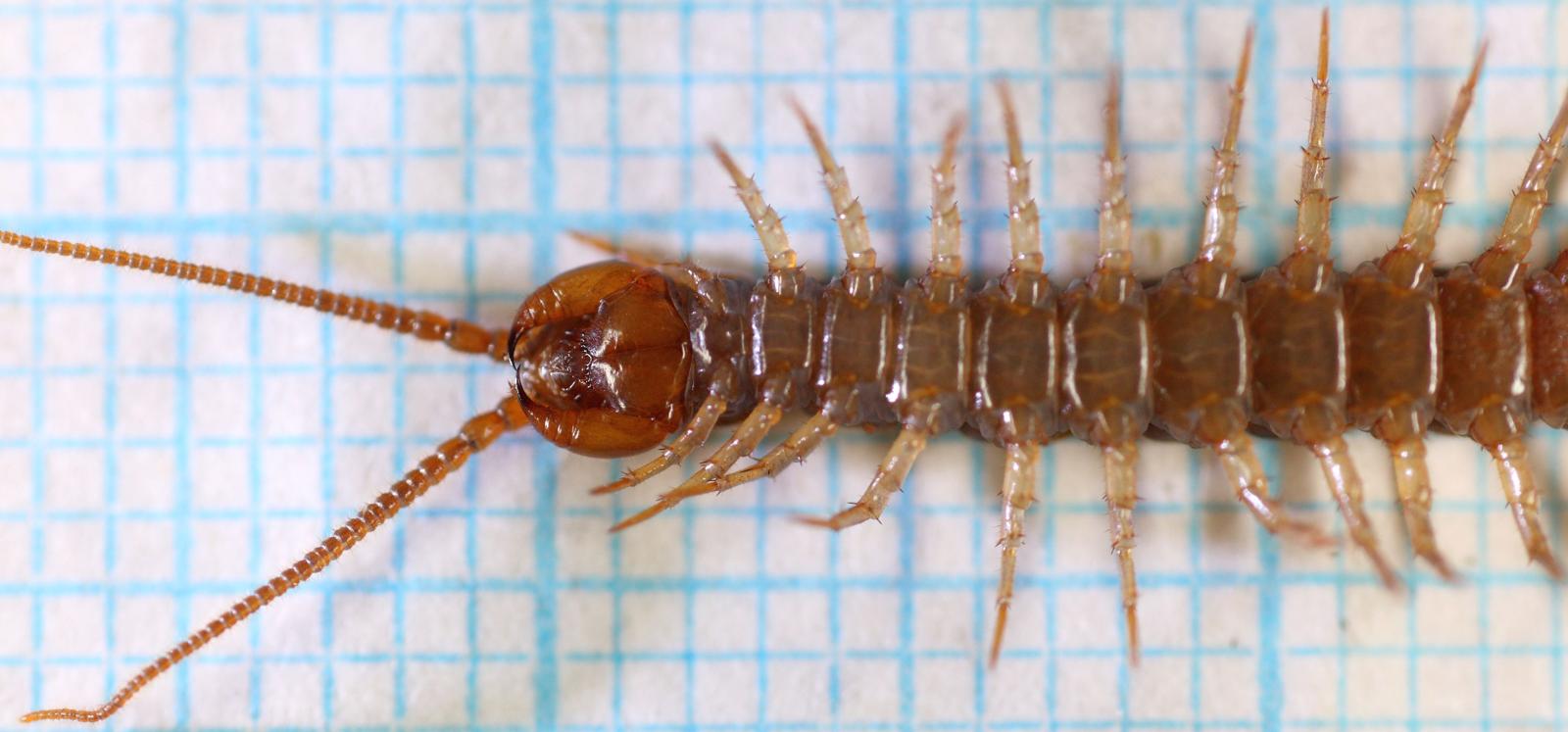
Like every centipede, the brown centipede is venomous, and like every small centipede, that fact matters far less than it sounds. Its venom is made for animals the size of a fly larva, and its fangs are small: most sources agree that it rarely breaks human skin at all, and a bite that does get through causes at most brief localized pain — a small, sharp nip, gone quickly, with no swelling worth mentioning and no medical consequences. It is considered harmless to humans, and there is no record of a brown centipede bite causing anything more than that.
It will bite if it has to. It is an aggressive hunter with its prey, and if you pick one up or squeeze it against your skin, it will defend itself the only way it can. The advice is the same as for every centipede in this library: do not handle it with bare hands. Admire it under its stone, put the stone back gently, and wash your hands if you touched it. If a child or a pet is nipped, treat it like a bee sting — wash, watch, and seek medical advice only if there is spreading swelling or an allergic reaction. There is nothing to be afraid of here, and nothing to be careless about either.
Life cycle: few eggs, long life
The brown centipede plays a long game. Centipede reproduction does not involve coupling: the male deposits a spermatophore — a small packet of sperm — on the ground for the female to pick up, and the female then lays her eggs singly, one at a time, in holes in the soil, filling each hole with soil and leaving it. The number is small, about ten to fifty eggs, and the time from egg to hatching is highly variable, from one month to several. The young hatch with seven pairs of legs and add segments and legs with each molt, reaching the full fifteen pairs after about four molts, but they take their time about adulthood: it can be one to two years before they are ready to breed, and they can live for five to six years if they escape their enemies.
That combination — few eggs, slow development, long life — is what biologists call K-selected, and it means the brown centipede cannot bounce back quickly from a bad year. A garden that sprays broad insecticide does not just kill the centipedes it can see; it removes a slow-breeding predator that will take years to return, while the fast-breeding pests it was eating come back in weeks. The brown centipede is a long-term resident, and it should be treated like one.
Unlike the scolopendromorph centipedes, the female brown centipede does not guard her eggs. She lays them singly, covers them, and leaves them — which is why the eggs are hidden one by one in the soil rather than gathered in a nest. The young are on their own from the start, and they are capable hunters even at small size, taking tiny prey from their first weeks. Everything about this animal is built for a quiet, solitary, long life in the dark under a stone.
The Florida angle: a northern animal, and what to check instead
Here is the honest Florida paragraph, and it matters. The brown centipede is a northern and eastern-seaboard animal in the United States, and Florida is at the warm edge of what it tolerates. If you are in Florida and you flip a log and find a small brown centipede, the most likely candidates are native stone centipedes in the same family — other Lithobius species and their relatives — or a young eastern red centipede, which starts life smaller and paler than the adult red animal in the guide. Do not force the identification: note the size, the color, the leg count, and the habitat, and compare it with the eastern red centipede guide, which is the small brown-to-red centipede Florida gardeners actually meet most often under logs. Read the full guide: Eastern Red Centipede.
That said, the advice in this guide still works for the animal under your Florida stone, whichever stone centipede it is. They all want the same things — damp, dark, covered soil — and they all do the same job: hunting small pests in the leaf litter. Put the stone back gently, keep the log pile, and let it hunt. The species name matters less than the role, and the role is the same.
Is it a pest?
Plainly: no. The brown centipede is not a pest of plants, houses, or people. It does not eat living plants, does not damage structures, does not eat stored food or fabric, and does not spread disease. It is a predator of small invertebrates, and its presence in a garden is a sign of a living soil, not a problem to solve. The only sense in which it is ever called a pest is the indoor one: a stray that wanders into a basement or cellar, looking for damp and prey, can startle a person — and even then, the honest description is a lost hunter, not an infestation. It does not breed indoors the way the house centipede does, and it does not want to be in your house. It wants to be under a stone, and if you put it back under one, it will stay there.
Against the startle factor, weigh the day job: it eats insects, spiders, slugs, worms, and fly larvae, including several small pests that damage seedlings and chew leaves. A garden with brown centipedes has fewer of those pests, and it has them for free. The goal is not to exterminate the brown centipede. It is to keep it in the garden, where it belongs, and out of the basement, where it does not.
Effects on the garden
On the plus side, the brown centipede is a genuine garden helper. It hunts at night in the top layer of the soil, under stones, in leaf litter, and in compost piles, taking insects and their larvae, spiders, woodlice, earthworms, slugs, and flies. Slugs are the headline: a small, fast predator that hunts in the same damp layer where slugs feed is exactly the kind of animal a gardener wants, and the brown centipede is one of the few small predators that will take a young slug. It also takes the larvae of flies and other insects that feed on roots and seedlings, and it takes spiders — which is a mixed blessing, since spiders are also helpers, but a generalist predator does not take sides.
On the minus side, there is very little to list, and honesty demands saying so. It eats earthworms, which are also helpers, and it eats spiders and ground beetles, which are also helpers. A generalist predator takes the good with the bad, and the net effect is still positive: the pests it removes are more numerous and more damaging than the helpers it occasionally takes. It does not eat living plants, does not disturb roots, and does not damage seedlings. It is, in garden terms, a small, quiet, useful hunter, and the garden is better with it than without it.
Effects on other garden animals
The brown centipede sits in the middle of the soil food web. As a predator it eats insects, spiders, woodlice, earthworms, slugs, and fly larvae, which puts it in competition with the other small hunters of the soil surface: ground beetles, spiders, and other centipedes all hunt the same prey in the same layer. It helps the soil by turning pest biomass into centipede droppings and, eventually, into a body that feeds the decomposers, and it helps the plants by keeping the numbers of root- and leaf-eating larvae down.
As prey, it is food for anything that can catch it under a stone: birds, toads, lizards, shrews, and ground beetles all take stone centipedes, and its speed is its only defense — it has no chemical weapon, no curl, no stink, and no armor worth mentioning. Its predators are also its competitors, which is the usual arrangement in the soil. For pets, the risk is negligible: a dog or cat that finds one will get a nip at worst and a bad taste, and learn not to do it again. The brown centipede’s place in the web is simple and useful: it eats the small animals that eat your plants, and the bigger animals eat it.
Look-alikes: the concrete checks
Small brown centipedes all look alike until you know what to check, and the checks are wonderfully simple — leg count, leg length, color, and speed. Work through them in order and you will rarely go wrong.
House Centipede (Scutigera coleoptrata) — the striped sprinter indoors. Same fifteen pairs of legs, but long, banded, and built for sprinting across open floors, with three dark stripes down the back and big compound eyes. Check: long banded legs and stripes mean house centipede; short stout legs and uniform brown mean brown centipede. Read the full guide: House Centipede.
Eastern Red Centipede (Scolopocryptops sexspinosus) — the red one under the log. Red to rust-colored, up to about two-and-three-quarter inches, with twenty-three pairs of legs and no eyes. It is bigger, redder, and blinder than the brown centipede, and it lives in rotting logs rather than under flat stones. Check: red and twenty-three leg pairs means eastern red; brown and fifteen means brown centipede. Read the full guide: Eastern Red Centipede.
Common Cryptops (Cryptops hortensis) — the small blind one in the soil. Pale reddish-brown, about an inch long, with twenty-one pairs of legs and no eyes, living under stones and logs in gardens. It looks like a small brown centipede until you count the legs: twenty-one pairs means cryptops, fifteen means stone centipede. Check the eyes too — the brown centipede has them, the cryptops does not. Read the full guide: Common Cryptops Centipede.
Greenhouse Millipede (Oxidus gracilis) — the small, bumpy one. Under an inch long, dark brown to black on top with pale, creamy-white legs, and it moves slowly and curls up when disturbed. The leg count settles it: two pairs per segment means millipede, one pair means centipede. Check: slow, curls, pale legs means greenhouse millipede; fast, runs, uniform brown means brown centipede. Read the full guide: Greenhouse Millipede.
Rusty Millipede (Trigoniulus corallinus) — the red, round one on the patio. Reddish-brown all over and cylindrical, about the same size as a brown centipede, but slow-moving and harmless, curling into a spiral when poked. Check: round, slow, and curled means rusty millipede; flattened, fast, and running means brown centipede. Read the full guide: Rusty Millipede.
Centipedes in general — the split that matters. Every centipede has one pair of legs per body segment, moves fast, and can bite; every millipede has two pairs per segment, moves slowly, curls up, and cannot bite. If you are not sure which you have, count the legs on one segment and watch what it does when poked. Read the full guide: Garden Centipedes.
How to attract it — and how to get rid of it
Most people who meet a brown centipede should be trying to keep it, not lose it. It is a free, slow-breeding, long-lived predator, and the way to attract it is to give it what it wants: damp, dark, covered ground with prey in it.
Keep a log pile. A small pile of rotting logs at the edge of the garden is a brown centipede hotel, and it is also a hotel for ground beetles, spiders, and toads. Keep it damp and undisturbed, and the hunters will move in.
Mulch, and leave the leaf litter. A mulched bed with a layer of fallen leaves is exactly the habitat this animal hunts in. Raking every leaf away starves the whole soil crew, centipedes included.
Keep a stone or two. Flat stones on damp soil are the classic brown centipede address. Put the stone back gently after you look under it — the animal underneath is doing you a favor.
Do not spray the soil. Broad insecticides kill the brown centipede and the other predators first, because they are slow to breed back, while the pests return in weeks. If you must deal with a pest, deal with that pest, not with the whole soil.
If one comes indoors — and it happens, usually a stray that followed damp into a basement or cellar — do not panic and do not spray. Put a jar over it, slide a card underneath, and carry it outside to a damp stone or log pile. Then fix the reason it came in: dry out the basement, seal the gaps at ground level, and clear the leaf litter back from the foundation. It does not breed indoors, and it does not want to be there.
Frequently asked questions
Is the brown centipede dangerous?
No. It is venomous, like all centipedes, but its fangs are small and it rarely breaks human skin. A bite that does get through causes at most brief localized pain. It is considered harmless to humans.
Does it bite?
It can, if picked up or squeezed against skin, but it would much rather run. Do not handle it with bare hands, and it will not bite you.
Why is it under my stones?
Because it needs damp, dark, covered ground, and the underside of a stone is exactly that. It hunts at night in the top layer of the soil and hides under stones by day.
How big does it get?
Adults are 18 to 30 millimeters long — about three-quarters of an inch to just over an inch — and up to 4 millimeters broad. Young ones hatch with seven pairs of legs and add the rest as they molt.
Is it a worm?
No. It is an arthropod with a hard segmented body and fifteen pairs of legs. Worms have no legs at all. If it has legs, it is not a worm.
What does it eat?
Small invertebrates: insects and their larvae, spiders, woodlice, earthworms, slugs, and flies. It is a fast, aggressive hunter that chases its prey down in the soil and leaf litter.
Will it hurt my plants?
No. It does not eat living plants, leaves, stems, roots, or seeds. In the garden it is a helper, hunting the small animals that do eat your plants — including young slugs.
Will it hurt my dog or cat?
Almost certainly not. A pet that finds one may get a nip and a bad taste. It is not a veterinary emergency, but call a vet if a pet is clearly distressed after a bite.
How do I get rid of it?
You almost certainly should not — it is a beneficial predator. If one strays indoors, catch it in a jar and release it under a damp stone outside, then dry out the basement and seal the gaps it came through.
Is it the same as the “garden centipede”?
It is one animal that goes by that nickname — brown centipede, stone centipede, and garden centipede are all Lithobius forficatus. But “garden centipede” is also used loosely for any small centipede in a garden, and our general guide to the whole group is called Garden Centipedes. If you are not sure which species you have, start there.
🌱 Keep learning
Three related guides worth reading next:
- Garden Centipedes — The general guide: how to tell a centipede from a millipede, which ones bite, and what to do about the one under your stone.
- Greenhouse Millipede — The small, bumpy millipede that shares the brown centipede’s address under stones and in pots — and the leg-count check that tells them apart.
- Compost Accelerators — Twelve things that actually wake up a lazy pile, and the microbes and small hunters — centipedes included — that do the work, Florida edition.
🪱 Your Soil Needs This
Reading about healthy soil is great. Growing in it is better. Our small-batch, traceable worm castings are the shortcut your garden deserves.
Shop Worm Castings Subscribe & SaveEvery bag comes with a lot certificate. Know what's in your soil.