
There is a centipede in the American garden that almost nobody has heard of, and that is exactly how it likes it. The common cryptops, Cryptops hortensis, is an inch-long, thread-thin, reddish-brown hunter with no eyes at all, living under stones and logs in gardens and woodland, hunting at night, and vanishing the moment its cover is lifted. It is a European immigrant, carried to North America in potted plants and greenhouses, and it is now established in cities across the United States — nineteen states and counting, by the best published figure. It is venomous, like every centipede, and it is also, honestly, one of the least dangerous animals in the garden: small, shy, and quick to run, with a bite that amounts to minor irritation at worst.
And if you are reading this because you just found a small, pale, blind centipede under a stone — stay with us. Count the legs first. Twenty-one pairs means you are in the right guide. Fifteen means a stone centipede. Twenty-three means an eastern red. The count is the whole identification, and this guide walks you through it.

What it looks like
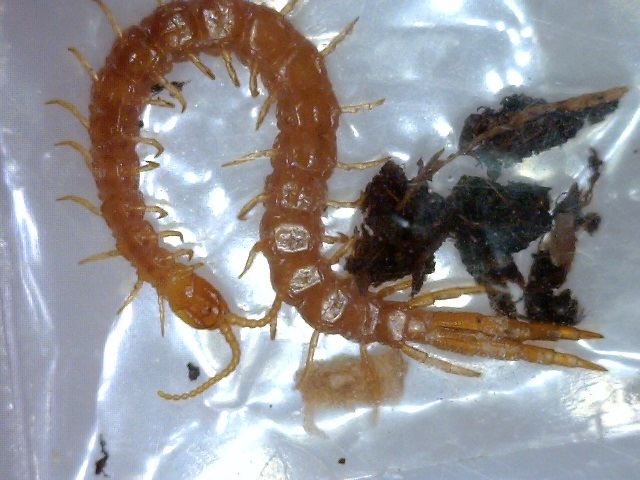
The common cryptops is a small, slender, unassuming animal, and its plainness is the point. An adult is 20 to 30 millimeters long — about three-quarters of an inch to just over an inch — and only about 1 millimeter wide, a thread of an animal, reddish to pale brown, with a smooth, slightly glossy body and short legs. It has twenty-one pairs of legs, one pair per segment, which puts it in the order Scolopendromorpha, and it has no eyes at all — not small eyes, not simple eyes, none. The head is curved and tucked, the antennae are short, and the last pair of legs is longer than the rest, with joints that can flex strongly so that a saw-like row of spines can grasp prey.
That combination — small, thin, pale brown, blind, twenty-one leg pairs — is the whole field mark, and it is also the reason this animal is so often misidentified. At a glance it looks like a young stone centipede, or a small earthworm with legs, or a pale eastern red centipede. The checks that settle it are the leg count and the eyes: a stone centipede has fifteen pairs of legs and clusters of simple eyes; an eastern red centipede has twenty-three pairs and is much bigger and redder; a cryptops has twenty-one pairs and no eyes at all. Count the legs, check for eyes, and you have it.
Young cryptops are smaller and paler versions of the adults, and they darken slightly as they grow. There is no dramatic color change, no banding that appears with age, and no size that would ever make you look twice — which is why this is a species most gardeners have met without ever knowing its name. If you have ever lifted a stone in a garden and seen a small pale centipede vanish into the soil before you could focus on it, there is a good chance you have met this animal.
The name game (hidden face, garden dweller)
The scientific name is a small piece of poetry. Cryptops comes from the Greek kryptos, hidden, and ops, face or eye — “hidden face,” for an animal with no eyes to show. Hortensis is Latin for “of the garden,” from hortus, a garden — and it is the truest part of the name, because this is a centipede of gardens, greenhouses, and potted plants, an animal that travelled the world in the soil of the plants people grow. The species was described by Donovan in 1810, from a garden in England, which is fitting: it has been a garden animal from the very first record.
The common names are the confusing part. “Common cryptops” is the straightforward one. But it is also called the garden centipede in some sources — a nickname it shares with the brown centipede, Lithobius forficatus, and with the whole group covered in our general guide, Garden Centipedes. Three different animals, one nickname, and the leg count is the only thing that sorts them out. The taxonomy, for the nerds in the back: kingdom Animalia, phylum Arthropoda, class Chilopoda, order Scolopendromorpha, family Cryptopidae, genus Cryptops. The family Cryptopidae is the cryptops family — the small, blind, soil-dwelling branch of the scolopendromorphs — and C. hortensis is its most widespread member.
Where it came from, and where it lives now
The common cryptops is a Palearctic animal by origin — native to Europe and east into western and central Asia, from the Atlantic coast to Tajikistan, and from Scandinavia to North Africa. From there it has been carried, unintentionally and repeatedly, to much of the rest of the world: the United States including Hawaii, Canada, St. Helena, and Australia including Tasmania. It travels the way garden animals travel — in potted plants, in greenhouse soil, in the damp corners of the plant trade — and it establishes itself where the trade puts it down, which is why its American distribution is a map of cities and greenhouses rather than a continuous range.
In the United States, the best published figure comes from the Encyclopedia of Arkansas, which reports that this Palearctic centipede “has been widely introduced in urban environments (likely from potted plants and greenhouses) and, although not yet reported in Arkansas, is now established in the adjoining states of Louisiana, Mississippi, and Texas as well as sixteen other U.S. states and Canada.” That is nineteen states, plus Canada, and the number is almost certainly an undercount — a small, blind, soil-dwelling centipede is easy to miss, and the states it is “not reported” from are often states nobody has looked in. It has been observed in South Carolina, Texas, Washington, Chicago, Philadelphia, and New York, among other places, and the pattern is consistent: cities, gardens, and greenhouses, wherever people grow plants in pots.
Its habitat is the damp layer of the garden: under stones and logs, in woodland leaf litter, in compost heaps, in the soil of potted plants, and in greenhouses. It is nocturnal, hunting at night and hiding by day, and it is secretive even by centipede standards — it does not cross open ground, it does not climb walls, and it does not come indoors the way the house centipede does. If you want to find one, lift a flat stone in a damp garden after dark, and look fast: it will be gone in seconds, back into the soil before your eyes have adjusted.
What it eats: the small hunter of the soil
The common cryptops is a carnivore, and a secretive one. It hunts at night in the soil and leaf litter, taking small invertebrates: flies, young caterpillars, small harvestmen, spiders, and other tiny arthropods. Its hunting method is the cryptops speciality: the last pair of legs has a prehensile role, the joints flexing strongly so that a saw-like row of spines grasps the prey, while the head curves around and the forcipules — the venom fangs — are buried in it. Gut-content studies of the genus have found spiders in the gut, and other Cryptops species have abundant earthworm remains in theirs, so earthworms are very likely on this species’ menu too, though the species-level gut study for C. hortensis itself is one of the gaps in the literature, and this guide says so rather than pretending otherwise.
What it does not eat is the list that makes it a friend rather than a problem. It does not eat living plants, leaves, stems, roots, or seeds. It does not eat stored food, fabric, or wood, and it does not damage structures. It does not eat your compost — it hunts in it, taking the small animals that live there. It is, in the simplest terms, a tiny predator loose in the leaf litter, and the leaf litter is better for it.
What it does not like is the other half of the management story. It does not like dry conditions: like all centipedes it loses water through its body surface, and it dries out fast in open air, which is why it stays under stones and in damp soil. It does not like bright light — it is a creature of the dark soil layer, and it flees the moment its stone is lifted. And it does not like being exposed: open ground, dry mulch, and bare soil are deserts to it. Damp, dark, and covered is everything it wants, and that is the whole strategy in the “how to attract it” section, in one sentence.
The bite: the honest answer
Like every centipede, the common cryptops is venomous, and like every small centipede, that fact matters far less than it sounds. It is capable of biting, but it is generally non-aggressive toward humans and will retreat if disturbed — running for the soil is its first, second, and third response to a threat. Its forcipules are small, its venom is mild, and a bite that does land causes only minor irritation. The general rule for small centipedes applies here in full: most small species are incapable of piercing human skin, and the bites of those that can are no worse than a bee sting. This species is at the mild end of that range.
It is not medically significant, and there is no record of a common cryptops bite causing anything more than brief local discomfort. The advice is the same as for every centipede in this library: do not handle it with bare hands. Admire it under its stone, put the stone back gently, and wash your hands if you touched it. If a child or a pet is nipped, treat it like a bee sting — wash, watch, and seek medical advice only if there is spreading swelling or an allergic reaction. There is nothing to be afraid of here, and nothing to be careless about either.
Life cycle: a mother that stays, in a genus that hides
Here is a fact the sources support at the level of the order, and this guide labels it as such rather than pretending it was studied in this exact species: scolopendromorph centipedes are among the most attentive mothers in the arthropod world. The female lays her eggs — fifteen to sixty of them — in a nest in soil or rotten wood, and she stays with them, curling her body around them, grooming them to keep fungi and bacteria off, and guarding them until they hatch. She remains with the young after hatching, guarding them until they are ready to leave. It is a long way from the lay-and-leave strategy of the stone centipedes, and it is one reason scolopendromorphs are slow to recover from disturbance: a destroyed nest is a lost generation.
Beyond that, the honest answer about this species’ life cycle is that little is published. No lifespan has been recorded for it, no egg count specific to it, no study of how long it takes to grow up. That is not a failure of this guide — it is the state of the literature for a small, blind, soil-dwelling animal that most people have never heard of. This guide would rather say “little is known” than invent a lifespan, and the “little is known” is itself useful: it tells you this is an animal that has been overlooked, not an animal that has been studied and found wanting.
The Florida angle: probably here, not yet proven
Here is the honest Florida paragraph, and it is short because the evidence is thin. The common cryptops is established in nineteen US states by the best published figure, and it travels in potted plants and greenhouse soil — two things Florida has in abundance. It is very likely present in Florida gardens, especially around nurseries and greenhouses. But no confirmed Florida record was found for this guide, and this guide will not claim a Florida presence it cannot verify. If you are in Florida and you find a small, blind, pale centipede under a stone, the animal to check first is the native relative, Cryptops leucopodus, a southeastern native cryptops that lives in the same damp layer and looks very similar — twenty-one leg pairs, no eyes, and a reddish-brown body. Telling the two apart takes a microscope and a key, and the distinction matters less than the role: whichever cryptops it is, it is a small, shy, beneficial hunter, and the advice in this guide works for it.
That uncertainty is also a reason to look carefully. If you do find a cryptops in a Florida garden and you can photograph it clearly, with a leg count and a location, you have a record worth sharing — with iNaturalist, with your extension office, or with the photo-ID tool on this site. Small, overlooked animals are overlooked precisely because nobody records them, and the record starts with someone lifting a stone and counting legs.
Is it a pest?
Plainly: no. The common cryptops is not a pest of plants, houses, or people. It does not eat living plants, does not damage structures, does not eat stored food or fabric, and does not spread disease. It is a predator of small invertebrates, and its presence in a garden is a sign of a living soil, not a problem to solve. It does not come indoors — it is a soil animal, not a house animal — and it does not want to be in your house. It wants to be under a stone, and if you put the stone back, it will stay there.
Against the startle factor, which is minimal for an animal this small and shy, weigh the day job: it eats flies, young caterpillars, small harvestmen, spiders, and very likely earthworms and other small soil animals, including some that damage seedlings. A garden with cryptops has fewer of those pests, and it has them for free. The goal is not to exterminate the common cryptops. It is to keep it in the garden, where it belongs, and to notice it — because noticing it is the first step to knowing your soil is alive.
Effects on the garden
On the plus side, the common cryptops is a genuine garden helper, in the quiet way of small predators. It hunts at night in the soil and leaf litter, under stones and in compost heaps, taking flies, young caterpillars, small harvestmen, spiders, and other tiny arthropods. Young caterpillars are the headline: a small predator that hunts in the same damp layer where caterpillars feed is exactly the kind of animal a gardener wants, and the cryptops is one of the few predators small enough to hunt there. It does not eat living plants, does not chew leaves or stems, and does not disturb roots. It is, in garden terms, a tiny, quiet, useful hunter, and the garden is better with it than without it.
On the minus side, there is very little to list, and honesty demands saying so. It eats spiders, which are also helpers, and it very likely eats earthworms, which are also helpers. A generalist predator takes the good with the bad, and the net effect is still positive: the pests it removes are more numerous and more damaging than the helpers it occasionally takes. It does not eat living plants, does not disturb roots, and does not damage seedlings. It is a small, shy, useful hunter, and the garden is better with it than without it.
Effects on other garden animals
The common cryptops sits near the bottom of the predator ladder in the soil food web, and it pulls in both directions. As a predator it eats flies, young caterpillars, small harvestmen, spiders, and other tiny arthropods, which puts it in competition with the other small hunters of the soil surface: ground beetles, spiders, and other centipedes all hunt the same prey in the same layer. It helps the soil by turning prey biomass into droppings that feed the microbes, and it helps the plants by keeping the numbers of caterpillars and fly larvae down.
As prey, it is food for anything that can catch it under a stone: birds, toads, lizards, shrews, ground beetles, and larger centipedes all take small cryptops, and its only defenses are speed and a willingness to vanish into the soil. It has no chemical weapon, no curl, no stink, and no armor worth mentioning. Its predators are also its competitors, which is the usual arrangement in the soil. For pets, the risk is negligible: a dog or cat that finds one will get a nip at worst and a bad taste, and learn not to do it again. The common cryptops’ place in the web is simple and useful: it eats the smallest animals that eat your plants, and the bigger animals eat it.
Look-alikes: the concrete checks
Small centipedes all look alike until you know what to check, and the checks are wonderfully simple — leg count, eyes, size, and speed. Work through them in order and you will rarely go wrong.
Brown Centipede (Lithobius forficatus) — the small brown one under the stone. Uniformly chestnut-brown, about an inch long, with fifteen pairs of short legs and clusters of simple eyes. Check: fifteen pairs and eyes means brown centipede; twenty-one pairs and no eyes means cryptops. Read the full guide: Brown Centipede.
Eastern Red Centipede (Scolopocryptops sexspinosus) — the red one under the log. Red to rust-colored, up to about two-and-three-quarter inches, with twenty-three pairs of legs and no eyes. It is much bigger and redder than the cryptops, and it lives in rotting logs rather than under flat stones. Check: big, red, and twenty-three means eastern red; small, pale, and twenty-one means cryptops. Read the full guide: Eastern Red Centipede.
House Centipede (Scutigera coleoptrata) — the striped sprinter indoors. Yellowish-grey with three dark stripes, fifteen pairs of long banded legs, big compound eyes, and a sprint across open floors. Check: striped and sprinting indoors means house centipede; pale, blind, and in the soil means cryptops. Read the full guide: House Centipede.
Greenhouse Millipede (Oxidus gracilis) — the small, bumpy one. Under an inch long, dark brown to black on top with pale, creamy-white legs, and it moves slowly and curls up when disturbed. The leg count settles it: two pairs per segment means millipede, one pair means centipede. Check: slow, curls, pale legs means greenhouse millipede; fast, runs, twenty-one pairs means cryptops. Read the full guide: Greenhouse Millipede.
Centipedes in general — the split that matters. Every centipede has one pair of legs per body segment, moves fast, and can bite; every millipede has two pairs per segment, moves slowly, curls up, and cannot bite. If you are not sure which you have, count the legs on one segment and watch what it does when poked. Read the full guide: Garden Centipedes.
How to attract it — and how to get rid of it
Most people who meet a common cryptops should be trying to keep it, not lose it. It is a free, shy, useful predator, and the way to attract it is to give it what it wants: damp, dark, covered soil with prey in it.
Keep a stone or two. Flat stones on damp soil are the classic cryptops address. Put the stone back gently after you look under it — the animal underneath is doing you a favor, and it will be gone in seconds if you leave the stone off.
Mulch, and leave the leaf litter. A mulched bed with a layer of fallen leaves is exactly the habitat this animal hunts in. Raking every leaf away starves the whole soil crew, cryptops included.
Keep a compost pile. A compost heap is a cryptops hunting ground, full of the small animals it eats. Let it hunt there, and it will keep the pile’s pest population down.
Do not spray the soil. Broad insecticides kill the cryptops and the other predators first, because they are slow to breed back, while the pests return in weeks. If you must deal with a pest, deal with that pest, not with the whole soil.
If one comes indoors — and it is rare, because this is a soil animal, not a house animal — do not panic and do not spray. Put a jar over it, slide a card underneath, and carry it outside to a damp stone or log pile. Then fix the reason it came in: dry out the damp corner, seal the gaps at ground level, and clear the leaf litter back from the foundation. It does not breed indoors, and it does not want to be there.
Frequently asked questions
Is the common cryptops dangerous?
No. It is venomous, like all centipedes, but it is small, shy, and quick to run, and its bite causes only minor irritation at worst. Most small centipedes cannot pierce human skin at all. It is not medically significant.
Does it bite?
It can, but it almost never does — it would much rather retreat into the soil. Do not handle it with bare hands, and it will not bite you.
Why is it under my stones?
Because it needs damp, dark, covered ground, and the underside of a stone is exactly that. It hunts at night in the soil and leaf litter and hides under stones by day.
How big does it get?
Adults are 20 to 30 millimeters long — about three-quarters of an inch to just over an inch — and only about 1 millimeter wide. It is one of the thinnest centipedes you will meet.
Is it blind?
Yes, completely. It has no eyes at all, which is what its genus name means: Cryptops, “hidden face.” It navigates by touch and smell.
What does it eat?
Small invertebrates: flies, young caterpillars, small harvestmen, spiders, and other tiny arthropods, and very likely earthworms. It hunts at night in the soil and leaf litter, grasping prey with its spiny hind legs and its venom fangs.
Will it hurt my plants?
No. It does not eat living plants at all. In the garden it is a helper, hunting the small animals that do eat your plants — including young caterpillars.
Will it hurt my dog or cat?
Almost certainly not. A pet that finds one may get a nip at worst and a bad taste. It is not a veterinary emergency, but call a vet if a pet is clearly distressed after a bite.
How do I get rid of it?
You almost certainly should not — it is a beneficial predator. If one strays indoors, catch it in a jar and release it under a damp stone outside, then dry out the damp corner and seal the gaps it came through.
Is it in Florida?
Probably, but no confirmed Florida record was found for this guide. It is established in nineteen US states and travels in potted plants and greenhouse soil, so it is very likely present in Florida gardens — but the small blind centipede most Florida gardeners meet under stones is the native relative, Cryptops leucopodus. Count the legs, photograph it, and share the record: small overlooked animals stay overlooked because nobody records them.
🌱 Keep learning
Three related guides worth reading next:
- Garden Centipedes — The general guide: how to tell a centipede from a millipede, which ones bite, and what to do about the one under your stone.
- Greenhouse Millipede — The small, bumpy millipede that shares the cryptops’ address under stones and in pots — and the leg-count check that tells them apart.
- Compost Accelerators — Twelve things that actually wake up a lazy pile, and the microbes and small hunters — cryptops included — that do the work, Florida edition.
🪱 Your Soil Needs This
Reading about healthy soil is great. Growing in it is better. Our small-batch, traceable worm castings are the shortcut your garden deserves.
Shop Worm Castings Subscribe & SaveEvery bag comes with a lot certificate. Know what's in your soil.