
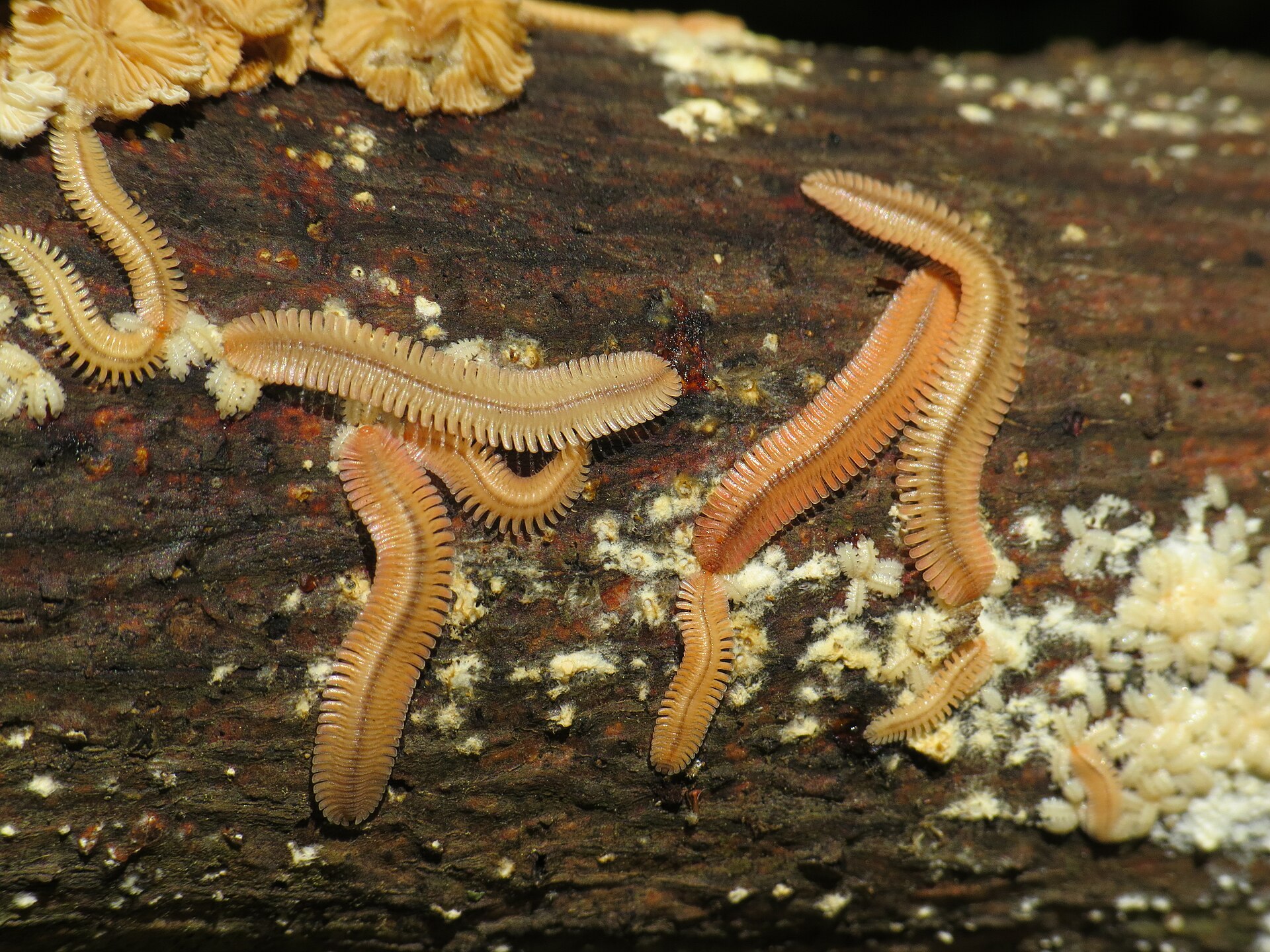
Under a rotting log in an eastern forest, there is a pink feather lying on the wood — except feathers do not arrange themselves into pinwheels, and they certainly do not have fathers guarding their eggs. The feather millipede, Brachycybe lecontii, is one of the strangest millipedes in North America: a small, blind, pink, flat-bodied animal that lives in colonies of up to a hundred, feeds only on fungus, gathers in star-shaped pinwheels with its head buried in its food, and leaves the childcare to the dads. Males curl around the eggs and guard them for weeks — paternal care so rare among arthropods that it made this obscure forest animal the subject of a full scientific monograph. This guide is about a millipede that breaks nearly every rule you thought millipedes followed.
And if you are reading this because you rolled a log in the Appalachians or the Ozarks and found a cluster of small pink feathery things huddled together — stay with us. They are not dangerous, they are not a pest, they are not going to eat your garden, and the pinwheel they are forming is one of the most charming sights in the invertebrate world.
What it looks like
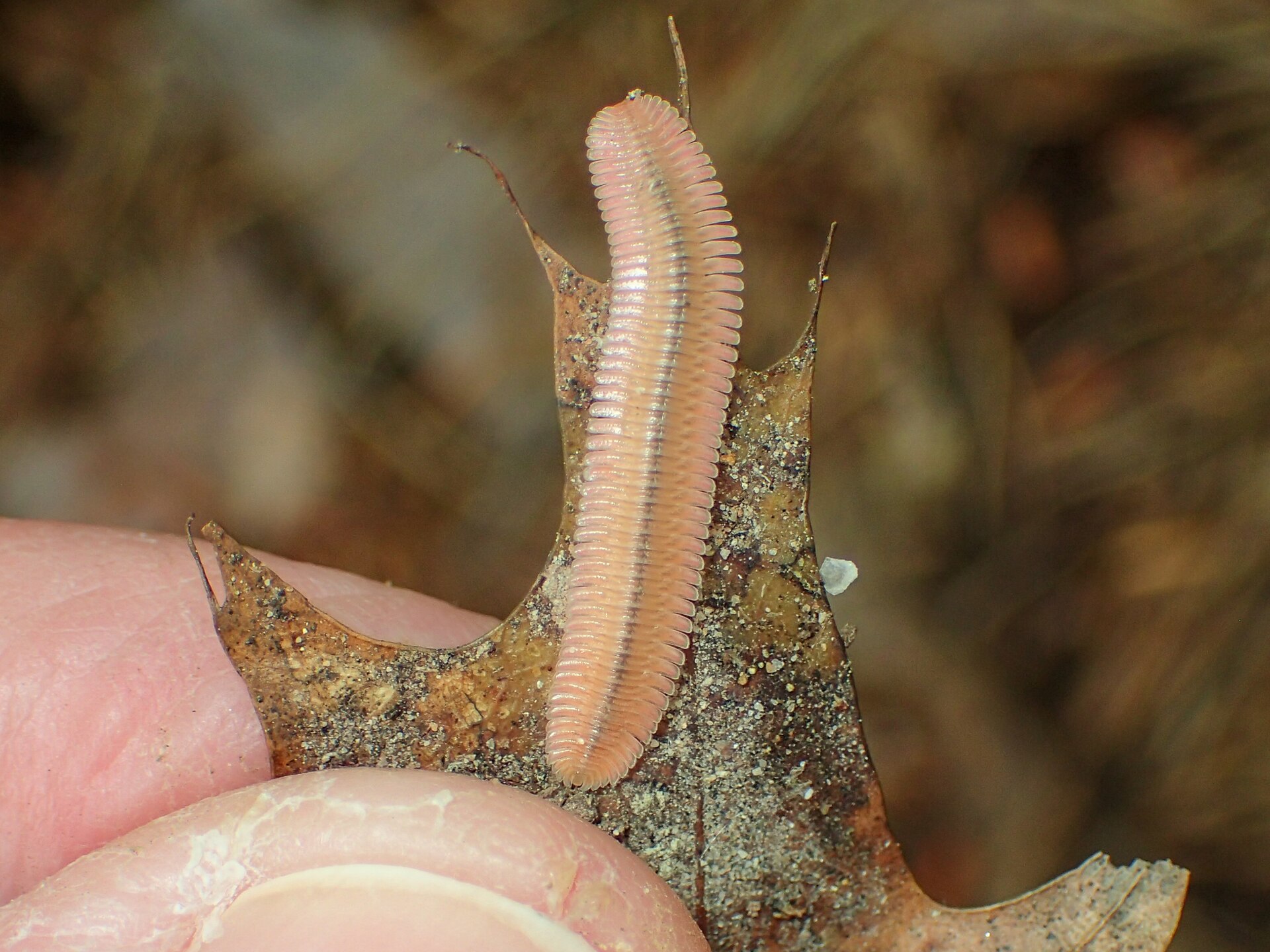
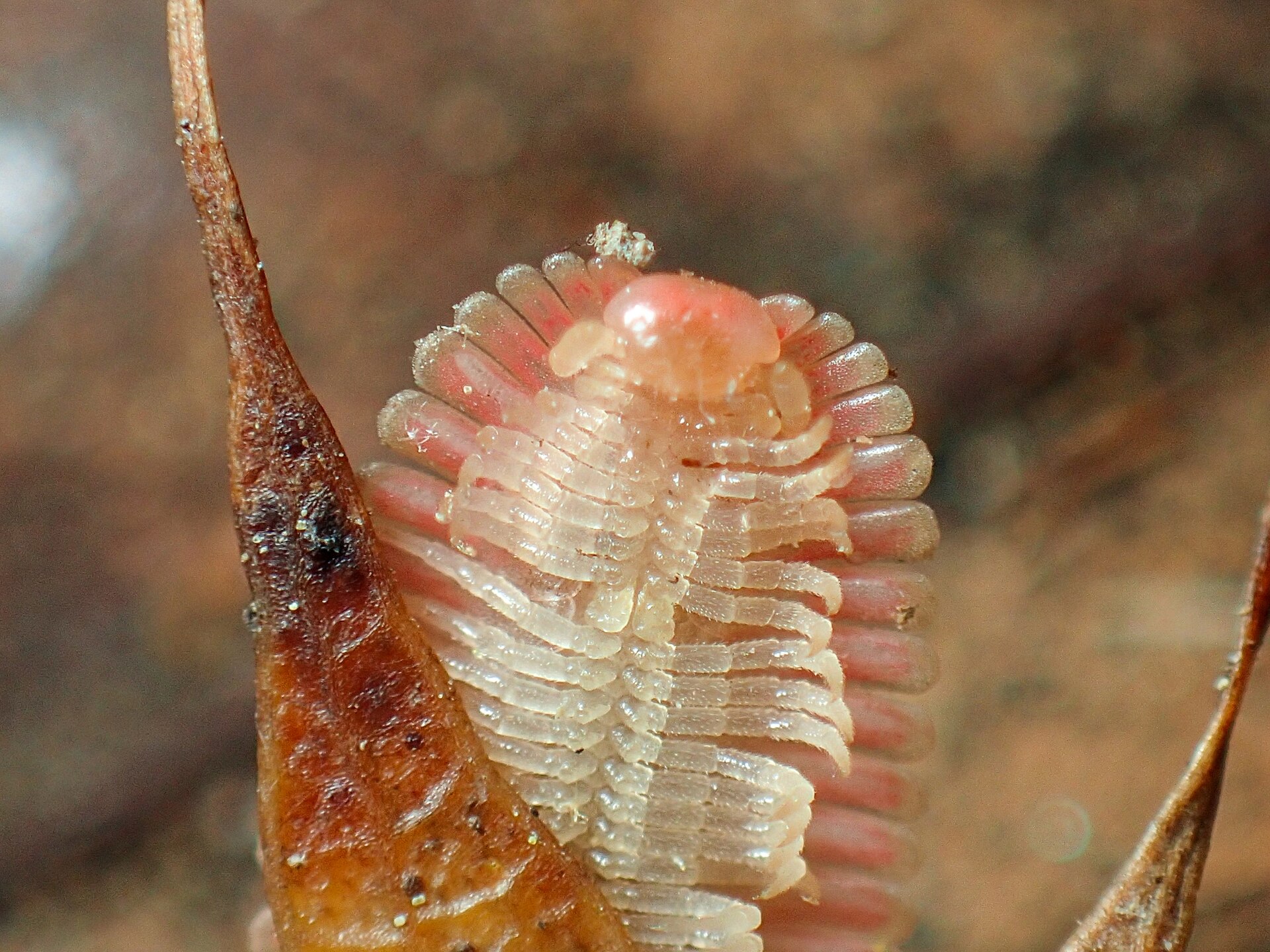
The first thing to understand about the feather millipede is that it does not look like a millipede at all — at least, not like the round, worm-like millipedes most people picture. It is dorsoventrally flattened, pressed flat top-to-bottom like a leaf, and each body segment carries a pair of wide, flat, keel-shaped side flanges called paranota. The paranota are so large that they make up as much as 60 percent of the animal’s whole body width, and because they overlap closely down the length of the body, the whole animal looks like a feather — a pink feather, lying flat on a log. That is where the common name comes from, and it is a good one: once you have seen it, you cannot unsee it.
Adults reach 4 to 5 centimeters long — about 1.5 to 2 inches — and only up to about 4 millimeters wide, so they are long, narrow, and delicate for a millipede. The color is pale pink to reddish-pink, varying geographically: some populations are a soft blush pink, others a deeper rose, and the shade can differ from one mountainside to the next. Like all platydesmidan millipedes, this species has no eyes at all — it is completely blind, navigating its dark world under logs by touch and by chemical senses. It has no ocelli, no eye patches, nothing: the head is a smooth, pale dome with antennae that do the seeing. Young animals are tiny versions of the same feathery shape, starting out at only a few millimeters long, and they add rings and legs with every molt, the way all millipedes do. A single animal on its own is easy to miss. A colony of fifty of them, pink feathers spread across a fungus-covered log, is not.
The flatness is not decoration; it is the animal’s whole way of life. A round millipede burrows through soil. A feather millipede slides into the tight spaces under bark and into the crevices of decaying wood, pressing itself flat against the surface where its food grows. The paranota also house its defense glands — slender, tube-like glands running through those wide flat flanges, occupying up to a third of the paranotal volume. Big flanges, big glands, and a chemical defense unlike any other millipede’s, as we will see below.
The name game
The name is a small lesson in millipede taxonomy. Brachycybe is the genus of feather millipedes, in the family Andrognathidae and the order Platydesmida — the flat-backed, small, mostly fungus-eating millipedes. Lecontii honors John Lawrence LeConte, the great 19th-century American entomologist, and the species was described by Horatio Wood in 1864 — the first andrognathid millipede ever described from the United States, from specimens collected in Georgia. The common name, feather millipede, is shared by the whole genus: all eight described Brachycybe species are called feather millipedes, in the eastern United States, the western United States, Japan, South Korea, eastern China, and Taiwan.
The taxonomy, for the nerds in the back: kingdom Animalia, phylum Arthropoda, class Diplopoda (the millipedes), order Platydesmida, family Andrognathidae, genus Brachycybe, species lecontii (Wood, 1864). There are two eastern United States species in the genus: this one, widespread, and Brachycybe petasata, confined to the Southern Appalachian Mountains. The two can be told apart in the field by the collum — the first body segment behind the head: B. petasata has a deep notch on the front edge of its collum, and B. lecontii does not. Molecular work has also shown that B. lecontii itself is divided into at least four geographically separated clades that may represent independent cryptic species — animals that look the same but are genetically distinct — so the name lecontii may one day be split. For now, one name covers them all, and this guide uses it that way. Its closest relative, by the same molecular data, is not its Appalachian neighbor but Brachycybe nodulosa from East Asia — a reminder that this genus is an old lineage, scattered across the Pacific.
Where it lives
The feather millipede lives in mesic temperate deciduous forests — damp, shady hardwood forests, the kind with deep leaf litter and logs that stay moist through the summer. It is found in and on decaying logs, under bark, and in the damp wood where fungi grow, almost always in groups. A single log can hold a colony of up to a hundred individuals of all ages — adults, juveniles, and hatchlings together, a multi-generational aggregation that persists in one place. The animals are not spread evenly through the forest; they are patchy, concentrated where the right fungus grows on the right log, and absent from the apparently identical log ten feet away. That patchiness is part of why they are so seldom seen: you have to roll the right log.
The range is large and fragmented, stretching from southern Missouri and West Virginia south to eastern Texas and southern Georgia — thirteen states in all, from eastern Oklahoma to western South Carolina, south to Louisiana, and north to southern West Virginia. Within that range the animals were collected, in the most detailed modern study, from fourteen localities in six states: Alabama, Arkansas, North Carolina, Missouri, Tennessee, and Virginia. The distribution overlaps with Brachycybe petasata in the Southern Appalachians, but the two species are not the same animal in the same place: petasata is the mountain specialist, and lecontii is the widespread lowland-to-mountain generalist. The range does not include Florida — no verified Florida record exists, and a pink feather millipede found in a Florida garden would be something else entirely, most likely a small flat-backed millipede. The fragmentation matters: the four genetic clades are geographically separated, which suggests the populations have been isolated from one another for a long time, each in its own patch of forest.
What the animal needs, above all, is moisture and fungus. Decaying logs in mesic forest hold both. A log in full sun, a dry hillside, a tidy garden with the leaf litter raked away — none of those will hold feather millipedes. They are forest animals through and through, and the garden version of their habitat is a shady, damp, undisturbed log pile at the back of the lot, left alone for years.
What it eats: the quiet recycling job
Here is where the feather millipede departs most sharply from the millipede stereotype. Most millipedes are detritivores — they eat dead leaves. The feather millipede is a fungivore: it eats fungus, and fungus only. Its mouthparts are reduced and specialized for the job, with a brush-like labrum and a cuticular structure on the tip of the labrum that researchers think helps it feed on fungal tissue, and a comb-like structure on the tibia and tarsi of its six frontmost leg pairs that has never been described in any other millipede. It feeds on the liquids from fungi of the order Polyporales — the bracket fungi and crust fungi that grow on dead wood — pressing its head into the fungus and drinking, rather than chewing leaves.
The fungal menu is astonishingly diverse. A study that sampled 313 individuals from twenty sites across seven states recovered at least 183 fungal genera in 40 orders from four phyla living in association with these millipedes — 176 genera in the published analysis — and the core fungal community, the fungi found again and again, was dominated not by the wood-decay fungi everyone expected, but by other groups. Wood-decay fungi, long speculated to be the primary food, were absent from the core assemblage and proved lethal to millipedes in pathogenicity assays, while entomopathogenic fungi of the order Hypocreales were common in the core but had little effect on millipede health. The honest summary is: this animal’s relationship with fungi is deep, old — the fungivorous colobognath millipedes diverged from detritus-feeders some 200 to 300 million years ago — and still only partly understood.
What it does not like is equally clear, and it is good news for gardeners. It does not eat living plants. It does not eat dead leaves, in the ordinary millipede sense — it wants fungus, specifically the fungi growing on decaying wood. It does not eat your vegetables, your seedlings, your fruit, or your house. A feather millipede in a garden is there for a fungus-covered log, and if there is no fungus-covered log, it is not there at all.
The curl and the chemistry
Disturb a feather millipede and it does not curl into a ball the way a round millipede does — it cannot, really; it is too flat. It presses itself tighter against the wood, or it walks away slowly, and if you pick it up, its defense glands go to work. The glands run through the paranota on both sides of the body, beginning on the fourth body ring, and they are large — up to a third of the paranotal volume. The secretion they produce is unlike any other millipede defense known: two isomers of the alkaloid deoxybuzonamine, a compound structurally similar to buzonamine, the defensive alkaloid of the millipede Buzonium crassipes. Buzonamine was shown in experiments to repel the ant Formica obscuripes, and the feather millipede’s own alkaloid is thought to work the same way — and in field observations, chemically defended adults were avoided by ants, the only predators actually observed attacking this species.
For a person, the defense is a non-event. There is no bite, no sting, no venom, and no record of the secretion irritating human skin in any serious way — though, as with any millipede, washing your hands after handling one is simple sense. The alkaloid may also do a second job: defensive chemicals in some millipedes double as aggregation cues, drawing other individuals together, and the pinwheel aggregations this species forms may be held together partly by chemistry as well as by food. That is a hypothesis, not a proven fact, and the researchers who raised it were careful to say so. What is certain is that this is a genuinely novel chemistry — the first report of this class of alkaloids from a platydesmidan millipede — from an animal most people have never heard of, living under a log a few miles from their house.
Life cycle
The life cycle is where this animal becomes genuinely famous, at least among people who study millipedes. Feather millipedes grow the usual millipede way — hatching from an egg with only a few segments and a handful of legs, then adding rings and legs with each molt, passing through seven or more stadia (developmental stages) before reaching adulthood — but what happens before the hatching is extraordinary. The egg-laying period runs from mid-April to late June, the eggs incubate for three to four weeks, and the eggs are cared for exclusively by the males. The male curls his whole body around the clutch, most of his length wrapped around the eggs, with a few posterior legs anchoring him to the substrate, and he stays there guarding them until they hatch. Care of juveniles after hatching was not observed — the father’s job ends at hatching — but the egg-guarding itself is vanishingly rare among arthropods, and among millipedes it is essentially unheard of.
In one observed case, the clutches of two males became combined and were later cared for by only one of the males — a small, odd, human detail in an animal’s life, and a reminder that field biology is full of things no textbook predicts. The aggregations are multi-generational: adults, juveniles, and hatchlings share the same log, and the pinwheel formations — the star-shaped clusters with heads together in a central hub and bodies radiating outward like spokes — are stable and persistent, sitting motionless unless disturbed. The pinwheels do not form in the absence of fungus, which is the strongest evidence that they are about feeding, not defense: the animals gather where the food is, heads together at the fungal patch, bodies radiating outward. A colony is not a crowd that happened to meet; it is a family group, gathered around dinner, with the fathers on egg duty nearby.
The science so far
Almost everything in this guide comes from one remarkable piece of research: Victoria Wong’s 2017 Virginia Tech thesis and the 2020 paper that grew from it, “Natural history of the social millipede Brachycybe lecontii,” published in the Biodiversity Data Journal. Before Wong, this species was known mostly from museum specimens and a handful of field notes — Gardner’s 1974 and 1975 work on the genus, Shelley and colleagues’ 2005 range map, and Eisner and colleagues’ 1978 description of the defense glands. Wong collected animals from fourteen localities in six states over three summers, watched them in the field and in the laboratory, and described the paternal care, the pinwheel feeding, the mouthpart structures, and the defensive chemistry in a single study. It is the kind of monograph that turns an obscure animal into a known one, and this guide leans on it heavily — and says so, because the reader deserves to know where the facts come from.
The fungal work that followed is just as striking. A team at East Carolina University sampled 313 individuals from twenty sites across seven states and recovered at least 183 fungal genera in 40 orders from four phyla living in association with these millipedes — one of the most diverse fungal communities ever documented on a single millipede species. The surprise was what was not there: the wood-decay fungi everyone assumed were the food were absent from the core assemblage and proved lethal to millipedes in pathogenicity assays, while entomopathogenic fungi of the order Hypocreales were common in the core but had little effect on millipede health. The millipedes were most frequently found with their heads buried in fungus growing on a log, feeding on liquids — and the pinwheels, the star-shaped aggregations, did not form where there was no fungus. The picture that emerges is of an animal whose whole life is organized around fungi it does not fully control, in a relationship 200 to 300 million years old, that science is still only beginning to map.
Is it a pest?
Plainly: no. It is not a pest in any sense of the word. It does not bite, sting, or spread disease. It does not eat living plants, seedlings, fruit, or crops. It does not eat your house, your clothes, or your stored food. It does not swarm patios after rain, it does not invade houses, and it does not show up in numbers anywhere a gardener would notice it — because it lives in damp forest logs, comes out only under bark, and exists only where the right fungus grows on the right log. A gardener will never meet this animal unless they go looking for it in the woods, and that is not a failure of looking. It simply is not a garden animal.
The only sense in which it could ever be called a problem is no sense at all — there is not even a nuisance version of this story. It is too small, too specialized, too forest-bound, and too few in any one garden to matter. If you find one, you have found something rare and interesting, not something to manage.
How to get rid of it — or how to attract it
There is nothing to get rid of, so this section is mostly about the opposite: how to keep the conditions that let this animal exist, if you are lucky enough to have it on your land. The answer is gloriously simple and gloriously lazy: leave dead wood alone. A feather millipede colony needs a decaying log in a damp, shady spot, with fungus growing on it, undisturbed for years. If you have a wooded corner, leave the fallen logs where they fell. Do not chip them, do not burn them, do not haul them away, and do not roll them every weekend to see what is underneath — every roll is a disturbance, and a colony that is disturbed repeatedly will not stay.
If you do roll a log and find a pinwheel, put the log back exactly as it was, gently, the same side down, and walk away. Do not collect the animals: they are fungus specialists that cannot live in a terrarium on leaf litter, and a colony removed from its log is a dead colony. Do not spray anywhere near them — broad-spectrum insecticides will kill them just as dead as they kill anything else, and a fungicide will kill their food. The single most helpful thing a gardener can do for feather millipedes is the same thing that helps every forest invertebrate: keep a messy corner, keep it damp, keep it shady, and keep your hands off it.
Effects on the garden
On the plus side, everything this animal does is helpful, in the quiet way fungus-eaters always are. It grazes fungi on dead wood, and its droppings feed the soil microbes that turn dead wood into soil nutrients. It is part of the crew that takes a fallen log and returns it to the forest floor, a few mouthfuls at a time. It does not compete with your plants for anything, because it does not eat plants.
On the minus side, there is nothing to list. It does not eat garden plants, it does not nibble seedlings, it does not hide in potted plants or drainage holes, and it does not stain patios, because it never visits one. The honest effect on a garden is: none, unless your garden backs onto damp woods with old logs — in which case the effect is the good kind, and the sign of it is a pink pinwheel under a log, which is a gift, not a problem.
Effects on other garden animals
The feather millipede sits at the bottom of the forest food web, and it knows it. As a fungivore it eats only fungus — it does not hunt other animals, does not eat living insects, and does not compete with predators for prey. Its competition is with the other fungus-eaters: the beetles, the springtails, the slugs, and the fungi themselves. It helps the soil microbes by grazing fungal growth and by returning fungal nutrients to the wood as droppings, and its colonies are, in effect, small fungus farms with legs.
As prey, it is a defended meal, and a small one. Ants are the only predators actually observed attacking it, and chemically defended adults were avoided by ants in the field — the deoxybuzonamine works. Birds, toads, lizards, and ground beetles take millipedes generally, and the same is likely true here, though no specific predator of this species has been documented beyond ants. For pets, the risk is essentially theoretical: a dog or cat would have to be rolling logs in a damp forest to meet one at all, and a pet that crunched one would get a mouthful of foul-tasting alkaloid and learn not to do it again. Unpleasant, not an emergency.
Look-alikes: the concrete checks
Small, flat, pink millipedes all look alike until you know what to check, and with this species the first check is the shape: flat as a feather, not round like a worm. Work through these in order and you will rarely go wrong.
Feather millipede, Brachycybe petasata — the closest look-alike, and the hardest one, because it is a genuine feather millipede in the same genus. It lives only in the Southern Appalachian Mountains, overlapping with B. lecontii there. Check: the collum, the first segment behind the head. B. petasata has a deep notch on the front edge of its collum; B. lecontii does not. In practice, telling them apart in the field needs a close look and a good photograph — and in most of the range, outside the Southern Appalachians, it cannot be petasata at all. No guide exists for B. petasata yet; it is named here so you know it exists.
Black-and-Yellow Flat Millipede (Apheloria virginiensis) — the flat-backed one most people know. Also flattened with wide paranota, but much larger, boldly marked in black and yellow, and a cyanide-defended cherry millipede of the forest floor — not pink, not feathery, and not found in pinwheel colonies on fungus. Check: black and yellow means Apheloria; small and pink and feathery means feather millipede. Note also that Apheloria virginiensis does not occur in Florida at all — it lives in Virginia and North Carolina. Read the full guide: Black-and-Yellow Flat Millipede.
Cyanide Millipede (Asiomorpha coarctata) — the small flat-backed millipede of gardens and greenhouses. Also flattened, but dark brown to black with pale paranota, much smaller, and a common garden animal — the feather millipede is pink, larger, and strictly a forest-log animal. Check: dark and in a garden means cyanide millipede; pink and on a fungus-covered log in the woods means feather millipede. Read the full guide: Cyanide Millipede.
Greenhouse Millipede (Oxidus gracilis) — the small, bumpy one. Under an inch long, dark brown to black on top with pale, creamy-white legs, and visibly bumpy and ridged along its back. Check: under an inch, pale legs, bumpy back — and in a greenhouse or garden, not in a forest log colony. Read the full guide: Greenhouse Millipede.
Centipedes — the one that actually matters, because this is the split with consequences. Centipedes have one pair of legs per segment, not two, and they move fast — darting, flickering, gone under the log before you have finished the sentence. Millipedes move slowly, in a steady wave, and curl up when disturbed; centipedes run. Centipedes are also flattened, with long legs that stick out sideways and a pair of venomous front fangs, and they can bite. Millipedes have short legs tucked under a round or flat body and no bite at all. Check: count the legs per segment (one pair means centipede, two pairs means millipede), then watch the speed (fast means centipede, slow means millipede), then watch what it does when poked (runs means centipede, curls means millipede). Read the full guide: Garden Centipedes.
Frequently asked questions
Is the feather millipede dangerous?
No. It does not bite, sting, or spread disease. Its only defense is a bad-tasting alkaloid secretion stored in glands in its flat side flanges, and there is no record of it irritating human skin in any serious way. Wash your hands after handling one, as with any millipede.
Is it a pest?
No — plainly and completely no. It does not eat living plants, seedlings, fruit, or crops, it does not invade houses, and it does not swarm patios. It lives in damp forest logs eating fungus, and it never visits a garden unless the garden backs onto damp woods with old logs.
How big does it get?
Adults are 4 to 5 centimeters long (about 1.5 to 2 inches) and only up to about 4 millimeters wide — long, narrow, and flat, like a pink feather. Hatchlings start out only a few millimeters long.
What is the pinwheel?
A star-shaped aggregation: many individuals gather with their heads together in a central hub and their bodies radiating outward like spokes. Pinwheels form around fungus — they do not form where there is no fungus — so they are most likely about feeding, with many animals sharing one fungal patch. The aggregations are stable, persistent, and multi-generational.
Do the fathers really care for the eggs?
Yes — and it is the most remarkable thing about this animal. Males curl around the egg clutch and guard it for the three to four weeks of incubation, from mid-April to late June. Only males were observed caring for eggs; care of juveniles after hatching was not observed. Paternal care this dedicated is vanishingly rare among arthropods.
Where does it live?
In mesic temperate deciduous forests of the eastern United States, from southern Missouri and West Virginia south to eastern Texas and southern Georgia — thirteen states in all. It lives in and on decaying logs, under bark, wherever the right fungi grow. It does not occur in Florida.
What does it eat?
Fungus, and fungus only. It feeds on liquids from fungi of the order Polyporales — bracket and crust fungi on dead wood — using reduced, brush-like mouthparts. A study of 313 individuals found associations with at least 183 fungal genera. It does not eat living plants or dead leaves.
Is it blind?
Yes — completely. Like all platydesmidan millipedes, it has no eyes at all, and navigates its dark world under logs by touch and chemical senses.
How do I tell it from Brachycybe petasata?
Check the collum, the first segment behind the head: B. petasata has a deep notch on its front edge, and B. lecontii does not. B. petasata also lives only in the Southern Appalachian Mountains, so outside that region it cannot be petasata.
What should I do if I find a colony?
Put the log back exactly as it was, gently, the same side down, and leave it alone. Do not collect the animals — they are fungus specialists that cannot live on leaf litter in a terrarium — and do not spray near them. A messy, damp, shady log pile left undisturbed for years is the best thing you can offer them.
🌱 Keep learning
Three related guides worth reading next:
- Soil Food Web Explorer — Meet the whole underground crew, from bacteria to beetles, and see where the millipedes — and the fungi they eat — fit in the chain.
- Compost Accelerators — Twelve things that actually wake up a lazy pile, and the microbes behind all of it, Florida edition.
- Garden Centipedes — One pair of legs per segment, fast, and with a bite: how to tell the centipedes from the millipedes, and what to do about each.
🪱 Your Soil Needs This
Reading about healthy soil is great. Growing in it is better. Our small-batch, traceable worm castings are the shortcut your garden deserves.
Shop Worm Castings Subscribe & SaveEvery bag comes with a lot certificate. Know what's in your soil.