
The Io moth is the garden’s best jump scare, and it pulls the trick twice: once as a caterpillar that looks like a tiny green porcupine wearing a high-visibility vest, and once as an adult that hides two enormous staring eyespots under its forewings and flashes them at anything that gets too close. It is a giant silk moth — family Saturniidae, the same family as the luna moth — and in Florida it is out and about for most of the year, with three or four generations stacked end to end. The caterpillar stings, so the first rule of this guide is the simplest one: look, admire, do not touch.
At a glance
- Latin name: Automeris io — family Saturniidae, the giant silk moths
- Wingspan: about 2.5 to 3.5 inches (roughly 6 to 9 cm); females are the larger of the two
- Florida range: statewide
- Host plants: oaks, willow, cherry, maple, sassafras, elm, and many more — the caterpillar is not a picky eater
- Flight: year-round in Florida, in three to four generations; adults fly at night and come to lights
- The caterpillar stings: yes — dense clusters of urticating spines deliver a painful, bee-sting-like sting. Do not handle it
The sting: respect it, don’t fear it
Let’s get this out of the way first, because it is the whole reason most people meet this caterpillar and then wish they hadn’t. The Io caterpillar is covered in dense clusters of branched spines, and those spines are urticating — hollow, connected to venom glands, and built to break off in skin. Brush against one and you get a sting that feels like a bee sting: sharp pain, redness, and swelling that usually fades within a few hours, sometimes with an itchy rash that lingers a day or two.
That sounds alarming, and it is genuinely painful, but it is not a reason to panic — and it is definitely not a reason to kill the caterpillar. The sting is a defence, not an attack: the caterpillar is not hunting you, it is a slow-moving leaf-eater that would much rather be left alone. The rules are simple. Do not pick it up, do not poke it, and do not let children or dogs investigate it with their hands or noses. Admire it from a few inches away and it cannot hurt you at all.
If someone does get stung, pull any visible spines out with tape pressed gently against the skin, then wash the area with soap and water. A cold compress helps with the soreness. Seek care promptly if a severe reaction develops — spreading redness, swelling that keeps growing, trouble breathing, or any sign of an allergic reaction. Those reactions are uncommon, but they are the reason “seek care if it gets worse” is the rule rather than the exception.
How to recognize it
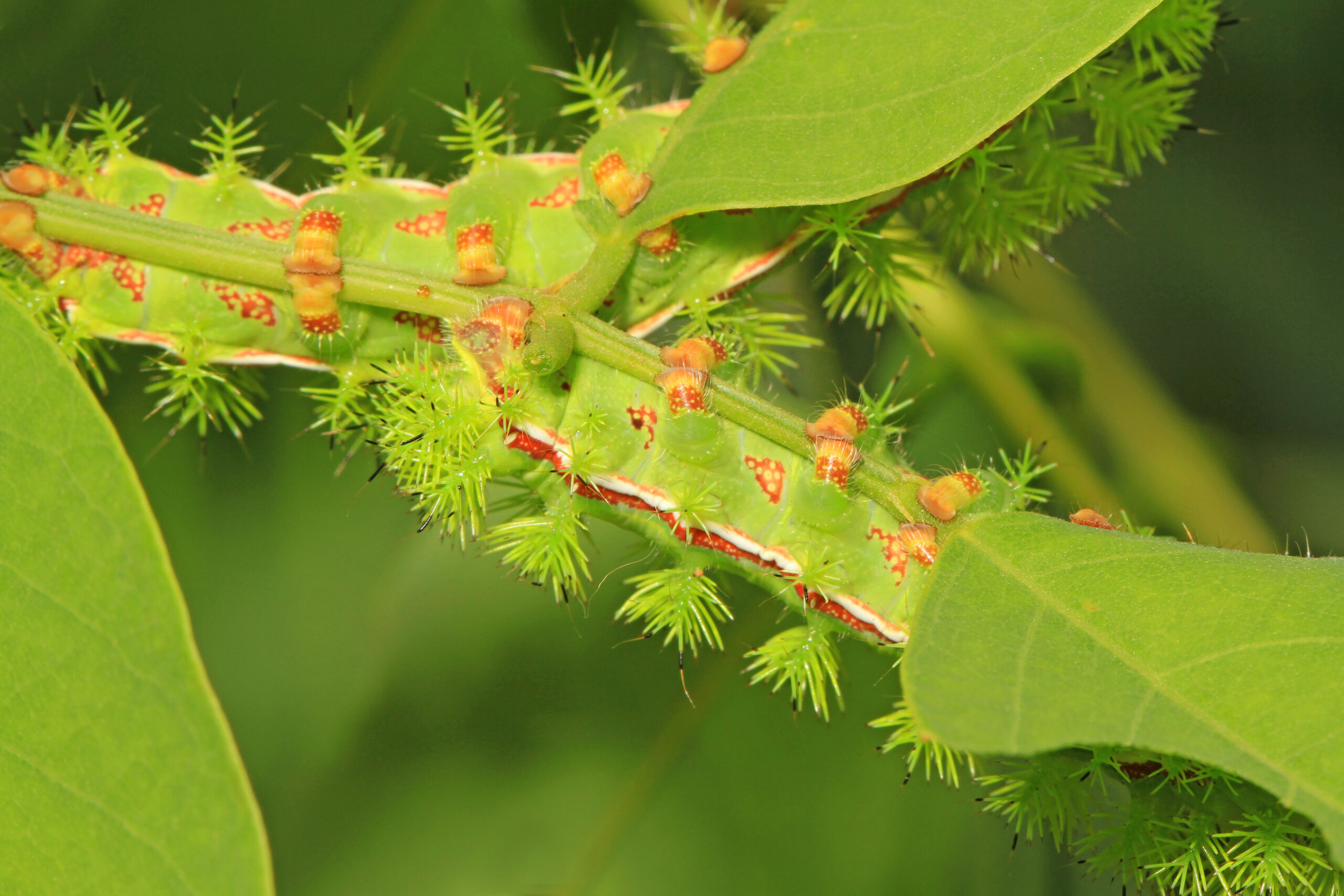
The caterpillar is the stage you are most likely to meet, and it is unmistakable once you know the three field marks. It is a plump, cylindrical caterpillar, bright green, growing to about 2 to 3 inches long, with rows of dense, branched spine tufts running down its body — it looks like a green bottle brush that learned to walk. Down each side runs a white stripe edged in red or pink, and that stripe plus the spine tufts are the decisive characters: green body, white-and-red stripe, dense spiny tufts, and you are looking at an Io. Young caterpillars start out orange or reddish and turn green as they grow, so a small orange spiky caterpillar on the same host plant may be the same animal a few moults earlier.
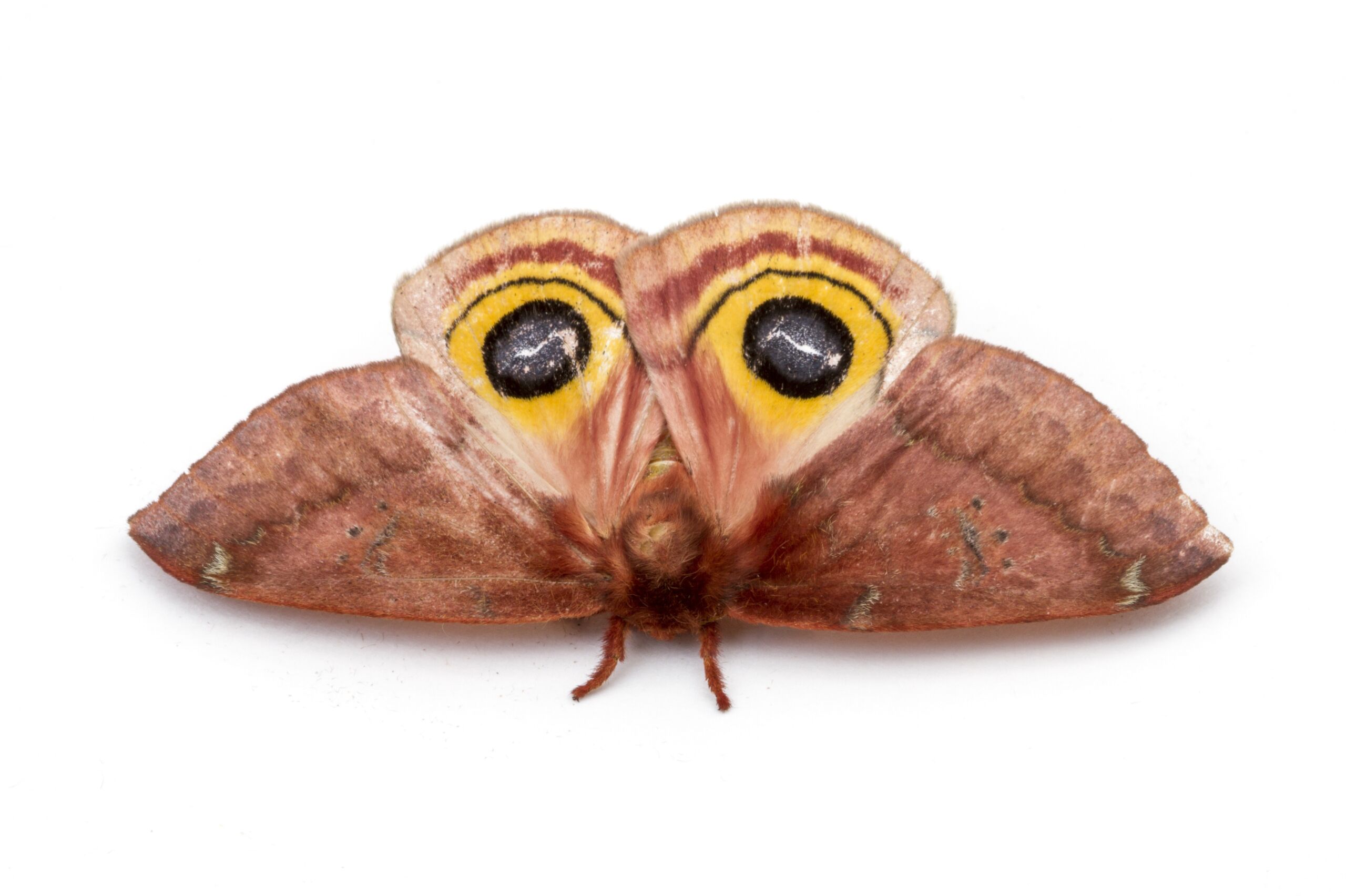
The adult is a different animal entirely, and a beautiful one. Males have yellow forewings, females reddish-brown, and both hide the show under those forewings: large, dramatic eyespots on the hindwings, black-ringed with blue and yellow, that flash open when the moth is disturbed. It is a startle display — a predator that was about to grab a brown moth suddenly finds itself staring into two enormous eyes, and hesitates long enough for the moth to escape. Adults do not eat at all. They have no working mouthparts to speak of and live about a week on the fat reserves they stored as caterpillars, which is a short adult life spent entirely on finding a mate and laying eggs. The caterpillar did all the eating; the adult is running on savings.
Life cycle
It starts with eggs laid in clusters on the underside of a host plant leaf. The young caterpillars hatch orange or red and feed together in a group, which is the one time in their lives they are social — safety in numbers, and a whole cluster of spiny siblings is a harder meal than one alone. As they grow they turn green, spread out, and feed alone, moulting several times and getting bigger and spikier with each moult. A full-grown caterpillar is about 2 to 3 inches of bright green attitude.
When it is ready to pupate, the caterpillar drops to the ground and spins a thin, papery cocoon among the fallen leaves — not a hard chrysalis like a butterfly, but a loose silk wrapping tucked into the leaf litter. (No verified photograph of the cocoon exists to show here — it is a thin, papery wrapping tucked into the leaf litter.) That is where it spends the winter in most of its range, pupating through the cold months. In Florida, with three or four generations a year, the cycle turns over faster: summer generations pupate for only a short while before the next round of moths emerges, and the population keeps going as long as the weather stays warm and the host plants keep leafing out.
Host plants
Io caterpillars are generalists, which is part of why they are so widespread: the list of plants they will eat is long, and it covers most of the common trees and shrubs in a Florida yard. Oaks are a favourite — live oak and the other oaks — along with willow, cherry including black cherry, maple including red maple, sassafras, and American elm. They will also use a long list of other trees and shrubs, so if you find one on a plant that is not on this list, that is normal — the caterpillar is not lost, it is just eating.
That generalist habit is good news for the moth and mostly harmless news for the garden. A few caterpillars on a large tree are no threat to it at all — the tree barely notices — and the caterpillars are food for the birds and wasps that keep the garden’s insect balance. Heavy feeding on a small young tree is worth watching, but the answer is never insecticide: it is patience, and if the caterpillar is somewhere people keep brushing against it, moving it with a leaf (not your hand) to a less-travelled host plant.
Florida notes
Florida is about as good as it gets for the Io moth. Warmth most of the year, host plants everywhere, and leaf litter to pupate in means three to four generations a year across the state, with adults on the wing from spring through fall and caterpillars findable for most of the growing season. That is more generations than in the northern part of its range, where the moth squeezes in one or two and spends the winter as a pupa.
The practical consequence is simple: in Florida you can meet this caterpillar in almost any month with leaves on the trees. It is a year-round neighbour, not a rare visitor, and the sting rule applies year-round too. Teach children the look — bright green, spiky, white-and-red stripe — the way you teach them to recognise a fire ant mound: not with fear, with respect, and from a sensible distance.
Lookalikes: check before you decide
A bright green spiky caterpillar is distinctive, but three other caterpillars get confused with the Io, and the differences matter — one of them is the reason the stripe is worth checking. In the photo that prompted this guide, the red-and-white side stripe is not clearly visible — small caterpillar, red background, awkward angle — so do not take the stripe on trust from a single photo. Check for it in person: it is the field mark that settles the question.
Buck moth caterpillar (Hemileuca maia) is the closest confusion. It is also spiny and also stings, but it is dark — black or very dark brown — with white spots, not bright green. If the caterpillar is dark, it is not an Io, whatever else it is.
Spiny oak slug (Euclea delphinii) is flattened, not cylindrical, and looks jewel-like: colourful red, orange, and yellow markings on a flattened body, more like a tiny spiny jewel than a bottle brush. If it looks flat and fancy, it is the slug, not the Io.
Imperial moth larva (Eacles imperialis) is large and green like an Io, but it has short spines and hairs rather than dense spine tufts, and it has no white-and-red side stripe. Green and big is not enough — look for the dense tufts and the stripe, and if they are not there, it is not an Io.
The rule of thumb: bright green cylinder, dense branched spine tufts, white stripe edged in red down the side — all three together, and it is an Io. Two out of three, and you should keep looking.
Wildlife value
The Io moth earns its place in the garden twice over. As a caterpillar it is food — for the birds that have learned to handle it, for parasitoid wasps and flies, and for the whole food web that runs on caterpillars. As an adult it is a night pollinator, visiting flowers after dark, and a meal in turn for bats and night-hunting birds. The eyespots and the spines are the moth’s side of the bargain: it gives the garden a pollinator and a prey animal, and it defends itself well enough to make a living at it.
The cocoons in the leaf litter are a quiet reminder that the garden’s floor matters. A yard raked bare all winter has nowhere for an Io pupa to wait out the cold; a yard with a leaf-litter corner — under a tree, at the back of a bed — is a nursery for moths, fireflies, and all the other animals that spend the winter in the leaves. Leave the leaves, get the moths.
What to do if you find one
First, enjoy it — from a few inches away. It is one of the most striking caterpillars in Florida, and most people only ever see one by accident. Take a photo for identification (that is how this guide started), note the plant it is on, and check the three field marks: green, spine tufts, white-and-red stripe.
Do not pick it up, and do not let children or pets touch it. If it is somewhere people keep brushing against it — a walkway, a play area, the arm of a chair — slide a leaf or a stiff piece of paper under it and carry the leaf to a host plant out of the traffic, then leave it there. No gloves needed if you use the leaf; no touching needed at all. If it is on a tree or shrub where nobody is likely to grab it, the best thing to do is nothing: it will eat, grow, pupate in the leaf litter, and come back as a moth with eyespots.
Fun facts
- The Io moth is named for Io of Greek myth — and the eyespots are a wink at Argus, the many-eyed watchman set to guard her. A moth named for a myth, wearing the watchman’s eyes on its wings.
- Adults do not eat. They live about a week on fat stored from their caterpillar days, which makes the caterpillar the one doing all the work and the adult the one spending the savings.
- The eyespots stay hidden under the forewings until the moth is disturbed, then flash open — a jump scare that buys the moth a second to escape.
- Young Io caterpillars are orange or red and feed in groups; they turn green and go solitary as they grow, like teenagers moving out.
- The spines are hollow and connected to venom glands — a sting that feels like a bee sting, delivered by an animal that is otherwise completely harmless and just wants to eat leaves in peace.
- Io moths come to lights at night, which is the easiest way to meet the adult: leave a porch light on near trees in summer and check what it brings in.
Keep learning 🌱
Where to go next:
🪱 Your Soil Needs This
Reading about healthy soil is great. Growing in it is better. Our small-batch, traceable worm castings are the shortcut your garden deserves.
Shop Worm Castings Subscribe & SaveEvery bag comes with a lot certificate. Know what's in your soil.