
If you have ever walked past an oleander hedge and noticed the new shoots turning brown, then looked closer and found a bright orange caterpillar wearing what looks like a bottle brush made of black spikes, you have met the oleander caterpillar. It is loud, it is spiky, it eats poison for a living, and it turns into one of the prettiest moths in Florida — a dark blue, white-polka-dotted wasp mimic called the oleander moth, or polka-dot wasp moth, Syntomeida epilais.
One honest note up front, because this guide exists largely due to a case of mistaken identity: this caterpillar is constantly confused with the milkweed tussock moth caterpillar, which is also orange, also spiky, and also fond of advertising itself. They are different animals with different host plants, and telling them apart is mostly a matter of looking for white tufts and checking what plant you found it on. There is a whole section below devoted to exactly that, so if you came here from an argument about which one yours is, skip straight there.
What it looks like
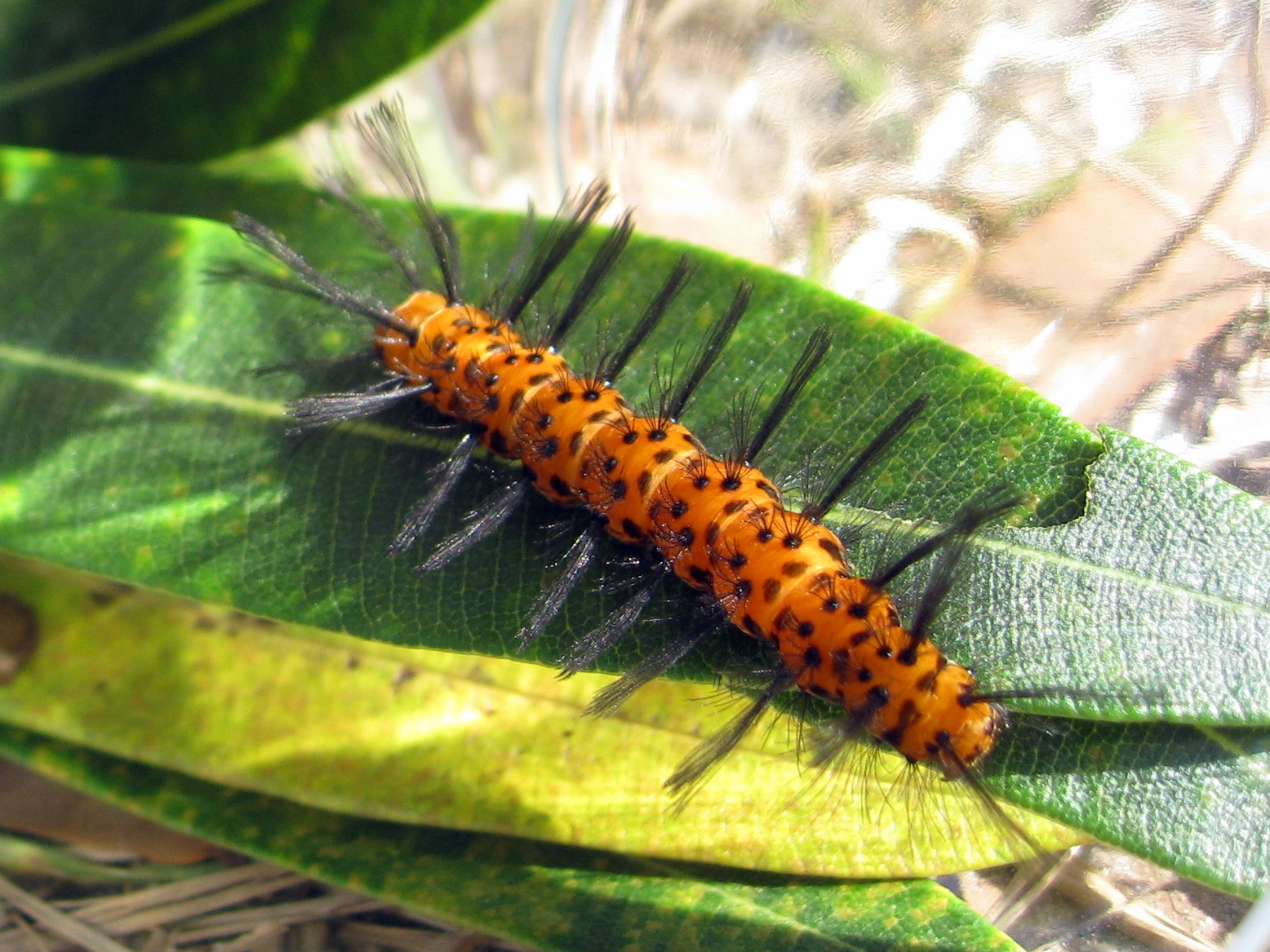
The caterpillar is hard to miss and harder to forget. The body is a bright, almost day-glow orange, studded with black bumps (tubercles), and each bump sprouts a tuft of long, black, spiked hairs. Between the tufts you can see small black dots on the orange skin. The head is mostly bare of tufts, which is one of the small details that helps separate it from its lookalikes. Young larvae start tiny — just a few millimeters — and grow to about two inches long through six instars, getting more dramatically spiked as they go.
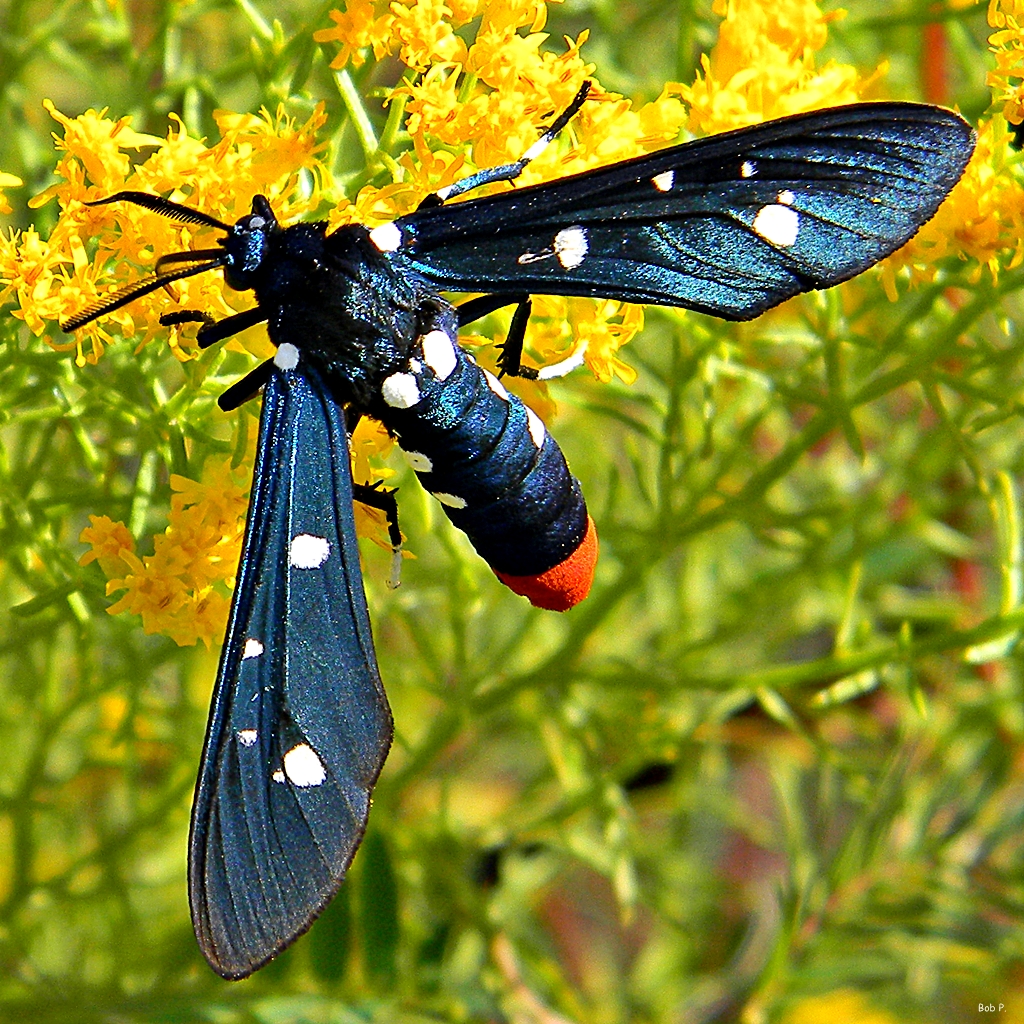
The adult is a complete change of costume. The oleander moth, also called the polka-dot wasp moth, is a slender, dark metallic blue-black moth with white polka dots scattered across its wings, body, and legs, and a bright red-orange tip on its abdomen. It flies during the day, slowly and deliberately, and it genuinely resembles a wasp — that is the point. Predators that have learned to avoid wasps give it a wide berth, and predators that have learned that orange caterpillars taste terrible give it a second reason. Its wingspan runs roughly an inch and three-quarters to two inches.
Host plants
First and foremost, this caterpillar eats oleander (Nerium oleander), which is how it got its common name. But oleander is not its only table. It also feeds on desert rose (Adenium species) and devil’s potato (Echites umbellata), a native vine of Florida beaches and pinelands that is believed to be the caterpillar’s original host, back before oleander arrived from the Mediterranean as an ornamental and the caterpillar happily switched to the new, abundant buffet. All of these hosts belong to the dogbane family (Apocynaceae), a family famous for milky sap and cardiac glycosides — poisons that most animals avoid and this caterpillar collects.
The adults, meanwhile, are nectar feeders, visiting flowers during the day. They are frequent visitors around oleander plantings, and they also pollinate desert rose — the caterpillar eats the plant, the moth pollinates it, and the whole arrangement somehow works out.
Lifecycle
It starts with eggs laid in clusters on the undersides of oleander leaves. The young larvae feed together in groups, skeletonizing leaves — eating the soft tissue between the veins and leaving the veins standing like little leaf skeletons. That skeletonizing, plus new shoots turning light brown, is usually the first sign you have company.
As they grow, the caterpillars go solo. The older instars eat whole leaves instead of skeletonizing, and they are the ones that can strip a bush in a hurry. The whole larval stage lasts a few weeks; the older, solitary caterpillars feed for around three weeks before they wander off to pupate. And wander they do: mature caterpillars leave the host plant and gather in groups on tree trunks, walls, fences, and buildings, spinning thin cocoons woven from silk and their own hairs. The pupae inside are smooth and brown. In Florida’s warmth there are multiple generations a year, which is why an oleander hedge can seem to go from fine to feasted-on in what feels like days, several times a season.
In Florida
The oleander caterpillar is a native of the Caribbean region, and it has made itself thoroughly at home in the coastal southeastern United States. In Florida it is a common sight on oleanders and southern Georgia too, and it lives year-round in south Florida and the Keys, where warm weather never really gives the oleander a break from it. If you have an oleander hedge in Florida, you will meet this caterpillar eventually — probably several times a year, and probably in a group.
Damage: how bad is it, honestly
Let’s calibrate. Young larvae skeletonize leaves and brown the new shoots, which looks alarming. Older larvae can defoliate an oleander bush quickly and thoroughly, leaving it looking like a collection of bare sticks with a bad attitude. That is genuinely unsightly, and on a small or young plant it is a real setback.
But established oleander usually refoliates and recovers. The insect is, in extension-service language, a producer of unsightly damage rather than a plant killer: it does not typically kill oleander. So the correct response is attention, not panic — and definitely not a panicked blast of broad-spectrum insecticide, which will kill the caterpillar’s natural enemies along with it and leave you worse off for the next generation. The gentlest-first ladder below is the whole plan.
Lookalikes: oleander caterpillar vs milkweed tussock caterpillar
This is the section that matters, because these two get mixed up constantly — including by photo-identification tools, which have been known to call an oleander caterpillar a milkweed tussock with great confidence. Here is how to settle it:
Oleander caterpillar (Syntomeida epilais): solid bright orange body; black dots on the orange skin between the tufts; long black bottle-brush spikes; head mostly bare of tufts; found on oleander, desert rose, or devil’s potato; older caterpillars wander onto bark, walls, and buildings to pupate in groups.
Milkweed tussock moth caterpillar (Euchaetes egle): tufts in three colors — black, white, AND orange — with longer black-and-white pencils sticking out at the head and rear ends; a black head capsule; a dense, fuzzy coat arranged like a little tent along the back; and it feeds only on milkweeds and dogbane, never on oleander.
The two fastest checks: white tufts present? Think tussock. Solid orange with black dots, no white anywhere, on an oleander-family plant? Think oleander caterpillar. And when the caterpillar itself is ambiguous, the host plant settles it — oleander caterpillars do not eat milkweed, and milkweed tussocks do not eat oleander. If it is munching oleander or desert rose, it is not a milkweed tussock, whatever an app told you.
One rarer cousin worth a sentence: the spotted oleander caterpillar (Empyreuma affinis) also feeds on oleander but wears white spots instead of black. If your orange caterpillar has white spots on its body rather than black dots, you have the spotted cousin, not this one.
Safety: poison in, poison out
Oleander is one of the most poisonous common garden plants — every part of it is toxic to people, pets, and livestock. The caterpillar eats that poison and keeps it. Its body accumulates cardiac glycosides from its host, which is exactly why it can afford to be bright orange: predators that try one learn, memorably, not to try another. That bright color is a warning label, and it works.
For humans, the practical rules are simple. Do not eat the caterpillars, and do not let children or pets eat them. Wash your hands after handling them. The hairs themselves do not sting — unlike many fuzzy caterpillars, this one’s spikes are not venomous, and picking one up will not hurt you the way a stinging caterpillar would. But the animal is full of sequestered plant poison, so admire it, photograph it, pick it off your oleander if you must — and then wash your hands and keep it away from mouths, small children, and curious pets. And remember the plant itself is the bigger hazard in this story: treat oleander with the respect a highly toxic ornamental deserves.
What to do, gentlest first
1. Tolerate light feeding on a healthy oleander. A few skeletonized leaves on an established bush are cosmetic. The plant will refoliate. Not every caterpillar needs a response.
2. Catch them early. Check new shoots and the undersides of leaves for egg clusters and groups of tiny larvae. Early clusters are easy to wipe or pick off before they scatter and start eating in earnest.
3. Handpick the big ones. Large caterpillars can be picked off by hand — the hairs do not sting — and dropped into a container of soapy water. Wear gloves if you prefer, and wash your hands after. This is the single most effective control for a home garden, and it has no side effects.
4. Leave pupation masses alone where they are not a problem. A cluster of cocoons on a trunk or wall is done eating. It is not damaging anything anymore, and it is full of the next generation’s natural enemies as well as moths.
5. Protect the helpers. This caterpillar has real enemies: the spined soldier bug (Podisus maculiventris) eats larvae, tachinid flies parasitize them, and a small wasp (Brachymeria incerta) parasitizes the pupae. Broad-spectrum insecticides kill those helpers too, which is one reason a sprayed hedge often gets hit harder the next time around.
6. Bt only as a last resort. For a heavy infestation on a plant you cannot handpick (a very tall hedge, for instance), Bacillus thuringiensis (Bt) is the caterpillar-specific option: it kills only caterpillar larvae that eat treated foliage and has no toxicity to beneficial insects. Use a product labeled for caterpillars, follow the label exactly, and use it sparingly — it will also affect any other caterpillars feeding on that plant, including ones you might want to keep.
Frequently asked questions
Is the oleander caterpillar dangerous to touch?
Its hairs do not sting and are not venomous, so picking one up will not hurt you the way a stinging caterpillar would. But the caterpillar’s body contains cardiac glycosides from the oleander it eats, so do not eat it, keep it away from children and pets, and wash your hands after handling.
Will oleander caterpillars kill my oleander?
Usually not. They can defoliate a bush quickly and make it look terrible, but established oleander typically refoliates and recovers. Small or young plants suffer more, so those are the ones worth handpicking early.
What does the adult moth look like?
The adult is the polka-dot wasp moth: a slender, dark metallic blue-black moth with white polka dots on its wings, body, and legs, and a bright red-orange tip on its abdomen. It flies during the day and mimics a wasp. If you see a slow, wasp-like blue moth with white dots hovering around your oleander, that is the grown-up version of the orange caterpillar.
How do I tell it apart from the milkweed tussock caterpillar?
Look for white tufts. Milkweed tussocks have black, white, and orange tufts plus long black-and-white pencils at both ends and a black head. Oleander caterpillars are solid orange with black dots and black spikes, no white, and a mostly bare head. And check the plant: oleander caterpillars eat oleander, desert rose, and devil’s potato; milkweed tussocks eat only milkweeds and dogbane.
Why is it on my tree trunk / wall / fence instead of the oleander?
It is looking for a place to pupate. Mature oleander caterpillars leave the host plant and gather on trunks, walls, and buildings, spinning thin cocoons of silk and hairs. A cluster of cocoons on a wall is not an infestation in progress — those caterpillars are done eating.
What eats oleander caterpillars?
Not much, thanks to the toxins — birds and small mammals generally leave them alone. Their real enemies are insects: the spined soldier bug eats larvae, tachinid flies parasitize them, and a small wasp parasitizes the pupae. Pathogens take a heavy toll too. That is one more reason to skip broad-spectrum sprays, which kill those helpers.
Should I spray my oleander?
Start gentlest: tolerate light feeding, pick off egg clusters and large caterpillars by hand, and let the natural enemies work. If the infestation is heavy and the plant is too tall to handpick, Bt (Bacillus thuringiensis) is the last-resort option — caterpillar-specific, labeled, and used sparingly, since it affects other caterpillars on the plant too.
Does it eat desert rose too?
Yes. Desert rose (Adenium) is a documented host, along with devil’s potato. If you grow desert rose anywhere near oleander, check it too — the same orange caterpillars will happily move in.
Is the oleander moth native to Florida?
It is a native of the Caribbean region that has naturalized across the coastal southeastern United States. In Florida it is common and lives year-round in the south, which is why oleander hedges here rarely get a season off from it.
I found this caterpillar with a photo — what tool was that?
That was the What’s This? photo tool. Snap a photo of a plant or creature in your yard and it tells you what you are looking at, with a guide when one exists.
🌱 Keep learning
Three related guides worth reading next:
- Castor Oil Plant: Beautiful, Deadly, and Invasive in Florida — Another beautiful, deadly, invasive plant — identified from a yard photo, with safe removal.
- The Night Garden: Florida Plants for Moths — What to grow if you want more moths in your yard — the night shift’s host plants.
- Green Lacewing: The Aphid Lion With Lacy Wings — Another garden creature identified from a photo — the aphid-eating ally with lacy wings.
🪱 Your Soil Needs This
Reading about healthy soil is great. Growing in it is better. Our small-batch, traceable worm castings are the shortcut your garden deserves.
Shop Worm Castings Subscribe & SaveEvery bag comes with a lot certificate. Know what's in your soil.