
It looks like a tropical dream and it is, in its own way, a nightmare. The castor oil plant, Ricinus communis, grows faster than almost anything in a Florida yard — from seed to small tree in a single season — wears some of the biggest, most dramatic leaves of any plant you will meet, and carries, in its pretty mottled seeds, one of the most famous poisons in the world. It showed up in a Florida yard, got photographed, and got identified by the What’s This? photo tool at 81% — and then, because there was no guide for it, this guide got written. It is not a growing guide. Nothing in here will help you grow one. This is a guide to recognizing it, respecting it, and getting rid of it safely.
One honest note up front, because the whole plant is a study in contradictions: the oil that made this plant famous is perfectly safe. Castor oil is a non-toxic vegetable oil, sold in pharmacies, and it contains no ricin at all — the poison is water-soluble, so it stays behind in the leftover seed cake when the oil is pressed out. Same plant, same seed, two completely different stories. The oil is medicine. The raw seed is a poison emergency. Never let the first story talk you into forgetting the second.
What it looks like
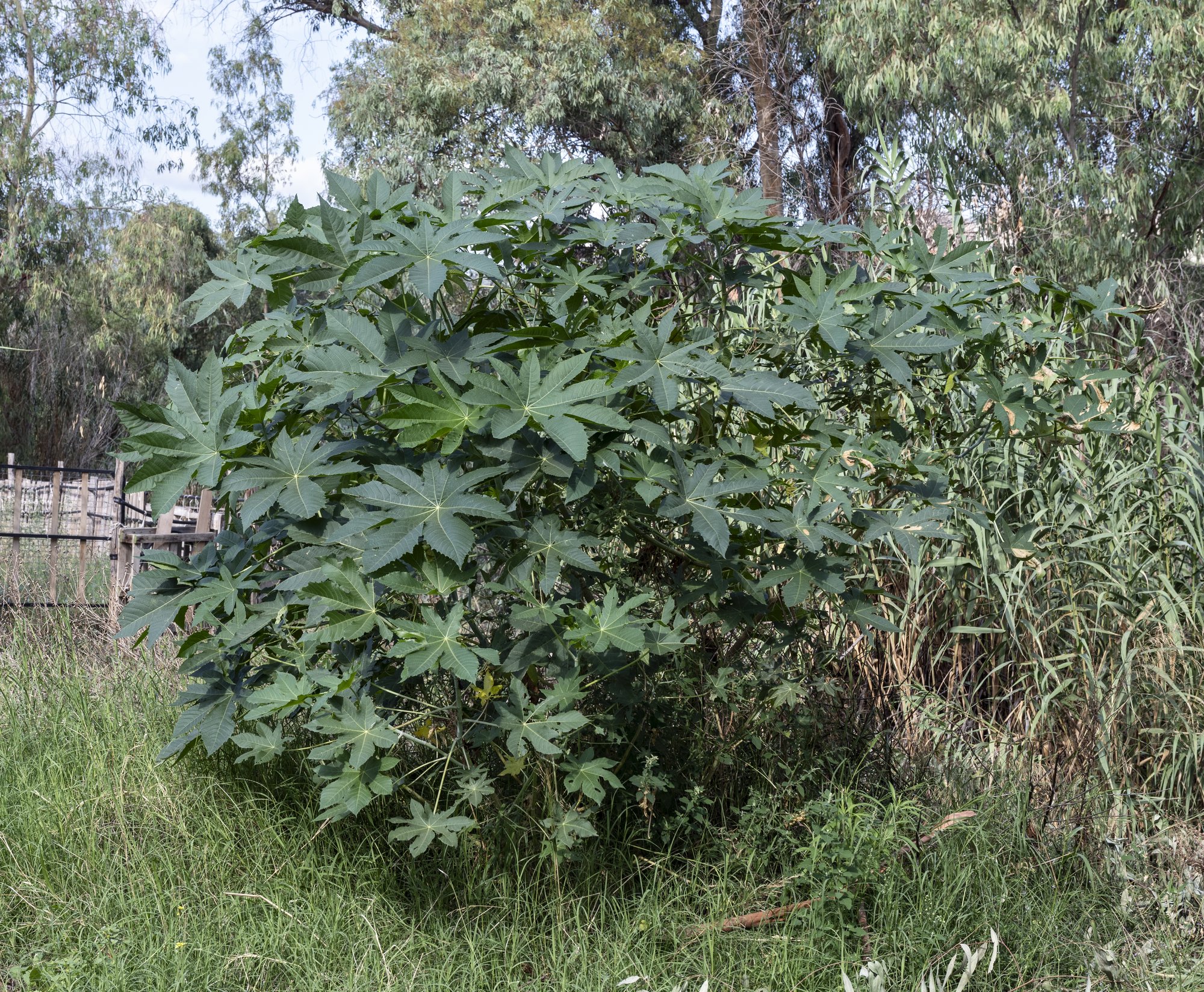
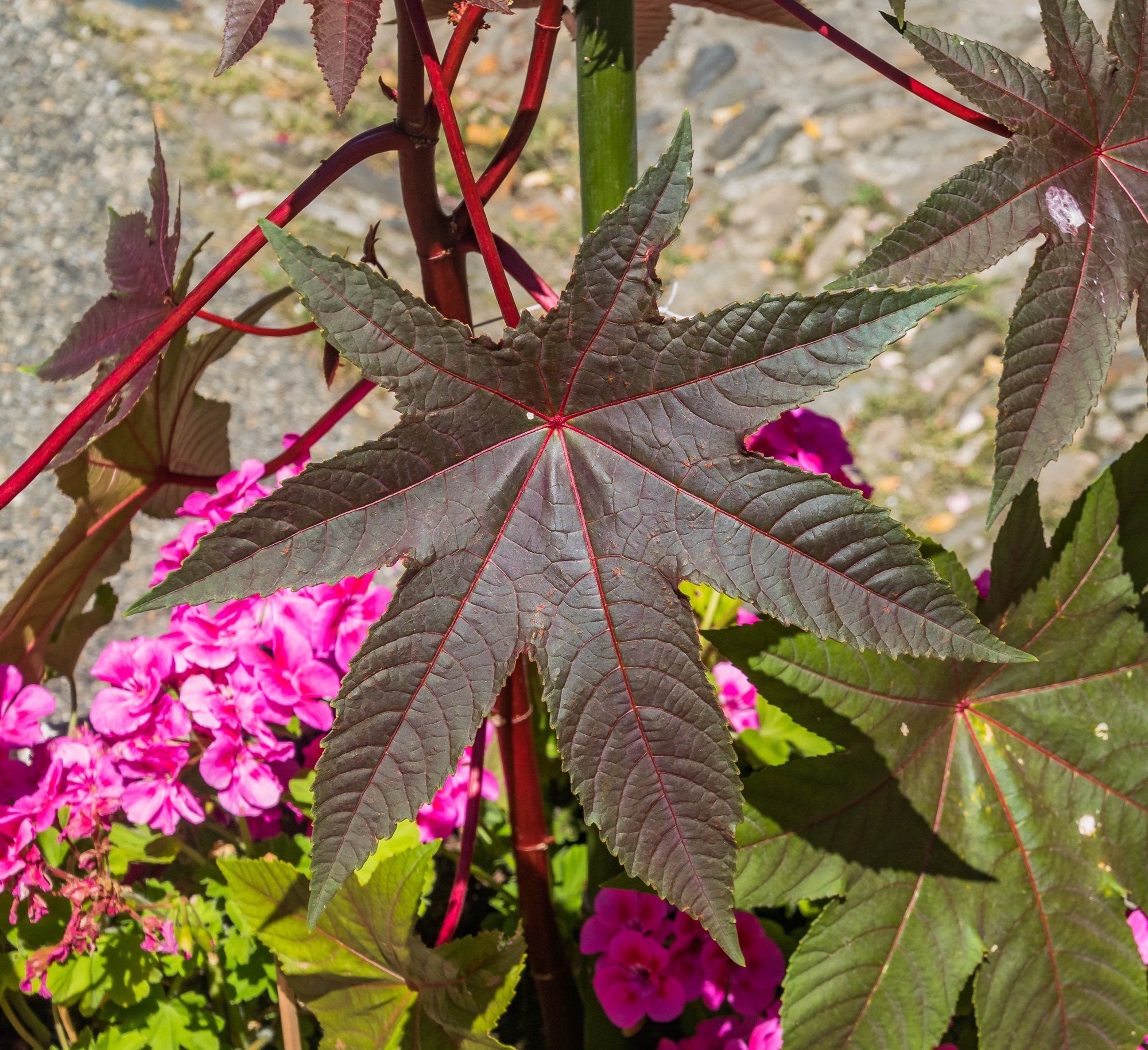
The leaves are the giveaway, and they are enormous. Each leaf is simple and alternate on the stem, 15 to 30 inches across — wider than a dinner plate, sometimes wider than two — and shaped like a hand with 5 to 11 narrow lobes, each lobe with a jagged, saw-toothed edge. The leaf is lopsidedly peltate, which is a nerdy way of saying the stalk attaches to the inside of the blade, above the center, instead of at the edge like most leaves. The color runs green to reddish, sometimes both on the same plant, and the stems are often reddish too. If you have ever seen a leaf and thought “that looks like a hand, but bigger than my head,” you were probably looking at this plant.
The rest of the plant is just as oversized. In frost-free Florida it grows into a semi-woody small tree up to 40 feet tall, with a trunk that can reach a foot thick — and it gets there fast, going from seed to tree-like in three to four months. Where frost knocks it back, it behaves like an annual and tops out around 15 feet instead. It is not wind resistant, and a big specimen can be blown over in a relatively mild wind event, which is worth knowing before you let one lean over a fence or a play area.
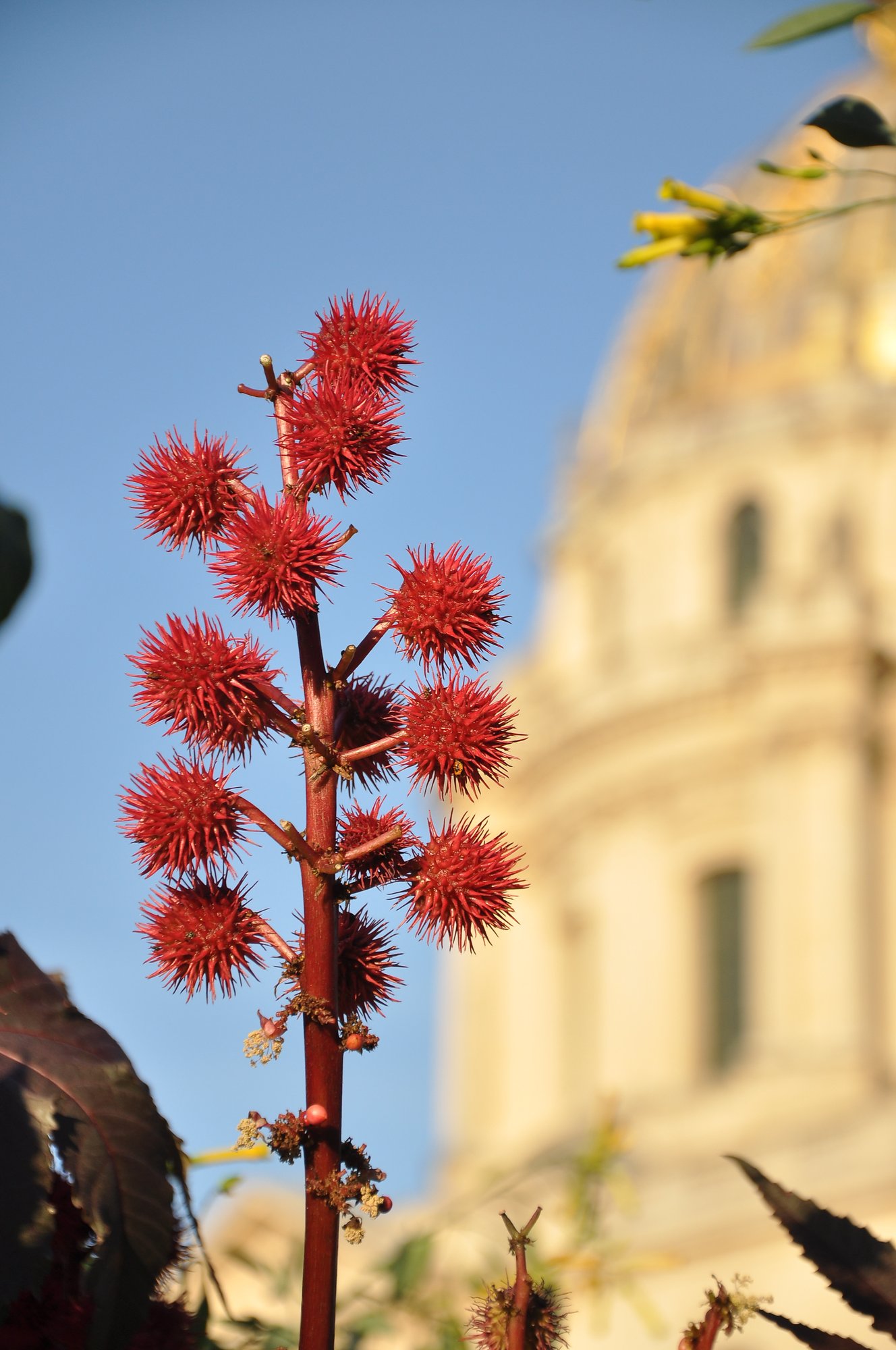
Flowers appear in summer and fall on tall spikes up to 18 inches long at the tops of the stems. The male and female flowers share the same spike — the yellow male flowers pollinate the red female flowers above them. The fruit is what you really need to recognize: a half-inch to one-inch spiny capsule that ripens from yellow to blue-green to brown, and inside each capsule sit three small, mottled seeds that look unsettlingly like dog ticks. That resemblance is not a coincidence. The genus name Ricinus is Latin for “a kind of tick,” and the seeds were named for it. The species name communis just means “common,” which, in Florida, it certainly is.
The poison: ricin
The seeds contain ricin, a protein toxin that shuts down a cell’s ability to make proteins — which is, to put it mildly, something a cell needs to keep doing. There is no antidote. Ricin is dangerous when the seeds are chewed or crushed and swallowed, because chewing breaks the seed coat and releases the toxin; a whole seed that is swallowed intact may pass through, but that is a gamble nobody should take, and the number of seeds it takes to cause serious harm runs from a single seed to dozens. The honest rule is that there is no safe number. Treat any ingestion of any part of a castor seed as a poison emergency, no matter how many were swallowed and no matter how fine the person feels right now.
That last part matters, because ricin poisoning does not announce itself right away. After swallowing, the first symptoms usually appear within ten hours: vomiting, diarrhea that may be bloody, severe dehydration, and low blood pressure, followed in serious cases by seizures, blood in the urine, and liver, spleen, and kidney failure. Death can follow within 36 to 72 hours. The delay is the trap — a child can eat a seed, feel fine for hours, and be in serious trouble by the time anyone notices. Do not wait for symptoms. If anyone — child, adult, dog, cat, horse — has eaten castor seeds or chewed any part of the plant, act immediately.
If a person has swallowed castor seeds: call 911 and Poison Control at 1-800-222-1222 right away. Do not force vomiting and do not give fluids to drink unless emergency staff tell you to — the CDC’s guidance is explicit on both points. If a pet has eaten seeds or plant material, call your emergency vet or the ASPCA Animal Poison Control Center at (888) 426-4435 immediately (a fee may apply); in pets, symptoms are often delayed 12 to 48 hours, which is exactly why waiting is the wrong move.
Touching the plant is a different story, and a much calmer one. Brushing against the leaves or stems is generally safe. The sap, flowers, leaves, and seeds can cause skin rashes in sensitive people, and the plant’s huge pollen production makes it extremely allergenic — severe allergies and asthma are documented — so gloves and a wash with soap and water after handling are simple, sensible habits. The danger is in the mouth, not on the skin. And one more distinction worth keeping straight: the leaves and stems are not where the ricin lives. The poison is concentrated in the seeds, and the seeds are the part to keep out of reach, out of pockets, and out of the hands of anyone too young to know what they are holding.
One more line to draw clearly, because it is the one people get wrong in both directions: ricin poisoning happens when the toxin gets inside the body — when chewed seeds are swallowed, or, more rarely, when ricin is inhaled or injected. Touching the plant does not cause ricin poisoning. You can brush a leaf, prune a stem, or stand under the thing without the poison getting into you; the touch story is the sap rash and the pollen allergy, both of which you have already read about above. That is not a green light to handle it carelessly — gloves and a wash are still the move — but it is the difference between a rash and a poison emergency, and it is worth knowing which is which.
One more thing worth knowing about the animals. Grazing animals generally leave it alone: the plant is unpalatable — the California Invasive Plant Council calls it largely unpalatable to wildlife and livestock — and livestock rarely eat it, in part because of the smell of the leaves (NSW Department of Primary Industries). Chickens are in the same boat: the plant is poisonous to poultry, but it is not usually eaten voluntarily. That is not a safety net — the seeds are the danger, and they need to stay out of reach of children, pets, and livestock alike. And do not file this plant under “pollinator plant”: castor oil plant is primarily wind-pollinated.
In Florida
Castor oil plant is a native of northeastern Africa and the Middle East, and it has made itself thoroughly at home in Florida’s disturbed ground — roadsides, old fields, rocky slopes, and the weedy edges of yards, anywhere with full sun and a little neglect. UF/IFAS Extension and the Florida Invasive Species Council list it as a Category II invasive species in all regions of Florida: abundant throughout the state, spreading, but not yet displacing native plant communities to the extent Category I species have. Category II is not a shrug — it is the ranking that says “this one is on its way up, and it may get promoted if the damage is demonstrated.” You will occasionally see it called Category I online, including in a popular arborist video; that is incorrect, and UF/IFAS is the authority here.
What makes it such a successful invader is the same thing that makes it such a fast garden plant: it grows astonishingly quickly, its seeds germinate readily in warm conditions, and it is very good at throwing its own seeds around. The dry pods split open explosively and fling seeds well away from the parent plant, so one plant standing at the edge of a yard becomes a scatter of seedlings the next season, and a scatter becomes a thicket. Florida’s nurseries understood this a while ago — members of the Florida Nursery Growers Association voted unanimously in 2001 to stop selling it, and it has not been available in Florida nurseries since. It is still extremely common, because it does not need a nursery to spread. It just needs one plant, one dry pod, and a little open ground.
Invasive — but easy to manage
Here is the other side of the story, and it matters, because “invasive” gets used as if it meant “unstoppable,” and for this plant it does not. Castor oil plant spreads by seed and by seed alone. It does not send out runners, it does not creep along rhizomes, and it does not root where a stem touches the ground — the California Invasive Plant Council’s assessment says so plainly: it spreads by seed, it does not spread by root fragments, and it has no quickly spreading vegetative structures. One honest footnote: cut it down and it can resprout from the root crown, which is why the removal section says to dig the crown out — but resprouting is not spreading. The plant comes back in the same spot; it does not colonize the next one. The whole invasion is the pods. The dry capsules split open and fling their seeds, and those seeds wait in the soil until warm weather wakes them. Which means the whole management plan is one job: take the pods off before they dry and split. Do that, and the plant stays where you put it. Miss a season of pods, and you get volunteers — which pull easily by hand while they are small, as the removal section says.
That is also what Category II means, in practical terms. The ranking says the plant has increased in abundance but has not been shown to displace native plant communities the way Category I species do. It is a plant that spreads fast and far when its seeds are left alone, and stays put when they are not — which is exactly why people who grow it will tell you it is invasive but easy to manage, in the same breath, without contradicting themselves. None of that changes the recommendation further down this guide — for most readers, the right move is still not to plant it. But if one is already standing in your yard, now you know why it is there and what it actually takes to keep it.
And the reason anyone puts up with the management at all is the growth. In full sun — and full sun is not optional, it is where this plant does its best work, per UF/IFAS — castor oil plant grows astonishingly fast, reaching small-tree size in a single season. That is the trade, and it is a real one: a plant that will give you a tree’s worth of shade in a single season, in a spot where little else will grow, in exchange for one job a year — the pods, before they split.
Lookalikes: the false castor oil plant
The one plant this gets genuinely confused with is the false castor oil plant, Fatsia japonica — and the confusion is so common that “false castor oil plant” is its everyday name. It is not a relative (it belongs to the ivy family, Araliaceae, while true castor is a spurge, Euphorbiaceae), but the leaves do the same trick: big, palmate, deeply lobed, and tropical-looking. Here is how to settle it:
Castor oil plant (Ricinus communis): leaves 15 to 30 inches across with 5 to 11 narrow, jagged lobes; reddish stems; full, hot sun; fast-growing to small-tree size in a season; and the decider — spiny seed capsules. If it has spiny pods, it is castor, full stop.
False castor oil plant (Fatsia japonica): leaves rounder and glossier with 7 to 9 lobes, up to about 16 inches across; an evergreen shrub that stays a few feet tall and loves deep shade; white umbrella-like flower clusters in fall, followed by small black berries. No spiny pods, ever. Its leaves contain saponins, which can give a pet an upset stomach or irritate skin, but it is in a different league of risk entirely.
The fastest checks: spiny pods present? Think castor. Big lobed leaves in deep shade with no pods and white flowers in fall? Think Fatsia. And when in doubt, the pods settle it — nothing else in a Florida yard makes a spiny capsule full of tick-patterned seeds.
Do not plant it
Let us be blunt, because this is the whole point of the guide: do not plant castor oil plant, do not propagate it, do not save its seeds, do not share cuttings or seedlings with a neighbor, and do not keep one “just for the look” in a corner of the yard. It is poisonous, it is invasive in Florida, the state’s own nurseries stopped selling it a generation ago, and UF/IFAS Extension does not recommend it as a landscape plant. Every seed it drops is a poison risk and a future plant, and it drops a lot of them.
If you want the look without the risk, the false castor oil plant above is the honest substitute: the same giant lobed leaves in a shady spot in north or central Florida, an evergreen shrub that stays where you put it and never makes a spiny pod. That is the trade — the drama, none of the danger, none of the spread.
How to remove it safely
If one is already standing in your yard, here is the order of operations. Do the pods first, the plant second, and the ground third.
1. Deal with the pods before anything else. Put on gloves, take pruners or scissors, and cut the seed clusters off whole — do not strip pods bare-handed, because the spines drive into skin and the seeds scatter. Drop the cut clusters straight into a bag. Do this before the pods dry and split, because once they split, the seeds are already on their way across the yard.
2. Bag the pods and seeds with the household trash — never the compost pile. Backyard compost does not reliably destroy ricin or the seeds, and a compost pile is exactly where children and pets go digging. Sealed bag, household trash, done. For a very large volume, check with your county’s waste department for guidance.
3. Take the plant out. Cut the stem at the base and dig out the root crown with a garden fork, so it does not resprout. A young plant pulls easily by hand (gloves on). A big one may need a pruning saw at the base and some leverage. Do not mow or string-trim a seeding plant — you will only scatter seeds further.
4. Clean up the ground. Walk the area and pick up any fallen capsules or loose seeds, gloves on. Seeds germinate readily in warm soil, so check the spot over the following weeks and pull volunteers by hand while they are small — they come out easily at that stage.
5. Wash up. Wash your hands with soap and water, and wash your tools too. The sap can irritate skin, and the whole point of gloves is that they stay between you and the plant.
One more thing, and it matters: if the plant is large, seeding heavily, or growing somewhere you cannot safely handle — against a fence you share with a neighbor, or in a thicket — that is a fair moment to call your county extension office for advice rather than improvising. Removing one plant is a Saturday job. Removing a thicket is a plan.
Castor oil: the safe half of a dangerous seed
Here is the contradiction that makes this plant famous: the seed that carries one of the most toxic substances in the plant kingdom is also the source of an oil that sits on pharmacy shelves. Both stories are true, and the chemistry that separates them is simple. Commercial castor oil is pressed from the seeds, then heated and refined. Ricin is a protein, and heat destroys it — the CDC puts the inactivation point above 176°F (80°C) — and because ricin dissolves in water rather than oil, it stays behind in the leftover seed cake when the oil is pressed out. That is why the finished oil contains no ricin: the poison never follows the oil out of the seed. The FAQ below gives the short version; this is the long one.
What is the oil actually good for? Sort the claims by how much evidence stands behind them, because the internet does not.
Established — the laxative. Castor oil is FDA-approved as a stimulant laxative for the temporary relief of occasional constipation. That is the one use with real regulatory standing behind it, and it works because the oil’s ricinoleic acid stimulates the bowel. It is a short-term fix, not a daily habit, and it is not something to take without reading the label — but it is the real thing, not folklore.
Established — on the skin. UF/IFAS notes castor oil’s long use as a topical agent, including for dermatitis, ringworm, and warts, and it is a common emollient in skin care — thick, moisture-holding, and gentle on skin. That is the oil doing what oils do, and it has a long track record.
Traditional — everything else. Folk medicine has used castor bean preparations for about everything: expelling intestinal worms, as a purging agent and an expectorant, as an antibacterial and a tonic, and in our own time as castor oil packs on the abdomen and oil rubbed into hair and skin. Say it plainly: these are traditional uses with limited clinical evidence. The packs, in particular, have very little research behind them — and the chemistry does not help their case, because ricinoleic acid does not penetrate past the skin, so the oil cannot reach muscle or fat underneath. If a pack helps, the honest explanation is probably the warmth, the pressure of the wrap, and the time spent caring for yourself, not the oil reaching deeper tissue.
And the one thing not to do: do not make it at home. There is no step-by-step pressing recipe in this guide, and that is deliberate. Pressing castor oil at home means handling and crushing the seeds — and crushing them makes ricin dust you can breathe in, which is exactly how ricin poisoning happens without anyone swallowing a thing. The leftover seed cake is concentrated ricin waste, too, with no safe use in a home garden. Commercial producers have the equipment to press, heat, and refine the oil safely; a kitchen does not. If you want castor oil, buy food- or pharmaceutical-grade oil from a pharmacy. It is cheap, it is tested, and it is the safe route — which, for a plant like this one, is the whole point.
Frequently asked questions
Is it safe to touch a castor oil plant?
Brushing against the leaves or stems is generally safe. The sap, flowers, leaves, and seeds can cause skin rashes in sensitive people, and the pollen is extremely allergenic, so wear gloves and wash with soap and water after handling. The real danger is eating the seeds — that is where the ricin lives.
What do I do if a child eats a seed?
Call 911 and Poison Control at 1-800-222-1222 immediately. Do not wait for symptoms — they can take hours to appear — and do not force vomiting or give fluids unless emergency staff tell you to. There is no antidote, so fast medical care is the treatment.
What if my dog or cat eats it?
Call your emergency vet or the ASPCA Animal Poison Control Center at (888) 426-4435 right away. Symptoms in pets are often delayed 12 to 48 hours, so do not wait to see if anything happens — by the time symptoms show, the poisoning is well underway.
How many seeds are dangerous?
There is no safe number. Reported cases range from a single seed to dozens, and a whole seed that is swallowed intact may pass through while a chewed one releases its ricin. The rule is simple: any ingestion of any part of a castor seed is a poison emergency, regardless of how many were swallowed.
Is castor oil poisonous?
No. Castor oil is a non-toxic vegetable oil — ricin is water-soluble, so it stays behind in the leftover seed cake when the oil is pressed out. That is why a bottle of castor oil sits on a pharmacy shelf while the raw seed next to it is a call to Poison Control. Same plant, two completely different stories.
How do I tell it apart from the false castor oil plant?
Look for spiny pods. Castor oil plant has spiny seed capsules and grows fast in full sun to small-tree size, with 5 to 11 narrow, jagged leaf lobes. False castor oil plant (Fatsia japonica) has rounder, glossier leaves with 7 to 9 lobes, loves deep shade, stays shrub-sized, and makes white umbrella-like flowers followed by black berries — never spiny pods.
Is it illegal to grow in Florida?
No Florida law bans owning one. The Category II listing is a recommendation to natural-resource managers, not a regulation. But the state’s nurseries stopped selling it in 2001, UF/IFAS Extension says not to plant it, and it is invasive — so the responsible move is removal, not cultivation.
Can I compost it?
No. Bag the pods, seeds, and any seed-bearing material in a sealed bag and put it in the household trash. Backyard compost does not reliably destroy ricin or the seeds, and compost is exactly where children and pets go digging.
Will it come back after I remove it?
It can, from seed. Castor seeds germinate readily in warm soil, so check the spot over the following weeks and pull volunteers by hand while they are small and easy. One plant that was allowed to drop pods can keep producing seedlings for a season or more.
I found this plant with a photo — what tool was that?
That was the What’s This? photo tool. Snap a photo of a plant or creature in your yard and it tells you what you are looking at, with a guide when one exists — which, as of this guide, now includes castor oil plant.
🌱 Keep learning
Three related guides worth reading next:
- Oleander Moth: The Polka-Dot Wasp Moth and Its Orange Caterpillar — Another toxic beauty, identified from a yard photo — the polka-dot wasp moth and its orange caterpillar.
- Plant This, Not That: Florida's Invasive Swaps — Invasive plants and what to plant instead — the swap list for a yard that pulls its weight.
- Habitat Gardening in Florida: One Tree, One Thicket — Turn the space an invasive occupied into habitat that feeds something.
🪱 Your Soil Needs This
Reading about healthy soil is great. Growing in it is better. Our small-batch, traceable worm castings are the shortcut your garden deserves.
Shop Worm Castings Subscribe & SaveEvery bag comes with a lot certificate. Know what's in your soil.