
If you have ever walked out to your car at night and found a pale green insect with golden eyes sitting on the taillight, wings folded over its back like a tiny tent, you have met a green lacewing. It looks like something a jeweler would make if you asked for a bug: soft green body, long threadlike antennae, and four transparent wings veined so finely they look like lace. It is also one of the best pest controllers your garden will ever host — with one catch that surprises most people. The pretty adult is not the hunter. Its children are.
This guide is about the green lacewing, Chrysoperla carnea — the common green lacewing, and the name the biological-control world uses for the whole group. One honest note up front, because species names deserve it: telling green lacewings apart to the exact species takes a microscope and an identification key, not a phone photo, and Florida’s own most common green lacewings include Chrysoperla rufilabris and its close cousins. The insect on your taillight might be carnea, or it might be a cousin wearing the same green suit. The identification, the lifecycle, and every piece of advice in this guide hold for the whole green lacewing group, so you are on solid ground either way — and the name on the label is the one gardeners and biocontrol suppliers actually use.
What it looks like
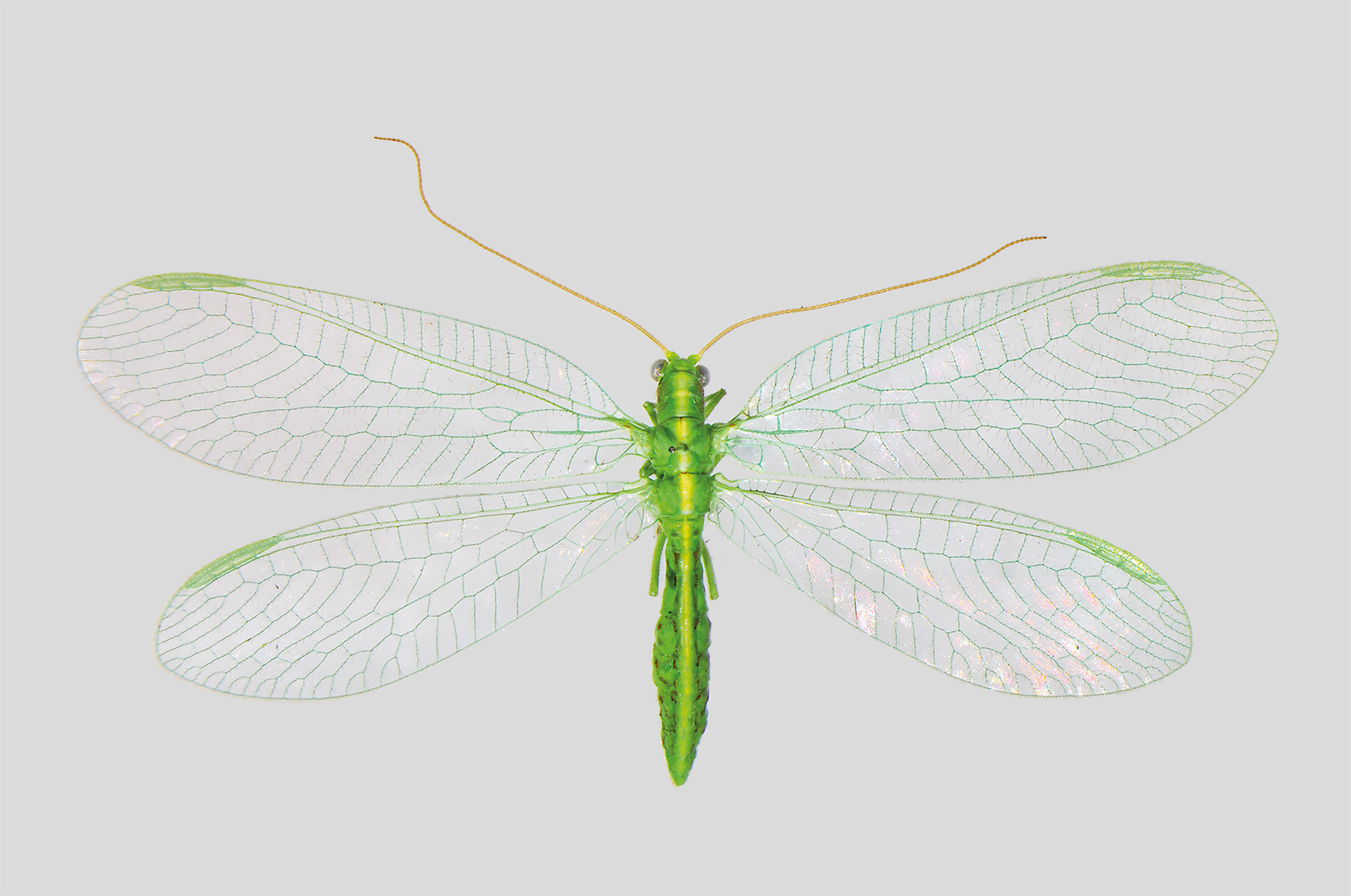
The adult is a delicate insect, about half an inch to three-quarters of an inch long, with a wingspan of roughly seven-eighths of an inch to an inch and a quarter — smaller than your pinky nail, wings included. The body is pale green, sometimes with a thin pale yellow stripe down the middle, and the four wings are transparent with a dense network of pale green veins. That net of veins is the giveaway for the whole order: lacewings belong to Neuroptera, the net-winged insects, a group that also includes antlions and mantidflies. At rest the wings are held rooflike, tented over the back, which is how you tell a resting lacewing from a resting damselfly at a glance — more on that below.
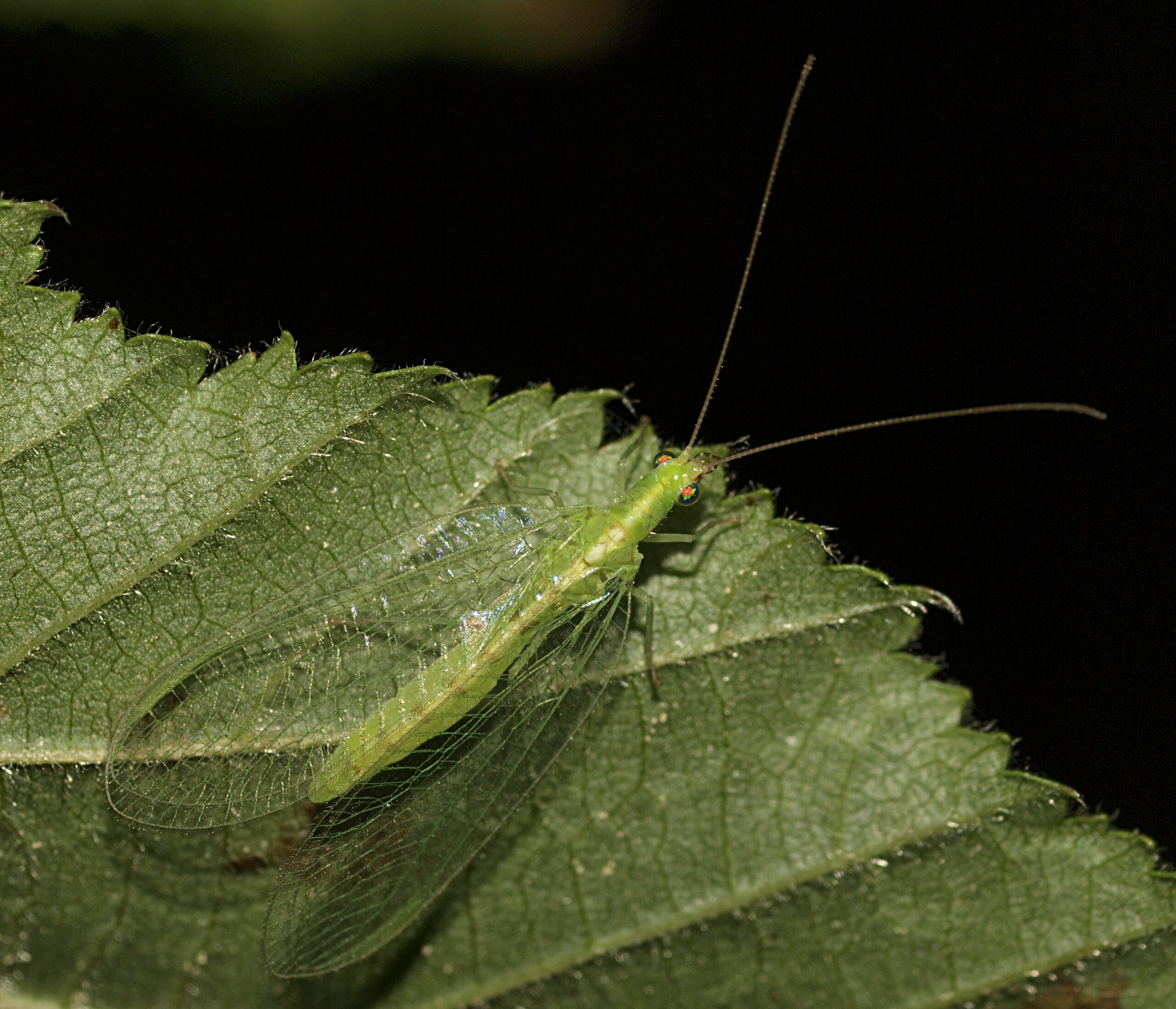
Then there are the eyes. Big, round, and gold or copper-colored, they catch the light like tiny beads. The antennae are long, thin, and threadlike, about as long as the body. The whole animal looks fragile, and it mostly is: green lacewings are weak, fluttery fliers, and they are nocturnal, which is why you meet them at porch lights and car taillights instead of in the midday garden.
Two more field marks, both useful. First, the smell: pick one up and it may release a sharp, unpleasant odor from glands on its thorax. That is a defense, not an attack — the insect equivalent of a skunk letting you know it would rather be put down. It is harmless, it washes off, and the lacewing is telling you, in the only language it has, to be gentle. Second, the color: in colder climates the adults can turn brownish for the winter, a seasonal costume change tied to overwintering. Florida’s warmth mostly skips that step, and our lacewings stay green and active through the year.
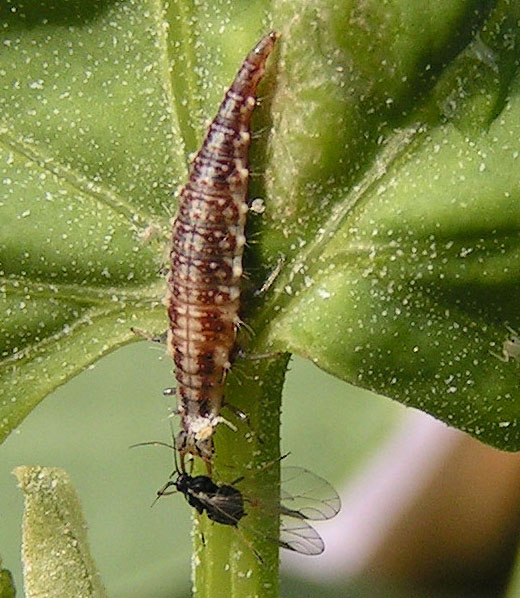
The larva looks like a different animal entirely, and it is the one that matters most. It is a mottled, alligator-shaped creature, grayish or brownish with dark markings, about a quarter to a third of an inch long when fully grown, with well-developed legs and two long, sickle-shaped jaws jutting from its head. If you see one on a leaf and think “tiny alligator,” you are on the right track — and you should leave it exactly where it is.
Lifecycle: four acts, and the second one does all the work
Green lacewings go through complete metamorphosis — egg, larva, pupa, adult — and the pest-control story lives almost entirely in act two.
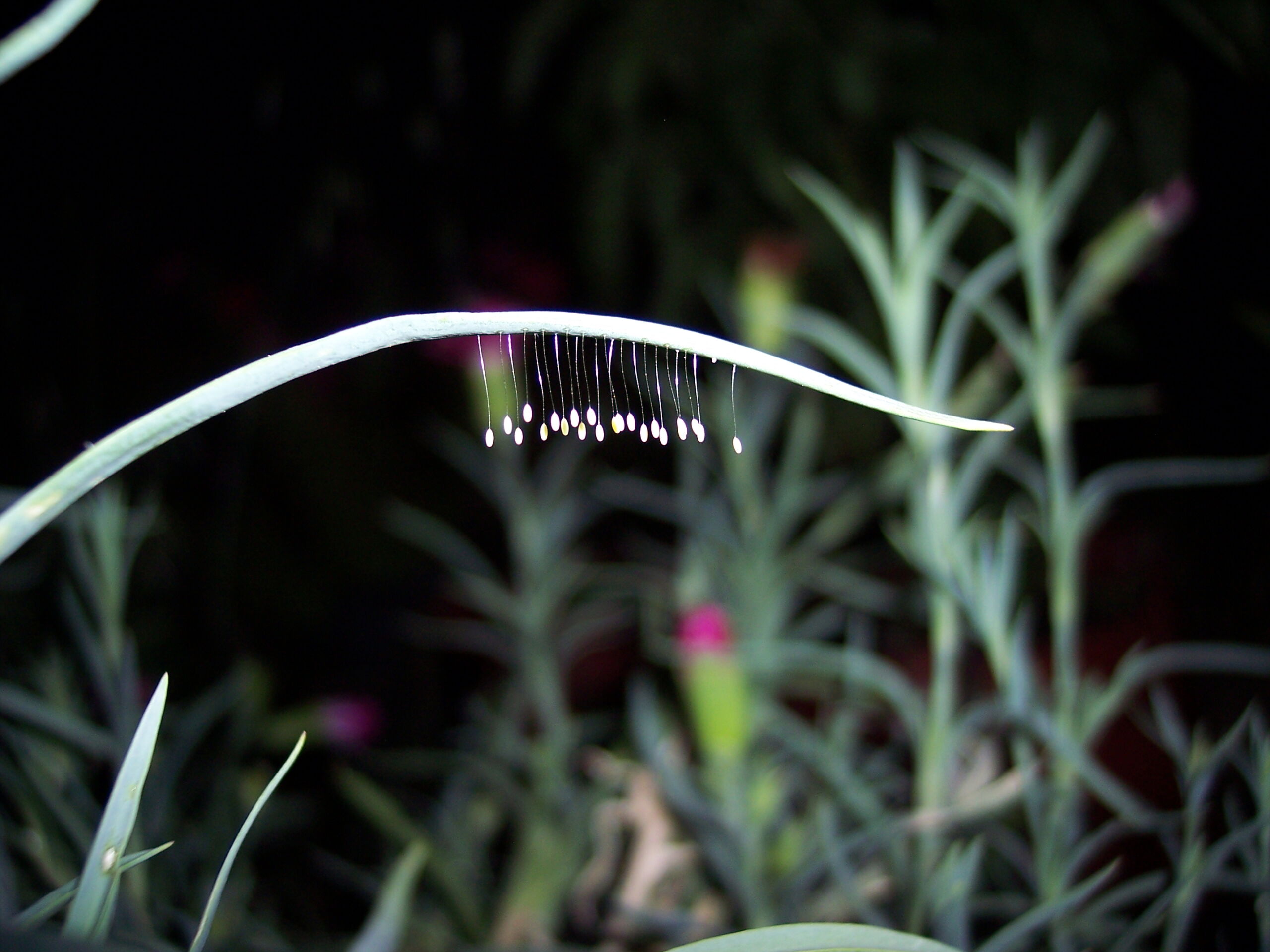
Act one: the eggs on stilts. A female lacewing lays her eggs singly, each one a tiny pale-green oval perched at the end of a hair-thin silk stalk about a quarter of an inch long. She often lays them near aphid colonies, sometimes in a spiral pattern on a leaf or a straight line along a stem, so the hatching larvae wake up next to breakfast. The stalk is the whole point of the exercise, and it does two jobs at once. First, it lifts each egg out of reach of the ants and other small predators that patrol leaves looking for something soft to eat — an egg lying flat on a leaf is an easy snack, and an egg on a stalk is a much harder one to reach. Second, lacewing larvae are strongly cannibalistic, and the first one to hatch would happily eat its unhatched siblings if they were lying flat on the leaf. Up on a stalk, each egg is out of reach of the others. Sibling rivalry starts early in the insect world, and the stalk is the mother’s answer to it. She lays a few eggs a day and several hundred over her lifetime, and the eggs hatch in roughly three to six days.
Act two: the aphid lion. The larva that hatches is a hunter from its first hour, and it hunts by touch — it blunders around the leaf until it bumps into something soft and small, then lunges. The sickle jaws are hollow, like hypodermic needles with a curve. The larva impales its prey, injects digestive juices, and sucks the insides out, leaving a dry husk behind. It is gruesome, it is efficient, and it is exactly what you want happening to your aphids.
The menu is the pest list every gardener knows by heart: aphids first and foremost, plus spider mites, thrips, whiteflies, small caterpillars, and the eggs of leafhoppers, moths, and leafminers. The larvae pass through three instars over two to three weeks, growing and eating the whole time. How many aphids does one larva eat in a day? Published figures vary so widely that pinning a number here would be inventing one — the honest statement is that a growing larva eats a lot, all day, every day, for two to three weeks, and a garden with a healthy lacewing population has noticeably fewer aphids on it. That is the whole business model, and it works.
Act three: the cocoon. When the larva is fully fed, it spins a round silken cocoon, usually in a sheltered spot on the plant or nearby, and pupates inside. The adult emerges after roughly a week or two, faster in warm weather.
Act four: the adult, on flower duty. Here is the part most people get backwards. The adult green lacewing of Chrysoperla carnea mostly does not hunt. It feeds on flower nectar, pollen, and aphid honeydew — the sweet waste aphids excrete, which is also how the adults find the aphid colonies where they lay their eggs. One honest footnote: that is true of Chrysoperla, the common green lacewings in most gardens — but in the cousin genus Chrysopa, the adults hunt too, jaws and all. If you ever see an adult lacewing eating an aphid, you have probably met a Chrysopa, not a Chrysoperla — same green suit, different dinner plans. The adults are pollinators by accident and pest controllers by parenthood: their job is to fly, feed on flowers, and lay the next generation of aphid lions. So if you see a lacewing on your flowers and wonder why it is not eating your aphids, it is doing exactly what it is supposed to do. Its children are the ones with the jaws.
Lookalikes: three animals that cause confusion
Brown lacewings are the closest relatives and the easiest confusion. They are smaller, brown instead of green, and also beneficial — their larvae and adults both hunt small pests. Color and size settle it: a brown lacewing is a brown lacewing, and a green one is green. Either way, you have a friend in the garden, so the distinction matters less than the welcome.
Damselflies are the lookalike most likely to fool you at a glance, because they are also slender, long-winged, and sometimes greenish. The differences are in the resting pose and the body. A damselfly holds its wings folded flat along its body when it rests; a lacewing holds its wings tented over its back like a little roof. A damselfly’s body is much longer and thinner, almost a needle with wings, and its eyes sit wide apart on a narrow head. Damselflies are daytime fliers usually found near water, while lacewings are nocturnal and come to lights. If it is sitting on your porch light at night with tented wings and golden eyes, it is a lacewing.
Antlions are lacewing cousins in the same order, and the adults look strikingly similar — net-veined wings, similar size, similar habits. The quick check is the antennae: antlions have short antennae with a distinct club at the tip, while lacewings have long, threadlike antennae with no club. If the antennae end in a little knob, you are looking at an antlion, whose larvae are the famous pit-builders of sandy soil. Also a beneficial insect, also welcome, just a different one.
And then there is the identity question within the group itself: the green lacewings all look alike, and the exact species is a job for a microscope. That is fine. For garden purposes, a green lacewing is a green lacewing, and the advice in this guide applies to all of them.
Why gardeners want them
Aphids are the pest that makes gardeners reach for the spray bottle first, and lacewing larvae are the reason you might not have to. The larvae eat the aphids themselves, and they eat the eggs and young of the other small soft-bodied pests that cluster on the same leaves. The pests they target are largely the same sap-suckers behind the stippled, curled leaves and sticky honeydew in our sucking-insect feeding-injury guide — so if you have been reading those symptoms on your plants, a lacewing population is the living version of the fix. Around a vegetable bed, that is a mighty useful neighbor: the larvae patrol the same leaves your tomatoes and peppers grow on, eating the pests that would otherwise eat the crop.
There are limits, and honesty demands them. Lacewing larvae eat prey their own size. They will not solve a problem with big caterpillars: a two-inch oleander caterpillar is far too large, far too spiky, and far too full of plant poison for a quarter-inch larva, and no number of lacewings will change that. They also will not rescue a plant that is already overwhelmed — they are a steady pressure that keeps pest numbers low, not a fire brigade for an infestation that has already exploded. Think of them as the garden’s immune system: always working, best appreciated before things go wrong, and no substitute for actually looking at your plants.
How to attract and keep them
Lacewings need two things from a garden: food for the adults and food for the larvae, plus somewhere to hide. Give them those and they will come on their own — Florida has plenty of them, and a garden that offers flowers and shelter is a garden they will find.
Feed the adults. Adult lacewings eat nectar and pollen, so small, open flowers are what they want — the kind with the nectar within easy reach of a small insect. Dill, fennel, yarrow, cosmos, sweet alyssum, and coreopsis are all good choices, and they are worth growing anyway. A garden with flowers blooming through the season holds adult lacewings; a garden with no flowers at all sends them looking elsewhere.
Leave them somewhere to hide. Lacewings shelter in leaf litter, mulch, dense foliage, and undisturbed corners. A garden that is raked bare and tilled flat every season has nowhere for a lacewing to spend the day, and nowhere for a pupa to wait out its week in a cocoon. Leave a corner a little wild. The lacewings will use it, and so will a dozen other useful things.
Leave them something to eat. This is the paradox of beneficial insects: a garden with zero aphids has nothing to keep lacewing larvae fed. You do not need to cultivate an infestation, but a few aphids on a plant are not an emergency — they are the reason the lacewings stay. The goal is balance, not sterility: enough pests to feed the predators, few enough that your plants never notice.
Do not spray. Broad-spectrum insecticides kill lacewings as efficiently as they kill aphids, and the aphids always come back faster than the predators do. A sprayed garden is a garden that has to start its whole pest-control ecosystem over from scratch, and the next aphid outbreak will arrive before the next lacewing does. The gentlest-first ladder in our integrated pest management guide is the whole plan: tolerate what you can, handpick what you cannot, and save the sprays for problems that have genuinely earned them. And do not let the word “organic” talk you out of that caution: pyrethrin and spinosad are organic-approved and still broad-spectrum killers on contact — a spray that lands directly on a lacewing larva or an egg-covered leaf kills it just as dead as a synthetic one would. Neem is gentler on adult beneficials, but its residues are harder on the soft-bodied young. “Organic” says where the chemical came from, not who it spares — so the same rule applies: spray only what must be sprayed, only where it must be sprayed, and never as a routine.
Buying lacewing eggs, honestly
You can buy green lacewing eggs by mail order, usually sold on little cards you hang on a plant, and the idea is tempting: order predators, hang card, watch aphids vanish. Here is the honest version.
What you are buying is eggs, and the larvae that hatch from them are the ones that do the work. Released larvae stay where the food is, more or less — they are small, slow, and motivated. Released adults, on the other hand, tend to fly off: they are weak fliers drawn to lights, and your garden is one of many options. So buy eggs or larvae, not adults, and release them in the evening, near the aphid colonies, on plants that actually have pests on them.
And the bigger honesty: mail-order lacewings help most where food and habitat already exist. If your garden has flowers for the adults, shelter for the pupae, and aphids for the larvae, a release is a boost to a population that was probably already on its way. If your garden has none of those things, the released larvae will eat what they can and then leave or starve, and you will have bought a one-time snack for your aphids’ enemies instead of a resident workforce. Fix the habitat first, then consider a release — in that order, and the order matters. A release is a supplement to a healthy garden, never a substitute for one.
What NOT to do
Do not spray them. Covered above, worth repeating: the spray that kills your aphids kills your lacewings too, and the aphids recover first.
Do not scrape off the stalked eggs. Those tiny pale-green beads on hair-thin stalks, standing up from the underside of a leaf like pins with green heads, are lacewing eggs — not pest eggs, not mold, not something wrong with the plant. They are the best news your garden can post on a leaf. If they are somewhere you genuinely must clean, move the whole leaf rather than scraping the eggs off it.
Do not clean up without looking first. Before you pull a spent plant or clear a bed, flip a few leaves and look underneath — that is where the stalked eggs hide, and a plant that looks finished to you may be a nursery to a lacewing. If a plant with eggs on it has to come out anyway, do not scrape the eggs off: cut the whole leaf, carry it gently to a sheltered spot on a nearby plant, and tuck it in there with the stalks intact. The eggs will hatch where they are, the larvae will drop onto their new plant, and you will have moved a whole aphid-lion nursery instead of destroying one.
Do not squish the larvae. A lacewing larva looks like a tiny mottled alligator, and a gardener who does not know what it is could easily mistake it for a pest. It is not. If you see a small, bristly, alligator-shaped insect prowling your leaves, leave it alone — it is at work.
Do not expect the adults to eat your aphids. The adults are on flower duty. If you are watching a lacewing stroll across a flower while aphids cluster two leaves over, nothing is broken. The aphid-eating generation is either still in its cocoon or already at work on the next leaf down.
Do not handle them roughly. They will not bite you, but they may release that sharp defensive odor if grabbed, and a lacewing is a fragile animal — a rough hand can damage wings that do not repair. Cup and card if you must move one, gently, and put it down somewhere sheltered.
In Florida
Green lacewings are common statewide in Florida and active year-round, with several generations a year in our warmth. They are nocturnal, and they are strongly drawn to lights — porch lights, security lights, and car taillights, which is how one ends up posing on a bumper at ten at night. Like fireflies, they are part of the night shift: the garden has a whole second workforce that clocks in after sunset, and lacewings are among its most useful members.
They overwinter as adults tucked into sheltered spots — leaf litter, sheds, garages, the quiet corners of a house. In colder climates the adults can turn brownish for the winter; Florida’s warmth mostly skips that costume change, and our lacewings stay green and working through the year. If you find one indoors in January, it is not lost. It is just spending the winter the way it always does, in the warmest shelter it could find.
Frequently asked questions
Are green lacewings dangerous to people? No. Adults do not bite and do not sting, and they have no venom worth mentioning. The larvae have jaws built for aphids, not people — they do not go after humans, and if one nips while being handled it is a startling pinch at most, not a bite to worry about. They are safe around children and pets.
Do they come indoors? Yes. Lights draw them in at night through open doors and windows, and a garage or shed population is common. A cup and a stiff card will move one outside without harm. Or leave it: a lacewing in a garage is eating the flies and mosquitoes that wandered in with you, and it asks for nothing in return.
What should I do if I find the stalked eggs? Leave them alone. Those tiny green beads on hair-thin stalks are lacewing eggs, and each one is a future aphid lion. Do not scrape them off, and do not spray the leaf they are on. If they are somewhere you must clean, move the whole leaf to a sheltered plant instead.
What do the larvae eat? Mostly aphids, but also spider mites, thrips, whiteflies, small caterpillars, and the eggs of leafhoppers, moths, and leafminers. Anything small, soft-bodied, and in reach is on the menu, which is why they are generalist predators rather than aphid specialists — aphids are simply the most common item on it.
Do the adults eat aphids too? Mostly no. Adult Chrysoperla carnea feed on flower nectar, pollen, and aphid honeydew. The larvae are the hunters. That split is the whole design: the adults fly and reproduce, the larvae eat, and the garden gets both pollination and pest control from the same insect.
How do I tell it from a damselfly? Look at the resting wings and the body. A lacewing holds its wings tented over its back like a little roof; a damselfly folds its wings flat along its body. A damselfly is much longer and thinner, usually found near water in the daytime. A lacewing is compact, green, golden-eyed, and out at night around lights.
Why is there one on my porch light / car? Because it is nocturnal and strongly attracted to lights, and a weak flier that follows the glow. Porch lights, security lights, and car taillights all pull them in. It is not lost or confused — this is normal lacewing behavior, and it is also why you mostly meet the adults at night instead of in the daytime garden.
Should I buy lacewing eggs? Only if the garden is ready for them. They help most where flowers, shelter, and aphids already exist — then a release boosts a population that was probably already on its way. Buy eggs or larvae, release in the evening near the aphid colonies, and do not expect a one-time release to fix an infestation or a garden with no habitat. Fix the habitat first.
Will they eat my big caterpillars? No. Lacewing larvae eat prey their own size — aphids, mites, thrips, whiteflies, small caterpillars, eggs. A large caterpillar, especially a spiky or toxic one like an oleander caterpillar, is far too big and far too well defended. That is a job for handpicking and the gentlest-first ladder, not for a quarter-inch larva.
Why does it smell when I pick it up? That is its defense. Green lacewings release a sharp, unpleasant odor from glands on the thorax when handled, to persuade whatever grabbed them to let go. It is harmless, it washes off with soap and water, and the correct response is to set the lacewing down gently somewhere sheltered and let it get on with its night.
The short version: the prettiest insect in your night garden is also one of the hardest working, and its children are the hardest working of all. Give them flowers, give them shelter, leave them a few aphids to eat, and put the spray bottle down. And remember the quieter half of gardening: learning what to leave alone matters just as much as learning what to get rid of. The lacewings will handle the rest — quietly, at night, while you sleep.
🌱 Keep learning
Three related guides worth reading next:
- Ponds, Ducks, Fish & Chickens — The backyard ecosystem guide: stacking animals, water, and garden into one system.
- Grow Your Own Chicken Feed — Cut feed costs with duckweed, forage crops, and fermented feed.
- The Living Root Reading List — Books and resources that make better gardeners without requiring a lab coat.
🪱 Your Soil Needs This
Reading about healthy soil is great. Growing in it is better. Our small-batch, traceable worm castings are the shortcut your garden deserves.
Shop Worm Castings Subscribe & SaveEvery bag comes with a lot certificate. Know what's in your soil.