
🌿 Air Plant
What it looks like
An air plant is a plant that looked at soil and said, “No, thank you.” Tillandsia is a genus of around 650 species in the bromeliad family, and nearly all of them are epiphytes — plants that grow on other plants, rocks, wires, and fence posts, anchoring with small roots and feeding through their leaves. No pot, no potting mix, no drainage drama. They hang in trees across the Americas, from the southern United States to Argentina, and one of them — Spanish moss — is so common in Florida that most people have never realized it is a flowering plant at all.
The secret is on the leaves. Look closely at an air plant and you will see a silvery, almost frosty sheen: thousands of tiny scales called trichomes. Those scales are the whole plant’s root system, stomach, and water bottle in one. They catch rain, dew, and dust from the air and absorb moisture and nutrients straight into the leaf. The greener and smoother the leaves, the more water the plant wants; the whiter and fuzzier the leaves, the more drought-tough it is. That one rule — silvery means dry-loving, green means thirsty — will carry you through almost every air plant you ever meet.
This is a genus guide, not a single-species guide, because “air plant” is a whole world. The three kinds below cover most of what you will find for sale, and the care rules in this guide apply to all of them, with the differences flagged where they matter.
The kinds you’ll meet
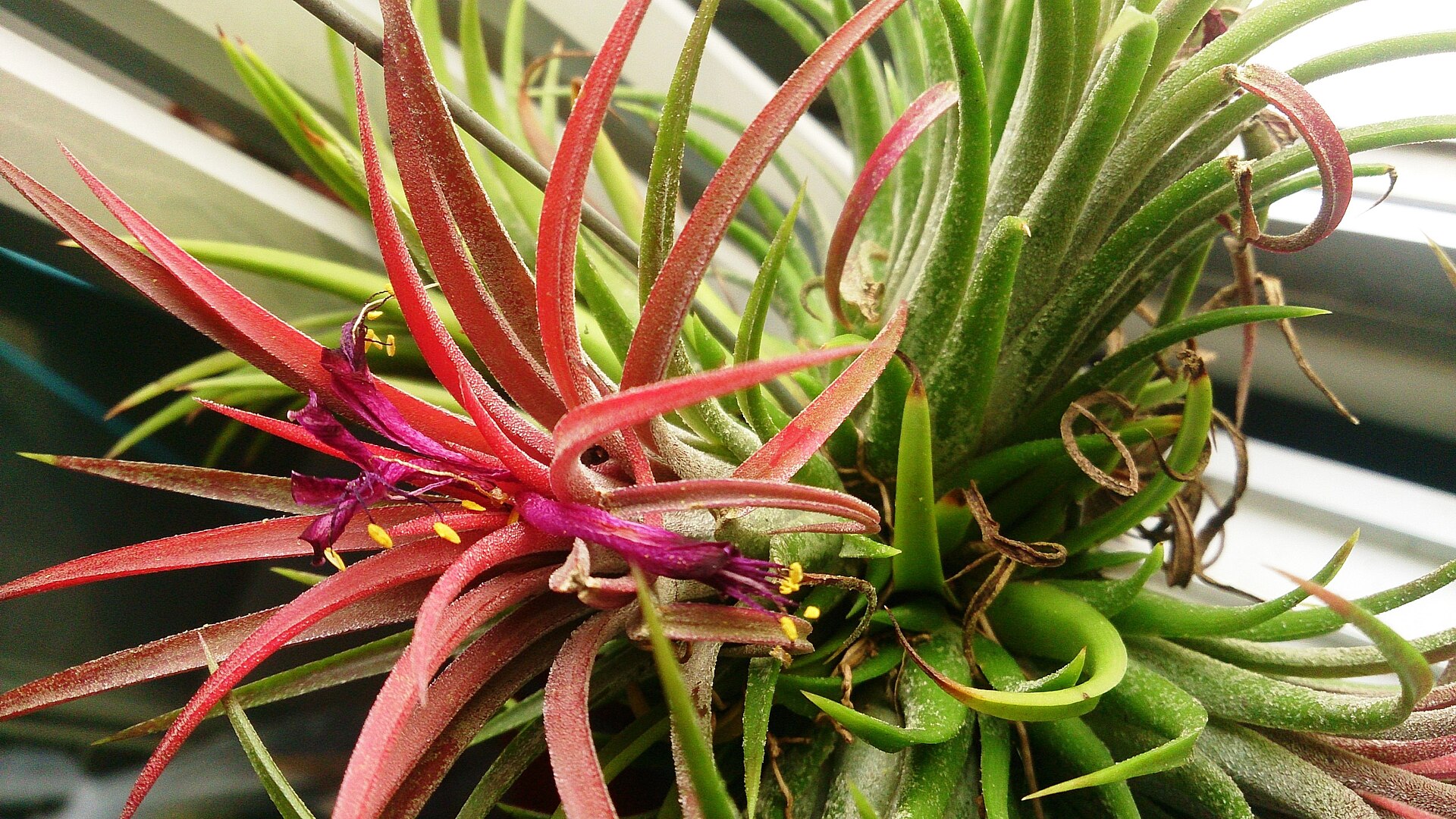
Tillandsia ionantha — the classic. Small, spiky, and everywhere: a rosette a few inches across that blushes bright red or pink when it is about to bloom, then throws up a tiny purple flower. Ionanthas are the gateway air plant, cheap, forgiving, and prolific with pups. They like regular soaking and bright light, and they are the best first air plant there is.
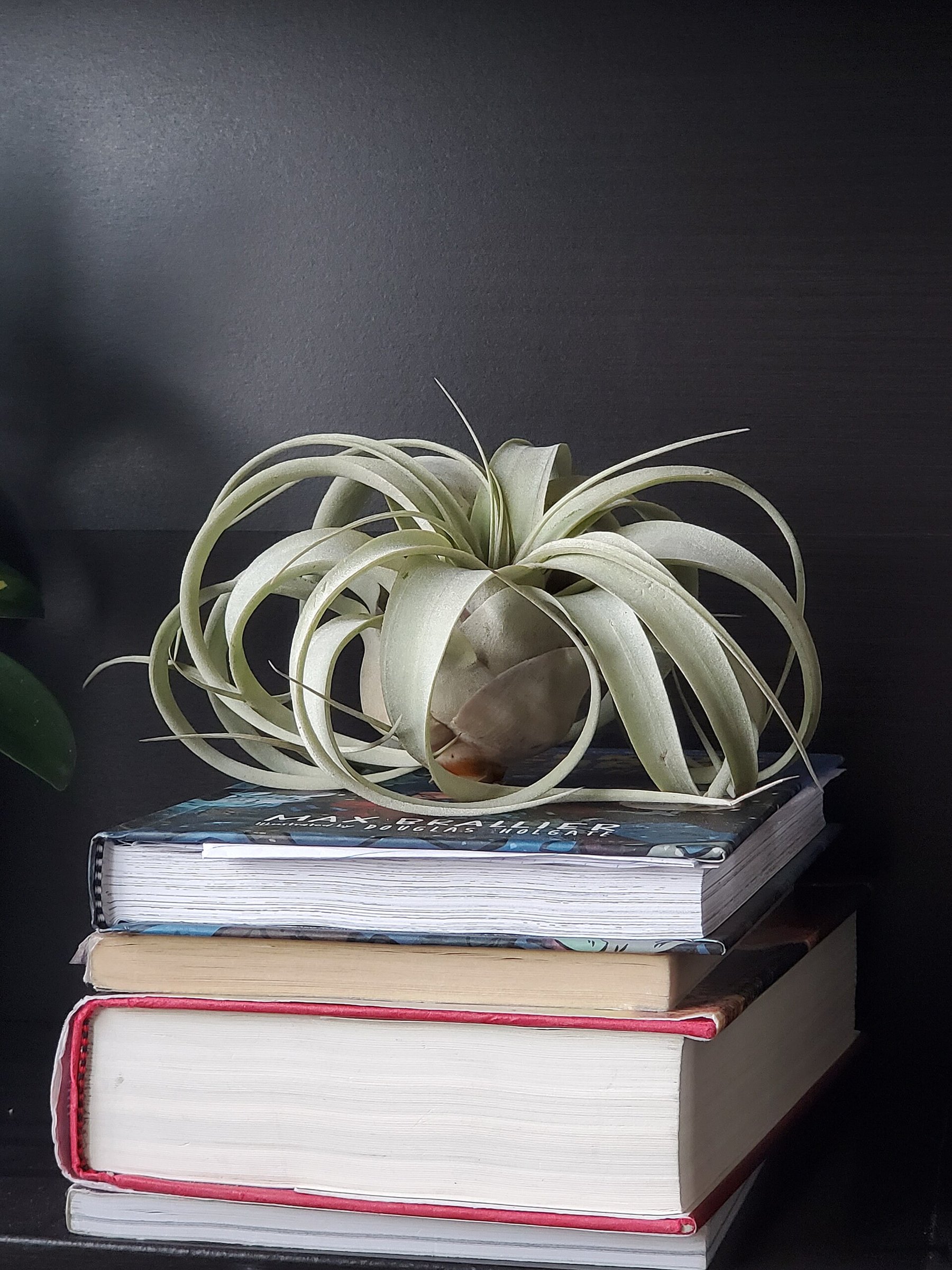
Tillandsia xerographica — the showpiece. A big, silvery rosette of wide, curling leaves that can reach a foot across, like a starfish made of frost. The name means “dry writing,” and it means it: xerographica is a xeric (dry-adapted) species from the deserts of Mexico and Central America, covered in dense trichomes. It wants less water than the others, more air movement, and a good long dry-out between soaks. It is also slow-growing and the priciest of the common kinds — buy it for the sculpture, not for fast results.
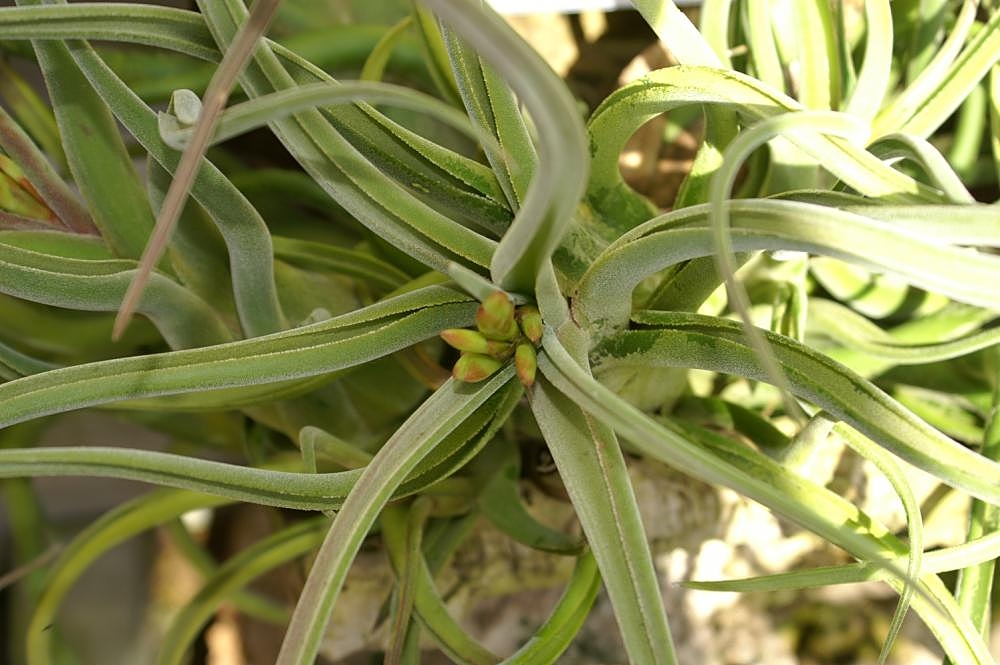
Tillandsia caput-medusae — the character. Its name means “head of Medusa,” and it earns it: thick, snaky leaves twist out of a bulbous base like a nest of snakes. It is a “myrmecophyte” in the wild, meaning ants live in its hollow base — do not worry, the ones you buy have been evicted. It likes bright light and regular watering, and it is one of the most dramatic-looking air plants you can hang on a wall.
Other common kinds worth knowing: Tillandsia usneoides (Spanish moss), the draping gray strands that hang from Florida live oaks — it is a flowering air plant, not a moss, and it grows wild all over the state; T. stricta, a small, soft-leaved rosette that loves humidity; and T. bulbosa, a bulbous-based cousin of caput-medusae that also hosts ants in the wild. If a shop tag just says “air plant” with no species name, it is usually an ionantha or a stricta — treat it as a green, moisture-loving type and you will be fine.
Light: bright and indirect, with air to spare
Air plants want bright, indirect light — near a window but out of the sun’s direct path. A few feet from a sunny window, or in an east-facing window with gentle morning sun, is ideal. The silvery xeric types like xerographica can take a little more sun than the green types; the green types like ionantha scorch more easily. Outdoors in Florida, hang them in dappled shade — under a tree, on a shaded porch, on a fence that gets morning sun only. Direct Florida afternoon sun will bleach and crisp them.
Light is only half the equation. Air movement is the other half, and it is the one beginners forget. In the wild, air plants live in moving air — that is how they dry out after rain, and drying out is what keeps them alive. A plant in a still, stuffy corner rots; the same plant near an open window or a ceiling fan thrives. Never keep an air plant in a closed terrarium or a jar with no airflow: that is a rot chamber with a cute label on it. Open-air display — hung, mounted on wood or cork, or set in a shell — is the way.
Water: the soak, the shake, and the dry
Here is the whole watering method in three steps: soak, shake, dry. Once a week, submerge the plant in room-temperature water for 20–30 minutes. Then shake it gently upside down to get the water out of its base and leaf joints. Then set it upside down on a towel for a few hours until it is completely dry before you put it back on display. That last step is the one that matters most. An air plant that stays wet at its base rots from the inside out, and by the time the center leaves pull out easily, it is already gone.
Green, smooth-leaved types (ionantha, stricta) like a weekly soak and a light misting between soaks in dry indoor air. Silvery, fuzzy types (xerographica, caput-medusae) prefer a shorter soak — 10–20 minutes — and a longer dry, every week to ten days. In a humid Florida summer outdoors, rain may do the watering for you; in air-conditioned winter air indoors, soak on schedule and do not skip.
Water quality matters more than it does for potted plants, because there is no soil to buffer anything. Rainwater is the gold standard, and Florida gives it away free. Distilled water or water left out overnight works too. Softened tap water is the one to avoid — the salt in it builds up on the leaves. Hard tap water is usable but can leave chalky spots on the trichomes; if you see white crust, switch to rainwater for a while.
And no — an air plant does not live on air alone. That is the myth that kills more air plants than anything else. “Air plant” means it does not need soil, not that it does not need water. A plant that is never soaked will slowly crisp up, curl inward, and die of thirst while its owner insists it is fine because it lives on air. It lives on air plus water. The air just delivers it.
Feeding: a whisper, once a month
Feed lightly, once a month in the growing season, with a bromeliad or orchid fertilizer at quarter strength — or any balanced liquid fertilizer diluted to a quarter of the label rate — added to the soak water. A little goes a long way: air plants absorb fertilizer through their leaves, and too much burns the leaf tips and leaves the plant looking scorched. In Florida, a monthly weak feed from March through October is plenty; skip it entirely in winter, and skip it for a month after the plant blooms or pups.
Do not use copper-based fungicides or fertilizers on air plants — copper is toxic to them. And never hang an air plant on copper wire for the same reason. Stainless steel, fishing line, plant-safe glue, or a simple wire hanger all work. If you are mounting a plant to driftwood or cork bark, a dab of waterproof glue on the base (never on the leaves) holds it until the roots grip.
Blooming: once, spectacularly, then the handoff
Every air plant blooms exactly once in its life. The show varies by species — ionantha blushes red and opens small purple flowers; xerographica sends up a tall, branching spike; caput-medusae produces a red bract with purple flowers — but the pattern is the same: the plant puts everything it has into one bloom, and then it slowly dies. This is not a failure. It is the plan. While it blooms and after, it produces pups — baby plants at its base — and those pups are the next generation. One plant becomes two, three, or five, and the colony keeps going. Do not throw away a blooming air plant, and do not throw away the mother while the pups are still small: she is still feeding them.
Common problems
- Center leaves pull out easily, base feels soft or smells sour: rot, almost always from water sitting in the base. The plant is usually lost, but pups at the base may survive — remove them and start fresh. Prevention is the soak-shake-dry routine, every time.
- Leaf tips browning and curling inward: underwatering or very dry air. Soak a little longer and a little more often, and mist between soaks. A plant that has curled tight like a fist is thirsty, not dead — a good long soak often brings it back.
- Leaves bleaching pale or going crispy brown on one side: sunburn. Move it out of direct sun, especially afternoon sun.
- Plant looks gray and dull, no growth: could be underwatering, or it could just be winter. Air plants grow slowly and rest in cool weather. Check the soak routine first, then be patient.
- White crust on the leaves: mineral buildup from hard water or fertilizer. Soak in rainwater or distilled water and cut back on feeding.
- Mealybugs or scale: cottony clumps or small brown bumps in the leaf joints. Rinse the plant, pick off what you can, and treat with insecticidal soap. Isolate it until the pests are gone.
- Plant falls apart when handled: severe rot or extreme desiccation. Check the base: if it is mushy, it rotted; if it is dry and papery all the way through, it dried out beyond saving.
Florida notes: your humidity is a cheat code
Florida is the easiest place in the country to keep air plants, and it is not close. The ambient humidity does a large share of the watering, the long growing season means they grow nearly year-round, and Spanish moss hanging from every live oak is living proof that these plants belong here. Hang air plants under a tree or on a shaded porch from spring through fall, bring them in (or cover them) when a freeze threatens — most Tillandsia suffer below about 40°F and die in a hard freeze — and let the rain and the humidity do the heavy lifting.
One Florida-specific caution: afternoon thunderstorms are a gift and a risk. A plant that gets soaked in a downpour and then dries in the breeze is thrilled; a plant that gets soaked and then sits in still, humid air under a solid roof can stay wet too long. Hang them where air moves, and tilt mounted plants so water runs out of the base instead of pooling in it. And if you collect Spanish moss from your own yard, give it a good shake and a soak first — it comes with hitchhikers, including the occasional chigger.
Propagation
Air plants propagate by pups — offsets that grow from the base of the mother plant, usually while she is blooming or just after. Leave the pups attached until they are at least a third to half the size of the mother: they are still drawing support from her, and a pup separated too early grows slowly and sulks. When a pup is big enough, gently twist or cut it away at the base with clean scissors, making sure it has a bit of its own base intact. Then treat it like an adult plant — soak, shake, dry — and it will grow on its own.
You can also leave the pups attached and let the plant become a clump. A clump of ionanthas in full blush is one of the prettiest things in the houseplant world, and clumps are more resilient than single plants, since the colony shares moisture. The only downside is that a clump needs more room and more thorough drying after soaking — shake it well and give it extra drying time.
Seeds exist — after blooming, some species produce fluffy, dandelion-like seeds — but growing air plants from seed takes years and greenhouse conditions, and it is not how anyone actually gets new plants. Pups are the method. One blooming plant and a little patience is a lifetime supply.
🌱 Keep learning
Three related guides worth reading next:
- Bromeliad — the wider family air plants belong to, from Guzmania to the pineapple on your counter.
- Pineapple — the most famous bromeliad of all, and the one you can grow from a grocery-store crown.
- Monstera — another tropical showpiece for the same bright room, with leaves that punch holes in themselves.