
🌳 American Sycamore: Growing Guide
What it looks like
Meet the tree
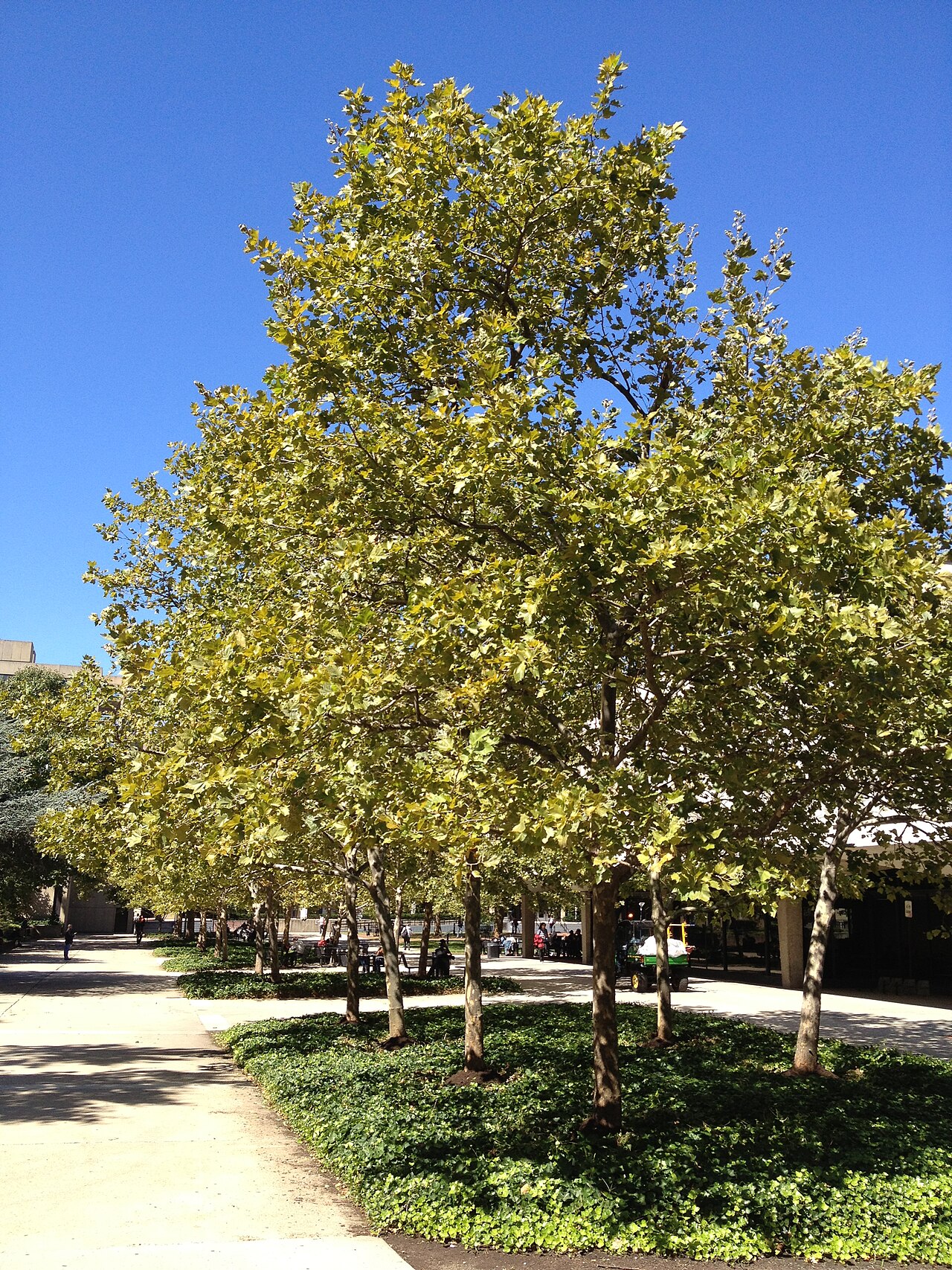
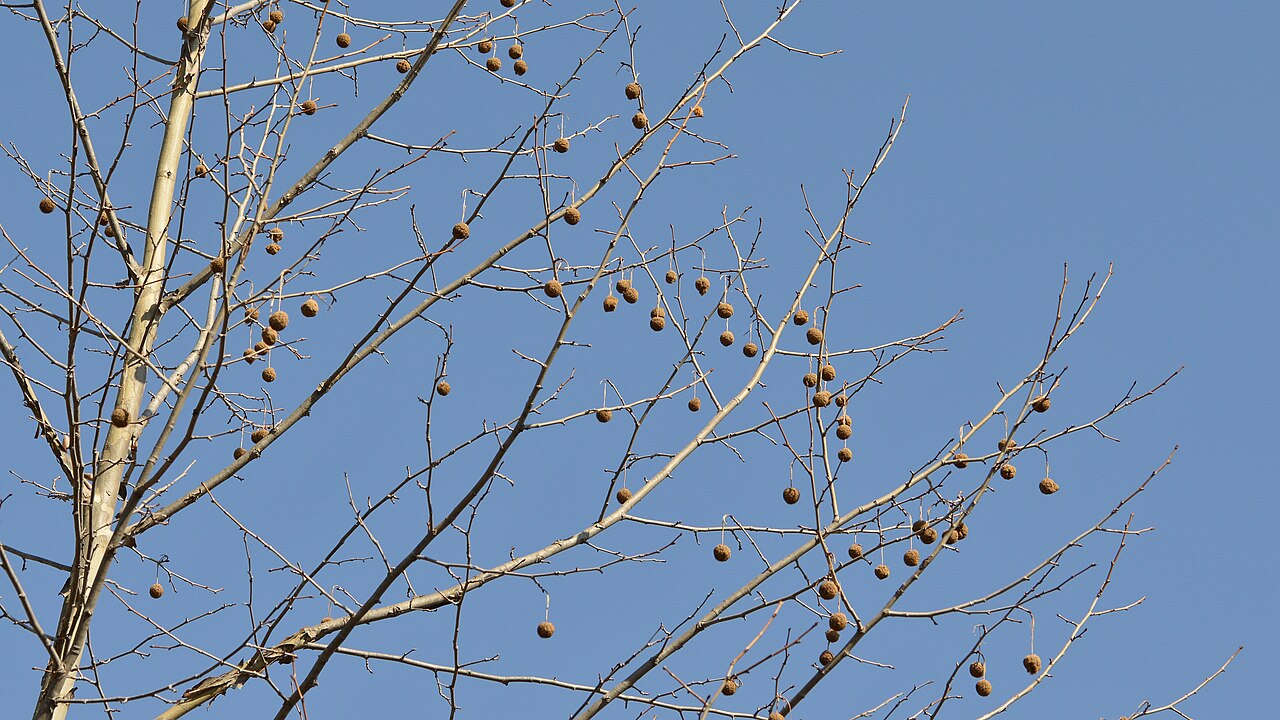
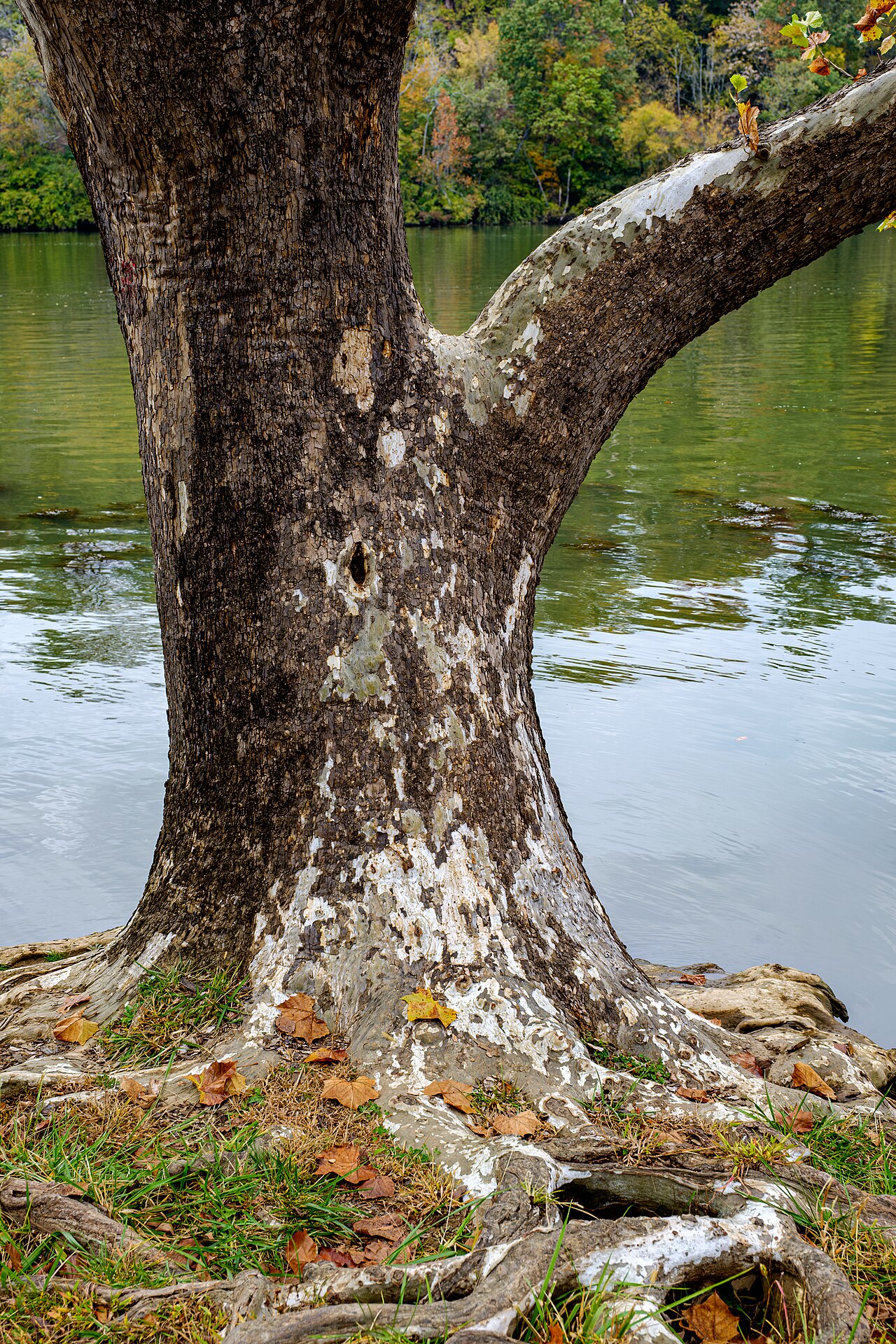
American sycamore — also called American planetree, buttonball tree, or buttonwood — is one of the largest broadleaf trees in North America, and it does not do subtle. UF/IFAS puts it at 75 to 90 feet tall with a 50- to 70-foot crown, and Florida 4-H Forest Ecology notes it commonly reaches 100 feet and rarely 150 to 170 feet, with a trunk 3 to 14 feet across. The leaves are the giveaway in summer: simple, alternate, broadly oval, palmately 3- to 5-lobed, 4 to 7 inches across, light green above with fuzz along the veins beneath, on stout hollow petioles 3 to 5 inches long that swallow the lateral buds in their swollen bases like a snake that ate a marble. The bark is the giveaway all year: thin bark that peels away in plate-like scales to reveal whitish-green inner bark, so the trunk looks mottled in cream, tan, and grey — camouflage print, but make it a tree. The fruit hangs in spherical heads about the size of ping-pong balls on slender stalks 3 to 6 inches long, each head a cluster of needlelike achenes with fine hairs for wind dispersal. Dad joke, required by law: sycamores do not shed bark because they are embarrassed. They shed bark because they are too big for last year’s outfit.
This guide is the standalone growing guide for American sycamore. For the native-plant profile, see American sycamore on Living Root Garden, and for the wider sycamore family, see Sycamore: Growing Guide.
Where it grows in Florida — think river, not rock garden
Sycamore is a bottomland tree by nature. UF/IFAS places it in riparian zones in moist soils along stream banks, the edges of swamps, and floodplain areas, and notes its roots intertwine and help stabilize soil, which is why sycamores are grown to minimize erosion, especially along stream banks, and why they have been planted over phosphate mining sites in Florida for reclamation. Give it what it wants — deep, moist, fertile soil and full sun — and it grows fast. Give it a dry, tight, hot island of a yard and it will grow slowly, look stressed, and drop leaves at you in protest. It tolerates saturated soil and acidic conditions, and once established it tolerates clay, flooding, compaction, and city pollution, which makes it tougher than its riverbank reputation suggests. It is not, however, a small-yard tree in any universe. UF/IFAS Key Plant, Key Pests advice is blunt: plant it with caution and forethought in urban settings because it can quickly outgrow smaller spaces. Forty to 50 feet from buildings, drives, and power lines is the starting point, not the stretch goal. If your lot cannot offer that, the honest answer is London planetree — the hybrid of American sycamore and Oriental plane, and the tougher city cousin named in the sycamore group guide — or a different tree altogether. Loving a tree and planting it in the wrong yard are two different things.
Planting
Plant in fall or early spring, at nursery depth with the root flare visible, in a wide hole in loosened soil. Water it in deeply, then mulch wide — 3 to 4 inches, kept off the trunk — because a young sycamore with steady moisture establishes far faster than one left to fend for itself. Stake only if the site is windy and the tree truly needs it, and remove stakes within a year so the trunk learns to stand on its own. Sycamore is fast-growing, and a fast-growing tree that is staked too long is a tree that never learned to be a tree. Site it over lawn or a natural area, not over a pool, patio, or driveway you love keeping clean: this tree sheds bark plates, enormous leaves (up to 9 inches wide, per UF/IFAS), and seed balls, and it considers that a feature, not a bug.
Water & feeding: moisture is the fertilizer
Water generously while establishing and in drought. Sycamore grows fastest with steady moisture and will slow markedly if dry, so deep, infrequent watering beats daily sprinkles. Once established near water or in naturally moist soil, it largely takes care of itself. Feed only if growth is poor: compost in spring — worm castings included — is enough for most trees, and a sycamore that is growing fast does not need pushing. If a sycamore looks hungry, check water first, because in Florida the usual story is “too dry,” not “too hungry.” Prune in late winter while young to remove dead or crossing wood and build a strong structure; mature sycamores mostly need deadwood removal and an arborist’s eye on old, hollow trunks (see below).
Pests, diseases & problems
UF/IFAS Key Plant, Key Pests: Sycamore (ENH1337) names the usual suspects, and none of them should panic you on a vigorous tree:
- Anthracnose in wet springs — leaves brown and drop, then regrow. Unsightly, rarely fatal on a vigorous tree. Rake and compost fallen leaves to reduce the local spore load, and do not reach for a sprayer you cannot aim at a 90-foot crown anyway.
- Sycamore lace bug — stippled, pale leaves in summer. Cosmetic in most years; healthy trees outgrow it.
- Bacterial leaf scorch, powdery mildew, and canker stain — all covered in the UF/IFAS Key Pests publication. Leaf scorch is the one to take seriously: scorched margins that spread, dieback, and decline deserve an arborist’s diagnosis, not a guess.
- Hollow trunks and falling limbs in old age — UF/IFAS notes sycamore is long-lived and may exceed 250 years in the wild, but often develops wood rot in old age, and falling limbs can be a concern. Have old trees inspected, keep targets (play areas, parking, roofs) in mind, and enjoy the wildlife habitat a hollow tree provides where it is safe to do so. A hollow sycamore is a condominium for owls, wood ducks, and bats — just not over your car.
- Litter — leaves, seed balls, and peeling bark, all year in some measure. This is the price of the camouflage trunk. Budget a rake, not a complaint.
Wildlife & ecology
Sycamore earns its place in a Florida landscape on ecology alone. Its seeds feed songbirds including purple finch, goldfinch, chickadees, and dark-eyed junco, plus mammals such as muskrats, beavers, and squirrels, according to UF/IFAS. Its intertwining roots stabilize stream banks, which is erosion control that also happens to be beautiful. Its hollow trunks shelter wildlife, and its broad crown is shade on a scale few trees can match. Historically, indigenous tribes used American sycamore medicinally, including for cold remedies, and in the 1960s and 1970s it was planted in southeastern plantations for timber — furniture, interior trim, boxes, pulpwood, and fuelwood. Today it is still valued for timber in the north and planted in urban landscaping for its fast growth, and in rehabilitation sites because it grows well in disturbed areas. A tree that holds a riverbank together, feeds finches, and once furnished houses is not decoration. It is infrastructure with leaves.
Florida mistakes to avoid
- Planting it 15 feet from the house because the nursery pot is small. The pot is a baby photo. The tree is the adult.
- Planting it in a dry, compacted hellstrip and wondering why it sulks. Sycamore wants moisture. Give it moisture or pick another tree.
- Panicking over anthracnose leaf drop in a wet spring and spraying a tree you cannot cover. It regrows. Breathe.
- Ignoring an old hollow trunk over a target area. Beauty and risk can share a trunk; get it inspected.
- Siting it over a pool or patio and then resenting the bark plates. The bark plates were in the brochure.
Saving seeds
American sycamore (Platanus occidentalis) is gloriously unbothered about reproducing — it flings its seed far and wide along rivers every year — but saving that seed yourself takes a little patience and a tolerance for fluff. The seed lives inside those spiky brown balls that dangle from the branches through winter. Each ball is a cluster of tiny achenes, each one wearing a tuft of fine hairs that catches the wind (and, less charmingly, catches in your nose and throat — do your seed-breaking outdoors, and wear gloves and a dust mask if you are sensitive to that kind of tickle).
Collect balls in late winter or spring, when they are brown and starting to break apart on the tree, rather than grabbing green ones in fall. Crumble a ball over a tray and pick out the small, dark seeds from the fluff. This is where the advice gets honestly messy: sources disagree about how much cold treatment sycamore seed needs, with recommendations ranging from about a month to about three months of cold. Some growers sow freshly collected late-winter seed straight away, on the logic that it has already spent winter hanging on the tree, while others refrigerate cleaned seed in barely damp sand for one to three months before sowing. If you collected your seed in fall, give it that cold spell in the fridge; if you collected it in late winter, you can try sowing it directly and still keep a backup batch chilled, just in case. Germination can also be staggered, with some seedlings appearing in a second spring, so do not throw a quiet tray away too soon.
Sow in spring, scattering seed on the surface of a loose, moist seed mix and covering it only very lightly — sycamore seed wants light and steady moisture, not burial. Keep the tray bright but out of scorching sun, and never let it dry out; a riverbank tree’s babies expect damp feet. Pot seedlings on individually once they are big enough to handle, grow them on somewhere sheltered for their first winter, and plant out in late spring or early summer after the last frost, giving the tree the enormous space it will eventually want. And one honesty note for the family tree: seedlings from a named cultivar will not reliably repeat that cultivar’s traits, and sycamore hybridizes readily with the oriental plane (Platanus orientalis) — the cross is the London plane — so seed from a tree growing near other planes may surprise you. Seed from an ordinary, open-pollinated species tree, on the other hand, grows true to species. In Florida, dry saved seed thoroughly before it ever goes into a jar — our humidity will mold it in storage — then keep it airtight with a desiccant packet, cool and dark, and sow it the following spring rather than hoarding it for years.
Sources
- UF/IFAS EDIS ST484, Gilman et al., “Platanus occidentalis: Sycamore” — size, zones, family, native range: edis.ifas.ufl.edu/publication/ST484
- UF/IFAS Florida 4-H Forest Ecology, “American Sycamore” — leaves, bark, twigs, fruit, size: florida4h.ifas.ufl.edu — American Sycamore
- UF/IFAS School of Forest, Fisheries, & Geomatics Sciences, Campus Tree Tour, “American Sycamore” — Moon Tree story, wildlife food, riparian habitat, timber uses: ffgs.ifas.ufl.edu/tree-tour/american-sycamore/
- UF/IFAS ENH1337, Borden et al., “Key Plant, Key Pests: Sycamore (Platanus spp.)” — anthracnose, lace bug, leaf scorch, powdery mildew, canker stain, urban caution, lifespan and hollow trunks: edis.ifas.ufl.edu/ep601
American sycamore native profile • Sycamore: Growing Guide • Browse all plant & pest guides