
🌾 Big Bluestem
What it looks like
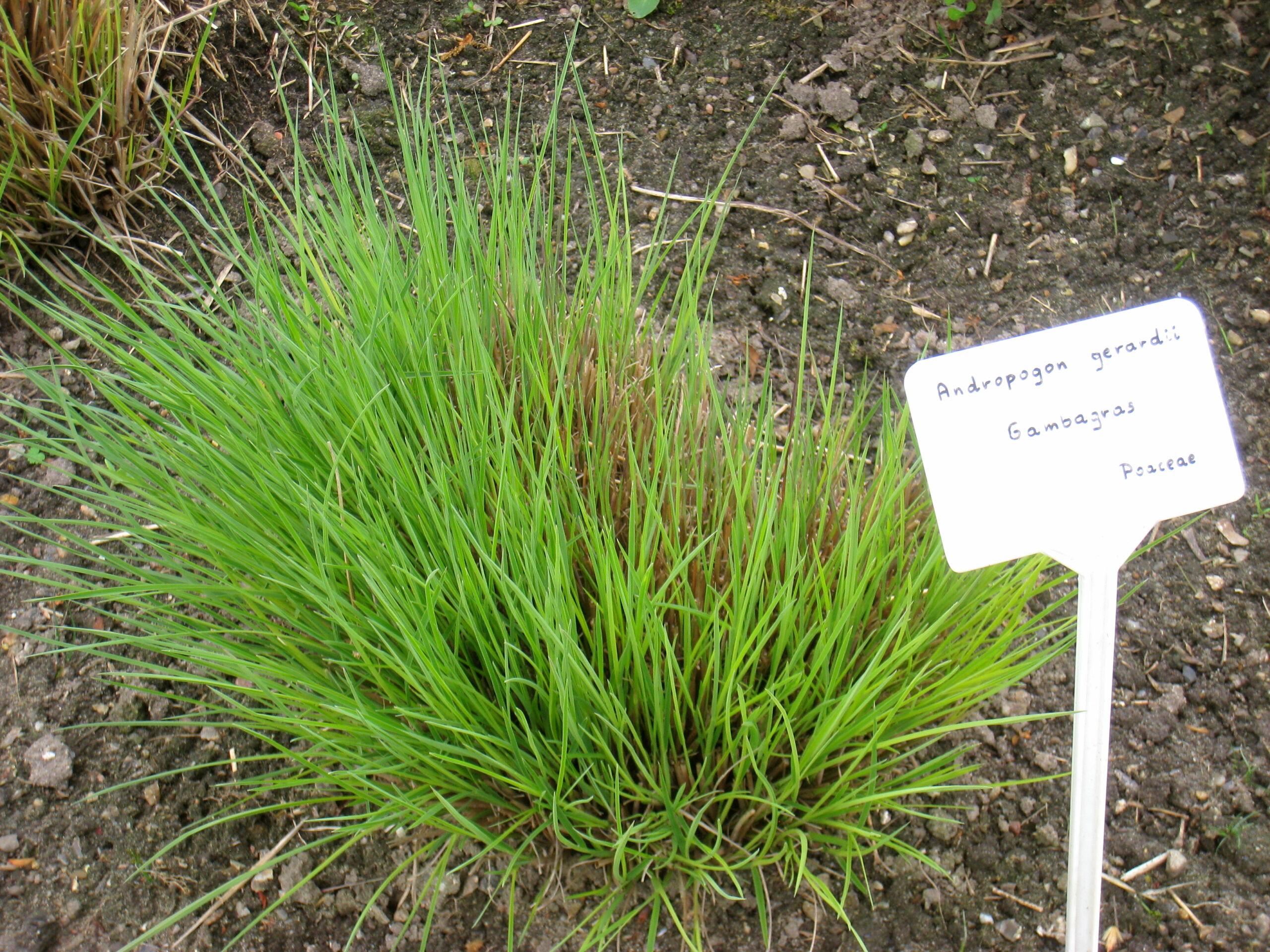
Big bluestem is not a plant you overlook. It is a warm-season perennial bunchgrass that stands 4 to 8 feet tall in flower — foliage usually 4 to 6 feet, with flowering stems rising above it in late summer — in dense, upright clumps of blue-green leaves that turn copper, bronze, and burgundy in fall and hold their shape, tawny and architectural, through winter. The stems carry a waxy, blue-tinted coating, especially near the base and the nodes, and that blue blush is where the name comes from: not blue flowers, not blue leaves exactly, but a blue bloom on the stems, like the bloom on a grape, that catches the light when the grass moves in the wind.
The flower head is the giveaway, and the reason for the plant’s other name, turkeyfoot. In late summer the stem tips split into two to six narrow, finger-like racemes — most commonly three — spreading outward like a turkey’s toes, purplish-red at first and fading to brown as the seed ripens. Each raceme is 2 to 4 inches long and packed with paired spikelets, one stalked and one stalkless, the fertile one tipped with a twisted, bent awn. Stand in a prairie in September and look at the horizon: the turkey feet are everywhere, nodding above the grass like a flock of small, rusty birds.
Underground, big bluestem is even more impressive than it is above. Its main roots reach 6 to 10 feet deep, with some reports of 12 feet or more, and it sends out strong, tough rhizomes that knit the plant into sod so strong that settlers breaking prairie with it famously cursed the stuff. That root system is the whole story of the tallgrass prairie in miniature: a grass that holds soil against wind and water, stores carbon deep underground, survives drought by drinking from depths other plants cannot reach, and comes back after fire because its growing points sit safely at or below the soil surface. You are not planting a grass. You are planting an anchor.
Florida note: Big bluestem’s native range does reach Florida, but read the zones before you get excited: this is a grass of zones 3–9, and it wants a real winter rest. In North Florida it is a plausible prairie-garden plant in full sun; in the peninsula’s warmer zones it is outside its range, and a warm-season grass that never gets cold will not perform the way it does on the prairie. Plant it where its zones say it belongs, not where its map says it once wandered.
Do not confuse it: Big bluestem (Andropogon gerardii) is one species, not the whole bluestem clan. Little bluestem (Schizachyrium scoparium) is a different, shorter grass in a different genus — it used to be classified as Andropogon scoparius, which is why old books lump them together. A separate group guide covers the bluestems as a group; this guide is about the big one only.
How to grow
Plant big bluestem in full sun in spring, after the last frost, and give it room: clumps spread 2 to 3 feet wide, so space plants 24 to 36 inches apart in a border, or mass them in drifts for a prairie effect. It tolerates a wide range of soils — average, dry to medium, well-drained soils suit it best, and it handles clay and sand — but it is less apt to topple in dryish, infertile soil than in moist, fertile soil, where it grows tallest and floppiest. Rich soil makes big bluestem big; lean soil makes it stand up straight. Choose accordingly.
From seed, sow in late spring when soil temperatures reach 65 to 70 degrees Fahrenheit, at a shallow depth of a quarter to a half inch — this is a warm-season grass, and cold soil means no germination, just patience wasted. From transplants, plant in spring and water well the first season. Either way, manage your expectations for year one: big bluestem is famously slow to establish, spending its first year or two building that enormous root system while showing only modest top growth, and typically taking 2 to 3 years to reach full size and vigor. The first year it sleeps, the second year it creeps, and the third year it leaps over your head — and then it stays, for decades, with almost no help from you.
Once established, maintenance is almost nothing. Cut stems to the ground in late winter before new shoots appear — Missouri Botanical Garden’s advice, and good advice, since it clears the tawny winter skeleton just before the spring growth starts. Do not cut it in fall if you can stand the look: the winter form is beautiful, birds eat the seed, and the standing stems shelter overwintering insects. Fire is part of this plant’s evolutionary history, and a controlled burn every few years, where legal and safe, rejuvenates a prairie planting — but it is not required in a garden, and a late-winter cut achieves most of the same renewal without the permits.
Water & feeding
Water regularly during establishment and then largely stop worrying. Once its roots are down, big bluestem is an excellent drought-tolerant grass — those 6- to 10-foot roots are doing the watering for you, pulling moisture from depths that make a sprinkler look like a joke. In a garden bed, supplemental water in severe drought is welcome but rarely necessary; in a prairie or meadow planting, no supplemental water at all is the honest regime. Overwatering is a bigger risk than underwatering, because wet, rich conditions produce tall, soft growth that topples in the first summer storm.
Do not fertilize it like a lawn. Big bluestem evolved on soils that nobody fertilized, and added nitrogen makes it taller, softer, and more likely to flop — the opposite of what you want from an architectural grass. A lean soil is a feature, not a failure. If you must feed, a light dressing of compost at planting is plenty, and after that, let the grass feed itself from the soil it has spent millennia learning to use. The one feeding it genuinely appreciates is fire, or its garden equivalent, the late-winter cut, which returns nutrients from the old stems to the soil surface.
Common problems
- Flopping: The classic big bluestem complaint, and almost always a sign of too much water, too much fertilizer, too much shade, or too rich a soil. Give it full sun and lean soil and it stands up; pamper it and it lies down. Shorter cultivars flop less — see the varieties list.
- Slow establishment: Year one looks unimpressive, and year two only moderately better. This is normal, not failure. The plant is building roots first and height later; by year three it will make up for lost time with interest.
- Self-seeding: Big bluestem seeds itself in favorable conditions, and volunteers appear in beds and paths. In a prairie planting this is a feature; in a tidy border, deadhead before seed ripens or pull volunteers while small.
- Shade intolerance: Big bluestem is shade-intolerant. In partial shade it grows thinner, flowers less, and flops more. If your spot gets less than six hours of direct sun, plant something else — this grass will tell you, politely at first and then by falling over, that it wants the sun.
- Confusion with little bluestem: Gardeners and even some nurseries blur big and little bluestem together under the one name. Check the Latin on the label: Andropogon gerardii is the big one, 4 to 8 feet; Schizachyrium scoparium is the little one, roughly half that. Both are wonderful. They are not interchangeable.
Harvest
Big bluestem’s harvest depends on what you are growing it for. As an ornamental, the harvest is the cut: leave the grass standing through winter for birds and winter interest, then cut stems to the ground in late winter before new growth. As forage or hay, it has a long history — it is high in protein and was long considered a desirable native forage — but it cannot tolerate overgrazing, and repeated close cutting weakens the stand, so graze or cut it rotationally and leave enough leaf to rebuild the roots. As a seed crop, harvest when the turkey-foot heads turn brown and the seed strips easily, and dry it promptly; seed saved from your own plants grows true to the species, though cultivars may vary.
And there is a harvest most gardeners forget: the seed heads left standing feed birds through fall and winter, and the dense clumps shelter everything from skipper caterpillars to overwintering insects. Big bluestem is a caterpillar host plant — the reason it appears in butterfly guides at all — and a meadow of it, left a little wild, does more wildlife work than a mowed lawn ever will. The best harvest from this grass may be the one you never take.
Saving seeds
Big bluestem (Andropogon gerardii) is a grass that wants to make seed, and then immediately throw it to the wind — which is your first problem and your whole timetable. Watch the turkey-foot heads in late summer and autumn: when they have turned brown and the seed strips easily from the raceme with a gentle pull, they are ready. Cut whole heads into a paper bag before a dry, windy day does the harvesting for you, because mature heads shatter from the top down, and the seed you lose to the breeze is seed you will never find again in the lawn.
Dry the heads in the bag for a few weeks in a cool, dry place, then rub or strip them to free the seed. Big bluestem seed is chaffy stuff, all awns and fluff, and home gardeners do not need a seed-cleaning machine to use it: a bit of chaff in the packet is fine, as long as the seed itself is dry. Rubbing out the awns by hand, if you have the patience, makes sowing less like wrestling a tumbleweed. In Florida humidity, “dry” has to be a decision, not a hope — finish drying indoors with airflow, and only seal seed away once it feels papery and cool, not faintly damp. Store it in a labelled paper envelope inside an airtight jar with a desiccant packet, cool and dark, and plan to sow it the following spring rather than hoarding it for years; grass seed kept at home loses vigour fairly quickly.
Here is where the sources politely disagree with each other, and honesty demands saying so. Some prairie references say big bluestem needs no stratification at all and germinates better after a year of cool, dry storage; others call for about a month of cold, moist chilling, and still others give four to six weeks. The home-garden way around the argument is to let winter do the work: sow outdoors in autumn, so the seed gets its cold spell naturally, or, if you are starting indoors, give it a month in damp mix in the fridge before sowing in spring. Either way, sow shallowly — about a quarter to a half inch deep — into warm soil, keep it evenly moist, and expect germination over a few weeks, not overnight.
Two truths to carry with the packet. First, seed saved from the straight species grows true to the species, which is exactly what a prairie or wildlife planting wants. Seed from a named cultivar, on the other hand, will not reliably repeat that cultivar’s colour or form, and because bluestem is wind-pollinated, seed from a plant standing near a different cultivar may be a mix. If you want ‘Pawnee’ again, divide ‘Pawnee’ or buy it; if you want big bluestem, your own seed is perfect. Second, be patient with the result. A seedling bluestem spends its first season looking like an ordinary tuft of grass and only becomes the towering, turkey-footed giant in its second or third year. Leave a few heads standing unharvested, too — the birds that eat them through winter are part of the harvest.
Varieties
- ‘Pawnee’: The refined prairie classic — bluish-purple stems, warm fall color that hangs on into winter, and roots deeper than your shovel.
- ‘Red Bull’: The tallest of the bunch — well over seven feet of prairie drama that somehow refuses to flop.
- ‘Dancing Wind’: The fall-color show-off — the longest-lasting, most intense red foliage of the big bluestems, swaying but never slumping.
- ‘Red October’: The scarlet showstopper — deep green with red highlights in spring, candy-apple red after the first frost, seed heads to match.
- ‘Blackhawks’: The compact showstopper — five feet of near-black fall drama, crowned the 2026 Perennial Plant of the Year.
- ‘Rain Dance’: The maroon dancer — red-tipped green leaves that turn totally maroon in fall, on upright red stems that refuse to be ignored.
- ‘Blue Warrior’: A nursery selection noted for deeper bronze color in stem and seed head, in the same bronze-stemmed family as ‘Dancing Wind’.
- Straight species (Andropogon gerardii, no cultivar name): The wild form, variable in height from 4 to 8 feet depending on soil and moisture, and the right choice for prairie restoration and wildlife plantings where genetic diversity matters more than uniform color.