
🌿 Cape Blanco Stonecrop
What it looks like
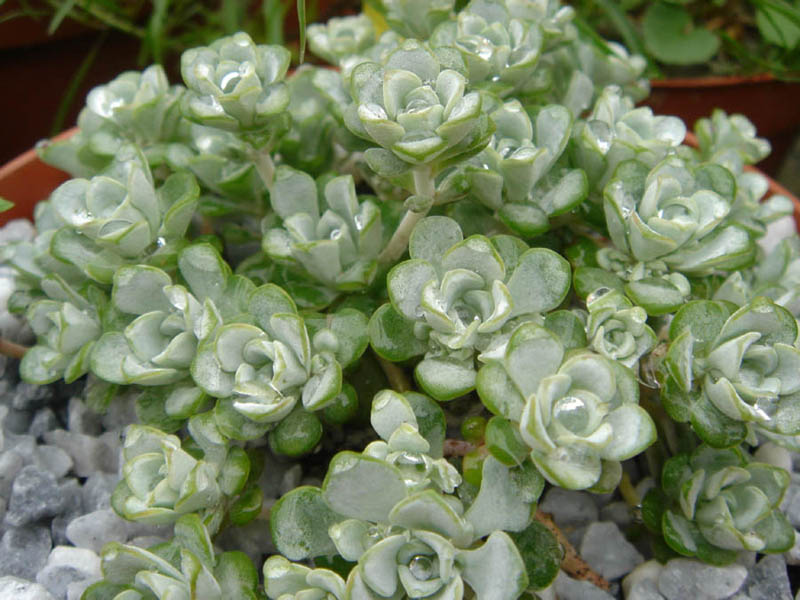
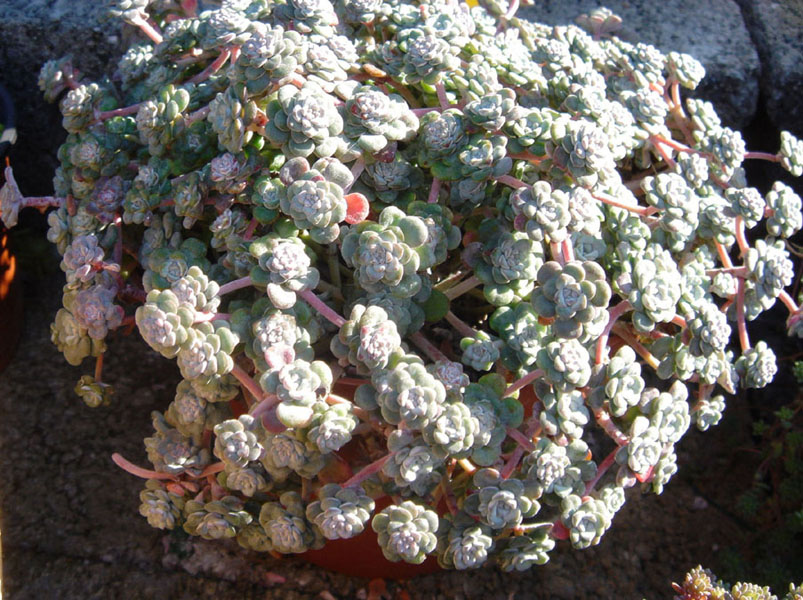
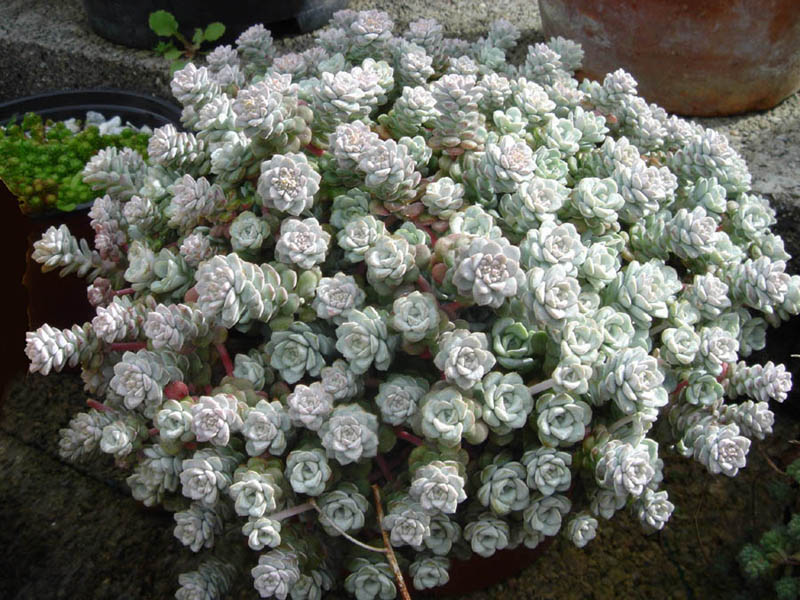
‘Cape Blanco’ is the stonecrop that looks dusted with frost in midsummer. It forms a dense, spreading mat of small, spoon-shaped, fleshy rosettes, each leaf thickly coated in a white, powdery, waxy bloom that gives the whole plant a silvery-white, pewter appearance. It grows about 4 inches tall and spreads to 24 inches wide, colonizing rock walls, crevices, and trough edges with cheerful determination. In summer it covers itself in flat clusters of bright, mustard-yellow, star-shaped flowers on short stems — pretty, but honestly an afterthought next to the foliage. It is named for Cape Blanco, Oregon, where the wild form grows, and it holds the Royal Horticultural Society’s Award of Garden Merit. In cold winters the rosettes can flush magenta, a bonus color show.
Why this variety
Plant ‘Cape Blanco’ when you want a groundcover for a place where almost nothing else will grow: a rock wall, a stone trough, a gravel edge, a crack between pavers with no foot traffic. It is more compact and more heavily powdered than the wild species, and it is one of the most widely grown stonecrops in the world for exactly that combination of toughness and beauty. The trade-off is that it is a Pacific Northwest native at heart: it thrives in mild, cool, maritime climates and merely tolerates heat. In Florida it is a container plant for a bright, airy, sheltered spot, not a bed plant — and that honesty matters more than enthusiasm.
How to grow
Plant ‘Cape Blanco’ in full sun to part shade in light, sharply drained, even poor and rocky soil — a gritty succulent mix in a container, or a rock-wall pocket with gravelly soil in the ground. Space 9 to 12 inches apart and let it knit together. Water sparingly: it stores water in its leaves and prefers to dry out between waterings. Propagate with absurd ease from stem cuttings or divisions — snap off a rosette, lay it on gritty soil, and it roots. Do not plant it where it will be walked on; the fleshy rosettes crush easily.
Water & feeding
Water little and rarely. ‘Cape Blanco’ survives on rainfall alone in suitable climates, and in a container it wants a thorough soak followed by complete drying. Overwatering is the fastest way to kill it — soft, rotted rosettes are the signature of too much kindness. Feed almost never; a lean soil keeps the rosettes tight and the powder thick.
Common problems
Rot from wet soil is problem number one, followed by heat and humidity stress in warm climates, where the plant thins and loses its powder. Slugs and snails may nibble rosettes in damp weather, and mealybugs can colonize stressed plants. One caution: stonecrop sap can irritate skin and the plant causes stomach irritation if eaten, so handle it as an ornamental and keep it out of the salad bed. Its one virtue in the pest department is that deer and rabbits mostly leave it alone.
Harvest
There is no edible harvest — the harvest is the carpet itself, and the cuttings you give away. Take stem cuttings any time in the growing season for new plants, and trim back any straggly growth after flowering to keep the mat tight. The yellow flowers can be left for pollinators, who visit them enthusiastically, or deadheaded for a tidier mat.
For the species as a whole, see the Broadleaf Stonecrop guide.