
🌿 Common Wireweed
This guide exists because a photo asked for it. Our photo-ID tool looked at a wiry little plant with small yellow flowers and serrated leaves, called it common wireweed — Sida acuta — at 69%, and then admitted, “We don’t have a guide for this one yet.” The owner of the photo said, in so many words: make a guide, include all the varieties, and tell me if it’s safe or not. So here it is — the varieties question answered honestly (spoiler: there are fewer than you’d think, and none of them gets its own guide, for reasons you’ll see below), and the safety question answered with sources instead of vibes.
First, the framing, because it matters for everything that follows: common wireweed is not a plant you grow. It is a plant that grows. It grows in the crack in your driveway, along the fence line, at the edge of the pasture, in the bed you meant to weed last weekend. It asks for nothing — no water, no fertilizer, no attention — and in return it gives you small pale-yellow flowers for months, a taproot that holds on like it has a mortgage, and hundreds of seeds per plant, each one ready to hitch a ride on your trousers, your dog, or your wheelbarrow. It is a weed in the honest sense of the word: a plant thriving exactly where you didn’t plant it.
It is also a native plant, in Florida at least, and a plant with a long history as a traditional medicine, a fiber source, and a butterfly host — which is why the safety question is worth a careful answer rather than a shrug. Wireweed sits in that awkward middle ground where “native” and “welcome” are not the same word, and “used in traditional medicine” and “safe to try at home” are definitely not the same sentence. This guide keeps those distinctions straight. For the genus as a whole — the whole fanpetal clan, including the arrowleaf, country mallow, and prickly sida cousins you’ll meet in the lookalikes section — see the Fanpetal genus guide.
What it looks like
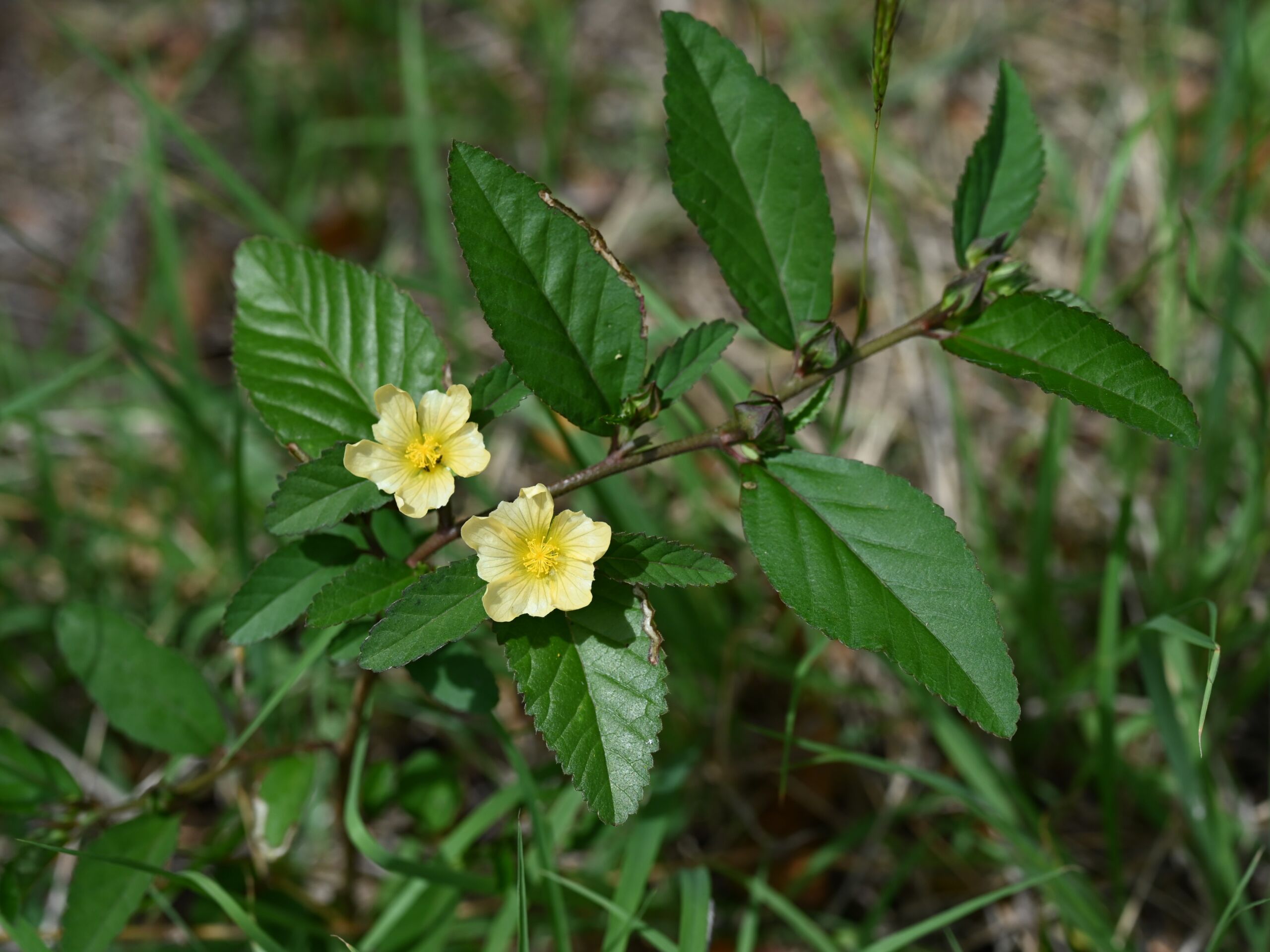
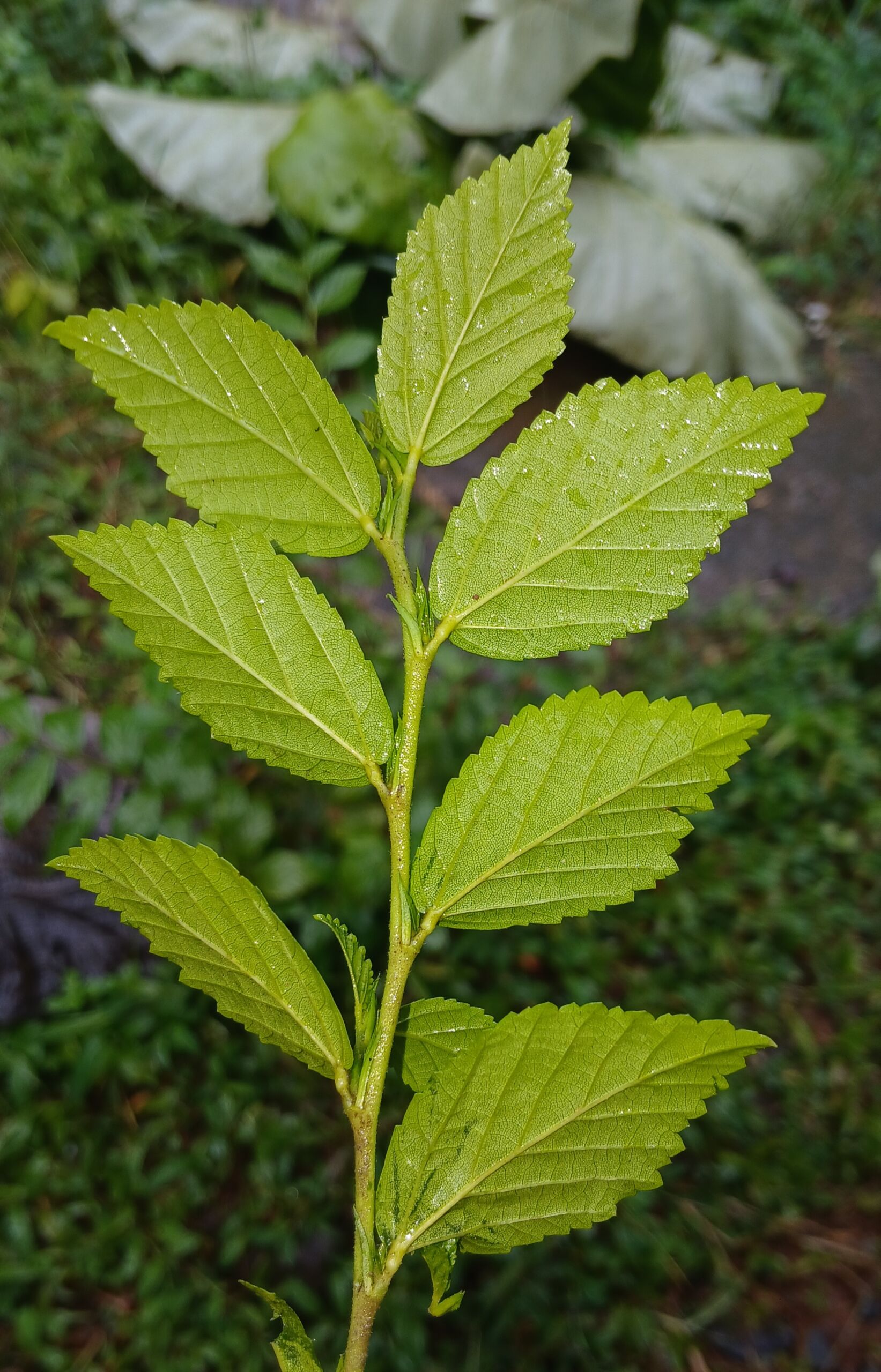
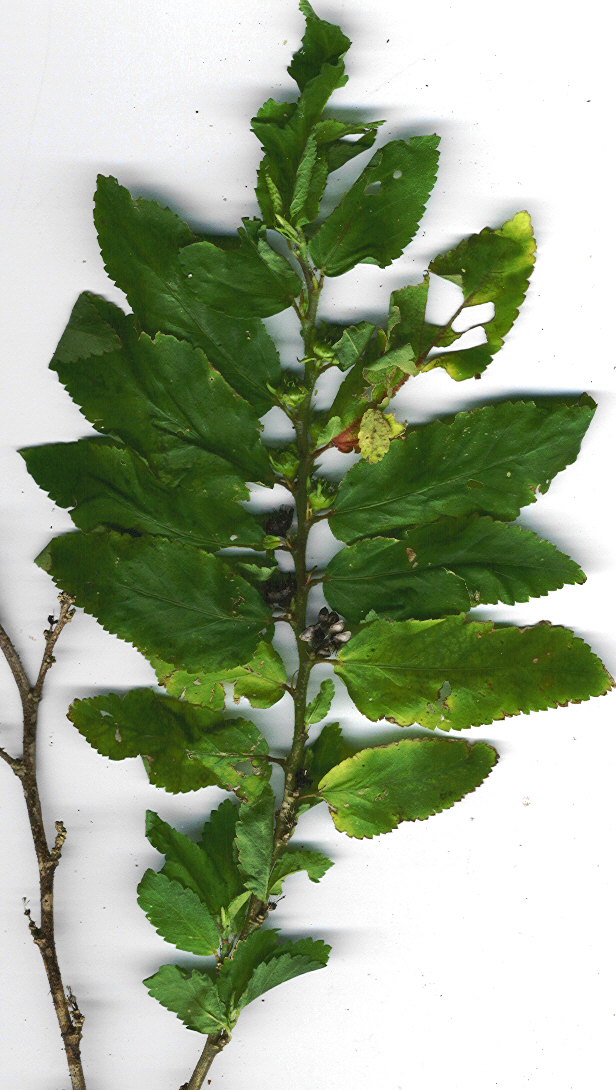
Start with the leaves, because they are the best field mark and the reason the plant photographs so well. They are narrowly ovate to elliptic — lance-shaped, in plain English — about 2 to 8.5 centimetres long, arranged in two neat opposite rows along the stem (botanists call this distichous, from the Greek for “two rows,” and once you see it you can’t unsee it). The margins are sharply toothed, like a bread knife, the tip comes to a fine point, and the veins stand out clearly on the underside. The leaves are usually smooth or only lightly hairy, which separates wireweed at a glance from its velvety cousin country mallow — more on that in the lookalikes.
The flowers are small and easy to miss if you’re walking past, and charming if you stop. Each one is a five-petalled fan, 6 to 9 millimetres across — about the width of a pencil eraser — in creamy white, pale yellow, or apricot, carried singly or in pairs on short stalks from the leaf axils. They open in the morning and fade by afternoon, but the plant makes them for months, so there’s always another one coming. If you’ve ever wondered why the genus is called “fanpetal,” this is why: the petals open like a little hand fan.
The rest of the plant is built for persistence. The stems are slender, tough, and wiry — the “wire” in wireweed — and woody at the base on older plants, with a deep taproot underneath that is the real reason pulling it feels like a workout. The whole plant is usually 1 to 3 feet tall in a Florida garden, though in the frost-free tropics it can reach 10 feet and turn properly shrubby. The fruit is a small roundish capsule that splits into 6 to 8 segments, each tipped with a short spine about 1 to 1.5 millimetres long. Those little spines are the plant’s travel plan: the segments catch on fur, fleece, and fabric, and one plant can produce hundreds of seeds. That is how a weed that nobody planted ends up everywhere.
One nerdy detail for the chromosome counters: Sida acuta has been recorded with two chromosome numbers, 2n = 18 and 2n = 28 — which is the kind of thing that makes taxonomists sigh and gardeners shrug, but it hints at why this plant is so variable and so hard to pin down. It is also why the varieties section below is the length it is.
Where it grows
Common wireweed is a pantropical plant, which is a polite way of saying it lives everywhere warm. It is native to tropical America and now grows throughout the tropics and subtropics of the world — roadsides, agricultural fields, pasture edges, forest margins, waste ground, and anywhere else the soil has been disturbed and the sun reaches it. In Florida it is a native plant: the Institute for Regional Conservation lists it as native to the southeastern United States, present in South Florida, and secure, and UF/IFAS describes it as a native perennial ranging from South Carolina through Florida and west into Mississippi. Its Florida growing season runs from late spring until frost, and in frost-free South Florida it can keep going year-round.
It likes exactly the conditions gardeners complain about: full sun, poor soil, dry spells, and neglect. UF/IFAS notes it is drought-resistant, tolerates heavy browsing, and forms dense stands along highways, in fields, and at the edges of woodland. It does not need your help, your compost, or your irrigation — rainfall is plenty, and rich soil mostly makes it leggier rather than happier. The seeds do the rest: they stick to clothing, animal fur, farm machinery, and vehicle tires, and they wait in the soil until conditions suit them, germinating in staggered waves rather than all at once. A single bad week cannot wipe out a wireweed seed bank, which is why pulling this year’s plants does not always mean you won’t see next year’s.
None of this is a reason to plant it on purpose. It is a reason to understand what you’re looking at when it shows up, and to decide deliberately whether this particular patch stays or goes — which is the subject of the safety section below.
Varieties
The owner asked for all the varieties, so here is the honest answer, and it is shorter than anyone expected: there are no accepted varieties of Sida acuta. Not one. The world’s two big plant-name databases — Plants of the World Online at Kew, and the World Flora Online — list no accepted infraspecific taxa for this species. The GBIF backbone, which aggregates global occurrence and taxonomy data, lists exactly one child name under Sida acuta: Sida acuta var. typica, published by K. Schumann in 1891. And var. typica is not a real variety at all — it is the “type variety,” which is nomenclature’s way of saying “the species itself, restated.” When a botanist splits a species into varieties, the original form automatically becomes the autonym variety — in this case var. acuta — and the old name var. typica is just a synonym of that. It describes no distinct plant, has no distinct range, and has no distinct growing information. There is nothing to build a guide about.
That is the whole list of what the databases accept. But old books and plant lists carry other names, and since the owner asked for all the varieties, here are the ones you will meet — and what actually happened to each of them:
| Name you may find | Published | What it is now |
|---|---|---|
| Sida acuta var. typica K.Schum. | 1891 | The autonym restated — a synonym of the species itself, not a distinct plant. |
| Sida acuta var. garckeana (Pol.) Baker f. | 1892 | Unplaced in World Flora Online — a name no taxonomist has yet been able to place in the taxonomy. Not an accepted variety. |
| Sida acuta var. stipulata (Cav.) K.Schum. | 1891 | Historical name, now treated as a synonym of the species. |
| Sida acuta var. obidensis Monteiro | 1936 | Historical name, now treated as a synonym of the species. |
| Sida acuta var. madagascariensis Hochr. | — | Historical name, now treated as a synonym of the species. |
| Sida acuta var. intermedia S.Y.Hu | 1955 | Historical name, treated as a synonym in the Flora of China. |
| Sida acuta subsp. carpinifolia (L.f.) Borss.Waalk. | 1966 | Not a variety at all — this is the separate species Sida carpinifolia. See below. |
So the standing rule — every documented variety with verifiable growing information gets its own standalone guide — produces a clear result here: zero standalone variety guides, because zero documented varieties with verifiable growing information exist. Building a guide for var. garckeana or var. obidensis would mean inventing a plant that no botanist can describe, in a place no one can locate, with growing advice no source supports. That is exactly the kind of padding this site does not do.
The last row of that table deserves its own paragraph, because it is where the confusion — and some real danger — lives. In 1966, the botanist Borssum Waalkes treated Sida carpinifolia as a subspecies of S. acuta. Later floras disagreed: the Flora of Tropical East Africa calls carpinifolia “a perfectly distinct species,” and Australian floras say whether the subspecies should be recognised “is questionable.” Modern taxonomy treats Sida carpinifolia as its own species, not a variety of acuta — and that distinction matters enormously for the safety section below, because the livestock-poisoning cases that get blamed on wireweed were actually caused by carpinifolia. The two plants are close cousins that have been confused in books, in herbaria, and on veterinary websites for decades. They are not the same plant, and this guide treats them as the separate species they are.
One more wrinkle, because honesty is the house rule: botanists have also argued for decades about whether the plants in Florida are Sida acuta or its near-twin Sida ulmifolia. Flora of North America keys Florida material to S. ulmifolia and treats the name acuta as a ballast waif — a plant that arrived on ships and never established — while UF/IFAS and the Institute for Regional Conservation treat the same plants as S. acuta, native to the southeastern United States. The two are so close that telling them apart takes a flower and a hand lens, and the difference comes down to fine details of the seed capsules. For a gardener deciding whether to pull a wiry yellow-flowered weed out of a bed, the answer is the same either way — and this guide follows UF/IFAS and the regional conservation authorities in calling it Sida acuta, which is also the name the photo-ID tool uses.
Is it safe?
This is the question the owner actually asked, and it deserves a careful answer, because wireweed’s safety story has three layers that get tangled together: what people have traditionally done with it, what its chemistry actually contains, and what its near-twin Sida carpinifolia has done to livestock. Untangling those layers is the whole job of this section. Every claim below comes from a named source. Where the evidence is thin, this guide says so instead of filling the gap with confidence.
Can you eat it?
There is no established food use for Sida acuta. Useful Tropical Plants, which catalogues edible and useful plants worldwide, lists its edible uses as “None known.” That is an absence of reports, not proof of danger — but it is also not an invitation. The broader picture is mixed: the PROSEA handbook notes that in South America, the leaves and shoots of Sida species generally are used as a vegetable, and the same handbook records S. acuta being cultivated in Mexico as a fibre crop, not a food crop. No source documents acuta itself being eaten as a regular food anywhere. The honest position is simple: don’t eat it. It is a wild roadside weed with real alkaloids in it (see below), no culinary tradition behind it, and nothing to gain from putting it on a plate. If you want edible mallows, grow okra — a cousin in the same family that was actually bred for the table.
Traditional medicine — and the chemistry behind it
Wireweed has a long history in traditional medicine across the tropics, and that history is real: in West Africa and India, the plant is used for fever, headache, skin diseases, diarrhoea and dysentery, and malaria; the roots are used as a coolant, astringent, febrifuge, diuretic, and tonic; the leaves are considered demulcent and diuretic, and leaf paste mixed with coconut oil is used for dandruff and hair care; fresh root is chewed for dysentery. The PROSEA handbook records the same pattern across Southeast Asia — decoctions and pressed juice of the leaves and bitter roots for cooling, emollient, diuretic, and fever-reducing purposes, poultices for boils and ulcers, and leaf juice for diarrhoea and dysentery in Papua New Guinea, the Philippines, and Fiji.
The chemistry gives that history a plausible backbone. The major alkaloid of the aerial parts is cryptolepine, an indoloquinoline alkaloid with documented antimalarial activity (Banzouzi and colleagues, 2004; Jang and colleagues, 2003, who also isolated quindolinone, cryptolepinone, and 11-methoxyquindoline from the plant). Cryptolepine also shows hypotensive and antimicrobial action in laboratory studies. The roots contain ephedrine at about 0.07% (PROSEA, Perumal 2001), along with small amounts of the alkaloids vasicine and vasicinone, and the seeds carry up to 0.26% total alkaloids plus the unusual fatty acids sterculic acid (about 11%) and malvalic acid (about 1.7%).
Two things need saying plainly here. First, the “ephedrine” reputation is mostly borrowed from wireweed’s cousin. Sida cordifolia — country mallow, also called Indian ephedra — carries roughly 0.28% ephedrine in its leaves, several times what acuta contains, and most of the breathless “natural ephedra” writing online is about cordifolia, not acuta. Ephedrine is a real stimulant with real cardiovascular effects — it raises heart rate and blood pressure, and it interacts with a long list of medicines — but at 0.07% in the roots, wireweed is a weak source of it, not a strong one. That doesn’t make it safe; it makes the hype misdirected. Second, and more important: the leaves are used as an abortifacient in parts of Africa (PROSEA records this use in Borneo, Vietnam, and Central Africa). Whatever else wireweed is, it is a plant with a documented history of use to end pregnancies — which means anyone who is pregnant, or trying to be, should stay away from it entirely.
None of this is a recipe, and this guide contains no dosages on purpose. Social media is currently full of short videos prescribing boiled wireweed for waist pain, arthritis, and fever, and those videos are not sources — they are content. Traditional use is evidence that people have used a plant, not evidence that it is safe or effective, and cryptolepine is a potent compound, not a gentle herb. Everything in this section is general information only. If you are considering any medicinal use of this plant, talk to a clinician first — especially if you are pregnant, nursing, taking heart or blood-pressure medication, or giving anything to a child.
Livestock — the case of the wrong sida
This is the part of the safety story where getting the species right actually matters, because the frightening cases are real — they just belong to a different plant. In Brazil, cattle, goats, horses, and sheep that grazed heavily on Sida carpinifolia developed a lysosomal storage disease — alpha-mannosidosis, caused by the alkaloid swainsonine — with tremors, incoordination, weight loss, and in severe cases death (Driemeier and colleagues, 2000, in goats; Loretti and colleagues, 2003, in horses; Furlan and colleagues, 2009, in cattle; Pedroso and colleagues, 2012, in fetuses). Those are serious, well-documented poisonings. But they are poisonings by S. carpinifolia — the species that older literature called S. acuta var. or subsp. carpinifolia, and that many veterinary websites still list under the wireweed name. One widely cited veterinary site lists its entry as “Sida acuta (Sida carpinifolia),” as if the two were one plant. They are not, and the poisoning record belongs to carpinifolia.
For Sida acuta in the strict sense, the picture is much quieter. No documented case of acute poisoning of livestock by S. acuta itself was found. Cattle graze it only sparingly (Egunjiobi, 1969), goats in the Philippines eat it as ordinary forage (Salvana and colleagues, 2019), and UF/IFAS treats teaweed — the pasture name for this plant — as a weed to control, not a listed poison. There is one honest qualifier: Furlan and colleagues (2008) noted that S. acuta “apparently exhibits some long-term toxicity,” which is the kind of cautious sentence that means “we have a signal, not a case series.” The fair summary is this: wireweed is not a documented livestock poison, but it is also not a forage plant to encourage. It is unpalatable enough that animals mostly leave it alone, competitive enough that it steals pasture from better forage, and closely related enough to a genuine poison that no one should be relaxed about a pasture full of it. Don’t plant it near grazing land, don’t rely on grazing to control it, and if animals are showing neurological signs — tremors, stumbling, a strange high-stepping gait — call a veterinarian and mention Sida by name, because the vet will want to know which sida it is.
Pets and children
There is no specific data on wireweed and pets or children — no poisoning cases, no feeding studies, no listing as a known pet poison. That is not the same as a clean bill of health; it is an absence of information. The plant contains alkaloids, its leaves have a traditional use as an abortifacient, and nobody has established a safe dose for a small body. So the guidance is general prudence, not alarm: don’t let children chew it, don’t let pets make a meal of it, and teach kids that a plant with small yellow flowers in the yard is not a snack. If a child or pet does eat a significant amount, call your pediatrician, veterinarian, or poison control and tell them the Latin name — Sida acuta — because that is the name that will get you a useful answer.
Weed and invasive status in Florida
Here is the part that surprises people: common wireweed is not an invasive species in Florida, because it is a native one. The Florida Invasive Species Council’s list covers non-native plants that alter natural areas — and a native plant cannot, by definition, be on it. Checking the current FISC list (updated April 2026) confirms it: the only Sida on the list is flatstem sida, Sida planicaulis, a Category II invasive for central and south Florida — a different species, and one that was itself reported for years under the name S. acuta, which is how the confusion keeps spreading. Wireweed is not on the list, not on the FDACS noxious weed list, and not something the state asks you to report.
But “native” and “welcome” are different words, and UF/IFAS is blunt about the second one: teaweed “reduces crop production” and “is not recommended for planting near agricultural fields.” In other parts of the world it is treated much more severely — in Australia’s Northern Territory and northern Western Australia it is a declared Class B noxious weed, serious enough that a biocontrol beetle, the sida leafbeetle (Calligrapha pantherina), was introduced to keep it in check. Florida’s position is the middle one: a native plant that behaves like a weed in the places people actually garden and farm, and a plant you are free to remove without a second thought about conservation. The Institute for Regional Conservation lists its South Florida status as secure — you are not harming a rare plant by pulling it out of your beds.
The pest-host problem
There is one more reason to keep wireweed away from the vegetable garden, and it has nothing to do with it competing for space. Sida species are alternate hosts for some of the most troublesome garden pests and the viruses they carry. The whitefly Bemisia tabaci — the tiny white cloud that rises off your tomatoes when you brush them — feeds and breeds on Sida, and with it come the begomoviruses it transmits: Sida golden mosaic virus, cassava mosaic virus, okra leaf curl virus, tobacco leaf curl virus, and tomato yellow leaf curl virus. S. acuta is also a documented host for the cotton aphid, Aphis gossypii, which transmits cotton leaf roll disease, and a confirmed reservoir for the cassava mosaic begomoviruses (African cassava mosaic virus and East African cassava mosaic virus) in Tanzania, as well as a host for cotton leaf curl virus. In plain terms: a weedy patch of wireweed beside your tomatoes, okra, or cassava is a whitefly nursery and a virus reservoir, sitting there all season and restocking the pests every time you knock them back. That alone is a good reason to pull it from the edges of the veggie beds, even if you tolerate it elsewhere.
The verdict
So — pull it, leave it, or manage it? Here is the plain version a gardener can act on:
Pull it from vegetable beds, flower beds, paths, and anywhere within a stone’s throw of tomatoes, okra, cassava, or cotton. Pull before it sets seed, pull after rain when the taproot comes out whole, and bag the seed heads rather than composting them. This is the default answer for most gardens, and it is the right one.
Leave it — or at least tolerate it — in a wild corner, a pasture edge, or a patch of ground you aren’t cultivating, where it feeds white-tailed deer (UF/IFAS measured about 24.5% crude protein in the forage, which is respectable for a weed), shelters bobwhite quail, rabbits, and young turkeys, and hosts checkered skipper caterpillars, which eat Sida leaves. A plant can be a weed in the beds and wildlife food at the boundary, and wireweed is exactly that plant.
Never plant it on purpose, never eat it, and never follow a social-media recipe for it. Its traditional medicinal history is real and interesting, and its chemistry is genuinely potent — which is precisely why it belongs in a conversation with a clinician, not in a teapot because a video said so. And keep it out of pasture: it is not a documented poison in the strict sense, but it is unpalatable, competitive, and a close cousin of a plant that is.
How to manage it (not how to grow it)
There is no “how to grow” section in this guide, because common wireweed does not need one — and because writing one would be irresponsible. Nobody needs help growing a plant that seeds itself by the hundred and hitchhikes on your trousers. What you need is a removal plan, and here it is.
Pull it young, pull it after rain. The taproot is the whole battle. A seedling pulls out with two fingers; a mature plant with a woody base and a deep taproot needs a weeding fork and damp soil. Pull after rain or watering, get your fingers or fork low, and take the root with the top — a snapped-off top just regrows from the crown, and you will be pulling the same plant again in a fortnight. This is the single most effective thing you can do, and it costs nothing.
Never let it seed. One plant produces hundreds of seeds, and the seeds wait in the soil for their moment. If a plant has already flowered, cut the seed heads off first and bag them — don’t carry a seeding plant across the garden at arm’s length, or you are doing the plant’s dispersal work for it. Deadhead any plant you are tolerating for the butterflies before the capsules split, and check the patch again in two weeks: staggered germination means the second wave is always coming.
Mow and mulch the edges. Regular mowing before flowering keeps a patch from setting seed and slowly exhausts it, since the plant puts its energy into regrowing stems instead of making capsules. A thick mulch layer suppresses seedlings in beds — it won’t stop a determined wireweed, but it slows the reinforcements, which is usually enough. Keep mulch away from the stems of the plants you want.
Don’t cold-compost it. Seed heads go in the trash or a genuinely hot compost pile, not in the casual heap that never gets above lukewarm. A wireweed seed that survives your compost is a wireweed plant in every bed you spread that compost on, and that is a mistake you only make once.
If you want it for wildlife, keep one patch and contain it. The checkered skipper caterpillars that eat Sida leaves, and the deer and quail that use the plant, are a real reason to tolerate a patch — at the far edge of the property, away from the vegetable beds, where you can watch it. Cut the seed heads before they scatter, pull any seedlings that wander, and treat it like a guest with a curfew rather than a resident. At pasture scale, where hand-pulling is not realistic, your county extension office can point you to UF/IFAS’s current pasture weed-control recommendations.
And one last nerdy note, because the plant earns it: the bark is a good source of fiber — the Flora of China says so plainly — and wireweed stems have been used for cordage and rough rope in the tropics. The “wire” in wireweed is not just about how the stems look. It is about how they behave: tough, stringy, and very hard to break. Which is also, incidentally, why your trowel hates them.
Lookalikes
The mallow family is full of small yellow-flowered cousins, and wireweed’s are all in its own genus — which is why the Fanpetal genus guide is the companion to this page. Four of them are worth knowing by sight:
Arrowleaf sida, Sida rhombifolia — the diamond-leafed one. The classic fanpetal, and the plant the genus guide is mostly about. Its leaves are diamond-shaped — rhomboid, which is what rhombifolia means — and its flowers sit on long, thin stalks 3 to 4 centimetres long, much longer than wireweed’s short stalks. Its seed capsules split into 8 to 10 segments, where wireweed’s split into 6 to 8. If the leaves are diamonds and the flowers dangle on long stalks, it’s arrowleaf, not wireweed.
Country mallow, Sida cordifolia — the velvety one. Soft to the touch all over, with heart-shaped leaves and a prominently ribbed calyx cupping the flower. The leaves are felted with tiny hairs, which wireweed’s are not, and the whole plant looks and feels downy where wireweed looks and feels wiry. This is also the species with the real ephedrine reputation — about 0.28% in the leaves — so if a “natural ephedra” claim is attached to a sida, it is almost certainly this one being talked about, not wireweed.
Prickly sida, Sida spinosa — the spiny one. Named for the small spine at the base of each leaf stalk, which wireweed does not have. Its leaf bases are heart-shaped rather than tapered, and its capsules split into just 5 segments. Feel for the spine at the leaf base: if it’s there, it’s prickly sida.
Flatstem sida, Sida planicaulis — the one that actually is listed. The stems are distinctly flattened rather than round, and this is the sida that appears on the Florida Invasive Species Council’s list as a Category II invasive for central and south Florida. It was reported for years under the name S. acuta, which is one more reason the name on a plant label is worth double-checking. If the stems look pressed flat, treat it as planicaulis and pull it — that one the state genuinely wants gone.
And then there is the twin this guide already mentioned: Sida ulmifolia, so close to wireweed that botanists have spent decades arguing about which one Florida’s plants are. Telling them apart takes a flower and a hand lens, and the seed capsules are the deciding character — ulmifolia splits into 8 to 12 segments, wireweed into 6 to 8. If you have counted the segments and you still can’t decide, you are in excellent company.
Frequently asked questions
Is common wireweed edible?
No established food use exists for Sida acuta — Useful Tropical Plants lists its edible uses as “None known.” Leaves and shoots of Sida species generally are eaten as a vegetable in parts of South America, but that is not documented for this species, and the plant contains real alkaloids. Don’t eat it.
Can I use wireweed as medicine?
It has a long traditional history — fever, diarrhoea, skin complaints, malaria — and its main alkaloid, cryptolepine, has documented antimalarial activity in the lab. But traditional use is not proof of safety or effectiveness, the plant also contains ephedrine and has a traditional use as an abortifacient, and social-media recipes for it are not sources. This guide gives no dosages. Anything medicinal is general information only — talk to a clinician first, especially if you are pregnant, nursing, or on heart or blood-pressure medication.
Is it poisonous to livestock or horses?
Sida acuta itself has no documented case of acute livestock poisoning. The frightening cases — swainsonine poisoning with tremors and incoordination in cattle, goats, horses, and sheep in Brazil — were caused by its close cousin Sida carpinifolia, which older books called a variety of wireweed. Don’t plant wireweed near grazing land, and don’t rely on grazing to control it, but the poisoning record belongs to the other species.
Is common wireweed invasive in Florida?
No — it is a native plant in Florida, listed as native and secure by the Institute for Regional Conservation, and it is not on the Florida Invasive Species Council’s list. The Sida that is listed is flatstem sida, Sida planicaulis, a Category II invasive. But native doesn’t mean welcome: UF/IFAS calls wireweed a weed that reduces crop production and says not to plant it near agricultural fields.
Should I pull it or leave it?
Pull it from vegetable beds, flower beds, and anywhere near tomatoes, okra, cassava, or cotton — it hosts whiteflies and the viruses they carry. Tolerate it in a wild corner or pasture edge if you like, where it feeds deer and quail and hosts checkered skipper caterpillars. Never plant it on purpose.
Does it attract butterflies?
Yes — in the caterpillar sense, which is the one that matters. Checkered skipper caterpillars eat Sida leaves, and adult butterflies visit the little yellow flowers for nectar. A patch left at the edge of the property is genuine butterfly habitat; a patch in the tomato bed is a whitefly nursery. Same plant, different postcode.
Why is it called wireweed?
Because of the stems: slender, tough, and wiry, woody at the base, with a deep taproot and bark that makes good fiber — wireweed stems have been used for cordage and rough rope in the tropics. The name is about how the plant behaves as much as how it looks: it bends rather than breaks, and it does not let go.
How do I get rid of it for good?
Pull young plants after rain, getting the whole taproot, and never let a plant set seed — one plant makes hundreds of seeds that wait in the soil. Mow before flowering, mulch to suppress seedlings, and bag seed heads instead of composting them. Staggered germination means you will be pulling the second wave in a few weeks; that is normal, not failure.
Is it the same plant as teaweed?
Yes. Teaweed is the pasture name for Sida acuta — the same plant, talked about by a different audience. UF/IFAS’s publication on it is titled “A Native Growing Season Forage for Wildlife — Teaweed,” and it describes the same wiry yellow-flowered plant, valued as deer forage and cursed as a crop weed in the same breath.
Can I compost wireweed?
The leafy parts, yes, once you’re sure no seed heads are attached. Seed heads go in the trash or a genuinely hot compost pile — a casual heap that never gets properly hot will not kill the seeds, and you’ll spread them to every bed you top up. When in doubt, bag it.
🌱 Keep learning
Three related guides worth reading next:
- Fanpetal: Growing Guide — The genus guide: arrowleaf sida, country mallow, and prickly sida — the whole fanpetal clan wireweed belongs to, including how to grow them on purpose for butterflies.
- Cotton: Growing Guide — A cousin in the mallow family, and the reason wireweed’s pest-hosting matters: the whiteflies and aphids that breed on Sida are cotton’s problems too.
- Butterflies — The hub for all 790 butterfly species on the site — including the checkered skipper, whose caterpillars eat wireweed leaves.