
🌼 Fanpetal
What it looks like
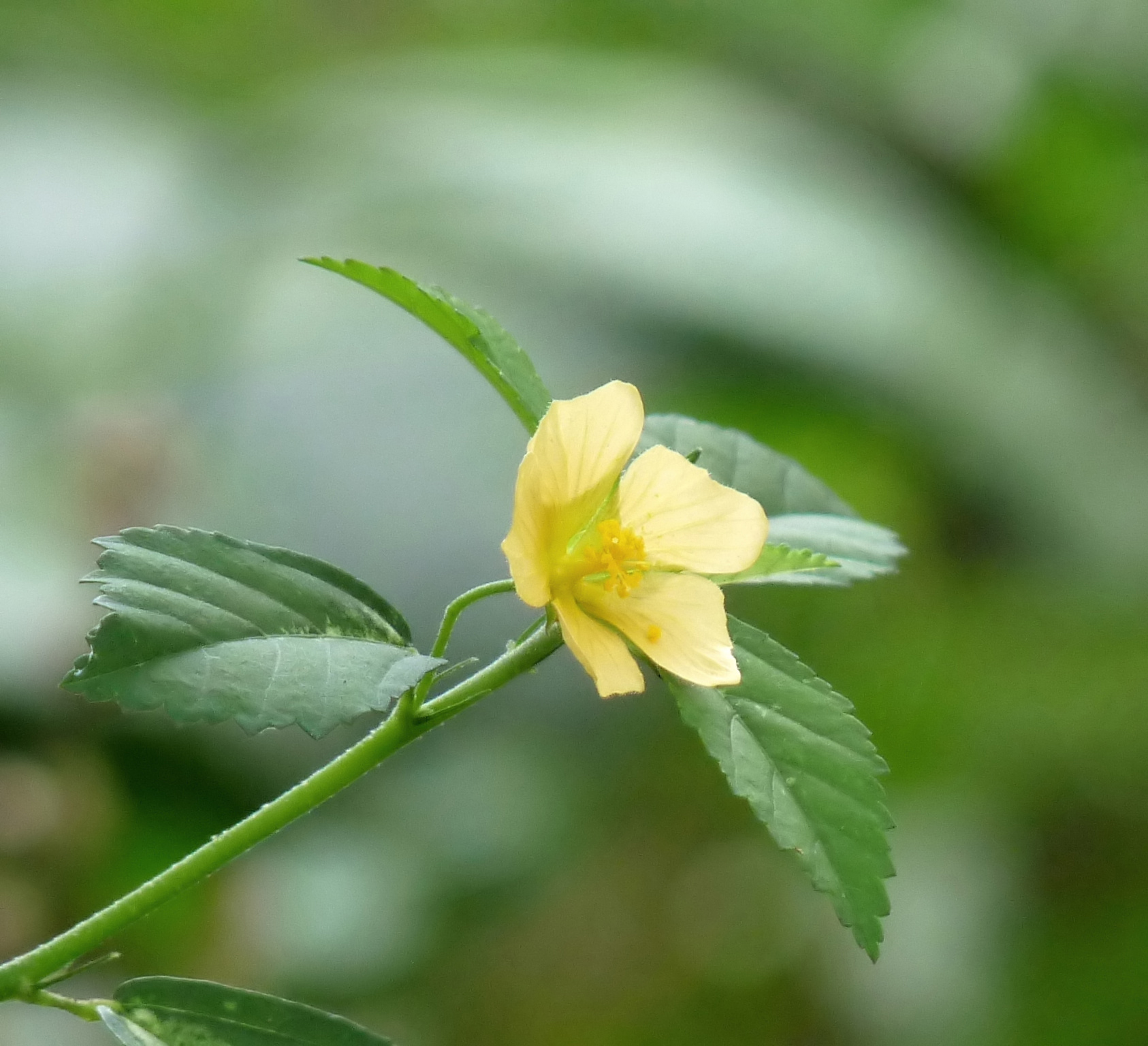
Fanpetals are not show-offs. They are the small, sturdy members of the mallow family (Malvaceae) that turn up along roadsides, in pastures and at the edges of gardens, and then quietly get on with flowering for months. The genus name Sida is old — Linnaeus published it in 1753 — and the common name “fanpetal” comes from the shape of the petals, which open like a little hand fan. The flowers are usually yellow to pale orange, five-petalled, and modest in size: arrowleaf sida’s flowers are around 1 to 2 centimetres across, carried singly on thin stalks from the leaf axils. Small, yes. But a plant that flowers for months, in heat, in poor soil, without being asked twice, earns its place in a butterfly garden by sheer reliability.
The leaves are the identification clue. Arrowleaf sida (Sida rhombifolia) has diamond-shaped — rhomboid — leaves, which is exactly what rhombifolia means: rhomb-leafed. Other species have heart-shaped, lance-shaped or nearly round leaves, often with toothed edges and a slightly rough, hairy feel. Stems are tough and wiry, sometimes woody at the base, and the whole plant has a wiry, “I have survived worse than your garden” look. Heights vary, but arrowleaf sida is typically 60 to 100 centimetres tall, occasionally reaching 2 metres in kind conditions. Think subshrub rather than shrub: woody below, herbaceous and branching above.
The fruit is a small, ribbed capsule that splits into segments — 8 to 10 in arrowleaf sida — each holding a seed. Those segments, and the plant’s habit of seeding freely, explain why fanpetals are so good at colonising disturbed ground. It also explains why a gardener growing them on purpose should deadhead or site them where volunteers are a bonus rather than a battle. Butterflies do not care about any of this. To a checkered skipper caterpillar, a sida is dinner; to an adult butterfly, those little yellow fans are a nectar stop on a hot day.
How to grow
Honesty first: most gardeners do not need to coax a sida into growing. In warm climates, fanpetals grow themselves wherever soil has been disturbed and the sun reaches it. If you are deliberately growing one — for caterpillars, for a tough dry corner, or because you like a plant that refuses to be fussy — give it full sun and well-drained soil, and otherwise stand back. Arrowleaf sida is recorded from roadsides, pastures, grasslands, open woodlands, crops and waste areas in tropical, subtropical and warmer temperate places, which tells you everything about its soil preferences: it does not have many. Average garden soil is luxury accommodation.
Sow seed in spring after frost, barely covered, in warm soil. Seed germinates over a few weeks; Flora of North America notes arrowleaf sida flowering year-round in warmer localities, so in a frost-free garden you can expect a long season, while in cooler gardens it behaves as an annual that flowers through summer and into autumn. Plants can be cut back after the first flush to encourage branching and a second round of flowers. In containers, choose a pot with drainage holes and a gritty, free-draining mix, and do not overwater — a sida in a soggy pot is a sadder sight than a sida in a cracked pavement.
Where you site it matters more than how you feed it. Because sidas seed freely and are regarded as weeds in some places — arrowleaf sida is considered a significant environmental weed in parts of Australia, for example — plant them where you can watch them, and remove seed heads before they scatter if you garden near natural areas or pasture. In a contained butterfly bed, with edging and a willingness to pull seedlings, that vigour becomes an asset: a self-renewing patch of caterpillar food that asks for nothing.
Water & feeding
Water to establish, then water sparingly. Fanpetals are plants of dryish, disturbed ground, and they tolerate drought once their roots are down. A deep soak in a long dry spell will keep flowers coming, but constant wet soil invites root problems and floppy growth. Think “rainfall plus a little help,” not “irrigation schedule.” In a container, let the top inch or two of mix dry between waterings.
Feeding should be light or skipped entirely. Sidas thrive in poor soil, and rich feeding tends to produce soft, leggy growth with fewer flowers relative to leaf. If your soil is extremely poor and plants look pale and stunted, a single spring application of compost mulch will do more good than a bag of fertiliser. Mulch also helps here for a different reason than usual: it suppresses the very seedlings you may not want, while keeping moisture in for the plants you do want. Just keep mulch away from the stems, and remember that a mulch layer will not stop a determined sida — it will merely slow the reinforcements.
Common problems
- It seeded everywhere. The most common fanpetal problem, and it is the plant doing what it evolved to do. Deadhead before capsules split, and pull volunteers while small.
- It looks weedy. It is, by some definitions, a weed — which is a human category, not a botanical one. If you want a tidier look, cut plants back hard after flowering, grow them at the back of a bed, or mix them with grasses that soften their wiry outline.
- Frost killed it. Most sidas are frost-tender. Treat them as annuals outside warm zones, or grow them in pots that can come under cover.
- Confusion with lookalikes. The mallow family is full of small yellow-flowered cousins. Check leaf shape and fruit: arrowleaf sida’s diamond leaves and 8-to-10-segmented capsules are good field marks, and prickly sida (Sida spinosa) carries a small spine at the leaf base that gives it its name.
- Livestock and pasture. Arrowleaf sida is noted as unpalatable to livestock and competitive in pasture. Do not plant it where it can escape into grazing land, and do not rely on grazing to control it.
Harvest
There is no food harvest to plan for fanpetals in this guide, and this is not a plant to experiment with medicinally on the basis of a garden blog. The useful harvest is seed, for next year’s patch, and stems for fibre if you are historically minded — arrowleaf sida has been used for cordage, and its common names include Cuba jute and Queensland hemp, though it is not related to true jute or hemp. Collect capsules when they are dry and starting to split, and store seed dry. Cut a few flowering stems for a wildflower posy if you like small, sunny things in a jam jar; they will not last as long as a rose, but they cost nothing and the butterflies have already had their share.
Browse all plant & pest guides
Saving seeds
Warning up front, because this genus does not need your help spreading: several fanpetals (Sida species) are prolific self-seeders, and some — prickly sida and arrowleaf sida among them — are weedy colonisers of roadsides, pastures, and disturbed ground. Save seed only from plants you genuinely want more of, in a place you control, and deadhead the rest before the capsules split. A Sida that escapes into grazing land or a neighbour’s bed is not a wildflower success story; it is a weeding bill with a Latin name. This section speaks at genus level, because this is a group guide covering several Sida species, and the capsule-and-hard-seed pattern below is the shared Sida habit, even though exact timing and hardiness vary by species.
Watch the small flowers fade into dry, roundish capsules. Collect them once they have turned brown and are just beginning to split — too early and the seed inside is soft and unfinished, too late and the plant has already sown itself all over your garden, which, given the warning above, is exactly the outcome to avoid. Finish the capsules in a paper bag indoors, then crush them gently to free the small, reddish-brown seeds. Cleaning is mostly a matter of picking out capsule husks and the odd spine — prickly sida capsules split into sections tipped with sharp spines, so handle them with care and do not thresh them bare-handed over your best table.
Now the nerdy part, and the reason Sida seed can seem maddeningly slow: many Sida seeds wear a hard, water-impermeable coat. In nature that coat is the plant’s time machine — it lets seed sit in soil for months, weathering wet and dry spells, and germinate in staggered waves rather than all at once, so a single bad week cannot wipe out the whole generation. In a seed tray that same coat reads as poor germination. You can work with it two ways. The patient way is to sow in fall or spring, barely cover the seed, keep the mix moist but not waterlogged, and accept germination spread over weeks, with some seed waiting for the next warm spell. The impatient way is light scarification: rub the seed gently between sandpaper or nick the coat with a nail clipper, taking care not to crush the embryo inside, and sow immediately — a nicked coat is an open door, including to rot, so nicked seed does not store well. Either way, keep the seed dry, cool, and dark in a labelled airtight jar with desiccant until sowing, and in Florida dry it thoroughly first, because humid air rehydrates stored seed faster than you would think. Seed-grown fanpetals are generally true enough for a wildflower patch — most Sida species are largely self-pollinating — but if you are trying to preserve one particular plant’s exact look, take stem cuttings instead, which clone the parent. And if a named cultivar is involved, remember the standing rule: a hybrid or selected cultivar grown from seed may not come back looking like its parent, so cuttings, not seed, are how you keep that plant.
Species in this group
Flannel weed / country mallow — Sida cordifolia — A velvety, heart-leaved subshrub with pale yellow to orange flowers; a tropical plant of warm climates, soft to the touch and easy to recognise by its felted leaves.
Arrowleaf sida — Sida rhombifolia — The classic fanpetal: diamond-shaped leaves, small yellow to pale-orange flowers on long thin stalks, 60 to 100 centimetres tall and sometimes to 2 metres; widespread in warm regions and a prolific self-seeder.
Prickly sida — Sida spinosa — A wiry sida named for the small spine at the base of each leaf stalk; small yellow flowers and a habit of turning up in disturbed, sunny ground.
Spinyhead sida — Sida acuta — A slender, upright sida with narrow leaves and small yellow flowers; another warm-climate coloniser of roadsides and open ground.
Sida ciliaris — A low, spreading sida with fringed (ciliate) leaf edges, for dry, sunny spots where a taller sida would be out of scale.
Note on alkali mallow: Malvella leprosa, formerly Sida hederacea and Sida leprosa, is not listed above because it is no longer classified in Sida. If a butterfly guide pairs the words “alkali mallow” with Sida, it is using the old name — the plant is real, the genus has moved.