
🌿 Rounded Dwarf Mistletoe subsp. globosum
Do not plant or propagate this plant. It is a parasite, not a garden plant: the guide below is for identification, ecology, and management only.
What it looks like
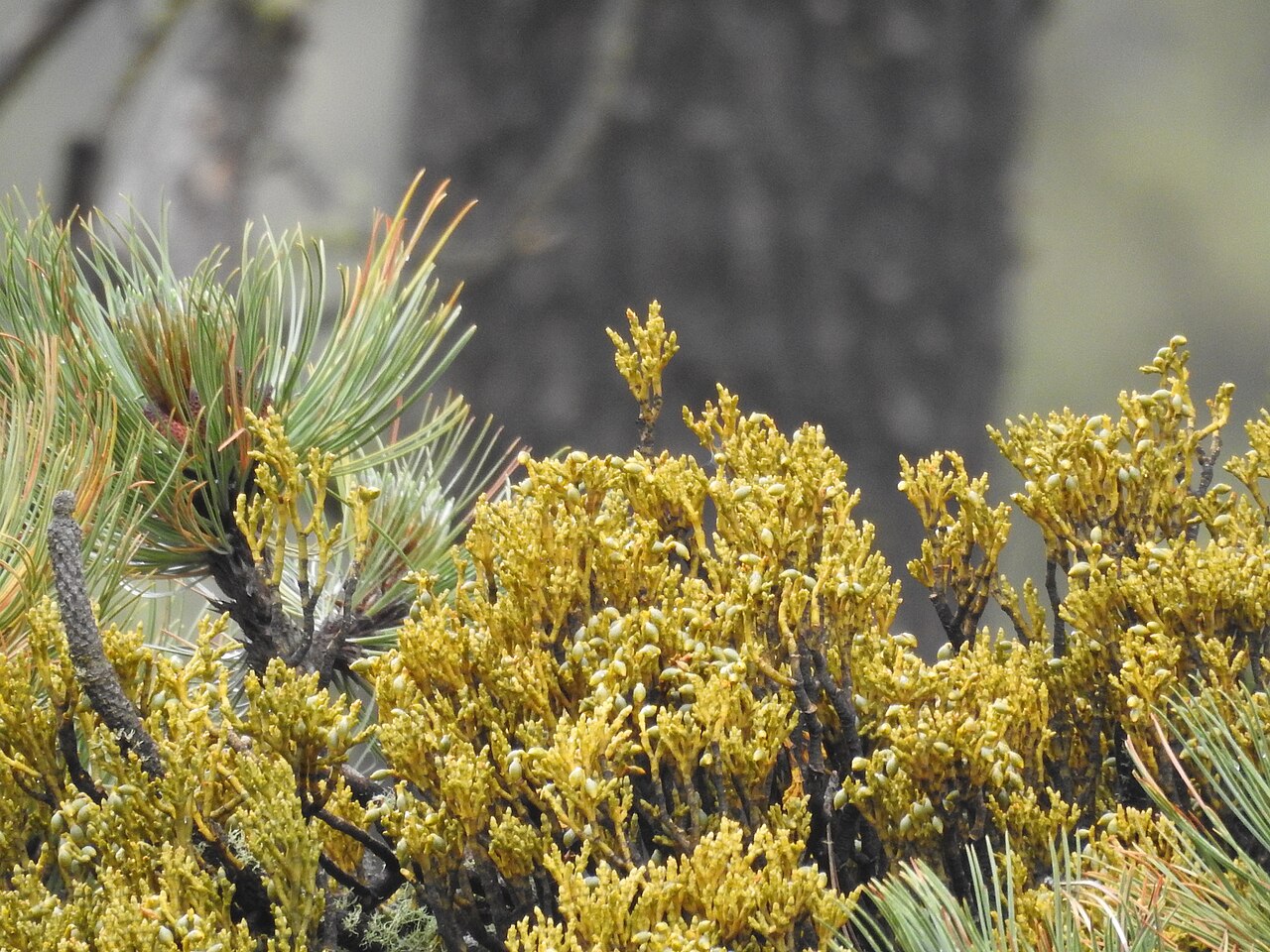
Subsp. globosum is the nominate subspecies of rounded dwarf mistletoe — the form the species name is anchored to — and it looks the part: shoots 15–20 centimeters tall (up to 50 centimeters at maximum), bright yellow, with fan-shaped (flabellate) branching, a basal diameter of 3–10 millimeters on dominant shoots, and mature fruit 5 by 2.5 millimeters. The clusters are globose — rounded balls of bright yellow shoots on a pine branch — which is where the common name comes from.
Unlike many dwarf mistletoes, this subspecies does not induce witches’ broom formation. An infected pine branch carries the bright yellow globes but not the dense twiggy nest, which is itself a field mark: yellow balls without brooms, on a Mexican pine, point toward this form.
Why this variety
A guide exists for a parasite you must never plant for the same reason as the fir forms: identification is management. Rounded dwarf mistletoe is among the most economically damaging dwarf mistletoes in Mexico and Central America, parasitizing commercial pines, and knowing which subspecies you have tells a forester which pines are at risk and where the infection’s range ends — this subspecies is confined to northwestern Mexico and does not overlap with its southern cousin, subsp. grandicaule.
It is also a lesson in how variable a ‘species’ can be: the globosum complex was split into subspecies precisely because size, color, host range, and geography differ consistently across its range, and lumping them hid patterns foresters needed.
How it lives
It lives only on living pine branches. Sticky seeds are explosively discharged, land on nearby branches, germinate, and penetrate the bark; the hidden system grows inside the branch and bright-yellow shoots emerge later. Spread is local, to nearby branches and neighboring host pines, which is why infections cluster in pine stands.
There is no cultivation, no soil stage, and no garden use. This guide is for recognition and management in the pine forests where it occurs.
Hosts & habitat
The habitat is pine forest in the Sierra Madre Occidental, from northwestern Chihuahua and adjacent Sonora, through Durango, to northern Jalisco — high, cool pine country in northwestern Mexico. It needs living pine branches in the canopy and the climate its hosts need.
Principal hosts are Cooper pine (Pinus cooperi), Durango pine (Pinus durangensis), and Engelmann pine (Pinus engelmannii); Arizona pine (Pinus arizonica) is occasionally parasitized, and ocote pine (Pinus teocote) is a rare host.
Host impact & management
- Growth loss in host pines — the main timber impact in Mexican pine forestry.
- Decline of heavily infected trees, especially under drought.
- Confusion with subsp. grandicaule — separated by range (northwest vs. central/southern Mexico) and host overlap patterns.
- Local spread within pine stands — sanitation works because seeds travel short distances.
If you find it
Do not plant or propagate it. Manage it by pruning infected branches well below visible shoots, removing severely infected pines, and replanting with non-host species where timber value matters. Check neighboring Cooper, Durango, and Engelmann pines first — they are the trees at risk.
Seen in the wild, the bright-yellow globes are unmistakable once you know them: a pine branch wearing a cluster of tiny yellow suns is not decorated, it is parasitized — and knowing the difference is the whole point of this guide.
See also: Rounded Dwarf Mistletoe: Growing Guide