
🌲 Rounded Dwarf Mistletoe
What it looks like
Rounded dwarf mistletoe is the least documented plant in this batch of guides, and this guide says so up front rather than padding the gap with borrowed details from its cousins. What is verified is this: it is a dwarf mistletoe, genus Arceuthobium, described by Hawksworth and Wiens, called rounded dwarf mistletoe, and it parasitizes pines in Mexico and south into northern Central America. Like all dwarf mistletoes, it is a small parasitic shrub whose visible shoots are jointed and scaly-leaved, whose leaves are reduced to scales, whose flowers are small and borne on separate male and female plants, and whose fruit is a sticky berry that fires its seed explosively. Most of the plant lives hidden inside the host branch as a haustorial system, tapping xylem for water and phloem for sugars, and only the small shoots show above the bark. That much is the genus pattern, and it applies here. Species-specific measurements for shoot length, shoot color, flower size, and fruit size were not verified from the sources consulted for this guide, and they are not asserted here. A guide that invents measurements for a Mexican forest parasite it has never seen would be worse than a guide that admits the gap.
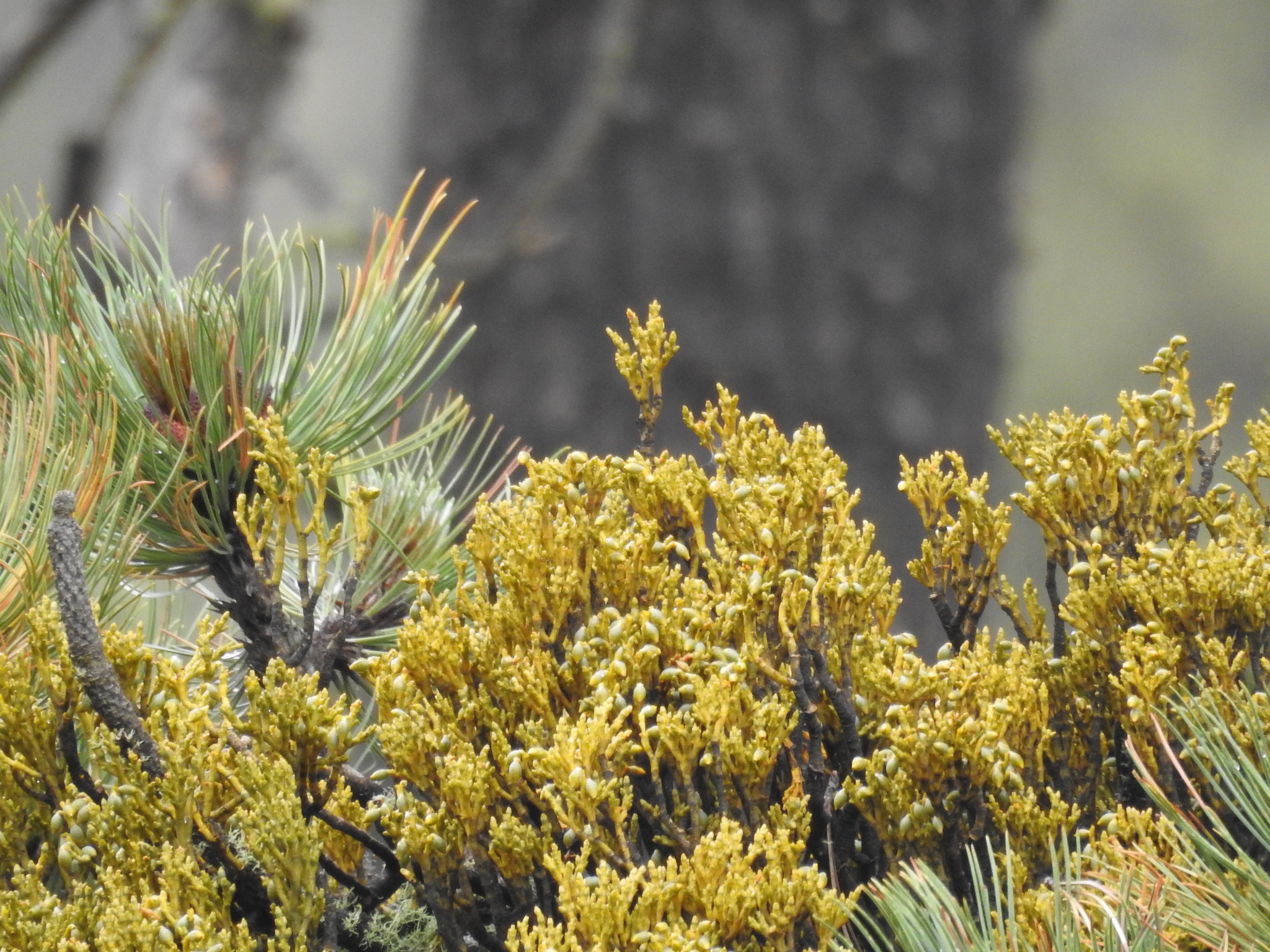
The one photograph verified for this species, shown above, comes from Mexico, which fits the documented range, and it is the only species-correct Commons photograph found for this guide. Other photographs labeled with this species’ epithet on the web belong to other organisms entirely, including fungi and spiders that happen to share the word globosum, and they were not used, because a wrong-species photograph is worse than an honest single photograph. The plant’s documented hosts are pines, including Hartweg’s pine, Pinus hartwegii, in central Mexico, where it has been studied growing alongside Mexican dwarf mistletoe in the Zoquiapan area of Iztaccíhuatl-Popocatépetl National Park. There, researchers tracked both mistletoe species on Hartweg’s pine over several years and found that the presence and severity of infection varied greatly between species and plots, that fire and logging affected mistletoe incidence, and that infected trees grew differently from uninfected ones. Cypress species have also been reported as possible hosts, but pines are the documented principal hosts, and the cypress record is noted here as a report, not a certainty.
It matters to butterflies at the edge of the map. The Thicket Hairstreak, whose range runs from British Columbia through the Rockies to New Mexico and Mexico and through California to Baja California, lists this species among its documented dwarf mistletoe hosts, and its caterpillars feed on dwarf mistletoe shoots, taking on their color and texture. At the southern end of the butterfly’s range, in Mexico, this is one of the mistletoes its caterpillars may be eating, which is presumably how a Mexican forest parasite ended up in a butterfly guide read mostly by North American gardeners. A plant does not have to be common, showy, or well photographed to matter to a butterfly. It only has to be there, on the right pine, at the right time.
Florida note: Say this plainly: rounded dwarf mistletoe is not a Florida plant, does not occur in Florida, and its Mexican pine hosts do not grow in a Florida yard. Its world is the high pine forest of Mexico and northern Central America. If you garden in Florida, this guide is for understanding butterfly guides, not for planting. Do not plant it anywhere, on purpose, ever.
How to grow
You do not grow rounded dwarf mistletoe. There is no nursery stock, no seed packet, and no planting guide, and the plant’s strategy, like its cousins’, is to arrive on its own: a sticky, viscin-coated seed lands on a young pine branch, germinates, spends years building its hidden system inside the branch, and then produces shoots that fruit and fire seeds in turn. What forest managers do with dwarf mistletoes generally is the opposite of growing: they prune infected branches before fruiting, remove heavily infected trees, and manage stand density so seeds have farther to travel. In the Mexican pine forests where this species lives, the research record emphasizes a different lesson: infection is patchy, it changes over time, and disturbance matters. Fire and logging both affected mistletoe incidence in the Zoquiapan study plots, and in some cases mistletoe regrew after disturbance, which means a forest that looks cleared of mistletoe may not stay that way. That is the kind of practical detail that matters more than any invented planting chart.
For the reader of butterfly guides, the useful skill is not cultivation but recognition of the pattern: a dwarf mistletoe on a Mexican pine, in the high central forests, is a candidate for this species, but it is not identifiable from a casual photograph, and it should not be identified to species from shoots alone without host, locality, and ideally a specialist. Dwarf mistletoes are notoriously hard to tell apart, their taxonomy is contested across the whole genus, and this species sits in a group whose boundaries different authorities draw differently. The honest field identification for this plant is genus first, host second, locality third, and species only with expert confirmation. That caution is not a cop-out. It is how you avoid turning one rare Mexican parasite into a mislabeled photograph that then circulates for years.
The conservation picture is also thin, and this guide does not fill it with guesses. No conservation status is asserted here, because none was verified for this species in the sources consulted, and a rare, poorly documented mistletoe should not be declared secure or imperiled on the basis of a shrug. What can be said is that its fate is tied to its pines: where high Mexican pine forest is logged, burned, or converted, the mistletoe goes with the trees, because a parasite cannot outlive its host, and where the forest remains, the mistletoe remains part of it, feeding hairstreaks and shaping stands in ways that are still being studied.
Water & feeding
Rounded dwarf mistletoe takes water and food from its host, as all dwarf mistletoes do, through haustoria that connect to the pine’s xylem and phloem, and it gives nothing back but brooms and seeds. Its greenish shoots photosynthesize weakly, and the plant depends on its host for most of its carbohydrates. That dependency is the whole story of this section, and it inverts the usual garden advice: there is nothing to water and nothing to feed, because the tree does the gathering and the mistletoe takes its cut. In the high pine forests of central Mexico, where water and growing seasons are shaped by altitude and rainfall, that cut matters to the tree, and studies of Hartweg’s pine infected by this species and its co-occurring cousin found that parasitism changed the trees’ growth and proportions, with trees infected by both species shorter at the same trunk diameter than uninfected trees or trees infected by one species alone. A parasite that shortens its host is not a decoration. It is a force on the forest’s shape.
The feeding web around it is only partly documented, and this guide does not invent the rest. Hairstreak caterpillars feed on dwarf mistletoe shoots generally, and the Thicket Hairstreak’s host list includes this species, so caterpillars are a documented consumer. Beyond that, the birds, squirrels, insects, and fungi that use other dwarf mistletoes are plausible company here, but plausibility is not a record, and this guide does not present it as one. The one documented interaction worth naming is the co-occurrence itself: where this species and Mexican dwarf mistletoe share a Hartweg’s pine, they are competitors as well as co-parasites, dividing one tree between them, and the tree pays for both.
Common problems
- It is the problem, for pines: For its host pines, rounded dwarf mistletoe is a parasite that reduces growth and alters tree form. It is not a garden plant, and it should not be introduced anywhere.
- Identification is genuinely hard: Dwarf mistletoes look alike, and this species is poorly photographed and thinly documented. Do not identify a Mexican dwarf mistletoe to species from a single photograph. Host, locality, and expert confirmation are all needed.
- Wrong photographs circulate: The word globosum belongs to many organisms, and image searches return fungi and spiders alongside this plant. Any photograph used for this species must be checked against its file record, not its filename alone.
- Disturbance does not end it: Fire and logging affected mistletoe incidence in studied plots, and regrowth was observed in some cases. Clearing a stand does not guarantee a mistletoe-free stand.
- Co-infection compounds damage: Trees carrying both this species and Mexican dwarf mistletoe grew shorter at the same trunk diameter than trees with one species or none. Two parasites on one tree are worse than one, which is obvious once stated and easy to miss in the field.
- Thin documentation: Species-specific measurements, flowering times, and conservation status were not verified for this guide and are not asserted. Treat any source that gives confident specifics for this species without citations with suspicion, including this guide’s cousins’ details, which belong to other species.
- Florida gardeners importing it: Do not. It will not establish without its Mexican pine hosts, and moving a forest parasite across borders is not a gardening project.
Harvest
There is no harvest. Rounded dwarf mistletoe produces no food, no medicine, and no material worth the pine growth it costs, and its berries are not for eating. What people take from the forests where it lives is timber and knowledge, and the knowledge harvest is the honest one here: a correct genus identification, a verified photograph, a host record that adds one more dot to a thinly mapped range, and a hairstreak caterpillar observed eating the shoots. Prune infected branches before fruiting where a valued tree is threatened, remove heavily infected trees where they seed a grove, and leave wild infections where they are part of the forest. The best rounded dwarf mistletoe harvest is a high Mexican pine forest that still has its pines, its mistletoes, and its hairstreaks, all in the same place at the same time.
Propagation
Rounded dwarf mistletoe earns the same verdict as its cousins — do not deliberately propagate it — with one extra reason for caution: it is less well documented than the western North American species, and thin information is a bad foundation for experimenting with a parasite. Arceuthobium globosum is a dwarf mistletoe of pines in Mexico and Central America, treated in modern classifications as a cluster of subspecies. Like the rest of its genus, it is dioecious, with separate male and female plants, and it spreads by the family’s signature trick: a ripe fruit that bursts and fires a glue-coated seed onto a nearby branch, where the seed sticks, germinates, and sends haustoria into the host’s tissues to steal water and nutrients.
That combination — an obligate pine parasite, plus a range centered outside the United States, plus taxonomy that specialists are still sorting out — makes home propagation a triple no. You would be infecting a pine with a parasite you cannot reliably identify to subspecies, in a genus where host specificity matters enormously, and moving plant material across regions or borders is exactly the kind of thing plant-health rules exist to govern. Those rules vary by jurisdiction and change, so the safe summary is simply not to move it at all.
What you can do is appreciate it as a piece of pine-forest ecology from a respectful distance: a tiny, leafless plant that has outsourced almost its living to a tree, whose explosive fruit is one of the plant kingdom’s better party tricks. Leave the seeds to the trees they evolved with. And Florida gardeners need not feel left out — this is a Mexican and Central American pine parasite with no Florida host story or garden use, so the right Florida action is none.
Varieties
- The species — Arceuthobium globosum: Rounded dwarf mistletoe, Mexico and northern Central America, on pines including Hartweg’s pine in central Mexico. Small scaly shoots on pine branches, sticky explosive berries, dioecious flowers, and a thin photographic and measurement record that this guide does not pad.
- Subspecies globosum — Arceuthobium globosum subsp. globosum: The nominate subspecies, as listed in the United States Forest Service mistletoe treatment of North American conifers. Subspecies boundaries in this genus are contested, and this listing is given as described, not as settled.
- Subspecies grandicaule — Arceuthobium globosum subsp. grandicaule: The second subspecies listed in the same Forest Service treatment. Its distinguishing characters were not verified for this guide and are not asserted here.
- On Hartweg’s pine — Pinus hartwegii: The best-documented host association, in the high forests of central Mexico around Zoquiapan, where this species co-occurs with Mexican dwarf mistletoe on the same trees.
- Possible cypress record: Cypress species have been reported as possible hosts in a literature survey, but pines are the documented principal hosts. The cypress record is noted here so a reader who encounters it is not confused, not as an established host relationship.